
Have you ever sat across from the person you love, pouring your heart out, only to be met with a blank stare or a shrug? It’s a heavy, hollow kind of loneliness when you’re constantly asking yourself, why does my partner lack empathy? You might feel like you’re speaking a foreign language, exhausted from the cycle of over-explaining your basic emotional needs while wondering if you’re just asking for too much.
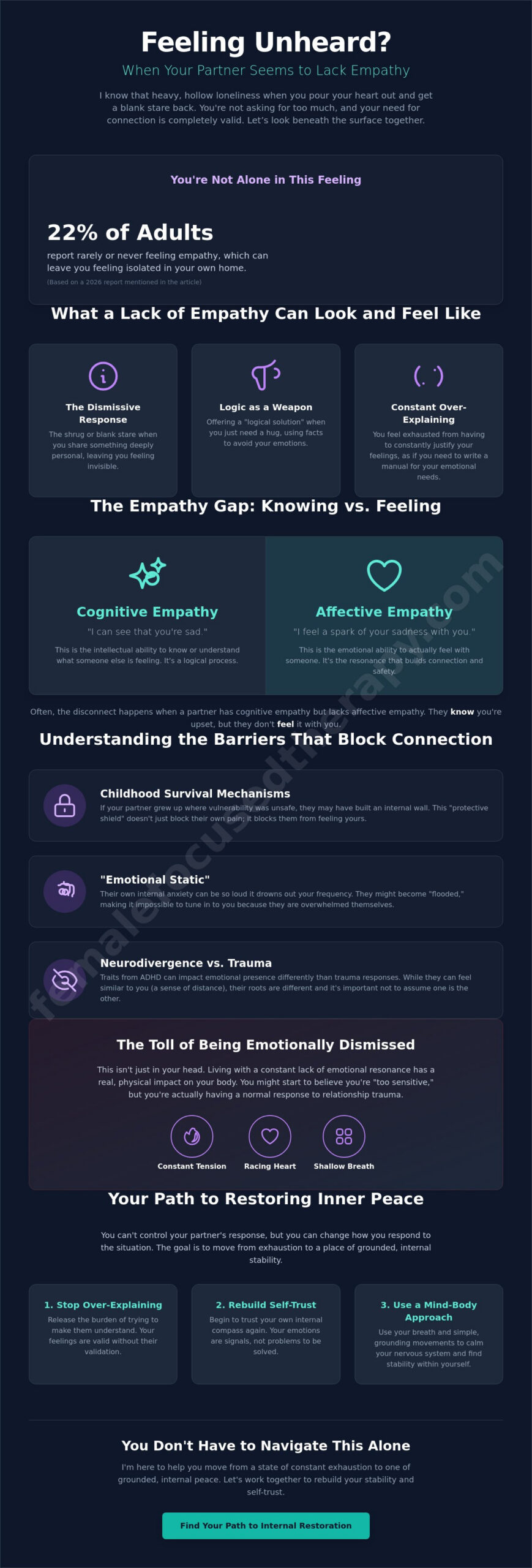
I want you to know that your need for connection isn’t a burden, and your feelings are completely valid. A 2026 report indicates that 22% of adults rarely or never feel empathy, which can leave you feeling gaslit and isolated in your own home. I’ll help you look beneath the surface to understand the roots of this emotional distance and how it impacts your sense of self.
We’ll explore the difference between cognitive and affective empathy to see where the gap truly lies. By looking at these patterns together, you can stop the cycle of exhaustion and start finding a path toward internal restoration and peace, regardless of how your partner chooses to respond.
Key Takeaways
- Identify the specific patterns of emotional distance that leave you feeling invisible and lonely in your relationship.
- Understand why does my partner lack empathy by exploring how childhood survival mechanisms and “emotional static” can block their ability to connect.
- Discover the difference between trauma-based responses and neurodivergent traits, such as how ADHD might impact a partner’s emotional presence.
- Gain practical insights on how to stop over-explaining your feelings and begin rebuilding your own internal confidence and self-trust.
- Learn how a mind-body approach can help you move from a state of constant exhaustion to one of grounded, internal stability.
Feeling alone in your relationship: What a lack of empathy looks like
I want to start by acknowledging how heavy it feels to share a life with someone who seems blind to your pain. It’s a specific, quiet kind of grief. You might spend your evenings wondering why does my partner lack empathy, feeling like you’re shouting into a void while they sit right next to you.
Empathy is more than just a polite concept. It’s the emotional resonance that makes us feel seen and safe. When we look at what is empathy?, we can see two distinct layers. There’s cognitive empathy, which is simply knowing that you’re sad. Then there’s affective empathy, which is the ability to actually feel a spark of that sadness with you.
In many relationships, it’s the “cold” moments that cause the most damage. You might recognise these patterns:
- The shrug when you’re sharing something deeply personal.
- The heavy silence that follows your request for support.
- The logical solution offered when you clearly just needed a hug.
The loneliness of being unheard
If you find yourself over-explaining your feelings, it’s often a sign that the empathy bridge is broken. You shouldn’t have to write a manual for your partner to understand why you’re hurt. This constant effort takes a real physical toll on your body.
I often see women in my practice who live with constant tension, shallow breath, and a racing heart because they’re always on high alert. You might have started to believe the narrative that you’re “too sensitive.” In reality, you’re likely experiencing relationship trauma from being consistently dismissed.
When “logical” becomes a weapon
It’s common for partners to use logic as a way to bypass emotional intimacy. They might tell you they’re just “problem-solving,” but it feels like they’re avoiding your distress. This can leave you feeling small and your valid experiences feeling like inconveniences.
When you’re trying to figure out why does my partner lack empathy, it’s helpful to look at how they use “facts” to shut down a conversation. There’s a massive difference between a partner who is genuinely trying to help and one who is using facts to avoid your emotions. When someone refuses to meet you in your emotional space, they’re choosing distance over connection. Emotional resonance is the heartbeat of a secure attachment.
Understanding the barriers that block a partner’s empathic response
When you’re trying to figure out why does my partner lack empathy, it’s easy to assume the problem lies with your delivery or your worth. You might think that if you just found the right words or the perfect timing, they would finally understand. However, the lack of connection usually has more to do with their internal landscape than anything you are doing or saying.
For many, emotional distance is a protective shield. If your partner grew up in an environment where vulnerability was seen as a weakness, they likely developed a “survival kit” that required them to shut down their feelings. This internal wall doesn’t just block their own pain. It also prevents them from feeling yours.
Sometimes, your vulnerability feels like a demand they simply cannot meet. This creates a cycle where your need for closeness triggers their fear of inadequacy. Instead of leaning in, they pull away to avoid the feeling of failing you. Understanding these Signs of a Lack of Empathy in a Relationship can help you see that their silence is often a reflection of their own limitations.
The impact of early conditioning
In my work, I see how deeply “boys don’t cry” narratives affect adult relationships. Many men were taught that big emotions are dangerous or shameful. This conditioning often leads to a dismissive-avoidant attachment style, where they view your emotional needs as a “criticism” of their performance as a partner.
They aren’t necessarily choosing to be cold. They are often operating from a place of deep-seated fear. When you share your distress, they don’t see an opportunity for connection; they see a problem they can’t solve, which feels like a personal indictment.
The “Emotional Static” theory
I often talk about “emotional static” with my clients. This happens when a partner’s own internal anxiety is so loud that it drowns out their ability to tune into your frequency. They might become “flooded,” a state where their nervous system is so overwhelmed by your pain that they shut down just to survive the moment.
When the brain perceives an emotional threat, it often prioritises survival over social connection. This means their nervous system might be choosing to “freeze” or “withdraw” rather than engage in the empathy you’re looking for.
If you’re feeling exhausted by these patterns, we can explore how to find your own grounding and clarity through individual psychotherapy sessions. Healing begins when you shift the focus back to your own well-being and internal stability.
Distinguishing between neurodivergence, trauma, and more complex patterns
I often see women in my practice who are confused by the “on-off” nature of their partner’s empathy. One minute they might be kind and present, and the next, they seem miles away. It makes you wonder why does my partner lack empathy, and if the connection you felt yesterday was even real or just a temporary phase.
As an adult woman with ADHD, I know how the neurodivergent brain can sometimes appear cold when it’s actually just overstimulated or focused elsewhere. It’s helpful to distinguish between a “functional” gap and a deeper refusal to care. There’s a massive difference between a partner who forgets to ask about your day and one who doesn’t care how you feel.
When we look at these patterns, we have to gently address the reality of relationship trauma and narcissistic abuse. Sometimes the distance isn’t a mistake or a symptom of a busy brain. It can be a core part of how a person chooses to relate to others, viewing your vulnerability as a weakness rather than a call for connection.
ADHD and the empathy “lag”
The ADHD brain often prioritises dopamine and immediate tasks over subtle social cues. This can lead to what looks like coldness but is actually just hyperfocus. For a neurodivergent partner, there is often an “out of sight, out of mind” emotional reality that can feel very painful for you.
Recent research into the “Double Empathy Problem” suggests that misunderstandings often arise from different communication styles between neurotypes. Your partner might seem empathic one day and totally detached the next because their executive dysfunction makes it hard to regulate their attention. They might love you deeply but simply lack the “bandwidth” to show it in the moment.
Recognising the patterns of narcissistic abuse
It’s important to recognise when an empathy deficit is part of a more complex personality structure. A major marker is the “Lack of Remorse.” If an apology is always followed by a “but” that shifts the blame back onto you, it’s a sign that they aren’t truly meeting you in your pain.
You cannot “teach” empathy to someone who views it as a tool for manipulation or a sign of inferiority. If you are constantly exhausted from over-explaining your basic human needs, the focus must shift. We start moving away from asking why they are like this and begin looking at how you can restore your own sense of self-trust and safety.
Restoring your self-trust when your emotional needs aren’t met
I often find that the most exhausting part of this journey isn’t the lack of connection itself. It’s the constant, circular questioning of why does my partner lack empathy. You spend so much energy trying to decode their silence that you lose track of your own voice. Healing begins when you finally stop asking why they are like that and start asking, “How am I feeling right now?”
The importance of rebuilding your internal confidence after being dismissed cannot be overstated. When your reality is constantly questioned, your self-trust starts to erode. You might feel like you’re floating, untethered from your own intuition. I work with women to help them anchor back into their own truth, independent of their partner’s reactions.
Setting boundaries is another vital step in protecting your peace. This isn’t about changing them, as you’ve likely realised that you cannot control their empathic response. It’s about deciding what you will no longer tolerate. When you stop looking for a bridge that isn’t being built, you can focus on strengthening your own foundation.
The practice of self-validation
You might have spent years being told you’re “too sensitive” or that you’re “misinterpreting” things. Learning to trust your gut again is a slow, gentle process. It starts with a simple daily check-in. Sit quietly for a moment and ask yourself what your “emotional weather” is like today. Your feelings are valid data points that reflect your lived experience, not problems that need to be solved or explained away.
Somatic tools for emotional safety
When you feel the “chill” of a partner’s coldness, your body often reacts before your mind does. Your shoulders might hunch or your breath might become shallow. I recommend a 30-second “box breath” to return to your centre. Inhale for four, hold for four, exhale for four, and hold for four. This simple act tells your nervous system that you are safe in this moment.
Incorporating gentle movement can help release the stored tension of relationship stress. My approach to somatic movement and yoga for women focuses on finding ease in the body when the mind is overwhelmed. It’s about creating a sanctuary within yourself that no one else can touch.
If you’re ready to stop the cycle of over-explaining and start your journey of restoration, you can book an individual psychotherapy session with me today.
How we can work together to rebuild your internal stability
I provide a safe, boundaried space for women to process the specific trauma that comes from long-term emotional neglect. When you spend years asking why does my partner lack empathy, you need a place where your own reality is the focus. I’m here to help you move through that fog and find your footing again.
My approach isn’t about diagnosing your partner or trying to fix them. Instead, I combine traditional psychotherapy with somatic awareness to help you feel whole. This integrated mind-body perspective ensures that we aren’t just talking about your pain but releasing it from your nervous system too.
Whether you are navigating life transitions or recovering from narcissistic abuse, you don’t have to do it alone. I’ve walked this path with many women, helping them move from a state of exhaustion to one of renewed self-assurance and internal stability.
Finding the right support for you
The benefits of individual psychotherapy for women in empathy-poor relationships are profound. It’s a space where you are finally the priority. In a session with me, you can expect warmth, deep insight, and zero judgement as we unpick the threads of your experience.
I also offer online therapy, which provides a vital lifeline for women worldwide. You can access professional support from the comfort of your own home, ensuring that geography or a busy schedule is never a barrier to your healing process. We work at a pace that feels manageable for you.
Your next step toward clarity
If you aren’t quite ready for a full session, I encourage you to explore my free therapy resources as a starting point. They offer gentle tools to help you begin the work of internal restoration at your own pace, without any pressure.
Please remember that choosing yourself is not an act of selfishness; it’s an act of survival. You deserve to feel seen, heard, and valued in your own life. When you’re ready to take that next step, book a consultation with me to begin your journey back to yourself.
Finding your way back to yourself
You’ve spent so much energy wondering why does my partner lack empathy, trying to bridge a gap that often feels impossible to cross. We’ve explored how early conditioning, ADHD lag, and more complex personality structures can create this painful distance. But the most important discovery is that your healing doesn’t depend on their ability to change. It depends on your willingness to return to your own body and trust your own heart again.
As a Registered Integrative Psychotherapist and a specialist in narcissistic abuse recovery, I use a trauma-informed and somatic approach to help you rebuild that internal stability. You don’t have to carry the weight of this loneliness alone. I provide a safe space to help you unpick these patterns and find the clarity you’ve been searching for.
If you’re ready to stop over-explaining and start restoring your sense of self, I’m here to walk with you. Book your individual psychotherapy session with Cheryl today to begin your journey toward clarity and calm. You are worthy of a life where you feel seen, and that starts with the kindness you show yourself right now.
Frequently Asked Questions
Can a person learn to have empathy later in life?
Yes, it’s possible to build cognitive empathy through dedicated practice and therapeutic work. I often help people learn to recognise and name emotions they previously ignored. While affective empathy, which is actually feeling the other person’s pain, is harder to “teach,” many can learn the skills needed to respond with kindness. This journey requires a partner to be fully committed to their own self-growth and willing to sit with discomfort.
Is a lack of empathy always a sign of Narcissistic Personality Disorder?
No, a deficit in empathy is a symptom that can stem from many different roots, including ADHD, autism, or past trauma. While you might ask yourself why does my partner lack empathy and fear the worst, it isn’t always a sign of a narcissistic personality. Many people use emotional distance as a protective shield because they never learned how to safely process big feelings during their childhood.
How do I explain to my partner that I feel they lack empathy without starting a fight?
I recommend focusing on your own feelings and somatic sensations rather than pointing out their perceived failings. You might say, “I feel a bit lost and my heart feels heavy when I’m sharing something important and we don’t connect.” This shifts the focus from their “deficit” to your “need.” It’s a gentler way to open a door without triggering the defensiveness that often leads to a fight.
What is the “Double Empathy Problem” in neurodivergence?
This theory suggests that misunderstandings in neurodiverse relationships aren’t caused by a “lack” of empathy, but by a difference in communication styles. If you and your partner have different neurotypes, you might both be empathic, but you express it in ways the other doesn’t recognise. It’s like trying to run two different operating systems; the “glitch” is in the translation, not in the individuals themselves.
Can couples therapy help if only one person is willing to change?
Couples therapy is a collaborative process that works best when both people are engaged, but your individual growth still has power. A 2026 survey found that 71% of people who attended couples therapy reported a noticeable improvement. When you change how you respond and set firmer boundaries, the entire relationship dynamic must shift. However, if your partner is unwilling to acknowledge your pain, individual therapy is often a safer space for your own restoration.
How can I tell if I am being gaslit about my emotional needs?
Gaslighting happens when your partner systematically dismisses your reality, making you doubt your own perceptions or “sensitivity.” If you’re constantly told that your emotional needs are “problems” or that you’re “remembering it wrong,” your self-trust is being eroded. I encourage you to pay attention to your body; if you feel a “knot” in your stomach during these talks, that’s your intuition speaking to you.
What happens to my body when I live in an empathy-poor environment for a long time?
Chronic emotional neglect keeps your nervous system in a state of “high alert,” which can lead to physical burnout and somatic illnesses. Over time, living without emotional resonance can cause persistent back pain, shallow breathing patterns, and a weakened immune system. Your body is physically reacting to the lack of safety and connection, essentially staying in a survival mode that was never meant to be permanent.

Article by
Cheryl Kennedy MacDonald MA BA (Hons) Pg. Dip. SAC BACP
Cheryl Kennedy MacDonald is a psychotherapist specialising in women’s mental health, relationships, and life transitions. She works with women navigating trauma, relationship breakdown, identity shifts, and midlife change, helping them rebuild self-trust, emotional stability, and a clear sense of who they are and what they want.
With over 20 years’ experience working with women internationally, Cheryl is the founder of YogaBellies, a global women’s yoga school, and the creator of the Birth ROCKS method. Her work sits at the intersection of psychotherapy and embodiment, integrating evidence-based therapeutic approaches with somatic, body-based practices that support deep, lasting change.
Known for her grounded and direct approach, Cheryl moves beyond surface-level insight to address the patterns held in the body and nervous system. Her work supports women to regulate, reconnect, and respond to their lives from a place of clarity, strength, and self-respect.
She is a published author in academic journals and has written multiple books on women’s health, pregnancy, and midlife wellbeing, available on Amazon and leading book retailers worldwide.