
You’ve spent months, perhaps even years, carefully choosing every word and holding your breath to keep the peace. It’s incredibly draining to live in a state of constant emotional labour, especially when you’re considering counselling for relationship issues but aren’t sure where to start. I know how heavy that silence feels when you’re walking on eggshells in your own home.
I believe that relationship healing isn’t about fixing another person, but about restoring the internal safety you’ve lost. My goal is to help you understand the patterns in your life and find a gentle path back to your own self-trust and peace. This process should feel like a step toward your own restoration rather than another heavy burden to carry.
In this article, I’ll help you find clarity on your situation and share practical tools for setting boundaries that actually work. We’ll explore how to reduce that constant anxiety so you can finally get some better sleep and start rebuilding your confidence. This is about finding a way forward that respects your intuition and supports your emotional well-being.
Key Takeaways
- Learn why your deep exhaustion isn’t just “stress,” but a sign of emotional burnout that deserves gentle validation.
- Recognise the patterns of gaslighting and the cycle of tension that can slowly erode your self-trust and inner peace.
- Discover why individual counselling for relationship issues often provides a safer and more transformative space for women than traditional couples work.
- Start using simple micro-boundaries today to protect your daily energy and reclaim your sense of identity.
- Find out how a neuro-informed, mind-body approach can help you manage the unique overwhelm of complex relationship dynamics.
Understanding why your relationship feels so draining right now
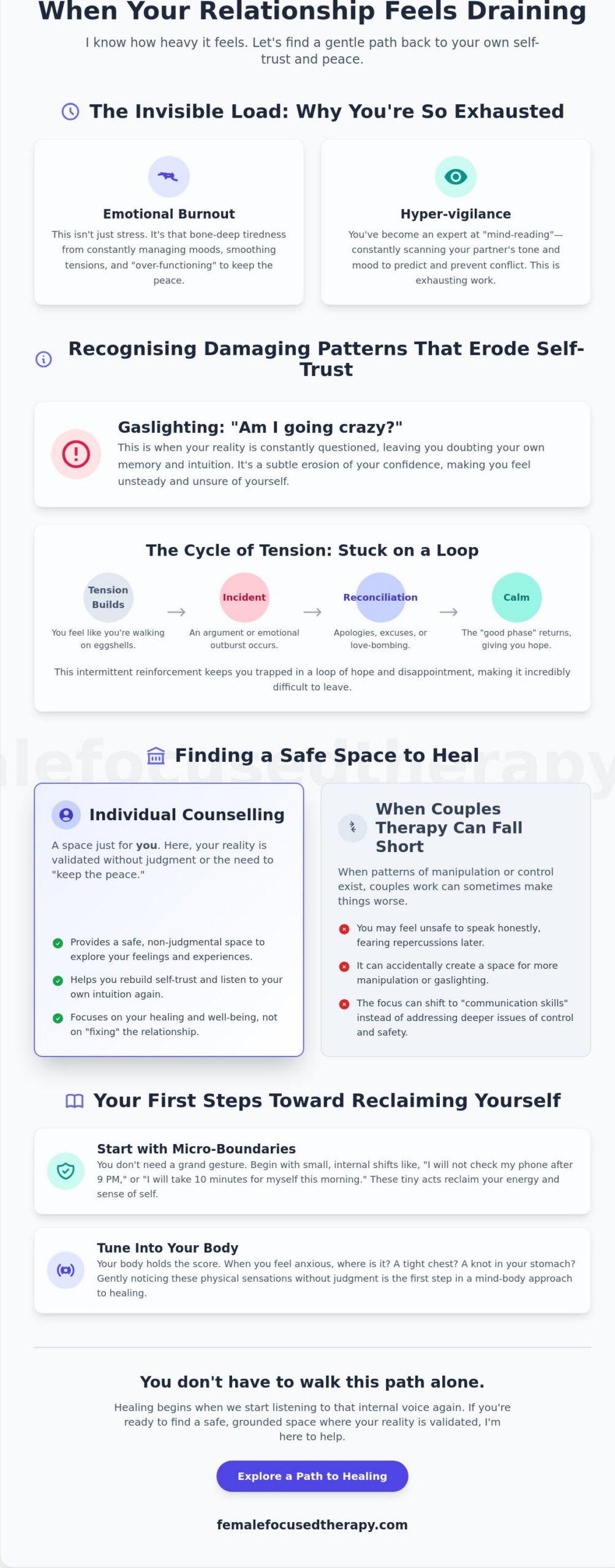
I want to start by validating the heavy weight you’re likely carrying right now. When you’re looking for counselling for relationship issues, it’s often because you’ve reached a point where you simply cannot carry the load alone anymore. That bone-deep tiredness you feel isn’t just standard life stress; it is often the quiet, compounding effect of emotional burnout.
I see relationship issues as the persistent gap between your fundamental need for connection and your current daily reality. For many high-functioning women I work with, this gap is filled by “over-functioning.” You might find yourself managing everyone’s moods, smoothing over tensions, and working twice as hard to compensate for the friction in the home.
If you’re an adult woman with ADHD, this burden feels even heavier. The executive function required to manage a household while also navigating emotional disconnect can lead to a specific kind of paralysis. It’s not that you aren’t trying; it’s that you’re trying so hard your battery has simply run dry.
The invisible load of emotional maintenance
You might notice you’ve become an expert at “mind-reading.” You’re constantly scanning your partner’s tone or the way they shut the door to predict a conflict before it even starts. This hyper-vigilance is a form of emotional labour that goes largely unseen but takes a massive toll on your well-being.
Being the primary emotional caretaker means you’re always the one “holding” the relationship. While empathy is a beautiful trait, it can become a tool for your own depletion when it’s used to excuse behaviour that leaves you feeling small. In my work, we look at how to stop this cycle of self-sacrifice and restore your own internal boundaries.
When “normal” disagreements feel like something deeper
It’s common to wonder if your struggles are just a “rough patch” or something more fundamental. Healthy conflict involves two people working against a problem, but when disagreements leave you feeling diminished or silenced, the safety of the relationship has shifted. You shouldn’t have to lose your sense of self just to keep the peace.
While Couples therapy is a well-known path for many, it’s often your own intuition that rings the loudest bell. If you feel like you’re losing your identity, your body might be trying to tell you something that your mind isn’t quite ready to face yet. Healing begins when we start listening to that internal voice again.
Recognising the patterns of relationship trauma and narcissistic abuse
Have you ever found yourself questioning your own memory of a conversation or feeling like you’re losing your footing on reality? Gaslighting is a subtle but deeply damaging form of manipulation that erodes your self-trust over time. It’s a quiet erosion of your confidence that leaves you feeling unsteady and unsure of your own thoughts.
I often see women who feel trapped in a “cycle of tension.” You might find yourself constantly waiting for the next “good” phase, hoping the person you first fell in love with will stay this time. This intermittent reinforcement, the breadcrumbing of affection followed by coldness, is what makes these dynamics so difficult to leave. It keeps you stuck in a loop of hope and disappointment.
It’s vital to understand that narcissistic abuse is a consistent pattern of control and psychological dominance rather than just a partner being “selfish” or having a big ego. Research from the Effective Health Care Program highlights how relationship health is fundamental to our overall well-being, yet these toxic patterns often go unrecognised for years because they are so covert.
When you come to me for counselling for relationship issues, I use a trauma-informed approach to help you unpick these complex layers safely. We move at your pace, creating a grounded space where your reality is finally validated. I’m here to help you see the patterns clearly so you can begin to trust your own intuition again.
Identifying the signs of a toxic dynamic
The “push-pull” energy in these relationships can feel almost addictive. One moment you’re being showered with affection, and the next, you’re being punished with silence or criticism. This creates a trauma bond that is incredibly hard to break alone because your brain becomes wired to seek the “high” of reconciliation.
Isolation often starts in very small, subtle ways. You might stop seeing friends because it’s “easier” than dealing with your partner’s subtle disapproval, or you might slowly let go of the hobbies that once defined you. For a deeper look at these specific patterns, you can read more about my work with relationship trauma and narcissistic abuse.
Why your body reacts before your mind does
Your body is often the first to know when a situation isn’t safe, even if your mind is trying to rationalise it. You might experience a persistent tightness in your chest, shallow breathing, or ongoing digestive issues. These are somatic signals that your nervous system is stuck in a state of survival.
You might also recognise “fawning,” which is a survival response where you instinctively try to please or appease your partner to avoid conflict. Even when the house is quiet and things seem calm, your nervous system remains on “high alert,” constantly scanning for the next shift in mood. If any of this feels familiar, you might find it helpful to explore a safe space to talk where we can start restoring your sense of self together.
Counselling vs. doing it alone: finding a safe space to talk
I’ve always believed that true healing happens within a relationship. In the therapeutic space I hold for you, you’re finally heard without judgement or the need to defend your perspective. This connection is the foundation of our work together; it’s a place where your experiences are witnessed and validated.
When you’re seeking counselling for relationship issues, the instinct is often to bring your partner along immediately. However, I often find that individual work is more transformative for women initially. It gives you the quiet room you need to breathe, think, and process without the immediate pressure of another person’s needs.
My integrative approach combines evidence based tools like CBT with mindfulness and somatic awareness. We look at how your body holds onto tension and how to find moments of genuine rest amidst the chaos. I believe that finding a therapist in Singapore is about finding a “fit” for your soul, not just a CV.
Why individual therapy is often the first step for women
In a private session, you have the absolute freedom to speak your truth without fear of your partner’s reaction. You don’t have to worry about how your words will be interpreted or used in an argument later that evening. This safety is essential for unpicking complex feelings that have been buried to keep the peace.
We focus on your own recovery and boundaries rather than trying to “fix” the other person. This internal work actually prepares you for healthier couples therapy in Singapore later on, if that’s a path you choose to take. You enter those joint sessions with a much stronger sense of self and a clearer voice.
Moving beyond “venting” to real internal restoration
While it’s helpful to share what happened during the week, we move quickly beyond just “venting.” We explore how those events made you feel and, more importantly, how they impact your sense of who you are. This is where the real restoration begins, moving from the story to the self.
We use self-compassion to break old relationship scripts that no longer serve you. It’s about moving from a constant state of reaction to a place of grounded, intentional response. I’ll help you build a toolkit of emotional regulation that stays with you forever, helping you stay connected to your own needs even when things feel overwhelming. Counselling for relationship issues is ultimately about your own journey back to peace.
Practical ways to begin reclaiming your sense of self
I want to give you something you can use today to feel a little more grounded. When you’re considering counselling for relationship issues, it’s often because your own needs have been pushed to the very bottom of the list. You don’t need to have all the answers to start taking small steps back toward yourself.
I believe that rest is a radical act of healing for an overwhelmed woman. If you’re looking for counselling for relationship issues while managing the unique buzz of ADHD or the shifts of midlife, your brain is likely working overtime. Giving yourself permission to simply “be” is a vital part of your internal restoration.
Setting boundaries that actually feel safe
One of the most powerful things you can do is learn to say, “I need a moment,” instead of reacting immediately. This small pause gives you back your power and prevents you from slipping into old patterns of over-functioning. It’s about protecting your physical and emotional space in ways that feel manageable and safe for you.
You might decide that your bedroom is a “no-conflict zone” or that you won’t discuss heavy topics after a certain time in the evening. Remember, a boundary is about your peace, not their permission. It is a tool for your own internal stability, helping you stay grounded even when the world around you feels shaky.
Using breath and movement to settle your nervous system
When you feel “triggered” or overwhelmed at home, try a simple three-minute breathing exercise. Inhale for four counts, hold for four, and exhale for eight. This longer exhale sends a direct signal to your nervous system that it is safe to settle. I often weave somatic movement and yoga into my sessions because your body holds onto relationship stress in the form of physical tightness.
Gentle movement helps release the tension stored in your shoulders, jaw, and hips. There is a deep connection between your physical heart and your emotional heart; when one feels constricted, the other often does too. When we move the body with kindness, we begin to soften the protective walls we’ve built around ourselves.
Reclaiming your sense of self is a journey that happens in both the mind and the body. By settling your nervous system, you create the space needed to think clearly and act with intention. If you’re ready to explore these tools in a supportive space, you can book a session with me to begin your journey back to peace.
How we can walk this path of healing together
I offer a warm, boundaried space where you can finally put down the weight you’ve been carrying for so long. When you seek counselling for relationship issues, you’re often looking for more than just advice; you’re looking for a witness to your experience. I want you to know right now that you are not broken. You are simply navigating a very difficult season of life, and it’s okay to need support through it.
When we work together, we aren’t just looking at the “now.” We are looking at the patterns that have shaped your journey so far. This deep, reflective counselling for relationship issues allows us to address the root causes of your exhaustion rather than just the symptoms. It’s a slow, steady process of reclaiming the parts of yourself that you might have tucked away to keep others happy.
My own background as a woman with ADHD helps me understand the unique, buzzing overwhelm that high-functioning women often face. I know what it’s like when your brain won’t switch off because you’re trying to solve every problem at once. This lived experience informs my work, ensuring I never offer generic solutions that don’t account for how your specific mind works.
I combine my professional psychotherapy training with my experience as a yoga master to help you find quietness in both your mind and your body. In our sessions, I might invite you to notice where you’re holding tension as we speak. This isn’t about performing yoga poses; it’s about developing a somatic vocabulary that helps you understand your boundaries before they are crossed.
By bringing together mental clarity and physical ease, we create a stronger foundation for your long-term recovery. This integrative approach means we don’t just talk about the stress; we work to release it from your nervous system. It’s a way of listening to your body’s wisdom to find a gentle path back to self-trust and internal peace.
Creating a personalised roadmap for your recovery
We’ll tailor our sessions to your specific history and the life transitions you’re moving through right now. In our first session, my priority is your safety and ensuring the pacing feels right for you. It’s about listening deeply to what you need, helping you move from simply “surviving” your relationship to truly thriving in your own life again.
Taking that first gentle step toward support
If my approach resonates with you, I invite you to read more about me and my philosophy on healing. You can book a confidential consultation whenever you feel ready to take that step. I want to leave you with a final note of reassurance. You have the strength within you to find peace again, and I would be honoured to walk part of that path with you.
Finding your way back to peace and self-trust
You’ve taken a significant step today by simply acknowledging that things need to change. We’ve explored how relationship burnout often stems from over-functioning and how your body holds onto the tension of toxic dynamics. Understanding that your healing begins with internal restoration is the key to moving from a state of survival back to your true self.
As a Registered Integrative Psychotherapist and a specialist in relationship trauma and narcissistic abuse with over 20 years of experience, I’ve seen how transformative this journey can be. Whether you’re navigating the complexities of ADHD or the weight of emotional labour, you don’t have to carry it alone. Seeking counselling for relationship issues is an act of courage that prioritises your peace and long term well-being.
You deserve a space where you are heard and validated without judgement. If you’re ready to start unpicking these patterns in a safe, boundaried environment, I’m here to support you. Book a gentle consultation with me today and let’s begin this restoration together. You have the internal strength to find your way back to a life that feels calm and authentic.
Frequently Asked Questions
How do I know if I need individual counselling or couples therapy?
You might find that individual work is the best starting point if you feel you can’t speak your truth safely in front of your partner. If you’re currently walking on eggshells or feel you’ve lost your sense of identity, individual sessions provide the quiet room you need to find your voice again. We can always transition to joint work later once you feel more grounded in your own needs.
Can counselling help if my partner refuses to change their behaviour?
Yes, because the focus of our work is your own internal restoration and peace. While I can’t change your partner, I can help you understand your own patterns and develop the strength to set micro-boundaries. Counselling for relationship issues is often about helping you decide what you will no longer accept, regardless of whether the other person chooses to change.
Is relationship counselling confidential if I live in a close-knit community in Singapore?
Absolute confidentiality is the foundation of my practice and a strict ethical requirement of my professional registration. I provide a completely private, boundaried space where you can speak freely without fear of your story leaving the room. Whether we meet online or in person, your privacy is my highest priority, ensuring you feel safe to explore even the most sensitive challenges.
What happens if I realise during therapy that I want to leave my relationship?
I am here to support your journey toward peace, whatever form that eventually takes. Therapy isn’t about “saving” a relationship at any cost; it’s about helping you find clarity on what is best for your well-being. If you decide that leaving is the healthiest path, I will walk beside you as you navigate that transition with self-compassion and strength.
How long does it usually take to feel better after starting relationship counselling?
Many women feel a sense of relief after the very first session just by being heard in a non-judgmental space. However, unpicking complex patterns of relationship trauma usually requires a longer commitment to see lasting change. Most of my clients find that three to six months of consistent work allows for deep internal restoration and better sleep.
Can therapy help me if I have ADHD and my partner doesn’t understand it?
Yes, I specialise in supporting women with ADHD who feel misunderstood or overwhelmed in their partnerships. I understand the unique executive function challenges you face and how they can lead to friction at home. We’ll work on practical tools to manage your overwhelm while helping you communicate your needs in a way that feels empowering rather than defensive.
What is the difference between counselling and just talking to a good friend?
While friends offer wonderful support, counselling for relationship issues provides an objective, professional perspective that a friend simply cannot give. I use evidence based frameworks and my 20 years of experience to help you see patterns you might have missed. Our sessions are entirely focused on your growth, providing a safe, boundaried space that is free from the biases of daily life.

Article by
Cheryl Kennedy MacDonald MA BA (Hons) Pg. Dip. SAC BACP
Cheryl Kennedy MacDonald is a psychotherapist specialising in women’s mental health, relationships, and life transitions. She works with women navigating trauma, relationship breakdown, identity shifts, and midlife change, helping them rebuild self-trust, emotional stability, and a clear sense of who they are and what they want.
With over 20 years’ experience working with women internationally, Cheryl is the founder of YogaBellies, a global women’s yoga school, and the creator of the Birth ROCKS method. Her work sits at the intersection of psychotherapy and embodiment, integrating evidence-based therapeutic approaches with somatic, body-based practices that support deep, lasting change.
Known for her grounded and direct approach, Cheryl moves beyond surface-level insight to address the patterns held in the body and nervous system. Her work supports women to regulate, reconnect, and respond to their lives from a place of clarity, strength, and self-respect.
She is a published author in academic journals and has written multiple books on women’s health, pregnancy, and midlife wellbeing, available on Amazon and leading book retailers worldwide.