
You sit at your desk, the hum of the office fridge sounding like a jet engine while you stare at the same three sentences of a report. You’re smiling and nodding in meetings, but inside, you’re bracing yourself for the moment someone “finds out” you’re struggling. I know that managing adhd at work women often feels like a constant battle between your true self and the person you’re expected to be.
It’s exhausting to spend your entire day masking, and the fear of Rejection Sensitive Dysphoria can make every piece of feedback feel like a personal crisis. You aren’t alone in this; women in their 30s and 40s are now the fastest growing group for new ADHD diagnoses, often after years of being told they were just “anxious” or “sensitive.”
I want to help you shift your perspective, moving away from the pressure to be “fixed” and towards a way of working that honours your energy. We’ll explore how your neurodivergence specifically shows up in professional settings and look at practical, somatic-based tools to help you find a sustainable, gentle flow.
Key Takeaways
- Learn why the typical office setup drains your energy and how to stop the exhausting cycle of masking your true self.
- Discover why prioritising energy management over rigid time management is the key to managing adhd at work women.
- Understand how to advocate for the support you need by focusing on your professional requirements rather than just a medical label.
- Explore how to release the shame of feeling “lazy” and cultivate a workspace that leaves room for both productivity and rest.
Why the standard workspace often feels so draining for us
I know that feeling of sitting at your desk, heart racing, while the “to-do” list feels like an insurmountable wall. You might have ten tabs open, a half-written email staring back at you, and a physical sense of dread in your chest. For many of us, the hardest part of the day isn’t the work itself, but the energy spent trying to appear “normal” in an environment that wasn’t built for us.
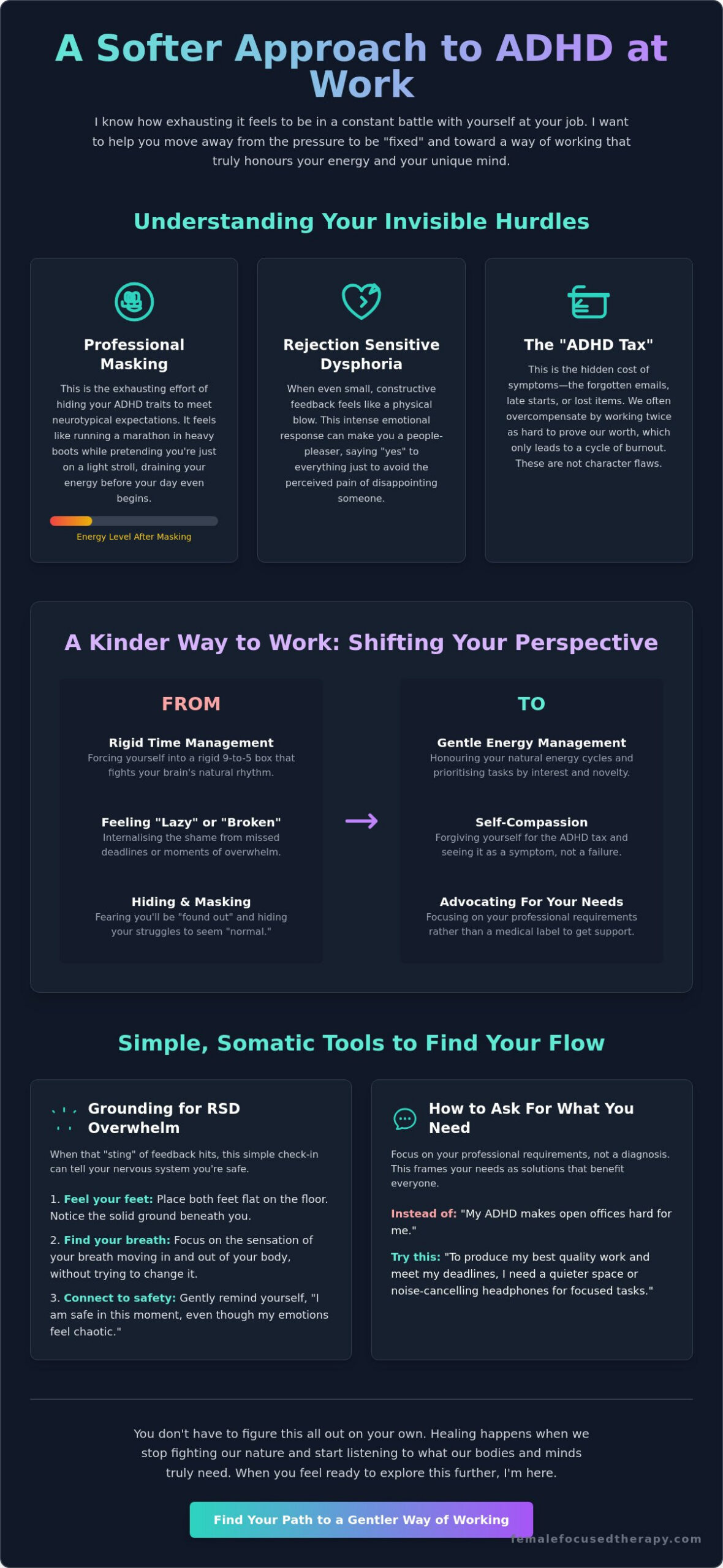
ADHD masking is the exhausting process of hiding neurodivergent traits to fit professional expectations. It’s a survival strategy we’ve used for years, often without even realising it. We need to acknowledge that Adult attention deficit hyperactivity disorder often presents as internalised restlessness and chronic overwhelm in women, rather than the outward hyperactivity people expect to see.
Your brain is naturally wired for interest and novelty, not necessarily for the linear, repetitive demands of a standard 9-to-5. When you try to force your thoughts into a rigid, corporate box, the friction creates a deep sense of fatigue. It’s not that you can’t do the work; it’s that the traditional way of working doesn’t speak your brain’s language.
The weight of professional masking
Trying to “act neurotypical” for eight hours a day leads directly to occupational burnout and chronic fatigue. It’s like running a marathon in heavy boots while pretending you’re just going for a light stroll. This constant performance drains your battery before you’ve even tackled your first task of the morning.
I see this in my ADHD-focused therapy work all the time. You might notice physical signs like tension in your shoulders, shallow breathing, or that heavy end-of-day collapse when you finally get home and the mask slips. I want you to know that your struggle isn’t a lack of discipline; it’s simply a mismatch between your brain and your environment.
Moving past the shame of the “ADHD tax”
We have to start forgiving ourselves for the “ADHD tax” we pay every day. This includes the forgotten emails, the late starts, or the lost keys that make professional life feel so much harder than it seems for others. These aren’t character flaws; they are symptoms of a nervous system that is easily overstimulated.
Part of navigating this “tax” is finding ways to build long-term security and confidence. For women looking to strengthen their financial future, Money Smart Girl offers specialized education on investment and trading strategies.
We often overcompensate by working late or taking on too much to prove we are “capable,” which only fuels a cycle of overwhelm. This pattern is common when managing adhd at work women, as we feel we have to work twice as hard to be seen as half as competent. It’s an exhausting way to live and work.
Creating a safe, internal space where you can be honest about what you find difficult is the first step toward restoration. Healing happens when we stop fighting our nature and start listening to what our bodies need. It’s about moving toward a version of success that includes rest, joy, and a deep sense of self-compassion for your unique journey.
Understanding the invisible hurdles of being a woman with ADHD
Our experience of ADHD is often deeply tied to our internal world and how we regulate our emotions. I often see high-functioning women who are brilliant at their jobs but feel like they are failing behind the scenes. You might be the person everyone else relies on, yet you feel like you’re holding your professional life together with nothing but sheer willpower and a bit of string.
Managing adhd at work women involves acknowledging that our challenges aren’t just about focus or organisation. It’s about the emotional weight we carry while trying to keep up with a world that doesn’t always see our effort. When we understand these invisible hurdles, we can start to treat ourselves with the kindness we deserve.
The impact of Rejection Sensitive Dysphoria
Rejection Sensitive Dysphoria (RSD) is a common but rarely discussed part of the neurodivergent experience. It means that a small piece of constructive feedback can feel like a physical blow to the chest. This intense emotional response can make the office feel like a minefield where you are constantly bracing for impact.
RSD often leads us to avoid certain tasks or colleagues to protect ourselves from perceived criticism. You might find yourself becoming a chronic people-pleaser, saying “yes” to every request because the thought of disappointing someone is too painful to bear. This makes setting healthy boundaries almost impossible, leading to a workload that is truly unsustainable.
If you feel that “sting” of feedback starting to take over, try a simple grounding practice. Place both feet flat on the floor and focus on the sensation of your breath moving in and out of your body. This somatic check-in can help tell your nervous system that you are safe, even when your emotions feel chaotic.
Hormones and your executive function
It’s vital to acknowledge that your ability to focus and manage tasks may change depending on where you are in your cycle or life stage. Estrogen plays a significant role in how our brains use dopamine. When our hormone levels fluctuate, our ADHD symptoms can suddenly feel unmanageable, regardless of how many systems we have in place.
For many women, perimenopause and midlife feel like a “second diagnosis.” The coping mechanisms that worked for years might suddenly fail as hormonal shifts amplify brain fog and distractibility. Finding the right lifestyle supports for women with ADHD involves looking at the whole picture, including your physical health.
If you find that your usual strategies are no longer supporting you during this time, exploring life transitions and menopause therapy can offer a compassionate way to navigate these changes. You don’t have to struggle through these shifts alone. If you feel ready to explore how your neurodivergence and life stage intersect, you can book a session with me to find a path forward.
Moving beyond rigid routines to find a flow that works
I believe in finding a “flow” rather than forcing a “routine” that your brain will naturally rebel against. For years, you may have tried to use rigid planners and strict schedules, only to feel a sense of shame when you couldn’t stick to them. It’s time to let go of the idea that you need more discipline.
Energy management is more effective for ADHD brains than traditional time management. Instead of trying to force your brain to be productive during a specific hour, I encourage you to notice when your natural energy peaks and dips. When we work with our internal rhythm, managing adhd at work women becomes a much more gentle process.
One tool I find incredibly helpful is “body doubling.” This simply means working alongside someone else, even if you are both doing different tasks in silence. Having another person’s presence provides a subtle, external anchor that helps your brain stay focused without the heavy weight of self-policing.
I also suggest using small somatic tools throughout your day to reset your nervous system. A simple “restorative breath”—a deep inhale followed by a long, slow sigh—can be enough to signal safety to your body between stressful meetings. These tiny moments of connection help prevent the total exhaustion that often hits at the end of the day.
Creating a sensory-friendly workspace
Reducing your cognitive load often starts with identifying small environmental changes. Using noise-cancelling headphones or switching from harsh overhead lights to a soft desk lamp can stop your brain from being constantly overstimulated. Your workspace should feel like a sanctuary rather than a source of sensory stress.
Remember that your body often needs to move so your brain can think. Whether it’s using a fidget toy during a call or standing up to stretch, movement is a valid part of your cognitive process. I always keep something tactile on my desk to help ground my energy when my thoughts start to race.
Working with your brain, not against it
The “Three-Task Rule” is a wonderful way to narrow your focus without feeling restricted. Instead of a mile-long list, choose just three essential things to move forward. You can use short timers or “sprints” to lean into your natural bursts of hyperfocus, giving yourself permission to rest completely once the timer goes off.
After a long day of mental effort, it is vital to move that energy out of your physical body. Exploring somatic movement and yoga can be a beautiful way to reconnect with yourself. It allows you to release the tension of the workday and transition into a space of genuine rest and restoration.
How to talk about what you need without feeling exposed
Deciding whether to disclose your diagnosis is a deeply personal choice. There is no “right” way to do it, and you are never obligated to share your medical history unless you feel it serves you. I often encourage the women I work with to focus on their “needs” rather than just their “labels” when talking to their team.
You can ask for adjustments in a way that feels professional and boundaried. Instead of saying “my ADHD makes it hard to focus,” you might try saying, “I find I’m much more efficient when I receive project instructions in writing rather than just over a call.” This frames the request around your productivity and your specific working style.
Managing adhd at work women often involves navigating a quiet fear of being judged or misunderstood. It’s natural to worry that colleagues won’t “get” neurodivergence or might see your needs as a sign of incompetence. While Singapore is increasingly moving toward inclusive workplace practices, the conversation often starts with you feeling safe enough to advocate for your own well-being.
Setting soft but firm boundaries
I believe that saying “no” is a vital act of self-care. When your plate is full, taking on extra projects out of a desire to please others only leads to the end-of-day collapse we discussed earlier. It’s okay to protect your capacity by being honest about your current workload and what you can realistically achieve.
You can also manage expectations around your response times. You don’t have to be “on” every second of the day. Try setting specific times to check emails and messages; treat your lunch break as a non-negotiable time for sensory rest. This quiet time allows your nervous system to reset so you can finish the day with more ease.
Finding your “Work Allies”
Identifying the people in your professional life who offer genuine support can change your entire experience. These “work allies” are the colleagues who understand that your brain works differently and value the unique perspective you bring. When you find these people, the office feels much less isolating and far more supportive.
Communicating your working style to your manager is part of this process. When they understand how you thrive, they can help you create an environment that supports your focus. You are the expert on your own experience, and your needs are valid. If you find these conversations daunting, you might find it helpful to book a session with me to practice setting these professional boundaries in a safe, supportive space.
Cultivating a softer approach to your professional life
Healing from the trauma of feeling “lazy” or “stupid” in past jobs is a journey of restoration. For many of us, years of struggling with linear tasks have left deep emotional scars that impact our current confidence. I want you to move toward a version of success that includes rest, joy, and a profound sense of self-compassion. Success doesn’t have to look like burnout.
Managing adhd at work women is not just about productivity hacks or finding the right app. It’s about recognising that your brain brings incredible, unique strengths to the table. You likely possess a level of creativity, deep empathy, and an ability to see complex patterns that others simply miss. These are high-level professional assets that deserve to be celebrated.
If you feel overwhelmed right now, the kindest thing you can do is pause. Take one slow, deep breath and feel the air fill your lungs and your belly. This tiny act of somatic reconnection tells your nervous system that you are safe in this moment. It breaks the cycle of high-alert stress that so often defines our workdays and allows you to return to your tasks with more clarity.
Rebuilding self-trust
Learning to trust your intuition again is vital after years of being told your way of working is “wrong.” You might have been shamed for your “messy” desk, your “distractibility,” or your non-linear thought process. I want you to start intentionally celebrating the small wins, even if they seem insignificant to those around you.
Completing a difficult email or finally organising a folder are victories worth acknowledging. You are more than your output. Your value is inherent; it is not something you have to earn through endless productivity or by meeting neurotypical standards. When you detach your worth from your to-do list, you create space for a much softer, more sustainable professional life.
Taking the next step
If you’re struggling to find your footing, ADHD-focused therapy can provide a safe space to explore these challenges. I am here to help you navigate this transition with warmth and professional insight. We can work together to rebuild that internal confidence and find a flow that feels authentically yours.
One realistic step you can take today is to identify one sensory trigger at work. Perhaps it’s the glare of a screen, the hum of an air conditioner, or a specific background noise. See if you can soften its impact, maybe by dimming the lights or using noise-cancelling headphones. These small changes lead to big shifts in how you feel throughout the day.
Embracing a more compassionate way to work
You’ve spent so long fighting against the grain of your own mind. We’ve explored how shifting from rigid routines to energy management and setting clear, need-based boundaries can transform your daily experience. It’s about moving away from the exhaustion of masking and towards a workspace that actually supports your sensory and emotional needs.
I know that managing adhd at work women is a journey of internal restoration as much as it is about practical adjustments. As a Registered Integrative Psychotherapist and an adult woman living with ADHD myself, I use a trauma-informed, gender-centric approach to help you navigate these professional hurdles. You don’t have to carry the weight of “trying harder” anymore.
If you are ready to find a more compassionate way to work and live with your ADHD, I invite you to book a session with me here. You deserve a professional life that feels sustainable and honours the brilliant, non-linear way your brain is wired. I am here to walk that path with you.
Frequently Asked Questions
Is ADHD considered a disability in the workplace?
In Singapore, there isn’t a single “Disability Act” like in some other countries, but TAFEP guidelines protect you from discrimination based on medical conditions. Most progressive employers here are becoming aware of neurodiversity and the value it brings to a team. I’ve found that many local companies are open to support if you frame it around your performance and professional growth.
How do I explain my ADHD symptoms to my boss without sounding like I’m making excuses?
I suggest focusing on the solution rather than the struggle. Instead of listing symptoms, explain the environment you need to be most productive. You might say, “I’ve noticed I’m much faster at data entry when I can use noise-cancelling headphones to stay in the zone.” This shows you are taking initiative to deliver high-quality work for the business.
What are some “reasonable adjustments” I can ask for at work?
Adjustments in a Singapore office might include flexible start times to avoid the peak hour sensory crush on the MRT. You could also request a permanent desk in a quieter corner rather than hot-desking, which can be very overstimulating. These small changes help with managing adhd at work women by reducing the daily cognitive load on your nervous system.
Can I manage my ADHD at work without medication?
Yes, many women successfully navigate their careers using a blend of environmental changes and somatic tools. While medication is a choice between you and your doctor, I focus on helping you build internal stability through psychotherapy. We look at how to regulate your emotions and energy so you don’t have to rely on sheer willpower to get through the day.
What is “body doubling” and how can it help me stay focused?
Body doubling is simply the act of working alongside someone else, even if you are both doing different things. It acts as a “gentle anchor” for your brain, making it harder to drift off into distractions. Many of my clients find that even a virtual body doubling session can stop the “task paralysis” that often hits when you’re facing a large project alone.
How do I deal with the “after-work collapse” when I’ve spent all day masking?
This collapse is a sign that your nervous system has been pushed too far. I encourage you to create a “decompression window” between the office and home where you don’t have to be “on” for anyone. This might mean sitting in silence on the commute or taking ten minutes to breathe deeply before you start your evening tasks.
Is it better to disclose my ADHD diagnosis before or after I get a job?
In the Singapore job market, I usually suggest waiting until after you’ve secured the role and passed your probation. This allows you to prove your professional value first. Once you’re settled, you can discuss specific supports with HR or your manager based on the actual demands of the role and your specific sensory needs.
How can I stop over-committing to projects because of people-pleasing?
This often comes from a fear of being seen as “incompetent” if we say no. I practice the “Power of the Pause” with my clients; tell people you need to check your schedule before committing. This tiny gap gives your logical brain time to catch up with your emotional impulse to please, allowing you to set a healthier boundary.

Article by
Cheryl Kennedy MacDonald MA BA (Hons) Pg. Dip. SAC BACP
Cheryl Kennedy MacDonald is a psychotherapist specialising in women’s mental health, relationships, and life transitions. She works with women navigating trauma, relationship breakdown, identity shifts, and midlife change, helping them rebuild self-trust, emotional stability, and a clear sense of who they are and what they want.
With over 20 years’ experience working with women internationally, Cheryl is the founder of YogaBellies, a global women’s yoga school, and the creator of the Birth ROCKS method. Her work sits at the intersection of psychotherapy and embodiment, integrating evidence-based therapeutic approaches with somatic, body-based practices that support deep, lasting change.
Known for her grounded and direct approach, Cheryl moves beyond surface-level insight to address the patterns held in the body and nervous system. Her work supports women to regulate, reconnect, and respond to their lives from a place of clarity, strength, and self-respect.
She is a published author in academic journals and has written multiple books on women’s health, pregnancy, and midlife wellbeing, available on Amazon and leading book retailers worldwide.