
What if the symptoms you’ve been trying so hard to fix are actually the very things that kept you safe when life felt impossible? It’s a heavy burden to carry the feeling that you’re somehow broken or that your high functioning anxiety is a personal failing you must hide from the world.
I understand the fear that opening up about your past might leave you feeling more overwhelmed than when you started. You deserve a space where you don’t feel judged or clinicalised. In this article, I’ll explain what is trauma informed therapy and how it moves us away from asking what’s wrong with you toward understanding your unique story.
We’ll look at how this gentle approach restores your internal safety and why it’s so effective for women navigating ADHD or major life transitions. By the end, you’ll see how healing happens when we treat your experiences with the compassion and steady care they deserve.
Key Takeaways
- Learn how we shift the focus from clinical labels to your personal story, honouring how you survived rather than just looking at symptoms.
- Understand what is trauma informed therapy and how I use core principles like safety and empowerment to protect your emotional well-being.
- Discover why high-functioning women often carry trauma differently and how we can address the unique pressures of life transitions or neurodivergence.
- Explore how integrating somatic awareness helps release tension held in the body, moving beyond simple talk therapy for deeper restoration.
- Gain insight into how this approach helps you rebuild internal confidence and trust your own intuition again.
Defining Trauma-Informed Therapy: It Is About Your Story, Not a Label
When you walk into a therapy room, you shouldn’t feel like a specimen under a microscope. I believe that Trauma-Informed Care is less about ticking boxes and more about creating a sanctuary where you’re finally heard. It’s a framework built on safety, trust, and empowerment, ensuring that the process of healing never feels like another source of stress.
So, what is trauma informed therapy? In my practice, it’s a commitment to seeing you as a whole person rather than a set of symptoms. It means I recognise that your current struggles, whether it’s high-functioning anxiety or feeling constantly on edge, aren’t flaws in your character. They’re often natural responses to very unnatural or overwhelming events you’ve faced.
Traditional clinical models often focus on a “diagnosis” to explain why you feel the way you do. While labels can sometimes be helpful, they often miss the heart of the matter. I prefer a “narrative” model, where we look at the story of your life and how your experiences have shaped your internal world. This approach honours your resilience and the clever ways your brain has tried to protect you.
You don’t need to have survived a major, life-threatening catastrophe to benefit from this way of working. Trauma isn’t always a single, dramatic event. Sometimes, it’s the slow, quiet wear and tear of being a woman in a world that demands perfection. It’s the weight of carrying everyone else’s needs while your own are left behind.
The Shift from “What is Wrong” to “What Happened”
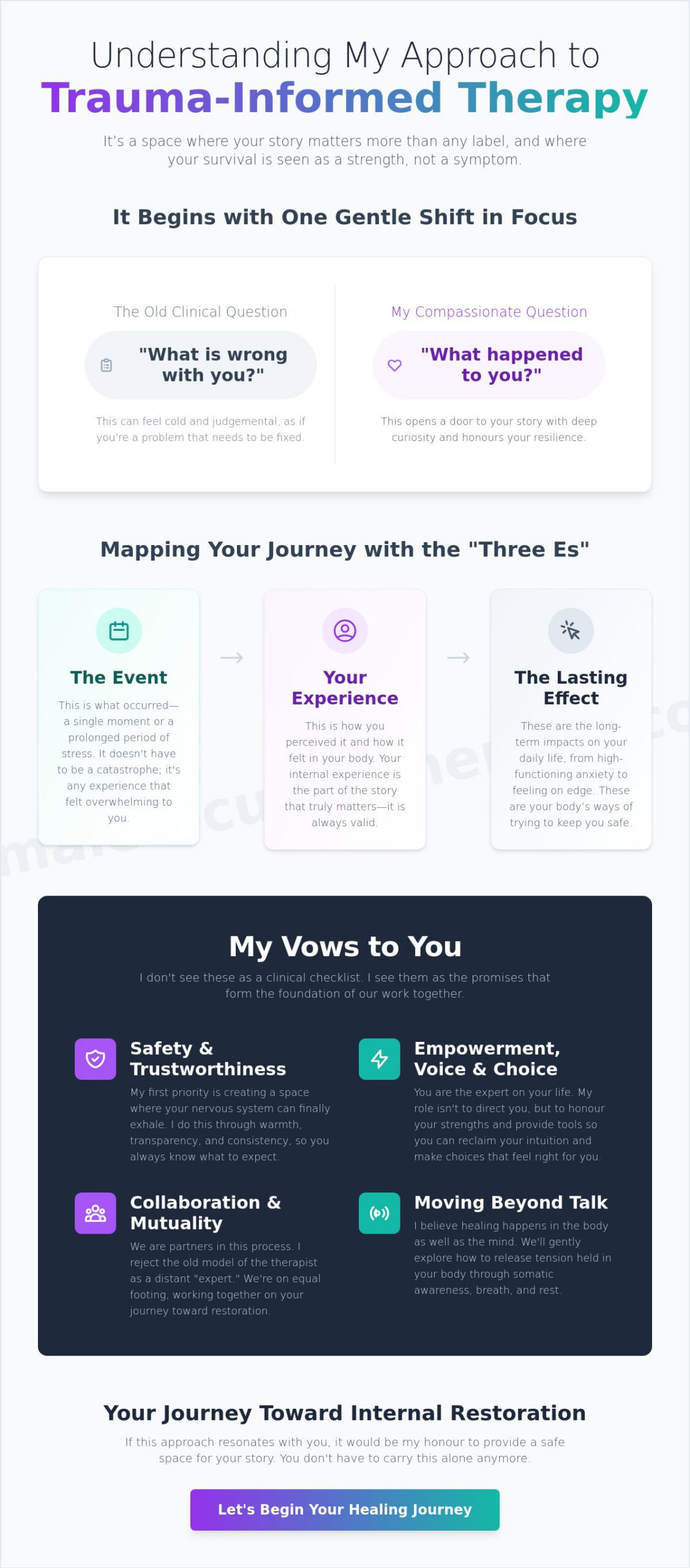
Traditional therapy often starts by looking for a problem to solve, focusing on “what is wrong with you.” This can feel cold and clinical, especially if you’re already feeling vulnerable. I find that shifting the question to “what happened to you” changes the entire therapeutic relationship. It moves us from a place of judgement to a place of deep, compassionate curiosity.
This simple change in language shifts the power back to you. It validates your current coping mechanisms, like your need for control or your tendency to over-prepare, as tools you once used to stay safe. This perspective is vital when you’re finding a therapist in Singapore or anywhere else. You deserve someone who sees your strength before they see your struggles.
Understanding the “Three Es” of Trauma
To help simplify how I view this work, we can look at the “Three Es”: the Event, the Experience, and the Effect. The Event is what occurred; the Experience is how you perceived it and felt in your body; and the Effect is the long-term impact it has on your daily life. This framework helps us map out your journey toward restoration without getting lost in clinical jargon.
You might see these “Three Es” play out in a high-stress workplace where you never feel good enough, or during a difficult life transition like a relationship ending. Your body remembers how those moments felt, even if the “event” seemed small to others at the time. Ultimately, your personal experience of an event matters far more than the objective details of the event itself.
The Core Principles That Create a Truly Safe Space
I don’t see the principles of What is Trauma-Informed Care? as a dry academic checklist. Instead, I view them as my personal vows to you. They are the foundations of every conversation we have and every minute we spend together in our sessions.
Safety isn’t just a word I use to sound professional; it’s a physical feeling we build together. When you’ve experienced trauma, your nervous system is often on high alert. You might feel like you’re constantly waiting for the other shoe to drop or feeling “on” even when you’re exhausted. In our work, we prioritise creating an environment where your body can finally begin to exhale.
Many traditional clinical settings create a “power imbalance” where the therapist is the expert and the patient is the problem to be fixed. I reject that model entirely. I value transparency and trust above all else. We’re on equal footing. I’ll always be open about why we’re using a particular approach, ensuring you never feel like a passive participant in your own healing.
You are the only true expert on your own life. You know your history, your triggers, and your strengths better than anyone else ever could. My role isn’t to tell you what to do, but to provide the tools and the space for you to discover your own path forward. Understanding what is trauma informed therapy means knowing that your autonomy is never sacrificed for the sake of a “treatment plan.”
Safety and Trustworthiness in Practice
Creating a “boundaried” space means our time together is warm and compassionate, but also secure and consistent. Predictability is a powerful antidote to trauma. Knowing exactly when we start, how we communicate, and how I protect your confidentiality helps soothe a frayed nervous system. If you’re ready to experience this kind of supportive environment, you can explore my current availability for a session.
I handle professional support and confidentiality with the highest level of care. You need to know that your story is safe with me. By being reliable and consistent, I help you move away from the chaos of the past and toward a more stable, grounded present.
Choice, Collaboration, and Empowerment
We work as a team. I don’t sit in a “doctor” chair dispensing advice while you take notes. Empowerment in this context is about rebuilding the self-trust that trauma or narcissistic abuse often strips away. It’s about you reclaiming your voice and your right to say “no” or “not yet.”
You always set the pace for our work together. If a topic feels too heavy, we stop. If you need more time to sit with a specific feeling, we take it. This collaborative approach ensures that you are always in control of the journey, helping you restore a sense of agency that may have been lost.
Why Women Need a Specifically Trauma-Informed Approach
As a woman, the way you experience the world is unique, and so is the way your body stores difficult memories. We often carry our history in our muscles, our breath, and our nervous systems. You might be that “high-functioning” woman who seems to have everything under control, yet inside, you feel like you’re constantly one step away from a collapse.
This is why understanding what is trauma informed therapy is so crucial for us. It isn’t just about general principles; it’s about recognising how your life stages, from the pressures of motherhood to the hormonal shifts of menopause, intersect with your past. I’ve found that a trauma-informed approach allows us to look at these intersections with kindness rather than judgement.
I see many women who feel they are failing because they can’t “just get over” things. But your body doesn’t work on a timeline. Whether you’re navigating the fog of midlife or the overwhelm of a new career transition, your past experiences can amplify your current stress. A trauma-informed perspective honours these layers, helping you find stability in the middle of life’s many changes.
Navigating Narcissistic Abuse and Relationship Trauma
If you’ve spent years being gaslit, your sense of reality can feel fractured. A trauma-informed lens is vital for healing from relationship trauma and narcissistic abuse because it validates your experience. You might have been told you’re “too sensitive” or “dramatic,” but I see those traits as incredible survival skills that once kept you safe.
In our sessions, your hypervigilance is respected as a map of how you survived. We don’t spend our time trying to diagnose your former partner or parent; that only keeps the focus on them. Instead, we keep the focus firmly on you, your restoration, and your boundaries. This ensures the space remains yours, free from the shadow of the person who caused the hurt.
Neurodivergence and the Trauma of “Masking”
As a woman with ADHD myself, I know how exhausting it is to “mask” just to fit into a world that wasn’t built for us. Masking isn’t just a social tool. It’s a form of chronic stress that keeps your body in a state of high alert. When we apply a trauma-informed framework to neurodivergence, we acknowledge that this constant effort can be traumatic in itself.
My ADHD-focused therapy integrates these principles of safety and regulation. We look at how your neurodivergent brain and your life experiences have woven together. By understanding how you’ve had to adapt, we can begin to peel back the layers of masking in a way that feels safe, allowing your true self to emerge without the fear of being “too much” or “wrong.”
Moving Beyond Talk: Somatic Awareness and the Body’s Role
You might have spent years talking about your past, yet find that your heart still races when you hear a certain tone of voice. Or perhaps you feel a heavy, unexplained exhaustion that sleep never seems to touch. This happens because our experiences don’t just live in our memories; they reside in our muscles, our gut, and our breath.
When people ask me what is trauma informed therapy, they often expect a purely mental process. In my practice, I take an integrative approach that honours both the mind and the body. We don’t have to “do yoga” in our sessions unless you find it helpful. Instead, we gently explore how your body reacts to stress and use small movements or breathwork to “thaw” the freeze response that often follows difficult life events.
By bringing somatic awareness into our work, we address the parts of your story that words alone can’t reach. This isn’t about performing or achieving a certain physical state. It’s about learning to listen to the quiet messages your body has been sending you for years, helping you feel more at home in your own skin.
The Nervous System and Emotional Regulation
Your nervous system is like a silent guardian that sometimes gets stuck in the past. If you’ve been through periods of chronic stress, your body might still be acting as if the danger is present. I help you “befriend” these physical signals, like a tight chest or shallow breathing, viewing them as survival tools rather than things to fear.
A simple grounding exercise we might use is noticing the physical weight of your feet on the floor or the feeling of the chair supporting your back. These small moments of awareness help anchor you in the present. They send a direct signal to your brain that, in this moment, you are safe and supported.
Integrating Somatic Movement and Rest
I often weave in somatic movement and yoga for women because it offers a path to restoration that respects your boundaries. For many of the high-achieving women I work with, allowing yourself to truly rest is the most radical part of recovery. We live in a world that demands constant doing, but healing requires space for being.
This approach focuses on internal restoration rather than fixing physical flaws. It’s about finding a rhythm that works for you, whether you’re navigating menopause or the unique challenges of ADHD. If you’re ready to move beyond just talking and start feeling more grounded, you can book a session with me to begin your journey toward wholeness.
How I Can Support Your Journey Toward Internal Restoration
Choosing to seek support is a profound act of self-kindness. When I talk about what is trauma informed therapy, I’m describing a way of working that treats your history with the reverence it deserves. It’s my way of honouring the resilience that got you to this moment. You aren’t a project to be fixed; you’re a person who has survived, and that survival deserves respect.
My ultimate goal isn’t just to help you cope with symptoms. I want to help you rebuild your self-reliance and internal confidence. Trauma often makes us feel like we can’t trust our own reactions or decisions. Together, we work to restore that internal compass so you can move through the world with a renewed sense of self-assurance and stability.
I provide a warm but boundaried environment for women globally, from those navigating international transitions to those managing high-pressure careers at home. This space is a sanctuary where you can explore your story at your own pace. You’ve carried the weight of your experiences for a long time. You don’t have to carry them alone anymore.
What a First Session with Me Looks Like
Our first meeting is always unhurried and gentle. I know how daunting it can feel to meet a new therapist, especially if you’ve felt misunderstood or clinicalised in the past. There is absolutely no pressure to perform or to share your entire history in one go. We start by simply getting to know one another and seeing how it feels to sit in this space together.
We’ll discuss what you hope to gain from our time and how I can best support your unique needs. If you’re ready to see how this approach feels in practice, you can book a consultation to begin our work together. It’s a chance for us to connect without any rush, ensuring you feel safe from the very first minute.
Your Realistic Next Step
You don’t have to make any big leaps today. A gentle first step might be simply noticing one moment today where you feel even a tiny bit of safety in your body. Perhaps it’s the warmth of a cup of tea or the feeling of a soft blanket. Just noticing these small glimmers is a vital part of what is trauma informed therapy in action.
If you aren’t quite ready for a full session, I encourage you to explore my free therapy resources. These tools are designed to help you begin understanding your nervous system and finding moments of calm on your own terms. You have an incredible capacity for change, and I’m here to support you whenever you’re ready to take that next step toward wholeness.
Your Journey Toward a Safer, More Grounded Self
You’ve spent a long time navigating life while carrying the weight of the past. Healing isn’t about being fixed or fitting into a clinical box. It’s about reclaiming your narrative and learning to trust your body again. By understanding what is trauma informed therapy, you can move away from the exhaustion of masking and toward a life where you feel truly safe and seen.
As a Registered Integrative Psychotherapist, Specialist in Narcissistic Abuse Recovery, and Yoga Master, I’m here to guide you through this process with patience and expertise. We’ll combine traditional talk therapy with somatic movement to ensure your recovery is deep and lasting. You have the strength within you to restore your internal peace; you just need a safe space to begin.
When you’re ready to start this unhurried journey, please book a consultation with me. You deserve to feel whole, and you don’t have to navigate the road to restoration on your own. Your future self is waiting for you to take this first, gentle step toward healing.
Frequently Asked Questions
What is the main difference between trauma-informed therapy and regular therapy?
The primary shift is moving from asking “what is wrong with you” to understanding “what happened to you.” Traditional therapy often focuses on managing symptoms or reaching a diagnosis; whereas I prioritise your safety and the regulation of your nervous system first. My approach ensures that we don’t just talk about problems, but we actively build the internal stability you need to process them.
Do I have to talk about my past trauma in detail for the therapy to work?
You never have to share any details that you aren’t ready to voice. In fact, forcing yourself to relive painful memories can often do more harm than good. I work with the “here and now” of how your history shows up in your body and your current relationships. We can find deep healing by focusing on your current feelings and somatic responses without you ever feeling pressured to tell the whole story at once.
How do I know if I need a trauma-informed therapist?
If you feel constantly “on edge,” struggle with high-functioning anxiety, or have a history of narcissistic abuse, this approach is often the most supportive path. You might find that regular talk therapy feels too clinical or leaves you feeling overwhelmed and unheard. When you explore what is trauma informed therapy, you’ll find a space that respects your boundaries and understands why you might feel “stuck” despite your outward success.
Can trauma-informed therapy help with ADHD or neurodivergence?
Yes; it’s particularly helpful because the act of “masking” your ADHD traits to fit into a neurotypical world is a form of chronic stress. This approach recognises that your neurodivergent brain has its own unique way of processing the world. I create a space where you don’t have to hide your traits, allowing us to address the overwhelm and sensory exhaustion that often accompany ADHD in women.
What does “re-traumatisation” mean in a therapy context?
Re-traumatisation occurs when a therapeutic environment or process accidentally mimics the dynamics of the original trauma, such as a lack of choice or being forced to talk before you’re ready. It can leave you feeling more overwhelmed or “shut down” than when you started. I prevent this by ensuring you are always in control of the pace, the topics, and the physical space during our sessions.
Is trauma-informed therapy only for people with PTSD?
No; it’s designed for any woman who has experienced overwhelming life events, even if they don’t fit a specific diagnosis. This includes relationship trauma, difficult life transitions like menopause, or the quiet, cumulative stress of being a caregiver. What is trauma informed therapy is actually a universal standard of care that offers compassion and safety to anyone navigating the complexities of being human.
How long does it typically take to feel results with this approach?
Healing is a steady, unhurried journey rather than a quick fix. While many of the women I work with feel a sense of relief and safety within the first few sessions, rebuilding deep internal trust and self-reliance takes time. We work at a pace that your nervous system can handle, ensuring that the changes we make are sustainable and don’t lead to further overwhelm.

Article by
Cheryl Kennedy MacDonald MA BA (Hons) Pg. Dip. SAC BACP
Cheryl Kennedy MacDonald is a psychotherapist specialising in women’s mental health, relationships, and life transitions. She works with women navigating trauma, relationship breakdown, identity shifts, and midlife change, helping them rebuild self-trust, emotional stability, and a clear sense of who they are and what they want.
With over 20 years’ experience working with women internationally, Cheryl is the founder of YogaBellies, a global women’s yoga school, and the creator of the Birth ROCKS method. Her work sits at the intersection of psychotherapy and embodiment, integrating evidence-based therapeutic approaches with somatic, body-based practices that support deep, lasting change.
Known for her grounded and direct approach, Cheryl moves beyond surface-level insight to address the patterns held in the body and nervous system. Her work supports women to regulate, reconnect, and respond to their lives from a place of clarity, strength, and self-respect.
She is a published author in academic journals and has written multiple books on women’s health, pregnancy, and midlife wellbeing, available on Amazon and leading book retailers worldwide.