
You wake up and reach for your phone, feeling a surge of anxiety until you see a message. It feels less like love and more like a physical craving, leading you to wonder why do I feel addicted to my partner even when the relationship is draining. I’ll help you understand the biological and emotional roots of this pull and offer gentle tools to help you reclaim your sense of self and self-trust.
Key Takeaways
- I’ll help you understand why your brain responds to emotional highs and lows like a physical craving, answering the question, why do I feel addicted to my partner?
- We’ll explore how “bonding chemicals” can trap you in a cycle of intensity, even when you feel emotionally drained and exhausted.
- I’ll show you how your body physically stores these feelings of attachment and why gentle somatic awareness is a key part of your healing.
- Discover my gentle, unhurried approach to reclaiming your identity and rebuilding the internal confidence you may have lost.
- Learn how a collaborative therapeutic space can support you as you move from feeling out of control to a place of lasting self-trust.
Understanding the intense pull of “addictive” love
I want to start by telling you that I hear you. The feeling of being “hooked” on another person is physically and mentally draining. It’s a heavy weight to carry, especially when you’re trying to keep the rest of your life together. I know how exhausting it is to feel like your happiness depends entirely on someone else’s mood.
When you ask yourself, why do I feel addicted to my partner, it’s often because your body has mistaken this person for your primary source of safety. In my work as an integrative psychotherapist, I see how this sensation isn’t just “all in your head.” It is a biological craving for emotional connection that feels as vital as air. Your nervous system is simply trying to find a way to feel secure.
Many high-functioning women feel a deep sense of shame about this. You might be a leader in your field or the person everyone else leans on, yet you feel “weak” when it comes to him. Please know that this isn’t a character flaw. It is a physiological response to a bond that has become your body’s only way to feel regulated. You might recognise these signs:
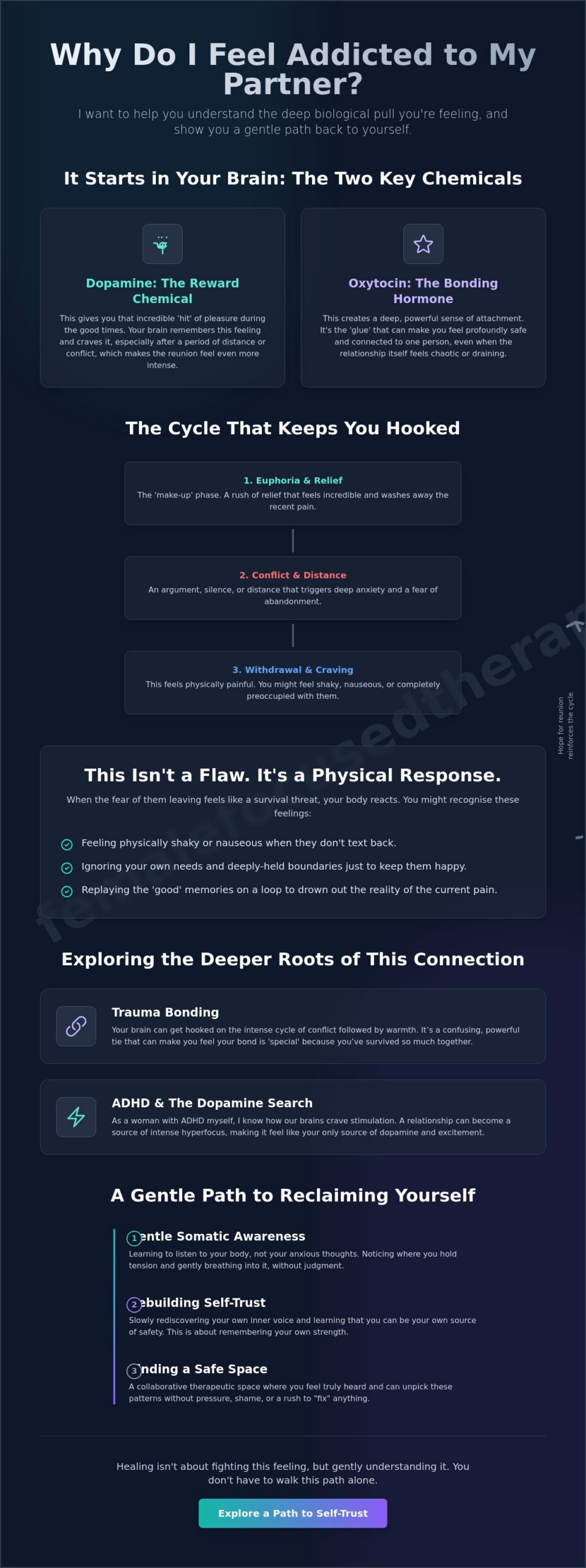
- Feeling physically shaky or nauseous when they don’t text back.
- Ignoring your own boundaries to ensure they stay happy.
- Ruminating on “good” memories to drown out current pain.
While the term love addiction is widely debated in clinical circles, the lived experience is very real. This intensity often masks a deeper, unmet need for internal restoration and self-trust. It is a sign that your system is overwhelmed and needs a different kind of support.
The cycle of highs and lows
Think about the “euphoria” you feel during a make-up phase. It’s a rush of relief that washes away the pain of the previous conflict. Then, when things go wrong again, you hit a period of “withdrawal” that feels physically painful. Our brains are wired to prioritise the memory of those beautiful, “good” moments over the difficult ones. Intermittent reinforcement keeps us stuck in a cycle of hope because the occasional reward makes the struggle feel worth the wait.
When love feels like a survival need
Your brain can easily confuse romantic intensity with actual physical survival. When you find yourself asking why do I feel addicted to my partner, it’s helpful to look at how your nervous system reacts to the threat of distance. The fear of abandonment can trigger a “fight or flight” response rooted in our earliest experiences. When that fear shows up in your adult relationship, it can lead to a total loss of the self-assurance I help women rebuild in my practice. This feeling is often linked to relationship trauma, where the body learns to equate drama with depth.
The hidden reasons your brain craves this connection
When you ask yourself, why do I feel addicted to my partner, it helps to look at what’s happening beneath the surface of your conscious thoughts. Your brain is a complex organ designed for survival, and it uses powerful chemicals to ensure you stay bonded to others. These biological processes are often much stronger than our logical minds, which is why you can’t simply “think” your way out of the intensity.
Two primary chemicals, dopamine and oxytocin, play a massive role in this pull. Dopamine is your brain’s reward system, giving you a “hit” of pleasure during the good times. Oxytocin is the “bonding hormone” that creates a deep sense of attachment. Research has shown there are clear neurochemical parallels between love and addiction, meaning your brain can react to a partner in the same way it might react to a powerful substance.
Our history also creates an “attraction blueprint.” We often find ourselves drawn to what feels familiar, even if that familiarity is rooted in chaos or unpredictability. If you grew up in an environment where you had to work hard for love, your brain might mistake high-stress relationships for the real thing. Understanding these biological and historical drivers is the first step toward internal restoration.
Trauma bonding and the “glue” of conflict
A trauma bond occurs when a cycle of intense conflict followed by emotional warmth creates a powerful, confusing tie to another person. It is essentially your brain getting “hooked” on the relief that comes after a period of stress or mistreatment.
This cycle often creates an artificial sense of depth. You might feel that because you’ve survived so much together, your bond is more special than a “normal” relationship. I often help women unpick these layers in my work with relationship trauma and narcissistic abuse, helping them find safety within themselves again.
ADHD and the search for dopamine
As a woman with ADHD, I know first-hand how our brains seek out stimulation. Neurodivergent women often experience emotions with much greater intensity than others. When we fall in love, the “hyperfocus” typical of ADHD can land squarely on a partner, making the relationship feel like the only source of dopamine in our lives.
This can lead to an overwhelming sense of obsession that feels impossible to switch off. My specific approach to ADHD in women addresses this exact type of emotional overwhelm. We work on finding balance so your relationship doesn’t become your only source of regulation.
If you feel like you’re losing yourself in this intensity, please know that you don’t have to navigate this alone. You can reach out for a private session to begin reclaiming your sense of self in a safe, supportive space.
How your body holds the feeling of “addiction”
I believe healing happens when we bridge the gap between our minds and our bodies. You might know a relationship is unhealthy, yet your body reacts as if your life depends on it. When your partner is distant, you may feel a literal “hunger” or a crushing tightness in your chest.
These aren’t just metaphors; they are somatic signals that your nervous system is under intense stress. Your body naturally seeks “co-regulation,” where two nervous systems settle each other into a state of calm. When bonded to someone unstable, your body keeps trying to find that settlement from a source that cannot provide it.
This creates a state of constant high alert. Your body is trying to protect you by keeping you close to what it perceives as safety. Supporting this, research from the National Institutes of Health highlights the profound physical parallels between romantic attachment and other dependencies.
When you sit with the question, why do I feel addicted to my partner, try to notice where that lives in your skin. Is it a buzzing in your hands or a lump in your throat? Acknowledging these physical truths is a vital part of reclaiming your sense of self and internal restoration.
The somatic “withdrawal” sensation
The anxiety you feel while waiting for a text isn’t just “overthinking.” It is a physical event involving a racing heart or shallow breathing. This is why “just stopping” feels impossible; your body genuinely feels as though it is in immediate danger.
There is a powerful gut-brain connection at play during relationship stress, often leading to digestive issues or a persistent “hollow” feeling. These symptoms are your body’s version of withdrawal. Your system is simply exhausted from trying to keep you safe in a chaotic environment.
Finding rest in your own skin
The first step toward freedom is often as simple as learning to soothe your own breath. When we focus on the body, we can start to ground ourselves without needing external validation to feel okay. This allows you to find safety within yourself first.
I often use somatic movement and yoga to help women find their way back to internal safety. Learning to rest is a radical act of self-reclamation. It sends a message to your nervous system that you are safe, even when you are alone.
Gentle ways to start reclaiming your sense of self
I often hear people give the advice to “just go no contact” or “just leave him,” but I know that for many women, it isn’t that simple. We have already explored how your brain and body are physically hooked on the cycle. Asking you to just stop is like asking a person to stop breathing. It ignores the reality of your experience.
Instead, I prefer a gentle, unhurried approach. You didn’t get here overnight, and you won’t find your way back to your centre in a day either. When you ask, why do I feel addicted to my partner, the answer is often found in the way your world has shrunk until he is the only thing in it. Reclaiming yourself starts with widening that world again, one tiny step at a time.
You don’t need to “fix” yourself to be worthy of a calm, stable love. You are already worthy. This process is about restoration, not repair. It is about slowly gathering the pieces of your identity that have been set aside. I want to help you rebuild your internal confidence so you can trust your own choices again.
Setting internal boundaries
Boundaries are often discussed as walls we build against others, but I find internal boundaries to be much more powerful. An internal boundary is a promise you make to yourself about how you will spend your energy. It is a way of protecting your mental space from constant overwhelm.
For example, you might decide: “I will check my phone once an hour.” This small act allows you to stay grounded in your own life for fifty-nine minutes of every hour. It slowly teaches your nervous system that you are safe, even when you aren’t waiting for a signal from him. It creates a small pocket of peace that belongs only to you.
Reconnecting with your intuition
In an intense relationship, your inner voice often gets quiet. You become so attuned to his needs and moods that you forget how to listen to your own. This loss of intuition can make you feel adrift. Reconnecting starts with very small moments of self-inquiry.
Try a simple practice. Once a day, place a hand on your heart and ask, “What do I need in this moment?” It might be a glass of water, a stretch, or five minutes of quiet. I have created several free therapy resources to help you with this kind of self-reflection. They are designed to help you gently tune back into your own wisdom.
If you feel ready to explore these patterns in a safe, non-judgmental space, you can book an individual psychotherapy session with me. Together, we can work on restoring your sense of self at a pace that feels manageable for you.
Finding a safe space to heal and move forward
Moving from the confusing intensity of a trauma bond toward internal restoration is a brave and deeply personal journey. You’ve spent so much time asking why do I feel addicted to my partner, and now it is time to focus on how you can feel like yourself again. This isn’t about a quick fix or a clinical checklist; it’s about slowly rebuilding the foundation of your own life.
In my practice, I use an integrative approach that looks at both the mind and the body. We don’t just talk about the patterns; we work on how your nervous system can find its way back to a steady state of calm. Healing is possible, and it doesn’t have to happen all at once. You are allowed to take this at a pace that feels manageable and safe for you.
I want you to know that the emotional exhaustion you feel right now is not permanent. It is a sign that your system has been working overtime to maintain a connection that doesn’t serve you. As we work together, that weight begins to lift, allowing your natural self-assurance to return. We focus on restoration rather than just “fixing” what feels broken.
Rebuilding self-trust through therapy
I find that individual psychotherapy is a powerful tool for untangling the complex bonds that keep us stuck. My work is specifically tailored for women navigating difficult life transitions and trauma recovery. We create a collaborative space where your experiences are validated and your voice is finally the one that matters most.
Our sessions are a private, confidential sanctuary where you can explore these difficult feelings without any fear of judgment. It is a place where you can be both high-functioning and deeply human at the same time. Together, we work to move you from a place of feeling out of control to a position of internal stability and peace.
Taking your first realistic step
Your first step doesn’t need to be a giant leap. It can be as simple as acknowledging how you feel right now without trying to change it or judge yourself for it. Simply noticing the physical sensations in your body and naming them is a quiet but powerful beginning to the healing process. It marks the moment you stop fighting yourself.
If you feel ready for professional support, I invite you to book a consultation. We can discuss how to help you reclaim your sense of self in a way that respects your unique history and neurodivergence. You don’t have to carry the weight of these patterns alone anymore; there is a path forward.
You are inherently resilient, even if you don’t feel that way right now. The intensity you’ve survived is proof of your strength, not a sign of your weakness. I am here to help you channel that incredible strength back into your own growth and restoration, guiding you toward a life that feels truly yours again.
Your path back to internal restoration
Reclaiming your identity after feeling lost in a relationship is a journey of patience and kindness toward yourself. We’ve explored how your brain’s neurochemistry and your body’s nervous system work together to create that intense, overwhelming pull. I hope this helps you understand why do I feel addicted to my partner and reminds you that your feelings are a biological response rather than a personal failing.
As a registered integrative psychotherapist specialising in relationship trauma and ADHD, I offer a gender-centric and trauma-informed space for your healing. We can work together to untangle these complex bonds and help you find safety within your own skin again. You don’t need to fix yourself; you simply need the space to remember who you are outside of the chaos.
When you feel ready to take that first step toward self-trust, I am here to guide you. You can book a calm, confidential consultation with me here to begin your restoration at your own pace. You have always possessed the resilience to heal, and you deserve a life that feels steady, secure, and entirely your own.
Frequently Asked Questions
Is it possible to be literally addicted to a person?
Yes, your brain can respond to romantic intensity in ways that mirror substance dependency. While “love addiction” isn’t a formal clinical diagnosis in the DSM-5, the neurochemical highs of validation and the painful lows of distance create a very real physical craving. I see this often in my practice where the bond feels more like a compulsion than a choice.
How do I know if it’s love or a trauma bond?
Love is generally characterised by consistency, safety, and a steady sense of growth over time. A trauma bond, however, is built on a cycle of intense highs and crushing lows, often leaving you asking why do I feel addicted to my partner. It feels more like a roller coaster than a partnership.
If you feel you only “thrive” during the make-up phase after a period of mistreatment, it’s likely a trauma bond. In these relationships, the relief of the conflict ending is mistaken for deep intimacy. Healthy love doesn’t require you to lose your sense of self to keep the peace.
Can ADHD make relationship addiction feel more intense?
My experience as a woman with ADHD has shown me that neurodivergence can significantly amplify relationship intensity. The ADHD brain often seeks out high-stimulation environments to find dopamine, and a turbulent relationship provides that in abundance. It becomes a source of constant neurological “noise” that can be hard to switch off.
Hyperfocus can also lead you to fixate on a partner to the point where your own needs and identity completely fade away. This intensity can make the “lows” feel catastrophic and the “highs” feel like the only thing that matters. Understanding this link is a vital part of your restoration.
Why do I feel physically sick when my partner and I fight?
Feeling physically ill during conflict is a sign that your nervous system has entered a state of high alert. Your body perceives the emotional threat of a fight as a threat to your actual survival, triggering a “fight or flight” response. This is a somatic experience where your body is trying to protect you.
This can lead to nausea, heart palpitations, or a “hollow” feeling in your stomach as your body reacts to perceived abandonment. I often use breathwork and somatic tools to help women settle their systems during these moments. It’s about teaching your body that you are safe even when there is disagreement.
How long does it take to ‘break’ an addiction to a partner?
There is no fixed timeline for healing, as every woman’s journey toward internal restoration is unique. While some studies suggest it takes a few months to reset behavioral patterns, the emotional untangling often takes longer. I focus on steady, manageable progress rather than a “quick fix” that might not last.
The goal isn’t just to stop the “addiction” but to rebuild your self-trust and somatic safety. As you widen your world and reconnect with your own intuition, the pull of the relationship naturally begins to weaken. Healing happens at its own pace when you feel supported and seen.
What should I do if I feel like I can’t leave even though the relationship is toxic?
If you feel unable to leave, the first step is to stop judging yourself for staying. Acknowledging the complexity of your bond is vital, as the “addictive” pull is often a survival mechanism. You aren’t weak; you are currently navigating a very powerful neurobiological tie.
I suggest starting with small internal boundaries to protect your energy. This might mean reclaiming ten minutes of your day for quiet reflection or a simple grounding practice. These tiny acts of self-reclamation help you slowly build the internal confidence needed for larger changes when you feel ready.
Can therapy help me feel more independent in my relationship?
Therapy can help you reclaim your sense of self by providing a safe, confidential space to explore your patterns. In my sessions, we work on untangling the roots of your attachment while using somatic tools to ground you. This process allows you to find your own internal stability regardless of your partner’s moods.
By rebuilding your self-trust, you can move from a place of emotional dependency toward a more stable way of being. This doesn’t always mean the relationship has to end, but it does mean you stop being “hooked” on the intensity. You learn to trust your own skin again.

Article by
Cheryl Kennedy MacDonald MA BA (Hons) Pg. Dip. SAC BACP
Cheryl Kennedy MacDonald is a psychotherapist specialising in women’s mental health, relationships, and life transitions. She works with women navigating trauma, relationship breakdown, identity shifts, and midlife change, helping them rebuild self-trust, emotional stability, and a clear sense of who they are and what they want.
With over 20 years’ experience working with women internationally, Cheryl is the founder of YogaBellies, a global women’s yoga school, and the creator of the Birth ROCKS method. Her work sits at the intersection of psychotherapy and embodiment, integrating evidence-based therapeutic approaches with somatic, body-based practices that support deep, lasting change.
Known for her grounded and direct approach, Cheryl moves beyond surface-level insight to address the patterns held in the body and nervous system. Her work supports women to regulate, reconnect, and respond to their lives from a place of clarity, strength, and self-respect.
She is a published author in academic journals and has written multiple books on women’s health, pregnancy, and midlife wellbeing, available on Amazon and leading book retailers worldwide.