
You are sitting in the quiet of the nursery, the city lights of Singapore flickering outside, yet you feel a heavy, suffocating silence inside that doesn’t match the “bliss” everyone promised. I know that feeling of intense guilt when the “instant bond” doesn’t arrive, or the exhaustion that feels far deeper than just a few missed hours of sleep. It’s incredibly lonely to feel invisible within a healthcare system that focuses so much on the baby’s health while your own internal world feels like it’s unraveling.
I understand the fear of being labeled a “bad mother” simply because you are struggling. You are not alone; Ministry of Health research shows that up to 10.4% of women in Singapore experience postnatal depression. Finding the right postnatal depression support singapore offers can feel like one more daunting task, but I want you to know that you aren’t failing. You are navigating a profound life transition that requires a gentle, mind-body approach to help you feel like yourself again.
I will walk you through how to find a safe, non-judgmental space to talk about your experience. I’ll also share practical tools to help you manage daily overwhelm and the somatic symptoms of anxiety, so you can begin to move forward with a renewed sense of internal stability and confidence.
Key Takeaways
- Learn how to tell the difference between the temporary baby blues and the persistent, heavy numbness of postnatal depression.
- I’ll help you understand matrescence and why high-achieving women often struggle with the sudden loss of control in early motherhood.
- Discover how to navigate the various options for postnatal depression support singapore offers to find the gentle, professional care you deserve.
- You’ll find simple somatic tools to calm your overwhelmed nervous system and reclaim rest as a radical act of self-care.
- Explore how we can work together to rebuild your self-trust and help you find your way back to your true self.
Understanding the Heavy Cloud: Is it Baby Blues or Something More?
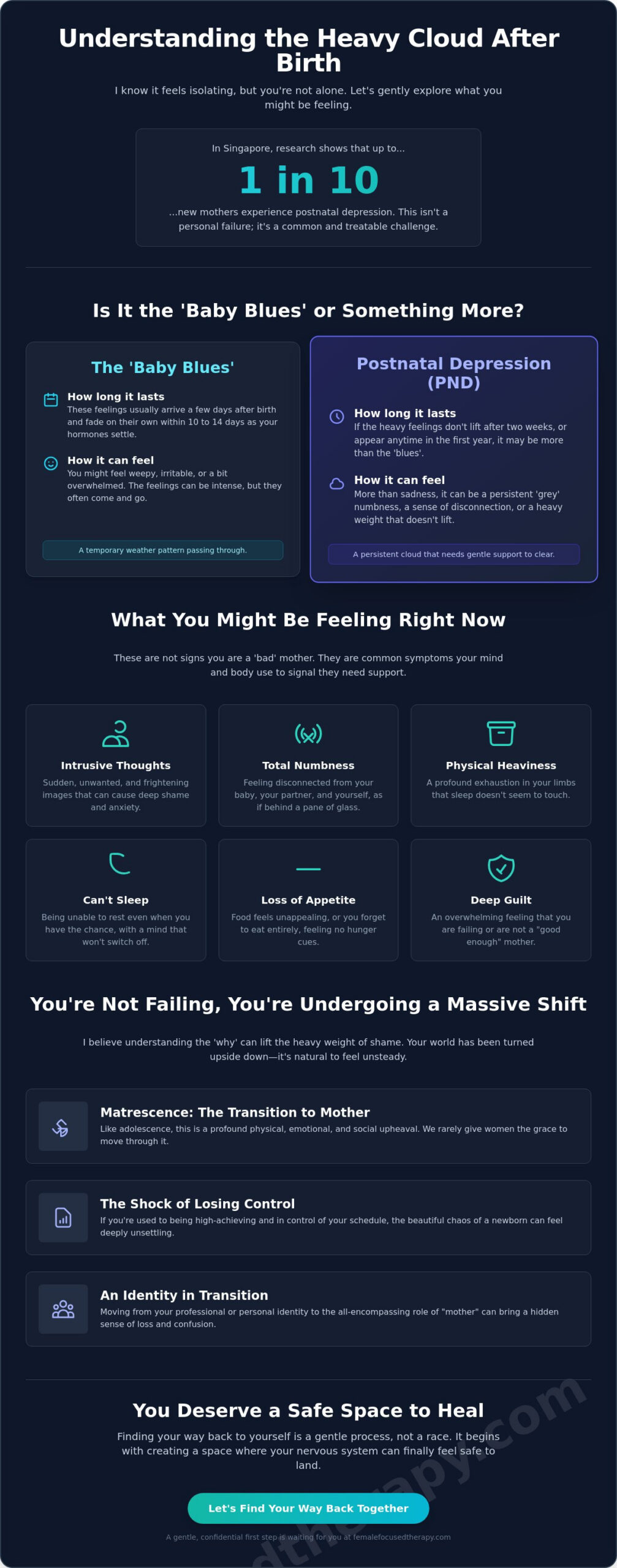
I want to help you distinguish between the common “baby blues” and the deeper, more persistent struggle of postnatal depression. Many women I speak with don’t describe their experience as a sharp, piercing sadness. Instead, they talk about a heavy, pervasive “grey” or a sense of total numbness. It’s like looking at your life through a thick pane of glass; you can see what’s happening around you, but you can’t quite feel the warmth or the connection you expected.
This emotional shift often becomes most apparent when the initial flurry of support begins to taper off. In Singapore, we often have a lot of help during the first month, whether that’s a confinement nanny, a helper, or family members. When that help leaves and you’re left with the quiet reality of daily life, you might find yourself searching for postnatal depression support singapore to help make sense of the internal weight. Understanding Postpartum Depression is a vital part of your healing journey. Postnatal depression is a manageable mental health challenge, not a reflection of your worth as a mother.
The ‘Baby Blues’ vs. Postnatal Depression
The “baby blues” typically arrive a few days after birth and resolve within 10 to 14 days as your hormones start to settle. You might feel tearful, irritable, or just a bit overwhelmed, but these feelings usually lift as you find your rhythm. If the cloud doesn’t move after those first two weeks, it’s a sign that you might need professional postnatal depression support singapore offers. Our high-pressure environment often tells us to “bounce back” immediately, but your mind needs time to heal at its own pace.
Common Symptoms You Might Be Feeling Right Now
You might be dealing with intrusive thoughts, those sudden, frightening “scary” images that make you feel like a “bad” mother. These are common symptoms of high-functioning anxiety. Physically, you might feel a literal heaviness in your limbs or a total disconnection from your body. You might also notice your appetite has vanished or you’re unable to sleep even when the baby is resting. These aren’t just “newborn disruptions”; they are signs your nervous system needs a safe space to land and recover.
The Invisible Shift: Why Postnatal Depression Happens to Intelligent Women
I believe that understanding the “why” behind your feelings can help strip away the heavy layers of shame you might be carrying. You aren’t failing; you’re undergoing “matrescence.” This is a term used to describe the profound physical, emotional, and social transition into motherhood. Much like adolescence, it’s a time of massive upheaval, but we rarely give women the same grace to struggle through it as they find their new footing.
For the high-achieving women I work with in Singapore, the lack of control in early motherhood is often the biggest shock. You’re used to managing teams, hitting deadlines, and being in charge of your schedule. Suddenly, a tiny human dictates every second of your day, and no amount of “planning” seems to work. This friction between your old, capable self and your new, vulnerable reality is a common reason to seek postnatal depression support singapore mothers often need to feel grounded again.
The Impact of Identity and Life Transitions
Moving from a career-focused identity to the all-encompassing role of a caregiver is a seismic shift. In our fast-paced city, your worth might have been tied to your productivity and professional success for years. When that’s replaced by the repetitive, often invisible tasks of childcare, it’s natural to feel a sense of loss. If you’re an expat, this isolation is magnified by being thousands of miles from your usual family support network. I often explore these themes in Life Transitions & Menopause Therapy, as the loss of “self” is a recurring thread in many significant female life stages.
Neurodivergence and the Postnatal Period
As an adult woman with ADHD, I know how the sensory landscape of motherhood can feel like an assault on the senses. The constant noise, the unpredictable textures, and the total lack of a routine are incredibly draining for a neurodivergent brain. Executive dysfunction makes the logistics of feeds and sleep cycles feel like a mountain you simply cannot climb. If you’ve always been high-functioning, this sudden inability to “keep it together” can be devastating. We can work through these specific hurdles together in ADHD therapy, focusing on how your unique brain processes this intense transition.
You don’t have to navigate this identity shift alone while trying to maintain a facade of “having it all.” If you feel like you’re disappearing under the weight of these new demands, you might find it helpful to book a session to talk through your experience in a safe, private space.
Navigating Your Options for Postnatal Depression Support in Singapore
Choosing the right path for your recovery is a deeply personal decision. I want you to feel empowered to find a space where you feel truly seen and safe. In our city, there are several layers of support available, but the “best” option depends entirely on what you need in this moment. Whether you require clinical intervention or a gentle space to process your emotions, understanding these differences is the first step toward feeling like yourself again.
I often see women who aren’t sure whether they need a psychiatrist or a psychotherapist. A psychiatrist is a medical doctor who can diagnose conditions and manage medication. This is often necessary if your symptoms are severe or if you’re struggling to function daily. A psychotherapist, like me, focuses on talk therapy and somatic tools to help you navigate the emotional and identity shifts of motherhood. Many women find that a combination of both provides the most comprehensive postnatal depression support singapore has to offer.
Hospital Programmes vs. Private Psychotherapy
Public healthcare institutions like KKH, SGH, and NUH have dedicated programmes for maternal mental health. These settings are excellent for acute clinical care, especially if you need subsidized services or medical management. They provide a structured, evidence-based approach that is vital for many families. However, these environments can sometimes feel a bit clinical or rushed due to the high volume of patients they see.
Private psychotherapy offers a different texture to the healing process. In my practice, we have the luxury of time to dive deep into your personal history and the “matrescence” we explored earlier. It’s a space designed for longer-term emotional processing and rebuilding the self-trust that often feels shattered after birth. We look at the whole person, combining traditional therapy with an understanding of how your body is holding onto stress and exhaustion.
Finding a Safe, Confidential Space
I know that many high-functioning women in Singapore worry about the stigma of seeking help. You might fear being “reported” or judged by the healthcare system, especially if you hold a high-profile job. This is why finding a private, confidential space is so important. You need to know that your story is held with the utmost respect and professional boundaries. It allows you to be completely honest about the “scary” thoughts or the numbness without fear of repercussions.
When you’re looking for a practitioner, check their credentials but also trust your intuition. You deserve a therapist who specialises in women’s mental health and understands the unique pressures of living and parenting in Singapore. If you’re feeling overwhelmed by the choices, I’ve put together a compassionate guide for 2025 to help you find the right fit for your specific needs. Finding the right postnatal depression support singapore begins with choosing a space where you don’t have to pretend you’re okay.
Softening the Struggle: Gentle Ways to Support Your Mind and Body
Healing from postnatal depression isn’t just about what happens in your thoughts; it’s about how your body feels. After birth, your body can feel like a stranger, or even like it’s let you down. I often weave gentle, somatic practices into our sessions because I’ve seen how powerful it is to reconnect with your physical self in a way that feels safe and supportive. When you’re looking for postnatal depression support singapore, it’s vital to find an approach that honours both your mind and your body.
I believe that rest is a radical act of self-care, especially in a city that prizes constant activity. We often think of rest as something we have to “earn” once everything is done, but in this season, rest is your medicine. Even in small increments, allowing your system to settle can make the daily overwhelm feel more manageable. It’s about finding those tiny pockets of peace where you can simply be, without any demands on your energy.
Grounding Your Nervous System
When you’re in the middle of a difficult night feed and your heart is racing, you can use simple breathing techniques to signal safety to your brain. Try making your exhales longer than your inhales, or imagine breathing into the soles of your feet. These “micro-rests” are essential tools for regulation. I explore these themes deeply in my work with Somatic Movement & Yoga, helping you find a sense of home within yourself again.
Self-Compassion as a Healing Tool
In Singapore, we’re often surrounded by “toxic positivity” and the pressure to look like we’re handling everything with ease. I want to give you permission to feel “not okay.” Healing begins when we stop fighting our feelings and start meeting them with kindness. You can practice reframing your internal dialogue from “I am failing” to “I am learning how to do something incredibly hard.”
Lowering the bar for yourself isn’t a sign of weakness; it’s a strategic choice for your mental health. It might mean letting the laundry pile up or saying no to social commitments that drain your battery. If you’re ready to explore these somatic and emotional tools in a supportive environment, you can book a session with me to begin your journey. You deserve postnatal depression support singapore that sees you as a whole woman, not just a set of symptoms.
Walking Back to Yourself: How We Can Work Together to Heal
I understand the unique pressures you face as a woman in Singapore. The expectation to be “on” at all times, combined with the quiet isolation of new motherhood, can feel like an impossible weight to carry. My role isn’t to “fix” you, because I don’t believe you are broken. Instead, I’m here to walk alongside you as you find your way back to your own strength and internal stability. We work as a team to help you navigate the heavy fog of this transition.
Rebuilding your self-trust is a central part of our work together. Postnatal depression often makes you doubt your instincts and your value as a mother, but those parts of you are still there, just waiting to be rediscovered. Finding the right postnatal depression support singapore offers means finding a practitioner who respects your individual journey and your unique brain. We’ll focus on creating a steady, reassuring flow in your life so you can move forward with a renewed sense of self-assurance.
An Integrative Path to Recovery
My approach combines evidence-based talk therapy with mindfulness and somatic awareness. We don’t just talk about your feelings; we look at how your body is responding to this transition and where you might be holding onto tension. By focusing on internal restoration and resilience, we work toward a long-term sense of peace rather than just a temporary lift in mood. You can learn more about who I work with to see if my integrative style feels like the right fit for you.
Taking the First Step
Reaching out is often the hardest part of the entire process. I want you to know that you don’t need to have all the answers or even a clear way to describe what you’re feeling before you call. In our initial consultation, I provide a safe, non-judgmental space for you to simply be as you are. It is a quiet, confidential moment for us to see how we might work together to help you feel like “you” again. You aren’t alone in this, and there is a way through the grey.
If you feel ready to take that small, brave step, I invite you to book a session today. There is no urgency or pressure, just a gentle opening for you to begin your healing journey. You deserve to feel grounded, supported, and truly heard as you navigate this profound life transition. Let’s find the postnatal depression support singapore that honours your experience and helps you reclaim your joy.
Reclaiming Your Light and Your Self
I know how heavy the silence of motherhood can feel when it’s filled with a persistent “grey” instead of the joy you expected. We’ve explored how the shift into motherhood is a profound identity transition that requires both patience and grace. By understanding your unique brain and using somatic tools to settle your nervous system, you can begin to lift that heavy cloud and find your way back to your own strength.
Finding the right postnatal depression support singapore offers is about more than just managing symptoms; it’s about being seen and validated as a whole woman. As a Registered Integrative Psychotherapist specialising in women’s mental health, I use a trauma-informed and somatic approach to help you rebuild your internal confidence and stability. You don’t have to carry this weight alone, and you don’t have to have all the answers right now to reach out for help.
Book a confidential consultation with Cheryl to begin your journey back to yourself.
I’m here to hold space for you whenever you’re ready to take that first, gentle step toward healing and restoration.
Common Questions About Postnatal Support
How do I know if I have postnatal depression or just ‘baby blues’?
I find that baby blues usually lift within 10 to 14 days as your hormones settle, but postnatal depression persists much longer. If you feel a constant sense of “grey” or find it hard to function after those first two weeks, it’s a sign you might need professional support. Research reported by the Ministry of Health in 2024 shows that up to 10.4% of women in Singapore experience this deeper struggle.
Can postnatal depression start several months after giving birth?
Yes, it’s quite common for these feelings to emerge several months after birth, even if you felt fine initially. Many women find the struggle intensifies when they return to work or when their initial support network, like a confinement nanny, leaves. This is a very normal time to look for postnatal depression support singapore, as the reality of your new identity truly begins to settle in.
Will I be judged or reported if I admit I have intrusive thoughts?
I want to reassure you that you won’t be judged for having intrusive thoughts; they are a recognized symptom of an overwhelmed nervous system. These “scary” thoughts are often your brain’s way of trying to protect your baby by imagining worst-case scenarios. In a safe, confidential therapy space, we can look at these thoughts without shame, helping them lose their power over your daily life.
Do I have to take medication to recover from postnatal depression?
No, you don’t always have to take medication, though for some women, it provides a helpful foundation for recovery. Many of the women I work with find that integrative psychotherapy and somatic tools are enough to help them reclaim their stability. While I don’t manage medication myself, I can help you hold the space to decide what path feels right for your body and your family.
How long does therapy for postnatal depression usually last?
Every woman’s journey is different, so there isn’t a set number of sessions that works for everyone. Some women feel a significant shift in their internal stability after 6 to 10 sessions, while others choose longer-term support to navigate the complex identity changes of motherhood. We move at a pace that feels manageable for you, focusing on steady, sustainable restoration rather than a rushed “fix”.
Can postnatal depression affect my relationship with my partner?
It’s very common for PND to create a sense of distance or irritability within your relationship. When you’re feeling numb or overwhelmed, it’s incredibly hard to connect with your partner or explain what’s happening inside. Therapy provides a space to find those words again, helping you move from feeling isolated to feeling supported and understood within your partnership as you heal together.
Is online therapy effective for postnatal support in Singapore?
I’ve found online therapy to be incredibly effective, especially for new mothers who find the logistics of leaving the house too draining. It allows you to access professional postnatal depression support singapore from your own sofa, often while your baby is napping. This removes the stress of travel and childcare, making it much easier to commit to the regular support you need for your recovery.
What should I do if my partner is the one struggling with postnatal depression?
The best thing you can do is offer a safe, non-judgmental space for them to share their feelings without trying to “fix” them immediately. Encourage them to reach out to a specialist who understands the unique pressures of maternal mental health in Singapore. Taking over practical tasks like night feeds or household chores can also significantly lower their sensory overload, giving them the mental room to begin healing.

Article by
Cheryl Kennedy MacDonald MA BA (Hons) Pg. Dip. SAC BACP
Cheryl Kennedy MacDonald is a psychotherapist specialising in women’s mental health, relationships, and life transitions. She works with women navigating trauma, relationship breakdown, identity shifts, and midlife change, helping them rebuild self-trust, emotional stability, and a clear sense of who they are and what they want.
With over 20 years’ experience working with women internationally, Cheryl is the founder of YogaBellies, a global women’s yoga school, and the creator of the Birth ROCKS method. Her work sits at the intersection of psychotherapy and embodiment, integrating evidence-based therapeutic approaches with somatic, body-based practices that support deep, lasting change.
Known for her grounded and direct approach, Cheryl moves beyond surface-level insight to address the patterns held in the body and nervous system. Her work supports women to regulate, reconnect, and respond to their lives from a place of clarity, strength, and self-respect.
She is a published author in academic journals and has written multiple books on women’s health, pregnancy, and midlife wellbeing, available on Amazon and leading book retailers worldwide.