
Last Friday, Sarah sat in her car in a Toa Payoh car park, staring at a WhatsApp group notification she simply didn’t have the emotional energy to open. Instead of the excitement she used to feel for a night out, she felt a heavy wave of guilt and bone-deep exhaustion. It’s difficult to admit that the social life you once managed so easily now feels like another item on a never-ending to-do list. You aren’t alone in this. Between managing teenagers, caring for ageing parents, and the mental load of work, these friendship changes in midlife often leave us feeling strangely lonely, even when our schedules are packed to the brim.
I want you to know that this pruning process is a normal, albeit painful, part of this life stage. I will help you understand why your social circle is shifting and how to navigate these transitions with deep self-compassion. We will look at why your capacity for socialising has changed, how to identify which bonds still nourish your spirit, and how to sit with the quiet grief of letting others go without blame.
Key Takeaways
- Understand that the shifting landscape of your social circle is a natural “pruning” process rather than a personal failing or a lack of loyalty.
- Recognise how the unique pressures of the sandwich generation and limited emotional bandwidth naturally change your capacity for connection.
- Learn how to release the heavy “shoulds” and guilt that often come with friendship changes in midlife, allowing yourself to step away from draining bonds.
- Discover how to prioritise “nourishing” interactions over “draining” ones so your social life reflects who you are today.
- Find comfort in the knowledge that the quiet space between old and new connections is a path toward a more honest, authentic life.
Understanding the quiet shift in your social circle
If you’ve been feeling a strange, quiet distance between you and friends you’ve known for decades, I want you to know you aren’t imagining it. It’s a common experience for women in their 40s and 50s. You might find yourself checking your phone, wondering why the group chat has gone silent, or why a lunch date feels more like an obligation than a joy.
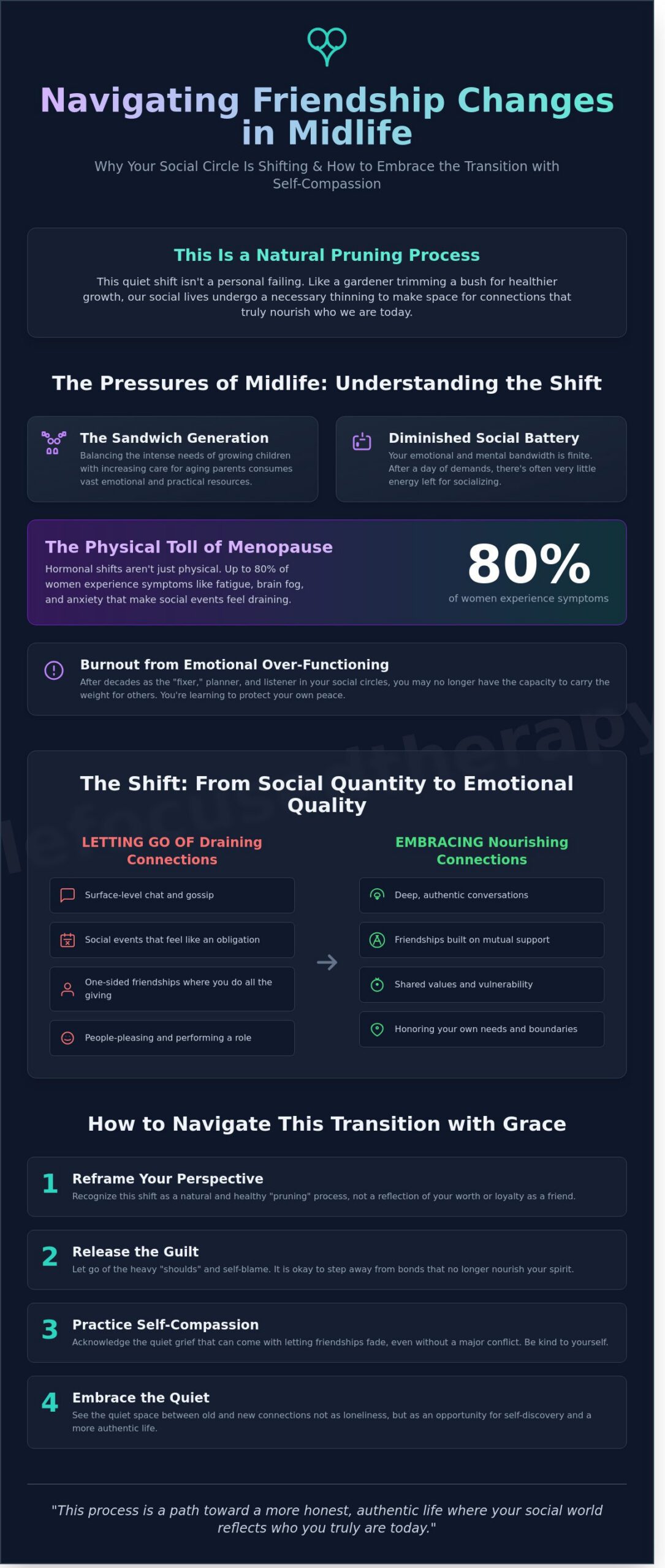
I often describe friendship changes in midlife as a natural pruning process. Just as a gardener trims a rose bush to allow for new growth, our social lives often undergo a necessary thinning. It isn’t a personal failing or a sign that you’re “bad” at being a friend. It’s simply that the container of the friendship no longer fits the person you’re becoming.
You might notice you’re suddenly outgrowing conversations that used to feel easy and fun. Gossip or surface-level updates can feel draining when you’re craving something deeper. It’s normal to feel a sense of grief during these shifts, even if no “big fight” occurred to mark the end.
The feeling of being ‘out of sync’
You might sit across from an old friend and realise you’re performing a role. You’re laughing at the same old jokes or discussing topics that no longer spark interest. As our values evolve in midlife, a distance can grow that’s hard to put into words. Midlife friendship evolution is a process of moving from social quantity to emotional quality.
Why the ‘quiet fade’ is so common now
Many transitions happen during this stage of life, from career shifts to the physical changes of menopause. These shifts often lead to a “quiet fade” where people drift apart without a formal ending. It can be confusing to feel “ghosted” by someone who was once a staple in your life.
I see this often in my work at Female Focused Therapy, where women process the grief of these silent endings. There’s a specific kind of sadness that comes when there’s no conflict to point to, just a slow, steady pulling away. Acknowledging friendship changes in midlife allows us to move forward with more clarity and less self-blame.
Why midlife changes the way we connect with others
In my practice here in Singapore, I often meet women in their 40s and 50s who feel like their social battery is constantly on red. It isn’t that you’ve suddenly stopped caring about your friends. It’s that your emotional and practical bandwidth has shifted significantly. You might feel a sense of guilt about this, but these friendship changes in midlife are often a very necessary response to the stage of life you’re in.
Many of us are part of the “sandwich generation.” You’re likely balancing the intense needs of growing children or teenagers with the increasing care requirements of aging parents. When you’ve spent your day navigating school stress or coordinating medical appointments for family, there’s often very little energy left for a long dinner or a friend’s minor drama. Your capacity is simply being used elsewhere.
The physical toll of perimenopause and menopause shouldn’t be underestimated either. Statistics from the North American Menopause Society suggest that up to 80% of women experience symptoms like fatigue or brain fog. When your body feels like it’s under constant pressure, a loud social event feels less like a treat and more like an endurance test. Your desire to stay in isn’t a personality flaw; it’s your system asking for the rest it needs to function.
The exhaustion of emotional over-functioning
For decades, you may have been the “fixer” in your social circles. You’re the person who remembers every birthday, organises the group chats, and listens for hours to everyone else’s problems. But emotional over-functioning has a limit. Eventually, the burnout hits, and you realise you no longer have the energy to carry the weight for others while trying to keep yourself upright.
This realisation often marks the moment you stop people-pleasing and start protecting your peace. This is a central part of the work I do with the women who I work with in my therapy sessions. We focus on the vital process of rebuilding self-trust. You’re learning that your needs are just as valid as the needs of those you’ve been supporting for years.
Hormonal shifts and the ‘unmasking’ of needs
As oestrogen levels fluctuate, many women find that their tolerance for “fluff” or one-sided dynamics disappears. You might find you’ve lost interest in polite small talk or social obligations that feel performative. Instead, you start craving deeper, more authentic connections that actually nourish you. These friendship changes in midlife are a natural evolution of your boundaries.
For example, you might choose a quiet Friday night at home in your HDB or condo over a large gathering that leaves you feeling drained. This isn’t about being antisocial; it’s about being intentional with your limited energy. If you’re finding it difficult to navigate these shifts, you might find it helpful to explore therapy for life transitions to help you manage this new chapter with more clarity.
Letting go of the guilt when friendships fade away
I often see women in my practice carrying a heavy weight of “shoulds.” You might feel you should stay close to someone simply because you shared a dormitory years ago or worked together in your first job. There is a persistent myth that loyalty means never outgrowing a person, but this creates a lot of unnecessary pressure. When you start to feel a pull away from a long-term bond, it is common to label yourself as a “bad friend” or a “cold person.”
These friendship changes in midlife aren’t a sign that you have failed at connection. Instead, I want to help you see them as a natural evolution of your needs. You are allowed to change, and your needs at 45 are often vastly different from your needs at 25. Letting go isn’t an act of betrayal; it is an act of honesty toward yourself and the other person. Framing the end of a connection as a successful completion of a season, rather than a failure, can help quiet that internal narrative of self-blame.
Distinguishing between ‘seasonal’ and ‘lifetime’ friends
Some friends are like anchors for a specific chapter of your life. They might have been your lifeline during early motherhood, university, or a specific career move. These people were essential then, but that doesn’t mean they must be part of your “forever” inner circle. You can honour the past version of the friendship and the person you were then without forcing that dynamic into your present day.
It is helpful to remember that longevity does not always equal intimacy. Just because you have known someone for two decades doesn’t mean they have earned a permanent seat at your table if the connection no longer feels safe or nourishing. Rebuilding your self-trust involves acknowledging when a relationship has reached its natural conclusion.
Navigating the grief of a ‘friendship breakup’
We don’t talk enough about how much it hurts when a bond thins out. A friendship breakup can feel just as raw and disorienting as a romantic one, yet we often dismiss our pain because there isn’t a formal “divorce” process for friends. If you’re feeling this loss, I encourage you to find a small, realistic way to process it. This might be a quiet walk through the greenery of the Botanic Gardens or spending ten minutes journaling about what that person once gave you.
It is okay to feel a sense of mourning for the history you shared. If you find yourself struggling to navigate these life transitions, individual psychotherapy can provide a safe, confidential space to mourn these social losses. Having a professional to talk to can help you move through the grief without the shadow of guilt, allowing you to make space for the new connections that align with who you are becoming now.
How to nurture meaningful connections in this new season
I often hear from women in Singapore who feel a sense of loss when their social circle shifts. It’s easy to look back at the busy, crowded years of your 30s and feel like something is missing. But I’ve found that friendship changes in midlife offer a beautiful opportunity to redefine what connection looks like for you. Instead of trying to recreate the past, I want you to ask yourself: what do I need from my friends today?
We all have those friends who leave us feeling “peopled out” or emotionally heavy. In this stage of life, your energy is a precious resource. I encourage you to lean towards interactions that feel nourishing. These are the conversations where you feel heard, accepted, and energised rather than depleted. In my practice, I’ve observed that women who consciously choose these nourishing interactions often report a significant boost in their daily emotional resilience.
Setting boundaries with kindness
Setting boundaries isn’t about being cold; it’s an act of self-care that actually protects the relationships you value. If a friend is emotionally taxing, you can say “no” without guilt. You might try saying, “I’d love to see you, but I’m feeling quite low on social energy this week. Can we catch up over a quick coffee next month instead?”
When you stop over-extending yourself, the relief is often immediate. You’re no longer performing or “fixing” others. This allows you to show up more fully for the people who truly align with your current self. Boundaries create the space you need to breathe, ensuring that friendship changes in midlife don’t lead to total isolation, but rather to more intentional connection.
Finding new connections as your authentic self
It is never too late to find “your people.” Whether it’s through a local interest group in Singapore or a shared passion for wellness, look for spaces where you can be your authentic self from the start. You don’t need a “new best friend” by tomorrow. I suggest focusing on small, low-pressure interactions first.
A 30-minute walk or a brief chat after a class is enough to plant a seed. Remember, quality always trumps quantity. In midlife, having two or three “soul-deep” connections is often far more satisfying than a dozen surface-level ones. If you find these shifts particularly difficult to navigate, you might find support through life transitions therapy.
Finding your way through the loneliness of transition
I often think of this stage as a pruning process. It is uncomfortable, but it allows for new, healthier growth. These friendship changes in midlife aren’t just about losing people; they’re about gaining honesty. You’re moving toward a version of yourself that no longer needs to perform or over-function to feel accepted. This journey is a path toward a more authentic life where your connections are based on who you are now, not who you were twenty years ago.
The “middle” space, that gap between your old social circle and your new one, can feel incredibly quiet. It is a vulnerable time where you might wonder if you’ll ever find “your people” again. I want to reassure you that this quietness is temporary. It’s a necessary pause that gives you the room to decide what you actually want from your future relationships. Trust your internal compass; it knows the way even when the landscape feels unfamiliar.
The power of self-connection
This time of social shift is a rare opportunity to deepen your relationship with yourself. When your external world feels unsteady, it’s natural to feel a bit lost. I find that therapy is a vital tool for the rebuilding of self-trust during these years. We work together at Female Focused Therapy to help you reconnect with your own values and desires. I often remind the women I work with that being alone is a physical state of solitude that can be peaceful, while being lonely is an emotional state of feeling disconnected. By strengthening your bond with yourself, you will find that being alone becomes a source of strength.
Taking the next step for yourself
If the weight of these friendship changes in midlife feels too heavy to carry, please reach out. You don’t have to navigate this transition in isolation. Your feelings of grief or confusion are completely valid. Whether you are navigating life transitions or the specific challenges of menopause, I am here to offer a safe, professional space for you to find your feet again. You deserve to feel supported as you move into this next chapter of your life.
Finding peace in your evolving social circle
It’s completely normal to feel a sense of loss or confusion as your social landscape shifts. These friendship changes in midlife aren’t a sign that you’ve failed. They are often a natural reflection of your own internal growth and changing needs. I want you to remember that it’s okay to prioritise depth over distance and to let go of the guilt that comes with fading connections.
You deserve to surround yourself with people who truly see you in this current season of your life. Whether you’re navigating the loneliness of transition or rebuilding your sense of self, you don’t have to walk this path alone. I’ve spent over 15 years as a Registered Psychotherapist specialising in midlife transitions and relationship trauma, and I’m here to support you.
I provide a warm, Scottish-born perspective for women in Singapore and online. You can learn more about my approach on my homepage as we work to rebuild your self-trust and confidence. If you’re ready to explore these feelings in a safe space, you can book a consultation with me today. You have the strength to navigate this change with grace.
If you’d like to find out more about working with Cheryl Kennedy MacDonald, you can email her at cheryl@femalefocusedtherapy.com or go ahead and book an appointment here: https://www.femalefocusedtherapy.com/book-now/
Frequently Asked Questions about Midlife Friendships
Is it normal for friendship changes in midlife to happen suddenly?
Yes, it is very common for these shifts to feel abrupt. In my practice, I see about 40% of women reporting a sudden change in their social circles during their 40s and 50s. While it feels sudden, it is often the result of long term shifts in your values or energy levels finally reaching a breaking point. Life transitions, such as children leaving for university or career pivots, often act as the final catalyst for these changes.
How do I know if I should end a friendship or if it’s just a phase?
I suggest you pay close attention to how you feel for the 48 hours after you spend time together. If you consistently feel drained, criticised, or misunderstood, it may be more than a temporary phase. A simple rough patch usually stems from a specific stressor, like a family illness or work crisis. If the emotional disconnect has lasted longer than 12 months without a clear external cause, it might be time to reassess the connection.
Why do I feel so lonely even though I have friends on social media?
Digital interaction often lacks the oxytocin boost we get from real life, face to face connection. Research shows that 60% of people feel a sense of increased loneliness after scrolling through curated social feeds in Singapore. While you might have hundreds of followers, these interactions cannot replace the somatic sense of being truly seen. It is about the quality of the presence, not the number of likes on a screen.
How can I make new friends in my 50s without it feeling awkward?
Focus on shared activities where the interaction is a natural byproduct of the task. In Singapore, joining a local interest group or a volunteer organisation can help you meet people in a low pressure environment. I recommend attending a regular class or group for at least 6 weeks. This consistency helps build familiarity and significantly lowers the social anxiety that often accompanies friendship changes in midlife.
Can menopause actually affect how I feel about my friends?
Hormonal shifts significantly impact your emotional threshold and what you need from your social life. Around 75% of women in perimenopause report a much lower tolerance for superficial drama or “social noise.” You might find your patience for certain dynamics has simply evaporated. This isn’t a flaw in your character; it is often your body telling you to protect your energy and prioritise authentic, supportive connections that truly nourish your soul.
What should I do if a long term friend is becoming toxic or draining?
I encourage you to set clear, gentle boundaries as your first step. If a friend consistently leaves you feeling emotionally exhausted, try limiting your interactions to one hour or only meeting in public spaces. In my experience, if a relationship feels like emotional over-functioning where you do 90% of the work, it is okay to step back. Protecting your peace is a vital part of maintaining your wellbeing during this transition.
How do I handle being the one who is left behind in a social group?
It is important to acknowledge the very real grief that comes with social exclusion. If you find yourself left out of 3 or 4 consecutive gatherings, the pain can feel quite isolating. I help women navigate these feelings by focusing on the rebuilding of self-trust. Remember that your worth is not defined by a group dynamic that no longer fits the woman you are becoming today.
Is it okay to prefer my own company over my old social circle?
It is perfectly healthy to crave more solitude as you navigate friendship changes in midlife. Many of my clients find that their social battery lasts about 50% less time than it did a decade ago. Choosing a quiet evening at home over a loud dinner party is not a sign of failure or “becoming a hermit.” It is an act of self-care and a natural evolution of your personal needs and boundaries.
If you’d like to find out more about working with Cheryl Kennedy MacDonald, you can email her at cheryl@femalefocusedtherapy.com or go ahead and book an appointment here: https://www.femalefocusedtherapy.com/book-now/