
Imagine standing in a meeting at your office near Raffles Place, or perhaps sitting at a quiet family dinner, and suddenly feeling like a ghost of your former self. You’ve spent decades building a career, yet a sudden loss of confidence in midlife makes the right words feel impossible to find through a thick, heavy brain fog. This experience is more than just a bad day. It’s a profound shift that can leave you feeling invisible in your own life.
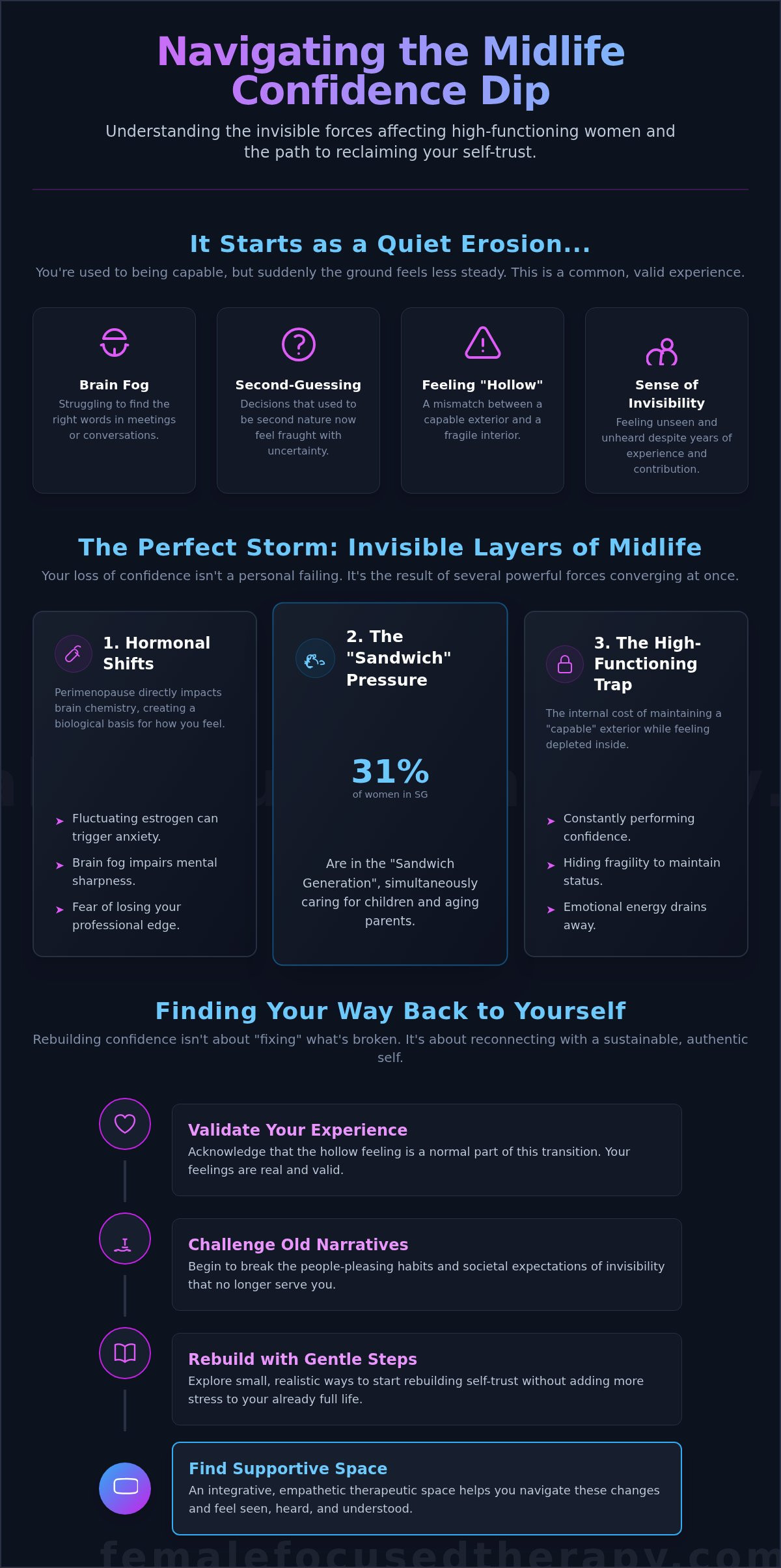
You might believe that this dip in self-assurance is a personal failing, especially when you’re likely part of the 31% of women in Singapore’s “sandwich generation” who are simultaneously caring for children and ageing parents. It’s an exhausting weight that many high-functioning women carry in silence while trying to maintain a “business as usual” exterior. I hear this from clients often, and I want you to know that your feelings are a valid response to a complex season of change.
I’ll help you understand the biological and situational reasons why your confidence has dipped and how we can work together to rebuild your self-trust. We’re going to look at why you feel this way and explore practical, grounded steps to help you feel seen, understood, and firmly back in the driver’s seat of your life.
Key Takeaways
- Understand why that “hollow” feeling is a normal part of your transition and how to validate your internal experience.
- Discover how the intersection of menopause and the pressures of the “Sandwich Generation” can lead to a loss of confidence in midlife.
- Learn to challenge the societal narrative of invisibility and begin breaking the people-pleasing habits that no longer serve you.
- Explore gentle, realistic ways to start rebuilding your self-trust today without adding more stress to your daily life.
- See how an integrative, empathetic therapeutic space can help you navigate these changes and find your way back to yourself.
Understanding why your confidence feels like it’s slipping away
I often hear women in my Singapore practice describe a strange, hollow sensation that seems to arrive out of nowhere. You might have spent the last twenty years building a career, raising a family, or navigating complex social circles with ease. Now, suddenly, the ground feels less steady beneath your feet.
This loss of confidence in midlife is a deeply personal experience, yet it is incredibly common. It isn’t a sign that you are failing or that you’ve lost your edge. Instead, I see it as a signal that you are outgrowing old versions of yourself that no longer fit who you are becoming.
I bring my own Scottish warmth and a grounded, practical approach to these conversations. My goal is to help you see that this isn’t about “fixing” something broken. It’s about understanding a significant life transition and learning to trust your internal compass again.
The quiet erosion of the “capable self”
You might find yourself second-guessing decisions that used to be second nature. Perhaps you’re in a meeting at work and, instead of speaking up, you stay silent, worried that your input isn’t quite right. You might even find yourself over-preparing for simple social gatherings in Orchard Road that you used to enjoy without effort.
High-functioning women are often experts at masking this self-doubt. You keep the plates spinning and maintain the “capable” exterior, but the internal cost is becoming heavy. When you are constantly performing confidence, you eventually run out of the emotional energy required to actually feel it.
Why this transition feels so disorienting
There is often a sharp mismatch between how the world sees you and how you feel inside. People likely still see you as the “strong one” or the person who has it all figured out. This creates a lonely bubble where you feel you must hide your fragility to maintain your status or relationships.
It is exhausting to maintain a facade when you feel like you are crumbling. My practice is a safe space where you don’t have to perform. We can be honest about the fact that your loss of confidence in midlife is real, valid, and something we can navigate together at Female Focused Therapy.
Acknowledging this fragility isn’t a weakness; it’s the first step toward rebuilding a version of confidence that is actually sustainable. You deserve to feel as solid on the inside as you appear to be on the outside.
The invisible layers of midlife: Hormones, roles, and the high-functioning trap
I often hear from women who feel they’ve suddenly become a stranger to themselves. You might find that the self-assurance you spent decades building has started to flicker. This loss of confidence in midlife isn’t usually caused by one single event. Instead, it’s often the result of several invisible layers pressing down on you at once. It’s a heavy load to carry, especially when you’re used to being the one who holds everything together.
In my practice, I see how the intersection of biological shifts and mounting social expectations creates a “perfect storm.” You’re navigating a phase where your body is changing while your external responsibilities are likely at their peak. It’s exhausting to maintain a high-functioning exterior when you feel internally depleted. Acknowledging these layers is the first step toward reclaiming your sense of self. You can learn more about how I support women through these specific shifts by exploring my approach to life transitions and menopause therapy.
The hormonal impact on your mental clarity
Fluctuating hormones during perimenopause do more than cause physical discomfort. They directly affect your brain chemistry. When estrogen levels dip, it can trigger feelings of anxiety that seem to come out of nowhere. You might experience brain fog or a sudden struggle to find the right words during a meeting. This often leads to a deep fear of losing your professional edge or being “found out.”
For many women, actively sharpening communication skills can be a concrete way to regain that sense of professional sharpness. If you feel this could be a supportive step, you can visit English Explorer to learn about courses designed for adult learners in Singapore.
I want you to know that these feelings have a real biological component. It’s not a sign that you’re less capable than you were a year ago. However, the emotional toll of these changes requires more than just medical management. It requires a safe space to process the frustration and the grief of losing that familiar mental sharpness. Rebuilding your confidence and self-trust starts with being gentle with yourself during this transition.
The trap of being the “strong one”
Many women in Singapore belong to the “Sandwich Generation.” A 2021 study by Silver Generation Office found that caregivers often balance the needs of ageing parents with the demands of growing children. You might be the emotional anchor for your family while also managing a team at work. This role of “fixer” is a common trap. You’ve become so good at anticipating everyone else’s needs that you’ve forgotten how to listen to your own.
- You feel responsible for everyone’s happiness but your own.
- “Doing it all” has shifted from feeling rewarding to feeling like a heavy obligation.
- You practice emotional over-functioning, where you take on the stress of others to keep the peace.
This constant output leads to a profound depletion of self-belief. When you’re always pouring into others, there’s nothing left for you. You might find that your loss of confidence in midlife stems from this quiet erasure of your own identity. It’s okay to stop being the “strong one” for a moment and admit that you need support too.
If you’d like to find out more about working with Cheryl Kennedy MacDonald, you can email her at cheryl@femalefocusedtherapy.com or go ahead and book an appointment here: https://www.femalefocusedtherapy.com/book-now/
Moving beyond the “invisibility” of the middle years
I often hear women describe a strange sensation as they cross into their forties and fifties. It’s a feeling of becoming a ghost in your own life. Society often suggests that once we aren’t “young” anymore, we somehow matter less. This narrative is a major contributor to the loss of confidence in midlife that I see in my practice. You might feel like you’re shouting into a void, even though you’re working harder than ever.
In my work with the women I support, we talk about reclaiming that space. I often lean on my Scottish roots here. In Scotland, we value being “grounded.” It’s about having your feet firmly in the soil, unswayed by the wind. It’s a quiet, sturdy strength that doesn’t need external permission to exist. You don’t need to be loud to be seen; you just need to be solid in yourself.
Re-evaluating your worth beyond your roles
For years, your value might have been measured by how well you cared for others. You’ve been the reliable mother, the supportive partner, or the high-achieving boss. When these roles change, perhaps as children leave home or careers plateau, it’s natural to feel a deep sense of grief. It’s okay to mourn the version of you that was defined by “doing.”
Therapy provides a space to explore who you are when the performance stops. We work together to build a sense of self that feels permanent and internal, rather than something you have to earn every day through service to others. This process isn’t about fixing a flaw, but about uncovering the person who was there all along.
Midlife as a time for radical honesty
This stage of life is a perfect window to drop the people-pleasing habits that leave you exhausted. Living in Singapore brings its own pressures, whether you’re managing the intense “kiasu” culture of achievement or the unique isolation of the expat community. Many women here feel they must maintain a perfect facade while balancing career and family.
Radical honesty means setting boundaries that protect your energy. It’s about saying “no” without a long list of excuses. By shedding the need to please everyone, you create room for the person you actually are to breathe. This shift is essential for overcoming the loss of confidence in midlife and finding your true voice. It’s a time to stop pretending and start being.
Small, gentle ways to start rebuilding your self-trust today
My central philosophy is simple; healing from a loss of confidence in midlife starts with rebuilding self-trust. It isn’t about achieving a massive goal or suddenly “fixing” yourself. Instead, it’s about learning that you’re a safe person for yourself to be with, even when things feel uncertain.
A realistic first step is to stop adding to your “to-do” list. You don’t need another chore or a self-improvement project. Instead, try to simply notice when you’re being hard on yourself. That’s it. No pressure to change it yet; just notice. Real change happens at a pace that feels safe and sustainable for you.
Practising the art of self-compassion
We’re often taught that “powering through” is the only way to survive. In reality, that’s usually the opposite of what you need when you’re feeling fragile. If a dear friend told you she was struggling, you wouldn’t tell her to work harder. You’d offer her a cup of tea and a listening ear.
Try to talk to yourself with that same kindness. When sudden self-doubt hits, use a grounding exercise. Place one hand on your chest and the other on your stomach. Feel the warmth of your hands and take three slow breaths. This small act tells your nervous system that you’re safe right now.
Listening to what your body is telling you
Physical tension often mirrors our internal loss of confidence in midlife. You might notice your shoulders are up by your ears or your jaw is clenched while you’re driving or sitting at your desk. These are somatic signals of emotional exhaustion and a lack of safety.
Try to reconnect with your physical self in tiny ways throughout your day. Whether you’re at home or out in the busy streets of Singapore, check in with your posture. Soften your belly. Wiggle your toes. If you’re looking for more ways to support yourself, you can explore my free therapy resources for gentle guidance.
Reconnecting with yourself is a journey, not a race. If you feel ready to explore these feelings in a professional, supportive space, you can learn more about Female Focused Therapy and how I support women through these transitions.
If you’d like to find out more about working with Cheryl Kennedy MacDonald, you can email her at cheryl@femalefocusedtherapy.com or go ahead and book an appointment here: https://www.femalefocusedtherapy.com/book-now/
Finding your way back to yourself through supportive therapy
I believe that having a confidential, professional space is essential when you’re feeling lost. It’s a place where you can truly explore what’s happening without the fear of being judged or misunderstood. A loss of confidence in midlife can feel like you’ve misplaced the map to your own life, and therapy provides the quiet environment needed to find it again.
My integrative approach combines evidence-based tools like CBT with mindfulness and deep empathy. This allows us to look at your thought patterns while staying grounded in the present moment. Together, we’ll work towards moving you forward with clarity, confidence, and a renewed sense of self-trust. You can learn more about my story and how I support women on the Female Focused Therapy homepage.
What to expect in our sessions together
Our work together has a calm, unhurried rhythm. I bring my natural Scottish warmth to every session, ensuring you feel safe and held throughout our time together. I want you to feel that you are in a space where your voice is the most important one in the room.
You don’t need to have all the answers or a perfectly formed list of problems before you reach out to me. We’ll figure it out together at a pace that feels right for you. Whether you’re navigating a specific life transition or a general loss of confidence in midlife, we’ll find the path back to your true self.
The bravery in asking for support
Choosing to seek help is a profound sign of self-awareness. It isn’t a weakness; it’s an act of courage to admit that things feel too heavy to carry alone. Many women I work with in Singapore are used to holding everything together for everyone else, but you deserve that same level of care.
Your feelings are completely valid, and they are reason enough to seek support. If you’re ready to take a small next step, I’m here to walk beside you. Reclaiming your life doesn’t happen all at once, but it starts with one honest, quiet conversation about where you are right now.
If you’d like to find out more about working with Cheryl Kennedy MacDonald, you can email her at cheryl@femalefocusedtherapy.com or go ahead and book an appointment here: https://www.femalefocusedtherapy.com/book-now/
Beginning your journey back to yourself
You aren’t imagining the shift you’re feeling; it’s a real response to a complex season of life. Between the physical impact of hormonal changes and the weight of being “the one who handles everything” in a fast-paced city like Singapore, it’s natural to feel a bit lost. This loss of confidence in midlife often feels like a quiet fading away, but it’s actually an invitation to rebuild on your own terms. I’ve spent over 15 years helping women navigate these transitions with my signature Scottish warmth and professional expertise.
We can work together to unpick the “high-functioning trap” and help you reclaim your sense of self. My approach is trauma-informed and integrative, meaning we look at both your mind and your body’s response to stress. You don’t have to figure this out alone or wait until you’re completely burnt out to seek support. You can start small by exploring the resources on the Female Focused Therapy homepage or reading more about my integrative therapy approach today.
If you’d like to find out more about working with Cheryl Kennedy MacDonald, you can email her at cheryl@femalefocusedtherapy.com or go ahead and book an appointment here: https://www.femalefocusedtherapy.com/book-now/
Frequently Asked Questions
Is it normal to lose confidence during perimenopause?
It is entirely normal to experience a loss of confidence in midlife during perimenopause. A 2022 study in the journal Menopause found that nearly 60% of women report a decline in self-assurance during this transition. I see this often in my practice. The fluctuations in oestrogen can impact your neurotransmitters, making you feel more vulnerable than you ever have before. It is a biological shift, not a personal failing.
Can therapy help me feel like myself again in midlife?
Therapy can absolutely help you feel like yourself again by providing a safe, professional space to process the heavy layers of midlife. We work together to peel back the “shoulds” and the roles you have played for others over the years. I use an integrative approach to help you find clarity and reconnect with your core. This process isn’t about fixing you; it is about helping you remember who you are underneath.
How do I know if my loss of confidence is “just age” or something deeper?
You can tell if your loss of confidence in midlife is something deeper if it persists for more than 3 months or starts impacting your daily functioning. While some shift in perspective is natural with age, a total loss of self-trust usually points to internalised burnout or old survival patterns. If you find yourself withdrawing from friends or work tasks you once handled with ease, it is time to look closer.
What is the difference between midlife confidence loss and depression?
The main difference is that a loss of confidence in midlife is usually about your “doing” or “capacity,” while depression affects your entire state of “being.” If you feel “I can’t do this anymore,” it is often a confidence or burnout issue. If you feel “nothing matters anymore” for at least 14 consecutive days, it may be depression. I help women distinguish these feelings so we can apply the right support.
How long does it take to rebuild self-trust in therapy?
Rebuilding self-trust typically takes between 8 and 15 sessions for most of the women I support in Singapore. Healing isn’t linear, but we usually see a significant shift in how you talk to yourself within the first 2 months. We move at a pace that feels safe and sustainable for you, focusing on small changes rather than a quick fix that doesn’t last. My goal is your long term wellbeing.
Can ADHD affect my confidence more as I get older?
ADHD symptoms often become significantly more difficult to manage as you age because oestrogen levels drop. Research indicates that this hormonal decline reduces the effectiveness of dopamine in the brain, which can make your ADHD feel 50% more intense. You might feel like you are losing your mind or your “edge,” but it is often just your brain needing different support during this specific life stage.
What if I’m too busy for therapy but feel I’m at a breaking point?
If you are at a breaking point, therapy becomes a necessary investment in your survival rather than another “to-do” item. I offer online sessions that fit into a busy Singapore lifestyle, with typical local rates ranging from S$200 to S$250 per hour. Taking that one hour for yourself can prevent a total burnout that might otherwise sideline you for months. It is about creating a sustainable path forward for your future.

Article by
Cheryl Kennedy MacDonald MA BA (Hons) Pg. Dip. SAC BACP
Cheryl Kennedy MacDonald is a psychotherapist specialising in women’s mental health, relationships, and life transitions. She works with women navigating trauma, relationship breakdown, identity shifts, and midlife change, helping them rebuild self-trust, emotional stability, and a clear sense of who they are and what they want.
With over 20 years’ experience working with women internationally, Cheryl is the founder of YogaBellies, a global women’s yoga school, and the creator of the Birth ROCKS method. Her work sits at the intersection of psychotherapy and embodiment, integrating evidence-based therapeutic approaches with somatic, body-based practices that support deep, lasting change.
Known for her grounded and direct approach, Cheryl moves beyond surface-level insight to address the patterns held in the body and nervous system. Her work supports women to regulate, reconnect, and respond to their lives from a place of clarity, strength, and self-respect.
She is a published author in academic journals and has written multiple books on women’s health, pregnancy, and midlife wellbeing, available on Amazon and leading book retailers worldwide.