
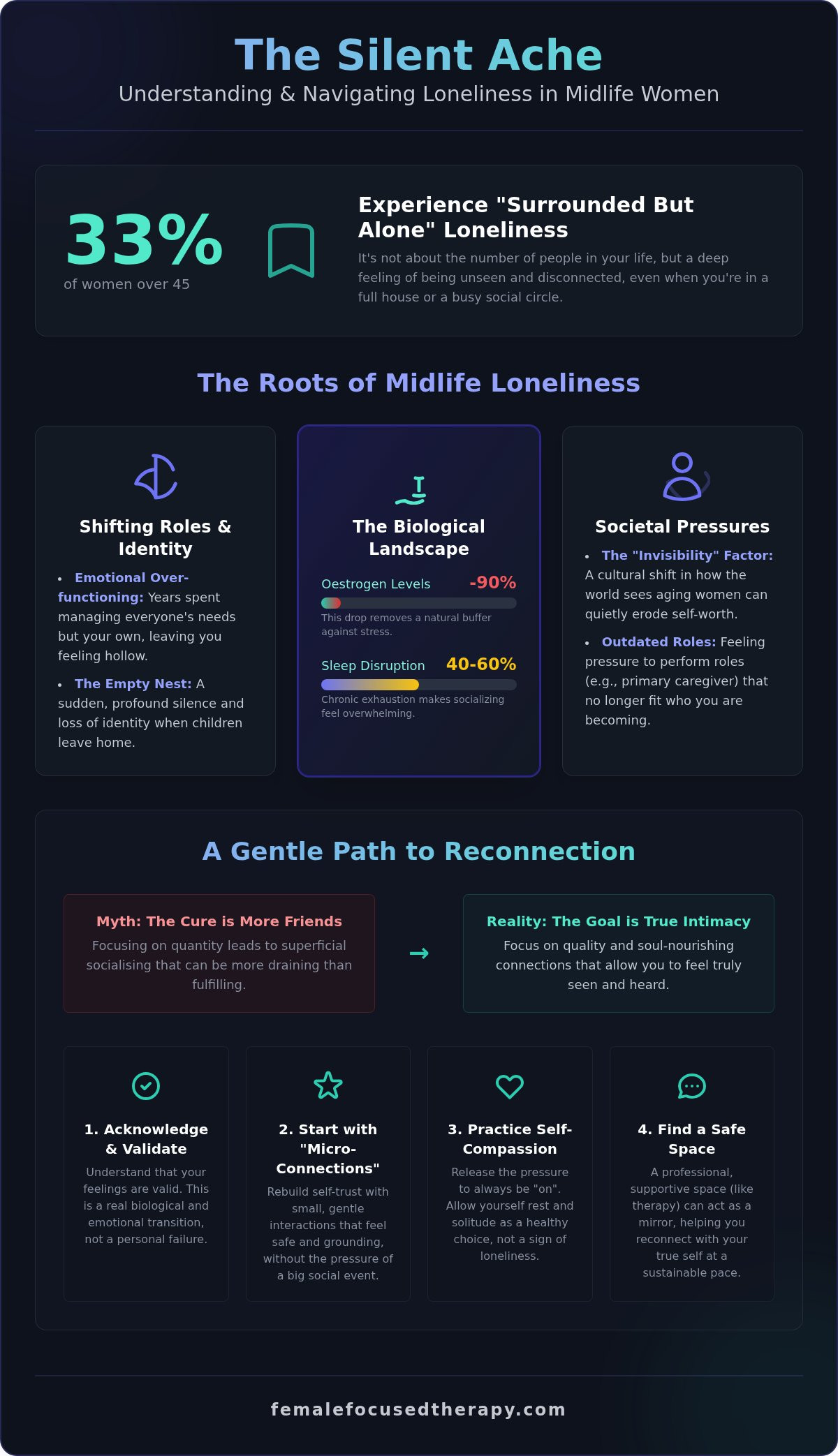
Imagine sitting at your kitchen table on a Tuesday evening, surrounded by the familiar sounds of your family, yet feeling like you’re watching a film of your own life from a distance. You aren’t alone in this. Data from a 2023 mental health survey suggests that 33% of women over 45 experience this specific, quiet ache of loneliness in midlife women. It’s a heavy feeling that often arrives just as your roles as a mother or professional begin to shift and change.
You might feel like you’ve become invisible in your own social circles or that the physical shifts of perimenopause have stolen your spark. It’s exhausting to keep up appearances when you feel so disconnected inside. I want you to know that your feelings are valid. There’s a biological and emotional reason for this transition that goes beyond just having a bad day.
I will help you understand why midlife loneliness feels so heavy and how you can begin to reconnect with yourself and others with compassion. We’ll explore the link between your changing hormones and your mood, and I’ll share a gentle path to help you feel seen and connected once again.
Key Takeaways
- Understand why you may feel “surrounded but alone” and distinguish between temporary isolation and the deeper, existential ache of loneliness in midlife women.
- See how perimenopause and societal shifts impact your social energy, helping you release the pressure to always be “on” or available to others.
- Move beyond the myth that simply having more friends is the cure by focusing on the difference between superficial socialising and true, soul-nourishing intimacy.
- Learn how to rebuild self-trust through gentle “micro-connections” that help you feel safe and grounded in your daily life without feeling overwhelmed.
- Discover how a professional, supportive space can act as a mirror to help you reconnect with your true self at a pace that feels sustainable for you.
Understanding why midlife loneliness feels so heavy right now
I often talk with women who feel a deep sense of isolation despite having a full diary and a busy home. You might be the person everyone leans on, the one who organises the schedules and anticipates every need. Yet, inside, there’s a quiet, persistent ache that doesn’t seem to go away with a night out or a phone call. This type of loneliness in midlife women is rarely about a lack of people; it’s about a lack of being truly seen.
It helps to distinguish between situational loneliness, like a temporary change in your social circle, and this deeper existential shift. As we enter the second half of life, our brains naturally begin to re-evaluate our connections and our purpose. Midlife loneliness is a vital bridge between the roles you once played and the woman you are becoming, rather than a permanent destination.
The weight of being the one who holds it all together
Many of the women I see at Female Focused Therapy are experts at emotional over-functioning. You’ve spent decades managing the feelings of your partner, children, and colleagues while keeping your own tucked away. This constant caretaking leaves you feeling hollowed out and disconnected from your own internal world.
The cost of putting your own needs last for 20 years is high. You might find yourself maintaining a “fine” exterior while feeling entirely empty inside. It’s exhausting to keep up the appearance of being the “strong one” when you’re craving a safe space to simply be yourself.
When the noise stops: the silence of the empty nest
The phrase “empty nest” is often treated as a cliché, but the reality is a profound loss of identity. For roughly 25 years, your daily rhythm has likely been dictated by the needs of your children. When they leave, the sudden shift in your household’s energy reveals a silence that can feel quite threatening.
This silence is often where loneliness in midlife women becomes most visible. Without the constant hum of parenting duties, you’re left with your own company. If you aren’t used to being alone with your thoughts, this transition can feel like a crisis of self. You can learn more about navigating these life transitions and how they impact your wellbeing.
If you’d like to find out more about working with Cheryl Kennedy MacDonald, you can email her at cheryl@femalefocusedtherapy.com or go ahead and book an appointment here: https://www.femalefocusedtherapy.com/book-now/
The physical and emotional landscape of midlife transitions
I often talk with women who feel they are losing their grip on the person they used to be. It isn’t just a mood or a phase. Your body is undergoing a profound recalibration that affects how you move through the world. When we look at the roots of loneliness in midlife women, we have to look at the biology first.
The transition through perimenopause and menopause involves a significant shift in our internal chemistry. According to the Endocrine Society, oestrogen levels can drop by up to 90 per cent during this time. This hormone acts as a natural buffer against stress. Without it, your “emotional filter” changes. You might find that your social energy is lower than it was five years ago. This is a biological evolution, not a personal failure.
Societal views often contribute to a feeling of becoming “invisible” as we age. This shift in how the world sees us can quietly erode self-worth. You may feel like you’re performing roles that no longer fit, such as the primary caregiver or the constant “fixer.” Shedding these roles involves a real sense of grief. It’s the loss of a younger version of yourself who felt more certain or more needed.
Hormones and the emotional filter
Declining oestrogen physically alters how we process connection. Research shows that 40 to 60 per cent of women experience significant sleep disruption during midlife. When you’re dealing with chronic exhaustion and brain fog, socialising feels like a mountain you can’t climb. It’s natural to withdraw to protect your energy. I want to help you distinguish between the healthy desire for solitude and the painful weight of loneliness in midlife women. One is a choice to rest; the other is a feeling of being disconnected from support.
Navigating life transitions with self-compassion
It is vital that we learn to be gentle with ourselves as these changes take hold. You aren’t “breaking down.” You’re recalibrating. Acknowledging the grief for your younger self is a necessary step in finding your way forward. This isn’t a crisis to be managed, but a transition to be understood. If you’re feeling stuck in this flux, you might find it helpful to explore a supportive space where these feelings are validated.
If you’d like to find out more about working with Cheryl Kennedy MacDonald, you can email her at cheryl@femalefocusedtherapy.com or go ahead and book an appointment here: https://www.femalefocusedtherapy.com/book-now/
Moving beyond the myths of social connection
I often see women in my practice who feel a deep sense of guilt because their calendars are full, yet their hearts feel empty. A common myth suggests that the cure for loneliness is simply “getting out more” or adding more names to your contact list. In my clinical experience, loneliness in midlife women is rarely about a lack of people. It is usually about the absence of being truly seen and known by those around you. You might find yourself surrounded by friends while still feeling entirely invisible.
Many of the high-functioning women I support are experts at “social performing.” You might be the person everyone leans on, the one who organises the dinners or manages the family schedules. This type of emotional over-functioning often becomes a barrier to true intimacy. When you are always the one providing support, it becomes incredibly difficult to admit you need it yourself. You may feel you should have “figured this out” by your 40s or 50s, but connection is a fundamental human need, not a milestone you ever outgrow.
The myth of the “busy” social life
A 2020 report by Cigna indicated that 61% of adults feel lonely, including those who are married or socially active. This explains why you can feel most alone in a room full of people you know. It is helpful to distinguish between “energy-draining” and “energy-giving” relationships. Energy-draining connections require you to wear a mask or hide your struggles to keep others comfortable. Energy-giving relationships are those where you can be messy, uncertain, and completely yourself. Learning to prioritise these soul-nourishing connections is a vital part of navigating life transitions and reclaiming your wellbeing.
Overcoming the shame of feeling lonely
There is often a heavy weight of shame attached to the word “lonely.” You might worry that feeling this way means you aren’t likeable or that there is something inherently wrong with your personality. This shame is what keeps us isolated because it tells us to stay quiet and keep pretending. I want you to know that loneliness is not a character flaw. It is a biological signal, much like hunger or thirst, telling you that a core need isn’t being met. There is immense power in the honest admission of “I feel lonely.” It is the first step toward rebuilding self-trust and finding genuine connection on your own terms at Female Focused Therapy.
If you’d like to find out more about working with Cheryl Kennedy MacDonald, you can email her at cheryl@femalefocusedtherapy.com or go ahead and book an appointment here: https://www.femalefocusedtherapy.com/book-now/
Small, realistic steps to reconnect with yourself
I’ve noticed that when loneliness in midlife women takes hold, we often lose the ability to trust our own instincts. Rebuilding self-trust is the vital foundation for every other connection you will make. It starts with being honest about how you feel and knowing that your internal world is a safe place to be. You don’t need to dive into a busy social calendar straight away. Instead, I encourage you to try three micro-connections each day. This might be a 30-second chat with the person at the post office or a brief wave to a neighbour. These small moments lower the stakes of socialising and remind your brain that the world is still a kind place.
When the ache of loneliness feels heavy, I want you to try sitting with it for exactly five minutes using mindfulness. Rather than running from the discomfort, notice where you feel it in your body without judging it. Small acts of self-care signal safety to our nervous system. This tells your body that you are being looked after, even in the quiet moments. Research from 2009 suggests it can take an average of 66 days to form a new habit of self-connection, so be patient with yourself as you start this journey.
Reclaiming your sense of self
It is so easy to lose “you” underneath the weight of being a mother, a partner, or a dedicated employee. I find that many of the women I support are rediscovering what brings them joy simply for the sake of it. You can see more about the women I work with to understand how common this feeling of being lost truly is. Give yourself permission to try a new interest, like spending 10 minutes a day on pottery or gardening, without the pressure to be “good” at it. It’s about the process, not the product.
The power of gentle boundaries
Saying “no” to social obligations that leave you feeling drained is not selfish; it is a form of self-respect. When you protect your energy, you create the necessary space for more meaningful connections to grow. Learning to communicate your needs to those closest to you can feel daunting at first. However, being clear about what you need helps others understand how to support you better. If you’re looking for a way to start this journey, visiting my home page can give you a sense of how we can work together to build these boundaries.
How finding a safe space can help you navigate this
I know how heavy the silence of an empty house or an emotionally distant relationship can feel. When you are the person everyone else leans on, admitting you feel isolated is incredibly difficult. Therapy isn’t about fixing something that is broken; it’s about providing a clear, compassionate mirror so you can finally see your true self again. We work together at a pace that feels safe for your nervous system, ensuring you never feel rushed or overwhelmed by the process of opening up.
Statistics from 2023 indicate that nearly 35 percent of women over the age of 45 report feeling chronically lonely. Because midlife brings specific shifts like menopause or changing family roles, a female-focused approach is vital. It allows us to speak the same language and acknowledge the societal pressures placed on us. You can find more resources on the Female Focused Therapy homepage to help you understand these transitions. Addressing loneliness in midlife women requires this specialised lens because your experiences are unique to this stage of life.
We can explore how these physical and emotional changes affect your identity through specialised therapy for women. This dedicated space allows you to unpick the layers of who you are now, versus who you were taught to be.
A trauma-informed path to connection
Sometimes, the isolation we feel today has roots in the past. If you grew up with emotional neglect or specific parental patterns, you might have learned that your needs don’t really matter. These old wounds often resurface during midlife transitions, making the world feel like an unsafe place to reach out to.
In our sessions, the healing power of being truly heard and validated by another woman can be a profound experience. We focus on rebuilding that internal sense of safety that may have been missing for decades. This foundation makes it possible for you to eventually reach out to the world again with a renewed sense of self-trust.
Taking the next small step
You don’t need to have all the answers today. The simple act of sharing the burden of loneliness in midlife women can bring immediate relief to a tired mind. It is okay to start with just one small conversation. Your wellbeing is worth the investment of time and energy, even when you have spent years putting everyone else first.
Sharing your story with someone who understands the nuances of your life can lighten the load significantly. You are not alone in this feeling, and you don’t have to navigate the way back to yourself without support. Taking that first step is often the bravest thing you can do for your future self.
If you’d like to find out more about working with Cheryl Kennedy MacDonald, you can email her at cheryl@femalefocusedtherapy.com or go ahead and book an appointment here: https://www.femalefocusedtherapy.com/book-now/
Taking your first gentle step forward
I want you to remember that the heavy feeling you’re carrying isn’t a personal failing. It’s a natural response to a season of immense change. We’ve explored how the physical shifts of menopause and changing family dynamics can create a perfect storm for loneliness in midlife women. You don’t have to navigate this transition alone or wait for the ache to simply disappear on its own.
In my 20 years as a Registered Psychotherapist, I’ve supported hundreds of women using a trauma-informed, integrative approach to find their footing again. Real change often starts with just 1 or 2 small, realistic steps to reconnect with your own needs. This might mean carving out 15 minutes of quiet time or seeking a professional space where you feel truly heard. You deserve to move through this chapter with clarity and a stronger sense of self.
I’m here to help you rebuild that vital connection to yourself at a pace that feels safe. If you’re ready to explore how we can work together, you can view my therapeutic services to see how I support women in midlife.
If you’d like to find out more about working with Cheryl Kennedy MacDonald, you can email her at cheryl@femalefocusedtherapy.com or go ahead and book an appointment here: https://www.femalefocusedtherapy.com/book-now/
Common questions about midlife and connection
Is it normal to feel lonely in my 50s even if I have a family?
Yes, it’s very common to feel this way. A 2023 study by the Campaign to End Loneliness found that 33% of adults feel lonely sometimes or often, even when they live with other people. You might be physically surrounded by your partner or children but feel emotionally disconnected because your roles are changing. It’s about the quality of the connection you feel, not just the number of people in your house.
Can menopause cause feelings of isolation and loneliness?
Hormone shifts during menopause directly impact your emotional wellbeing and how you relate to others. Research in the Journal of Women’s Health indicates that 40% of women experience mood changes or anxiety during perimenopause, which can lead to pulling away from social circles. When your body feels unfamiliar and your sleep is disrupted, it’s natural to feel a sense of isolation from those who aren’t experiencing the same transition.
How is midlife loneliness different from clinical depression?
Loneliness is a specific emotional ache for connection, while clinical depression often involves a persistent loss of interest in all parts of life. According to the DSM-5, depression requires at least five symptoms lasting two weeks, such as fatigue or feelings of worthlessness. I find that loneliness in midlife women often feels like a heavy weight that lifts when you feel truly heard, whereas depression can feel like a fog that stays regardless of who is with you.
What can I do if I feel invisible to my partner or children?
You can start by naming your experience in a calm, honest way. Research from the Gottman Institute suggests that 80% of successful relationship shifts start with a “softened startup,” like telling your partner you’ve been feeling a bit lonely and would love some focused time together. Small, intentional bids for connection, like a 10 minute walk together without phones, can help bridge the gap when you feel overlooked.
Is therapy effective for dealing with the “empty nest” syndrome?
Therapy is highly effective for navigating the identity shift that comes when children leave home. A 2021 study showed that women who engaged in talk therapy during major life transitions reported a 50% increase in life satisfaction within six months. In my practice, we work on rebuilding your sense of self beyond caregiving, helping you find new meaning in a space that feels safe and sustainable.
How do I start making new friends in midlife without feeling awkward?
I suggest starting with shared interests rather than the pressure of making a “best friend” immediately. Data shows it takes about 50 hours of shared time to move from being an acquaintance to a casual friend. Look for local groups or classes where the focus is on an activity, like a book club or a walking group. This removes the pressure of constant eye contact and makes socialising feel more natural and less forced.
What if I actually enjoy being alone but feel guilty about it?
There’s a vital difference between loneliness and solitude, and it’s healthy to crave your own company. Around 25% of the population are true introverts who recharge through being alone. If your time alone feels nourishing rather than draining, there’s no need for guilt. It’s simply a sign that you’re in tune with your own needs and boundaries, which is a key part of your wellbeing.
Can ADHD in women make midlife loneliness feel more intense?
ADHD often makes loneliness in midlife women feel more piercing because of how the brain processes social cues and rejection. Studies suggest that women with ADHD are 3 times more likely to struggle with low self-esteem during midlife. You might over-analyse social interactions or feel a profound sense of “otherness” compared to your peers. Understanding this can be the first step in rebuilding self-trust and finding connections that feel easier.

Article by
Cheryl Kennedy MacDonald MA BA (Hons) Pg. Dip. SAC BACP
Cheryl Kennedy MacDonald is a psychotherapist specialising in women’s mental health, relationships, and life transitions. She works with women navigating trauma, relationship breakdown, identity shifts, and midlife change, helping them rebuild self-trust, emotional stability, and a clear sense of who they are and what they want.
With over 20 years’ experience working with women internationally, Cheryl is the founder of YogaBellies, a global women’s yoga school, and the creator of the Birth ROCKS method. Her work sits at the intersection of psychotherapy and embodiment, integrating evidence-based therapeutic approaches with somatic, body-based practices that support deep, lasting change.
Known for her grounded and direct approach, Cheryl moves beyond surface-level insight to address the patterns held in the body and nervous system. Her work supports women to regulate, reconnect, and respond to their lives from a place of clarity, strength, and self-respect.
She is a published author in academic journals and has written multiple books on women’s health, pregnancy, and midlife wellbeing, available on Amazon and leading book retailers worldwide.