
What if that nagging feeling of “never being enough” isn’t a personal failure, but a natural response to a world that expects you to be everything to everyone? You might find yourself asking why do women need feminist therapy? when you feel misunderstood by traditional support or exhausted by the invisible labour of your daily life.
Additionally, for those whose recovery involves maintaining long-term sobriety, Individual Recovery Coaching offers specialized telehealth support to help you stay grounded and focused on your path.
Just as intensive work can be transformative for emotional health, specialized programs can also help with communication; for example, you can explore 5 Day Intensive Stuttering Therapy options to find new confidence in your speech.
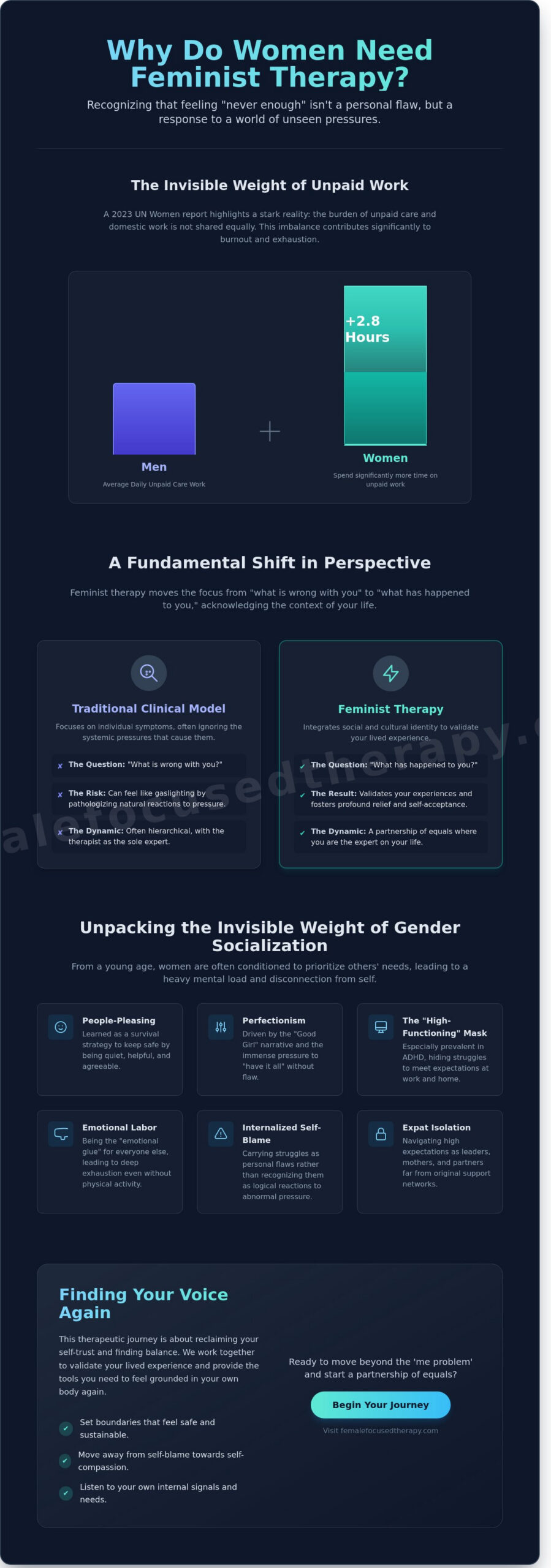
I hear this often in my practice. A 2023 report by UN Women shows that women spend 2.8 more hours on unpaid care work than men, yet we still take the blame for our own exhaustion. It’s vital to acknowledge that your struggles aren’t just in your head.
I’ll help you understand how this approach serves as a tool for reclaiming your self-trust and finding balance when life feels heavy. We’ll look at how moving away from self-blame allows you to set boundaries that finally feel safe and sustainable.
I’m going to walk you through the ways a female-focused space can validate your lived experience and provide the somatic tools you need to feel grounded in your own body again.
Key Takeaways
- Recognise that your feelings of “not being enough” are often a response to social pressures; asking why do women need feminist therapy? helps you see these are not personal flaws.
- Understand why do women need feminist therapy? to help you navigate the invisible weight of gender socialisation and reclaim your self-trust.
- Learn why ADHD in women is so often misdiagnosed and why do women need feminist therapy? to help you finally put down the “high-functioning” mask you have been carrying.
- Discover why do women need feminist therapy? through a trauma-informed lens that helps you move away from people-pleasing and start listening to your own internal signals.
- Explore why do women need feminist therapy? and what to expect when working with a therapist who prioritises safety, warmth, and a deep understanding of the female experience.
Moving beyond the ‘Me Problem’: Why feminist therapy feels different
I often see women arrive in my practice carrying a heavy, invisible weight. They feel like they are the problem. They feel like they aren’t doing enough or being enough, despite spinning a dozen plates at once. If you feel this way, I want you to know that your struggle isn’t a personal flaw.
This is often where we begin to explore why do women need feminist therapy? rather than a standard clinical approach. In our sessions, we look at your mental health through the lens of your social and cultural identity. It’s an integrative way of working that acknowledges the world you actually live in.
Traditional clinical models can sometimes feel like a form of gaslighting. They often focus solely on your symptoms while ignoring the systemic pressures that caused them. If a woman is burnt out, a clinical model might label her with a “disorder” instead of acknowledging that she is performing the vast majority of unpaid domestic labour. To understand the roots of this work, you can read more about What is feminist therapy? and its history of empowering women.
In my work as a therapist in Singapore, I see how these pressures are amplified. Many of the women I support are navigating the unique isolation of expat life. They are expected to be high-functioning leaders, perfect mothers, and supportive partners, all while living thousands of miles from their original support networks.
It’s not just in your head
I want to help you see that your anxiety or burnout isn’t a failure of character. We shift the focus from “what is wrong with you” to “what has happened to you” in a much broader sense. It’s about looking at the context of your life. This change in perspective can be life-altering.
There is a profound relief that comes when we stop pathologising your reactions. When you are under an abnormal amount of pressure, your body and mind will react. Those reactions are often incredibly logical. By understanding why do women need feminist therapy?, we can start to validate your experiences rather than just trying to “fix” your feelings.
A partnership of equals
In our sessions, I am not the all-knowing expert looking down at you from a clinical height. We are simply two humans in a room together. I bring my professional training and my own experiences as a woman with ADHD, but you are the absolute expert on your own life.
This non-hierarchical relationship is essential for reclaiming your power. It’s hard to find your voice if you feel like you’re being managed by a professional. I provide a safe, confidential space where your expertise is finally respected. This partnership allows you to rebuild the self-trust that life and society may have chipped away over the years.
Unpacking the invisible weight of gender socialization
From the moment we are small, many of us are taught to scan the room for other people’s needs before we check in with our own internal signals. I see this often in my work. It is the “Good Girl” narrative, where people-pleasing and perfectionism become survival strategies rather than actual personality traits. You learn that being quiet and helpful keeps you safe, but it also keeps you disconnected from yourself.
This conditioning creates a heavy mental load that follows you into adulthood. You might feel bone-tired even when you haven’t been physically active. It is the invisible labour of managing a household or a career while being the emotional glue for everyone else. This constant “on” state leaves very little room for your own rest or creative growth.
This reality is one of the primary reasons why do women need feminist therapy? It allows us to look at your life through a lens that acknowledges these systemic pressures. This approach is vital, according to the American Psychological Association, as it validates that your exhaustion isn’t a personal flaw. It’s a natural response to an unequal distribution of emotional work.
When you spend years prioritizing others, your sense of self-worth begins to shrink. You might find your relationship satisfaction drops because you have lost the ability to state your own needs clearly. In our sessions, I often invite you to notice where you feel this weight in your body. Perhaps it’s a tightness in your chest or a shallow breath that you’ve carried for years.
The myth of ‘having it all’
I see so many women in Singapore struggling with the crushing pressure to excel at work while being the perfect emotional anchor at home. It is a relentless cycle that leaves you feeling depleted. Often, “self-care” ends up feeling like just another item on your to-do list rather than a true source of nourishment.
We need to recognize the deep-seated guilt that arises when you try to set boundaries or say “no” to a request. This guilt isn’t a sign that you’re doing something wrong. It is simply a symptom of the roles you’ve been socialised to play. Learning to trust your own “no” is a radical act of healing.
Healing from narcissistic abuse and trauma
We are often socialised to be “nice” and to tolerate “difficult” behaviour from others, which can make us more vulnerable to toxic dynamics. I specialize in helping women navigate relationship trauma and narcissistic abuse by identifying these inherited patterns. We work together to stop the cycle of chronic self-blame that so often follows an abusive relationship.
When you understand the broader context of gender socialization, you can finally stop asking what is wrong with you. You can start asking what happened to you and how you can move forward. If you’re feeling ready to explore these patterns in a safe space, you might find it helpful to look at my free therapy resources to begin reconnecting with your own needs.
Beyond the couch: Rebuilding self-trust through a trauma-informed lens
I believe healing is about more than just talking through your week. It’s about learning to listen to that quiet voice inside you that you’ve been told to ignore for years. If you’ve spent a lifetime being told you’re “too sensitive” or “too emotional,” you might find yourself wondering why do women need feminist therapy? The answer usually lies in the way we’ve been taught to distrust our own bodies and minds.
In my practice, being trauma-informed means I understand how your past experiences have physically shaped your nervous system. We work together to rebuild the foundation of self-trust that life transitions or trauma may have eroded. We don’t just talk about the past; we notice how it shows up in your breath and your heartbeat today. You might benefit from this female-focused approach if:
- You feel like you’re constantly “over-functioning” or “people-pleasing” to keep the peace.
- You struggle to make decisions without seeking external validation first.
- You experience physical symptoms of anxiety, like a tight chest, even when things seem “fine.”
- You feel a sense of disconnection from your own desires and needs.
Reconnecting with your intuition
Trusting your gut is a radical act for many women. I see so many clients who are drowning in “shoulds,” trying to meet everyone else’s expectations while their own desires stay buried. I use an integrative approach to help you identify these patterns. We look at where you feel tension in your body when you’re saying “yes” but meaning “no.” In our sessions, we start with practical ways to honour your needs, like acknowledging a feeling without judging it first.
Navigating life’s biggest transitions
Whether it’s motherhood, divorce, or relocation, transitions can make us feel unmoored. I support women through significant life transitions and midlife shifts with a focus on finding clarity. A 2022 report by the Fawcett Society found that 1 in 10 women left the workforce due to menopause symptoms, highlighting how these shifts are often misunderstood or dismissed.
So, why do women need feminist therapy during these times? Because you deserve a space where your physical and emotional shifts are validated. We work to move you from a state of surviving to thriving at a pace that feels sustainable for you. Healing isn’t a race; it’s a steady reconnection to your own strength.
If you feel ready to start this journey, I’m here to walk alongside you. A gentle first step is simply noticing one moment today where you can choose rest over productivity.
When your brain and body don’t follow the ‘rules’: ADHD and midlife
As a woman with ADHD myself, I know how exhausting it is to mask your struggles just to fit into a neurotypical world. For years, I tried to force myself into boxes that weren’t built for my brain. It’s a tiring way to live, constantly performing a version of yourself that feels acceptable while feeling like you’re drowning underneath.
Many women arrive in my therapy room after years of being misdiagnosed with purely anxiety or depression. Clinical data suggests that up to 75 percent of women with ADHD remain undiagnosed until adulthood because our symptoms often look like “quiet” overwhelm rather than outward disruption. This is a core reason why do women need feminist therapy? because we need a space that acknowledges how gendered expectations hide our true neurodivergent selves.
The unique experience of ADHD in women
Understanding the emotional intensity and overwhelm that come with ADHD in adult women is the first step toward self-compassion. We’re often socialised to be the organisers and the emotional glue of the family. This makes the internal chaos of ADHD feel like a personal moral failure rather than a biological difference.
Traditional productivity advice usually fails us. Being told to “just use a planner” often leads to deeper feelings of shame when your executive function doesn’t work that way. In our sessions, we focus on learning to work with your brain, rather than against it, in a space that truly understands neurodivergence without judgment.
The intersection of hormones and mental health is also a huge factor that is often ignored. During perimenopause, oestrogen levels begin to fluctuate and drop. Since oestrogen plays a vital role in dopamine production, your ADHD symptoms can suddenly amplify in your 40s. It isn’t that you’re failing; it’s that your biology is shifting.
Somatic healing: Bringing the body into the room
Stress isn’t just a thought; it’s a physical experience that lives in your breath and your muscles. If you’ve spent decades in a state of high alert, your nervous system likely feels fried. I believe that somatic movement and rest are essential components of psychological healing for the ADHD brain.
We can explore simple ways to begin to settle your nervous system during our time together. This might involve gentle breathwork or noticing where tension sits in your jaw and shoulders. By bringing the body into the room, we allow your mind to find more space to breathe. It’s about finding a rhythm that feels safe and sustainable for you.
Healing happens when we stop trying to “fix” your brain and start supporting your whole self. If you’re ready to explore how your neurodivergence and your physical wellbeing connect, you can book a consultation with me here to start that journey.
Finding your voice again: How we work together at Female Focused Therapy
I provide a professional, grounded space where you can finally put down the ‘high-functioning’ mask you wear for the rest of the world. So many women spend their days holding everything together, appearing composed while feeling deeply depleted inside. This mask often hides a deep sense of loneliness or the feeling that you are performing a role rather than living your life.
When we meet for our first session, my priority is your safety and a genuine sense of connection. I want you to feel the warmth of a space where your experiences are validated rather than pathologised. I believe that the relationship between therapist and client is the most important factor in healing. It is not about me being an expert who fixes you, but about two humans sitting together to make sense of your world.
My commitment to you is a warm but boundaried relationship where you are the absolute priority. This approach is at the heart of why do women need feminist therapy? It allows us to look at your life through a lens that acknowledges the unique social and biological pressures you face. We don’t just look at symptoms, we look at the whole context of your life as a woman in a complex world.
Online and in-person options
I work with women locally in Singapore and globally through online therapy sessions. Whether you are looking for individual psychotherapy in Singapore or need support from your home elsewhere in the world, I am here to walk with you. My practice is designed to be worldly and adaptable, acknowledging the specific challenges of expat life and relocation that many of my clients face.
For those who feel they need a more dedicated, concentrated space for healing, I also offer focused intensive therapy options. These sessions allow us to dive deeper into specific issues like trauma or relationship recovery without the weekly wait between appointments. Understanding the societal expectations placed on us is a key part of why do women need feminist therapy? as it helps us untangle your personal identity from the roles you have been forced to play.
My goal is to ensure that therapy fits into your life in a way that reduces your stress rather than adding to it. We work together to rebuild your self-trust at a pace that feels sustainable. Healing should never feel like another exhausting item on an overwhelming to-do list.
Your next step toward clarity
You don’t have to have everything figured out or have a perfect list of goals before you reach out to me. Many women start our first conversation simply feeling that something is “off” or that they have lost their sense of self. That is a perfectly valid place to begin your journey toward reconnection.
I invite you to book a consultation so we can see if we are a good fit for your needs. This is a low-pressure way to see how it feels to talk together and to ask any questions you might have about my integrative approach. It is a chance to feel if this is the right safe space for you.
I want to leave you with one final reassurance: you are not “too much,” and your feelings are not a problem to be solved. You are certainly not alone in this, and there is a way back to feeling like yourself again with clarity and confidence.
Reclaiming your space and your self-trust
You’ve spent so long feeling like your exhaustion or your “busy brain” is a personal flaw. Whether you’re 25 or 65, navigating the invisible weight of gender socialisation and the reality of ADHD in midlife, it’s clear that you aren’t broken. You’re simply navigating a world that wasn’t designed for your nervous system.
In my practice, I focus on helping you move beyond the “Me Problem” to understand the bigger picture. You might wonder, why do women need feminist therapy? It’s because your struggles don’t exist in a vacuum; they’re shaped by the world around you. Healing involves more than just talking; it’s about rebuilding self-trust through a trauma-informed, mind-body approach that honours your lived experience.
As a Registered Integrative Psychotherapist specialising in trauma and narcissistic abuse recovery, I’m here to help you find your voice again. We’ll work together at a pace that feels safe, integrating breath and movement to help you feel grounded in your own skin. You don’t have to carry this weight alone anymore.
If you’re ready to start this journey, you can book your initial consultation with me here to begin our work together. You deserve a space where you feel truly seen and supported.
Frequently Asked Questions
What exactly is the difference between feminist therapy and regular counselling?
Traditional counselling often focuses on your internal thoughts as if they exist in a vacuum. In my practice, I look at the bigger picture of your life. I consider how being a woman in 2024 affects your mental health, acknowledging that your struggles are often natural responses to societal expectations or gender-based pressures.
This approach validates your lived experience instead of just looking for a “disorder” to fix. We explore how external power dynamics have shaped your self-trust. By understanding these influences, we can work together to rebuild your confidence from the ground up.
Do I have to be a ‘feminist’ to benefit from this type of therapy?
You don’t need to identify as a feminist or have any knowledge of political theory to find this work helpful. The “feminist” part describes my lens as a therapist, not a requirement for you. It simply means I’m committed to seeing you as a whole person within a specific social context.
Whether you’re navigating a career change, motherhood, or midlife, my focus is on your unique needs. We use a warm, non-judgmental space to help you feel heard. You don’t need to adopt any labels; you just need to be yourself.
Can feminist therapy help with specific issues like ADHD or narcissistic abuse?
Yes, I specialise in these areas because they often present very differently in women. A 2021 study showed that women are frequently diagnosed with ADHD much later than men, often after years of chronic self-blame. Why do women need feminist therapy? It’s because we need to dismantle the “people-pleasing” habits that society often encourages in us.
When recovering from narcissistic abuse, we look at how gender roles might have made you more vulnerable to certain patterns. We use an integrative approach to help you process the trauma. This helps you move from “over-functioning” for others to finally prioritising your own wellbeing.
Is feminist therapy only for women, or can men benefit as well?
My specific practice, Female Focused Therapy, is dedicated to women and those who share the female experience. While feminist principles can certainly help men, I’ve chosen to create a sanctuary specifically for the transitions of womanhood. This allows us to focus deeply on issues like menopause or the unique way women experience neurodivergence.
By specialising in this way, I can offer a higher level of insight into the specific physical and emotional cycles we navigate. This focused approach ensures you’re working with someone who truly understands the nuances of your daily life. It’s about creating a safe, relatable space just for you.
What does a ‘trauma-informed’ approach actually look like in practice?
Being trauma-informed means I prioritise your sense of safety above everything else. I’ll never ask you to “relive” a story before you’re ready or push you into uncomfortable territory. Instead, I watch for signs of stress in your body and use somatic tools, like gentle breathwork, to keep you grounded.
We work at a pace that feels sustainable for you. I understand that healing isn’t just in the mind; it’s in the nervous system too. This means our sessions are a collaboration where you always have the final say on how deep we go.
How do I know if Cheryl is the right therapist for my specific needs?
You’ll likely feel a sense of “being seen” when you read my words or hear my Scottish accent. I’m a registered integrative psychotherapist and a yoga master, but I’m also a woman who lives with ADHD. This combination of professional skill and human experience helps me connect with you on a deeper level.
If you’re looking for a blend of traditional talk therapy and body-based healing, we’ll likely be a good fit. I don’t pretend to be a detached expert; I’m a grounded guide who walks alongside you. You can trust that our space will be warm, professional, and entirely focused on your growth.
Does feminist therapy focus too much on the past instead of solving current problems?
We only look at the past to understand why you’re feeling stuck in the present. If you’re struggling with a relationship or a work issue today, that’s where we start. My goal isn’t to dwell on old stories, but to help you see how they might be affecting your current choices.
This approach is very practical. We work on building your self-trust so you can handle today’s challenges with more clarity. By connecting your history to your current reality, we create lasting change rather than just a temporary “fix”.
Is this approach suitable for high-functioning women who feel they should be able to cope?
This is actually the group I work with most often. Many high-functioning women feel they shouldn’t need help because they’re successful in other areas of life. Why do women need feminist therapy? Because it acknowledges the “invisible load” you carry every day that leads to emotional exhaustion.
I provide a space where you don’t have to be the “strong one” anymore. We look at why you feel the need to cope alone and help you find a more sustainable way of living. It’s okay to put down the mask and receive the same level of support you usually give to everyone else.

Article by
Cheryl Kennedy MacDonald MA BA (Hons) Pg. Dip. SAC BACP
Cheryl Kennedy MacDonald is a psychotherapist specialising in women’s mental health, relationships, and life transitions. She works with women navigating trauma, relationship breakdown, identity shifts, and midlife change, helping them rebuild self-trust, emotional stability, and a clear sense of who they are and what they want.
With over 20 years’ experience working with women internationally, Cheryl is the founder of YogaBellies, a global women’s yoga school, and the creator of the Birth ROCKS method. Her work sits at the intersection of psychotherapy and embodiment, integrating evidence-based therapeutic approaches with somatic, body-based practices that support deep, lasting change.
Known for her grounded and direct approach, Cheryl moves beyond surface-level insight to address the patterns held in the body and nervous system. Her work supports women to regulate, reconnect, and respond to their lives from a place of clarity, strength, and self-respect.
She is a published author in academic journals and has written multiple books on women’s health, pregnancy, and midlife wellbeing, available on Amazon and leading book retailers worldwide.