
Imagine standing in your kitchen, staring at a half-packed lunchbox, and realising you’ve completely forgotten where you were supposed to be ten minutes ago. It’s not just a simple lapse in memory; it feels like the very foundation of your self-control has dissolved overnight. If you are struggling with the overlap of adhd and menopause, your old coping mechanisms may simply stop working, leaving you in a state of deep fatigue.
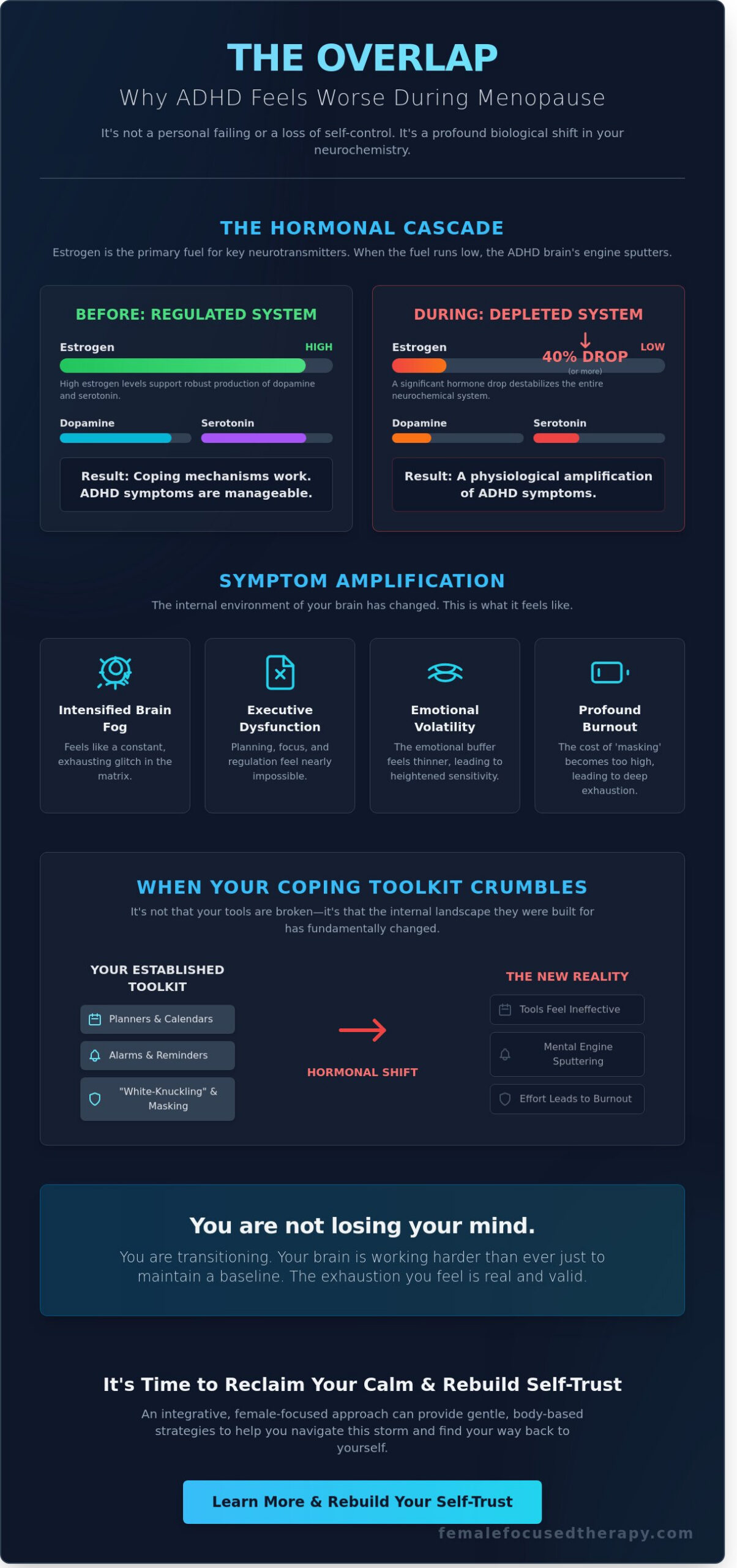
I know how frightening it feels when you start to wonder if you’re losing your mind. I want to reassure you that you aren’t failing and you aren’t alone. This is a unique, often overwhelming internal storm. Since oestrogen plays a vital role in dopamine production, the 40 percent drop in hormones during this transition can make your neurodivergent traits feel much louder than ever before.
I will help you understand the science behind why this shift is happening and how a somatic-focused approach can help you find your way back to yourself. We’ll explore why your brain feels so different right now and look at practical, body-based strategies to help you reclaim your calm and rebuild your self-trust.
Key Takeaways
- I will help you understand the ‘ADHD-Menopause overlap’ as a physiological amplification of your neurodivergence, validating that your brain fog is a lived reality of shifting neurochemistry.
- Discover how the drop in estrogen—the primary fuel for your dopamine and serotonin—directly impacts the intersection of adhd and menopause.
- Gain a clear framework to distinguish between your lifelong ADHD processing style and the specific “access” challenges of menopausal brain fog.
- I’ll share gentle somatic strategies that use breath and movement to help you settle your mind by first grounding your body.
- Learn how an integrative approach to therapy supports you in rebuilding self-trust and reclaiming your sense of self.
Why your ADHD might feel like it is ‘getting worse’ during menopause
The overlap between adhd and menopause is a physiological amplification of neurodivergence where your unique brain structure meets a significant hormonal shift.
When women talk about “brain fog,” it often gets dismissed as a minor inconvenience of middle age. In my practice, I see it as a lived reality of shifting neurochemistry. As oestrogen levels decline, they take your dopamine and serotonin levels with them. For an ADHD brain, which already struggles with dopamine regulation, this drop can feel like the floor has fallen out from under you.
It is incredibly common for women in Singapore to only receive an ADHD diagnosis when they hit this transition. You might have spent decades “white-knuckling” your way through life, only for the hormonal shifts of perimenopause to make those old coping strategies crumble. Many of my clients come to me with a deep, quiet fear that they are experiencing early-onset dementia. It is a heavy burden to carry, but understanding what ADHD is and how it interacts with hormones can be the first step toward reclaiming your self-trust.
The ‘Is this normal?’ feeling
You walk into a room, stop, and realize you have absolutely no idea why you are there. While everyone has “senior moments,” for us, it feels more like a constant, exhausting glitch in the matrix. Your brain is working harder than ever before just to maintain the same level of function that used to feel automatic.
I want you to hear this clearly: I see you, and you are not losing your mind. You are transitioning. The cognitive load you are carrying is immense, and it is okay to acknowledge that the mental gymnastics you used to perform are now taking a much greater toll on your nervous system.
Why the old hacks stop working
The planners, the colour-coded calendars, and the phone alarms that once kept your life together might suddenly feel like they are written in a foreign language. When your internal engine is sputtering, even the best tools can’t make it run smoothly. This is because the depletion of mental energy during menopause makes “masking” your ADHD symptoms feel incredibly heavy.
I’ve seen so many high-functioning women in their 40s and 50s suddenly hit a wall. You might have been the one who held everything together for your family or your career, but now, the cost of doing so has become too high. When your hormonal support system changes, the effort required to appear “fine” can lead to profound burnout. It’s not that you’ve become less capable; it’s that the internal environment of your brain has changed, and your old tools weren’t designed for this new landscape.
The invisible link between your hormones and your neurodivergent brain
I often see women in my Singapore practice who feel like they’re suddenly losing their grip. They describe a thick, heavy cloud that wasn’t there before. It feels like your brain is short-circuiting, but it isn’t a personal failing; it’s a biological shift. When we talk about adhd and menopause, we’re really talking about a chemical withdrawal.
I like to think of estrogen as the “fuel” for our most important neurotransmitters. It helps produce and move dopamine and serotonin around the brain. When your estrogen levels begin to fluctuate and eventually drop, the “fuel” for your ADHD brain disappears. This leaves many women feeling exposed and unsupported by their own chemistry.
The dance of estrogen and dopamine
Estrogen directly modulates the availability of dopamine receptors in the prefrontal cortex. This is the part of your brain responsible for focus, planning, and emotional regulation. When estrogen levels are high, your ADHD symptoms might feel manageable. When they dip, your executive function often dips right along with them.
This explains why your ADHD medication might feel less effective during certain weeks or stages of life. Many of my clients find that the stimulants that worked for years suddenly don’t “kick in” the same way. This hormonal drop is also a major contributor to the low mood and menopausal brain fog that often accompanies midlife ADHD.
In my work as an integrative therapist, I’ve noticed how this chemical shift impacts emotional stability. It isn’t just about forgetting your keys. It’s about the sudden, sharp spikes of irritability or the crushing overwhelm that follows a simple task. Your brain is working twice as hard with half the resources.
Why midlife is a unique neurodivergent challenge
Life in Singapore is fast-paced, and midlife often adds layers of pressure I call the “sandwich generation” effect. You might be managing a demanding career while caring for teenagers and aging parents simultaneously. These life transitions and menopause challenges are unique to women and require a specific kind of grace.
Physical symptoms like night sweats lead to chronic sleep deprivation, which is a disaster for executive function. If you haven’t slept, your ability to inhibit impulsivity or stay focused is already compromised. I often reflect with my clients on how our bodies are asking us to slow down and breathe, while the world is asking us to speed up.
It’s a difficult tension to hold. We’re expected to keep performing at a high level while our internal foundation is shifting. If you feel like your self-trust is wavering, we can explore adhd and menopause support options together to help you find your footing again.
Distinguishing ADHD symptoms from menopausal brain fog
It’s easy to feel like you’re losing your mind when these two forces meet. I often hear from women in Singapore who feel they’ve suddenly become “lazy” or “incompetent,” but I want you to know that isn’t the truth. Understanding the intersection of adhd and menopause starts with identifying where one ends and the other begins.
I find it helpful to look at the nuance of your experience. ADHD is typically about the architecture of your brain; it’s the “how” of your processing that has been with you since childhood. Menopause fog is more like a heavy mist that makes it hard to access those existing processes. One is the wiring, while the other is the signal strength.
- ADHD patterns: Lifelong struggles with consistency, losing keys since your 20s, and feeling “driven by a motor.”
- Menopause-specific: Sudden “tip-of-the-tongue” word-finding issues, forgetting a close friend’s name, and a new, heavy physical fatigue.
- The overlap: Both can make you feel overwhelmed by a simple grocery list or a busy office environment.
When you spot these differences, you can stop the cycle of self-blame. You aren’t failing; your neurobiology is simply shifting in a way that requires new forms of support for ADHD.
Executive dysfunction vs. hormonal brain fog
ADHD executive dysfunction is your lifelong companion. You’ve likely developed complex workarounds for it over decades to keep your life on track. Menopause fog feels like a new intruder. The Study of Women’s Health Across the Nation (SWAN) indicates that cognitive performance, specifically related to processing speed, truly does fluctuate during this transition.
If you find yourself staring at a screen unable to start a task you’ve done for years, that’s often the hormonal shift. I suggest tracking these moments for three months. Note your sleep quality and where you are in your cycle if it’s still present. This data helps us move away from “I’m lazy” and toward “my brain needs more dopamine today.”
Recognising the emotional intensity
Rejection sensitivity often spikes during perimenopause. As estrogen levels fluctuate, your serotonin levels can drop, making it much harder to find that “pause” button before you react to a perceived slight. This is where “menopause rage” meets ADHD impulsivity, and it can feel incredibly isolating.
I want to offer a gentle perspective on forgiving yourself for these outbursts. When your internal resources are drained by menopause symptoms, your ADHD brain has less energy to regulate emotions. It is a physiological response, not a character flaw. You deserve the same kindness you would offer a friend navigating the same storm.
Gentle somatic strategies to calm the midlife ADHD storm
I often tell my clients that healing happens just as much in our muscles and breath as it does in our thoughts. As a yoga master, I’ve spent decades observing how the body stores tension, and when adhd and menopause collide, that tension becomes a physical storm. It isn’t just a mental state; it’s a physiological state of high alert where your nervous system feels constantly frayed.
I focus on somatic movement because it offers a way to regulate your system without needing to quiet your mind first. When estrogen levels drop, your nervous system becomes more sensitive to every itch, sound, and internal distraction. Movement provides the physical anchor your racing brain is searching for, helping you move from a state of “threat” back into a state of “safety.”
Somatic movement and the ADHD brain
Gentle, rhythmic movement acts like a metronome for a scattered mind. I find that when I move slowly and with intention, my brain begins to mirror that rhythm. It’s a way of signalling safety to your amygdala, which is often stuck in fight or flight during midlife transitions. A 2017 study published in the Journal of Physiological Anthropology showed that slow, rhythmic breathing and movement can significantly increase heart rate variability, which is a key marker of a resilient nervous system.
Try this simple two-minute practice when you feel the overwhelm rising. Sit comfortably and place one hand on your chest and one on your belly. Inhale for a count of four, hold for two, and exhale for a count of six. As you exhale, imagine your weight dropping into your chair. This longer exhale tells your brain that you aren’t in danger, helping to lower the cortisol spikes that make adhd and menopause symptoms feel so much more intense.
The power of radical rest
There is a vital difference between sleep and rest, especially for neurodivergent women. You might get eight hours of sleep but still wake up feeling emotionally depleted because your brain never actually went “offline.” For the over-functioning ADHD brain, doing nothing is actually a high-level cognitive skill that requires deliberate practice. We’ve spent our lives being told to do more, so stopping can feel physically uncomfortable at first.
I encourage you to find small pockets of silence in your day, even if it’s just three minutes between tasks. A 2022 survey indicated that 60% of women in midlife report significant cognitive fatigue; for us, that fatigue is compounded by the effort of masking ADHD symptoms. Rest is a radical act of self-preservation. It allows your brain to process the sensory input that menopause makes so much louder. By choosing to pause, you’re rebuilding the self-trust that your needs actually matter.
If you’re feeling the weight of these changes and need a grounded space to process them, you can book a session with me to explore how we can support your nervous system together.
Cheryl Kennedy MacDonald is a registered integrative psychotherapist, yoga master, and founder of Female Focused Therapy. She provides a safe, confidential space for women to navigate life transitions, neurodivergence, and relationship recovery.
Contact: Female Focused Therapy | Book an Appointment
Rebuilding self-trust through female-focused therapy
Living with the combined weight of adhd and menopause can make you feel like you have lost the map to your own mind. I don’t see therapy as a process of fixing a broken machine. Instead, it is about rebuilding self-trust after years of feeling like you have let yourself down or wondering why things feel so much harder for you than for others.
My integrative approach looks at you as a whole person. We consider how your body, mind, and spirit interact during this transition. I work alongside you to navigate these messy middle years, using a blend of psychotherapy and somatic awareness to ground your nervous system when it feels most frayed.
If you are looking for therapy in Singapore, it is vital to find someone who understands neurodivergence. You deserve a space where your experiences aren’t dismissed as just hormones or stress. You need a therapist who recognizes how falling oestrogen levels directly impact your dopamine and executive function.
Moving from ‘fixing’ to understanding
There is a profound relief that comes when you finally understand your brain’s unique wiring. For many women I see, a late-in-life diagnosis brings a wave of clarity, but it also brings grief. We work through the sadness of what might have been if you had known sooner, perhaps in your 20s or 30s.
I want you to know that you are allowed to take up space. You don’t have to keep shrinking yourself or apologizing for how your mind works. Your needs are valid; asking for support is a sign of self-awareness, not a failure of character or a lack of discipline.
In our sessions, we look at how adhd and menopause intersect in your daily life. We create strategies that work with your brain, not against it. This isn’t about being more productive; it is about finding a rhythm that feels sustainable and kind to your spirit as you move through this change.
Your first step toward clarity
It is okay if things feel heavy right now. I want to offer you the calm reassurance that things can feel better. You don’t have to figure this all out by yourself or make any big changes overnight. Healing happens at a pace that feels safe and sustainable for you.
If you aren’t ready for a full session yet, a gentle next step might be exploring some free therapy resources. These can help you start identifying your patterns in a low-pressure way from the comfort of your own home. It is a simple way to begin the journey back to yourself.
When you feel ready to talk, I am here. I invite you to reach out and share what is on your mind. We can move forward together, one small, grounded step at a time, to help you reclaim your sense of self and your confidence in this new season of life.
Navigating Your Midlife Journey with Clarity
It is important to remember that you aren’t losing your mind or your capabilities. The intersection of adhd and menopause creates a unique neurological storm, but it’s one we can navigate together. When your oestrogen levels fluctuate, it directly impacts your dopamine, making those familiar ADHD hurdles feel much steeper than before.
By using gentle somatic strategies and trauma-informed support, you can begin to calm your nervous system. We focus on rebuilding the self-trust that often withers during these years of transition. I work with women to move away from self-blame and toward a life that feels sustainable and grounded.
As a Registered Integrative Psychotherapist, Yoga Master, and ADHD Specialist, I offer a safe, female-focused space to explore these changes. You don’t have to manage this overwhelm alone or settle for feeling perpetually exhausted. My approach is always trauma-informed, ensuring you feel heard and supported at every step.
If you’re ready to find your way back to yourself, book a gentle consultation with me to explore how we can rebuild your self-trust. You deserve to move through midlife with confidence and a renewed sense of peace.
Frequently Asked Questions
Does menopause make ADHD worse for women?
Yes, the drop in estrogen during this transition often intensifies your ADHD symptoms. Research from the Cleveland Clinic indicates that estrogen helps regulate dopamine, which is the neurotransmitter your ADHD brain struggles to manage. As your hormone levels fluctuate, you might find that your usual coping strategies no longer feel like enough to keep you grounded.
Can you be diagnosed with ADHD for the first time during menopause?
You can certainly receive a first-time diagnosis during this stage of life. Many of the women I support in Singapore didn’t realise they had ADHD until the hormonal shifts of perimenopause stripped away their ability to mask or over-function. A 2021 study in BMC Psychiatry highlighted that midlife is a common window for women to seek clarity on neurodivergence as their internal resources become stretched.
How do I know if it is ADHD or just menopausal brain fog?
The key difference usually lies in your history. While menopausal brain fog often appears suddenly in your 40s, ADHD is a lifelong trait, even if you managed to hide it well in your younger years. When adhd and menopause collide, the symptoms overlap, but I look for signs of executive dysfunction that existed long before your periods changed.
What are the best treatments for ADHD and menopause overlap?
An integrative approach that combines Hormone Replacement Therapy (HRT) with ADHD support often yields the best results. In Singapore, private specialist consultations for HRT can range from S$150 to S$300, providing a path to stabilize your estrogen levels. I’ve found that balancing your hormones often makes your ADHD management tools feel much more effective again.
Will ADHD medication still work during perimenopause?
Your medication will still work, but you might find it feels less potent on certain days of your cycle. Since estrogen helps your brain use dopamine, low hormone days can make your usual dose feel like it’s wearing off faster. It’s helpful to track these patterns so we can discuss adjustments with your doctor or psychiatrist.
How does estrogen deficiency affect neurodivergent symptoms?
Estrogen acts as a key messenger in your brain, and its decline directly impacts your cognitive clarity. When levels drop, your brain produces less dopamine and serotonin, which can lead to increased irritability, forgetfulness, and sensory overwhelm. This deficiency isn’t just in your head; it’s a physiological change that requires a compassionate, body-led response.
Can yoga or somatic movement help with ADHD and menopause?
Somatic movement is an incredible tool for calming the nervous system when you feel overstimulated. In my practice, I use gentle breathwork and movement to help you move out of a fight or flight state and back into your body. This mind-body connection helps lower cortisol, which is often elevated when you’re navigating the dual challenges of adhd and menopause.

Article by
Cheryl Kennedy MacDonald MA BA (Hons) Pg. Dip. SAC BACP
Cheryl Kennedy MacDonald is a psychotherapist specialising in women’s mental health, relationships, and life transitions. She works with women navigating trauma, relationship breakdown, identity shifts, and midlife change, helping them rebuild self-trust, emotional stability, and a clear sense of who they are and what they want.
With over 20 years’ experience working with women internationally, Cheryl is the founder of YogaBellies, a global women’s yoga school, and the creator of the Birth ROCKS method. Her work sits at the intersection of psychotherapy and embodiment, integrating evidence-based therapeutic approaches with somatic, body-based practices that support deep, lasting change.
Known for her grounded and direct approach, Cheryl moves beyond surface-level insight to address the patterns held in the body and nervous system. Her work supports women to regulate, reconnect, and respond to their lives from a place of clarity, strength, and self-respect.
She is a published author in academic journals and has written multiple books on women’s health, pregnancy, and midlife wellbeing, available on Amazon and leading book retailers worldwide.