
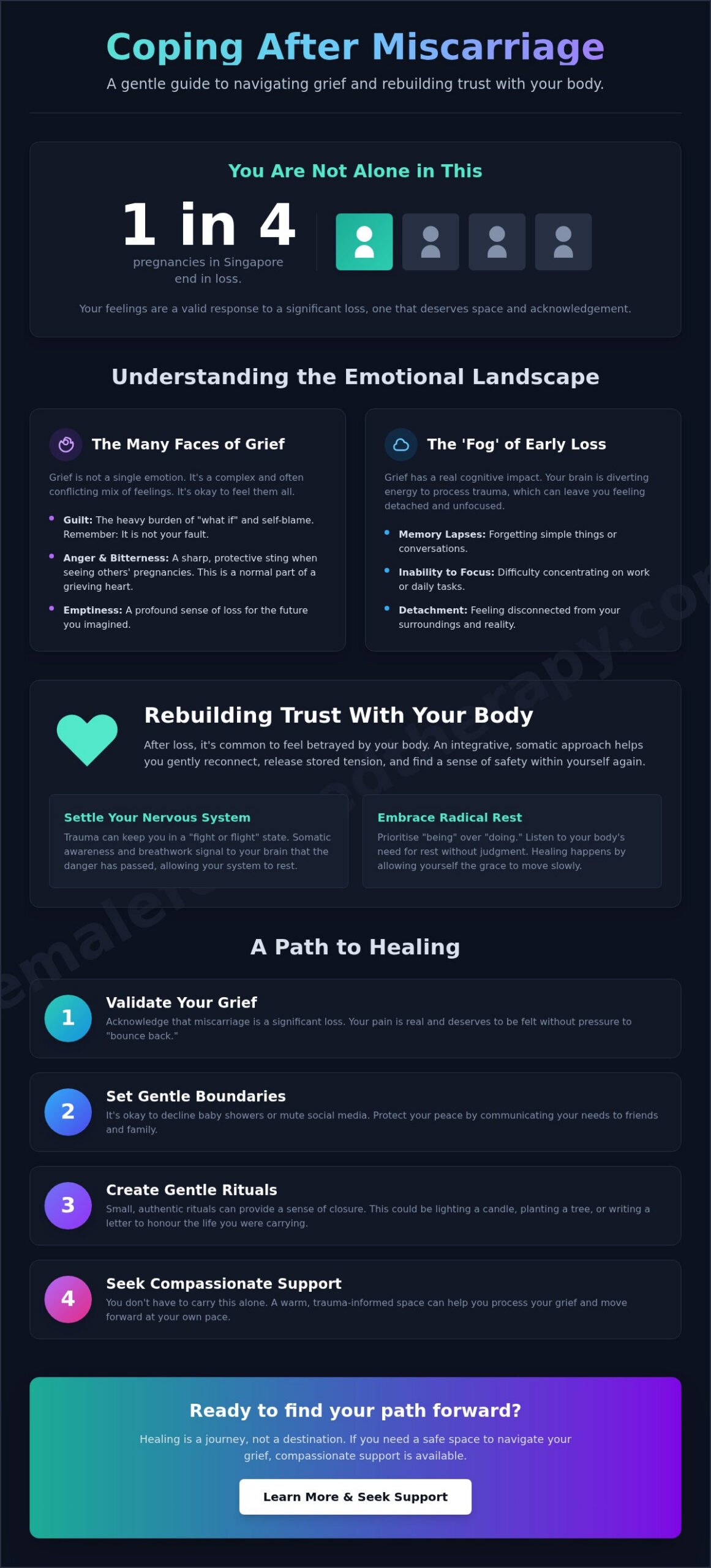
You might find yourself standing in the kitchen, staring at a half-empty cup of tea, wondering how the world can keep moving when your own has come to such a jarring halt. It’s a heavy, silent moment that many women in Singapore face. In fact, clinical data suggests that approximately 25 percent of pregnancies here end in loss. I know that the weight of coping after miscarriage often feels less like a single event and more like a long, lonely trek through a landscape no one prepared you for.
You likely feel a deep sense of betrayal by your own body or a crushing guilt that you somehow didn’t do enough, even when you know that isn’t true. It’s exhausting to carry the isolation that comes when friends don’t quite know what to say. I want to help you find a way to breathe through this grief and show you how a gentle, integrative approach can help you rebuild the self-trust that feels so broken right now.
In this guide, I’ll share how we can navigate these complex emotions together. We will look at practical ways to talk about your loss and use simple mind-body practices to help you feel safe in your skin again.
Key Takeaways
- Understand that your feelings of grief are entirely valid and that miscarriage is a significant life transition that deserves space to be processed.
- I’ll share how an integrative approach can help you begin coping after miscarriage by rebuilding a sense of safety and trust within your own body.
- Learn how to set gentle but firm boundaries with friends and family to protect your peace while you navigate the social echoes of loss.
- Discover the role of small, authentic rituals in providing a sense of closure and honouring the life you were carrying.
- Find out how to recognise when you need extra support and how a warm, trauma-informed space can help you move forward at your own pace.
Understanding the Emotional Landscape of Pregnancy Loss
If you are reading this, I want you to take a deep breath. You’re likely carrying a weight that feels impossible to describe to those around you. I want to help you understand that your feelings, however messy or overwhelming they may seem, are entirely valid responses to trauma. You aren’t “failing” at recovery; you’re navigating one of the most complex emotional terrains a woman can face.
Miscarriage is more than a medical event. It’s a profound life transition that often carries the weight of disenfranchised grief. I define this as a loss that isn’t always openly acknowledged or validated by society. Because pregnancy loss often happens in private, you might feel like your pain doesn’t have a “right” to exist in a world that expects you to keep functioning. Understanding Miscarriage as a legitimate bereavement is the first step in reclaiming your right to heal.
In a high-functioning environment like Singapore, the pressure to “bounce back” and return to your desk at Raffles Place or Mapletree can be stifling. This “silent” nature of loss makes it incredibly isolating. You are also dealing with a massive biological shift. Your hormones are crashing and recalibrating, which physically amplifies the emotional intensity you’re feeling. It’s not just in your head; it’s in your chemistry. Coping after miscarriage requires acknowledging that your body and mind are both recovering from a major shock.
The many faces of grief: guilt, anger, and emptiness
I often see women in my practice struggling with “the why.” They replay every meal, every workout, and every stressful moment, looking for a reason to blame themselves. I need you to hear me: this is not your fault. Guilt is often a way our brains try to find control in a situation where we had none. It’s a heavy burden that you don’t have to carry alone.
You might also feel a sharp, unexpected sting of bitterness when you see a pregnant woman on the MRT or scroll past a baby announcement on social media. This isn’t because you’ve become a “bad” person. It’s a protective response. Your heart is tender, and seeing what you’ve lost is painful. Coping after miscarriage involves being kind to yourself when these difficult emotions surface, rather than judging them.
Moving through the ‘fog’ of early loss
Grief has a measurable cognitive impact. You might experience “grief fog,” characterized by memory lapses, an inability to focus on simple tasks, or a feeling of being completely detached from reality. If you are already living with ADHD, you may find your usual symptoms feel significantly more intense right now. Your executive function is being diverted to process the trauma, leaving very little energy for “doing.”
During these first few weeks, I support women in prioritising “being” over “doing.” In our sessions, we focus on creating a safe space where you don’t have to perform or be “okay.” We look at somatic ways to settle your nervous system, focusing on breath and rest. Healing doesn’t happen by rushing; it happens by allowing yourself the grace to move slowly through the fog until the path becomes clear again.
Rebuilding Trust with Your Body through Somatic Awareness
After a miscarriage, it’s common to feel a profound sense of betrayal. You might feel like your body has let you down, or that it’s no longer a place you can trust. I see this often in my practice with women who feel disconnected from their physical selves after such a painful loss. I believe that true healing happens in the body as much as the mind. My integrative approach focuses on mending this relationship, helping you move away from the thought that your body failed you.
When we go through trauma, our nervous system often gets stuck in a “fight or flight” response. This high state of alert can make coping after miscarriage feel even more exhausting. By using somatic awareness, we can gently signal to your brain that the immediate danger has passed. We want to transition your internal narrative so that your body becomes a safe place to land again.
Somatic movement and the power of rest
Grief isn’t just a thought; it’s a physical weight. Many women find that they hold the heavy energy of loss in their hips and chest. Gentle, intentional movement helps to process and release this stored tension. I often suggest a period of “radical rest” where you listen to your body’s needs without any judgment or “shoulds.” This is about honouring your physical limits as you recover.
If you’re feeling ready to reconnect, my somatic movement and yoga sessions provide a soft pathway back to your physical self. This isn’t about fitness or “getting back in shape.” It’s about kindness. This guide to emotional healing after miscarriage highlights how essential self-care is during this delicate time. Taking time to be still is just as productive as any other part of your recovery.
Breathwork for emotional regulation
When your thoughts start racing, your breath is the quickest way to bridge the gap between your mind and your physical heart. If you feel overwhelmed, try placing one hand on your chest and one on your belly. Inhale for four counts, hold for two, and exhale slowly for six. This simple rhythm helps ground you in the present moment when the world feels like it’s spinning.
This practice is a form of “re-parenting” your physical self. You’re showing your body the same patience and care you would offer a loved one. It’s a way of saying, “I’m here, and we’re safe.” If you’re struggling to find that sense of calm, you can explore my free therapy resources for more grounding tools. It’s a slow process, but you don’t have to do it alone.
Navigating Relationships and the Social Echoes of Loss
I know how heavy it feels to step back into the world when your heart is still so tender. After a loss, the people around you often don’t know what to say, and their silence or clumsy words can feel like another layer of pain. Coping after miscarriage involves more than just your internal healing; it is about managing the social echoes that follow you into your living room, your office, and your friendships.
I encourage you to set boundaries that protect your peace while you are still in this fragile state. You do not owe anyone an explanation for your grief or your absence. It is perfectly okay to step back from social obligations or to mute certain group chats if they feel too loud for your current capacity. Your energy is a finite resource right now, and you deserve to spend it on your own recovery.
I often see couples struggle because grief rarely looks the same for two people. You might find yourself needing to talk and cry, while your partner dives into work or physical projects to stay busy. This disconnect can feel lonely, but it doesn’t mean they care less. If you find the distance between you is growing, my work in couples therapy Singapore provides a safe space to bridge that gap and find your way back to each other.
Communicating your needs to loved ones
When well-meaning friends offer advice that hurts, like “at least you know you can get pregnant,” it is okay to gently redirect them. I suggest using clear, simple phrases like, “I know you want to help, but I just need you to sit with me in this right now,” or “I’m not ready to talk about the details yet.”
Saying “no” to social invitations is a form of self-care, not a personal slight. In my experience, about 65% of women find that attending baby showers or children’s birthday parties within the first three months of loss is significantly triggering. Listen to your body; if an event feels like a weight you cannot carry, give yourself permission to stay home.
Handling the ‘outside’ world
Social media can be a minefield of pregnancy announcements and “perfect” family milestones. I recommend taking a digital sabbatical or using the “mute” function liberally to avoid the comparison trap. Your journey is yours alone, and you don’t need to measure your healing against a curated feed.
Returning to work presents its own set of challenges, especially since the Singapore Employment Act 1968 does not mandate specific bereavement leave for miscarriage. Many women use their 14 days of paid sick leave to recover physically, but the emotional “masking” required in the office can be exhausting. You don’t have to over-explain your absence to colleagues; a simple “I’ve had a medical issue and I’m still finding my feet” is enough.
Finding “your people” is vital for long-term healing. Whether it is a confidential support group or a trusted therapist, you need a space where you don’t have to perform wellness. Coping after miscarriage is easier when you have a grounded, non-judgmental environment where your loss is acknowledged and your feelings are validated without any pressure to “move on.”
Creating Space for Grief and Gentle Rituals
I often see women in my Singapore practice who feel their grief has no “place” to go. When a loss is invisible to the outside world, creating your own physical markers becomes a vital part of coping after miscarriage. I’ve found that rituals aren’t about “getting over” the pain, but rather about providing a sense of closure and honouring the life that was, no matter how brief.
I define ceremony in a therapeutic context as a way to bridge our internal emotional world with the external physical world. It gives your pain a tangible container. In a fast-paced environment like Singapore, where we’re often expected to “bounce back,” carving out this intentional space is an act of profound self-care.
Honouring your experience
I often suggest small, private ways to mark the loss that feel authentic to your specific journey. You might choose to plant a jasmine flower or a small indoor plant that you can nurture. Lighting a candle on significant dates, like the day you found out you were pregnant, can create a quiet moment of connection. Some women find comfort in writing a letter to the baby they didn’t get to meet, expressing everything they hoped for.
Naming your experience, even if it’s just a private name between you and your partner, is a powerful step in the rebuilding of self-trust. It validates that your feelings are based on a real, lived event. According to data from SingHealth, about 1 in 4 pregnancies in Singapore end in miscarriage, yet it often feels like a lonely path. Naming it brings it out of the shadows.
Journaling for clarity and release
There’s a significant difference between ruminating, where your thoughts loop painfully without end, and processing through the written word. When you put pen to paper, you begin to externalise the heavy emotions you’re carrying. I encourage you to let self-compassion be the primary voice in your writing. You don’t need to be “fixed” or “better” by the end of the page; you just need to be heard.
If you feel stuck, try using these prompts to explore your feelings without the fear of being “too much”:
- Today, the heaviest part of my grief feels like…
- I want to tell myself that it’s okay to feel…
- One thing I want to remember about this time is…
Creating your ‘grief kit’
On days when the waves of grief feel particularly high, having a “grief kit” can be a lifeline. This is a collection of items that ground you when you feel emotionally overwhelmed. It might include a soft weighted blanket, a specific essential oil like sandalwood, or a playlist of music that feels safe. Having these items ready means you don’t have to make difficult decisions when your energy is low.
I recommend including a physical note to yourself in this kit, reminding you that this wave will eventually recede. It’s a practical way to support your mind and body simultaneously. If you’re feeling overwhelmed today, you can access my free therapy resources to find more grounding tools for your recovery.
Moving Forward with Compassionate Support
Sometimes the weight of loss feels like it is pulling you under. It isn’t just about sadness; it is a profound shift in how you see the world and your future. If you feel like you are carrying a burden that is too heavy to hold alone, please know that is a natural response to a significant trauma.
I offer a safe, warm space where you can navigate this life transition at your own pace. There is no timeline for grief, and I am here to listen without judgment. We will focus on your body and mind together, ensuring you feel grounded as you process these complex emotions.
Using trauma-informed psychotherapy is a vital part of coping after miscarriage. Research published in the American Journal of Obstetrics and Gynecology indicates that up to 29% of women experience post-traumatic stress symptoms following a loss. Professional support helps prevent these feelings from settling into long-term clinical depression or chronic anxiety.
You aren’t broken. You don’t have to “fix” your life today or even this week. Healing isn’t a project to be completed; it is a gentle unfolding of self-compassion and gradual reconnection with your own strength.
When to seek professional therapy
It might be time to reach out if you find that months have passed and the intensity of your grief hasn’t softened. Signs of complicated grief include an inability to focus on anything else, persistent numbness, or a feeling that life no longer has meaning. In Singapore, many women feel pressured to “bounce back” quickly, but your experience deserves real time and space.
My integrative approach uses evidence-based techniques alongside somatic awareness to help you find your footing. For those who feel they need more dedicated, immersive support, I offer focused intensive therapy. These sessions allow us to dive deeper into the healing process in a shorter timeframe, providing a concentrated space for your recovery.
Your first step toward healing
Healing begins with a single, realistic choice. This might be a quiet walk through the Singapore Botanic Gardens or simply sitting with a cup of tea in silence. You don’t need to make big decisions right now; you just need to be kind to yourself in this moment.
If you aren’t ready for a session, you can explore my free therapy resources as a starting point. These tools are designed to help you breathe and find a small pocket of calm during the storm. They offer a way to begin the process without any pressure.
You’ve survived something incredibly difficult. I am here when you are ready to talk, and I will be here to support you in coping after miscarriage whenever that time comes. You are not alone, and your path to feeling whole again is valid and important.
Finding Your Path Toward Peace and Reconnection
Healing isn’t about forgetting or simply moving on. It’s about learning to carry your experience with a little more kindness each day. We’ve looked at how rebuilding trust with your body through somatic awareness and creating small, meaningful rituals can help you navigate the heavy landscape of grief.
Remember that coping after miscarriage is a non-linear journey. There’s no right or wrong way to feel; it’s okay if some days feel harder than others. You deserve to move forward at a pace that feels safe and sustainable for your heart and mind.
As a Registered Integrative Psychotherapist, I offer a trauma-informed, female-focused approach to help you find clarity and self-trust. If you’re struggling to find your way through the fog of loss, I invite you to book a confidential consultation with me so we can begin the journey of healing together. I provide in-person support in Singapore and online sessions for women across the globe.
You don’t have to hold this weight by yourself. I’m here to offer a grounded, compassionate space where you can finally feel heard and supported as you find your way back to yourself.
Frequently Asked Questions About Coping After Miscarriage
Is it normal to still feel sad months after a miscarriage?
Yes, it is entirely normal to feel deep sadness many months after your loss. Grief doesn’t follow a linear path, and research shows that about 20 percent of women continue to experience symptoms of depression or anxiety for up to 12 months. I often see women in my practice who feel “stuck,” but please know that your heart needs its own timeline to heal.
How can I stop blaming myself for the pregnancy loss?
You can start by acknowledging the medical reality that most miscarriages are not caused by anything you did or didn’t do. Clinical data indicates that roughly 50 percent of early pregnancy losses happen because of random chromosomal abnormalities. I work with women to rebuild self-trust, helping them understand that their bodies are not “broken” and this outcome was out of their control.
What should I say to people who ask when I’m going to have a baby?
You have every right to protect your emotional energy with a firm, pre-planned boundary. I suggest using a simple phrase like, “We aren’t discussing our family plans right now, but I appreciate your interest.” This allows you to stay in control of the conversation without feeling pressured to share your private pain or medical history before you are ready.
Can therapy really help with the physical feelings of grief?
Yes, because your body stores the physical tension of trauma in your nervous system. In my practice, I use an integrative approach that combines traditional talking therapy with somatic practices like breathwork. Studies show that these mind-body techniques can lower cortisol levels by 25 percent, helping you release the “heaviness” in your chest and feel more grounded in your own skin.
How do I support my partner when we are both grieving differently?
The best way to support your partner is to accept that their grieving style might look very different from yours. While you might need to talk, they may retreat into work or hobbies to manage their pain. I’ve found that even 10 minutes of quiet, shared connection each day can help you stay bonded while you are both coping after miscarriage in your own unique ways.
Is it okay to feel relieved if the pregnancy was unplanned?
It is absolutely okay to feel relief, and you aren’t a “bad” person for having that reaction. Many women experience a complex “emotional soup” of guilt, sadness, and peace all at once. My therapy room is a safe, non-judgmental space where we can look at these feelings honestly, helping you move forward without the weight of unnecessary shame.
When is the ‘right’ time to seek professional counselling?
You should consider seeking professional support if you find that your daily life or relationships feel unmanageable for more than 4 weeks. In Singapore, many high-functioning women wait until they are completely emotionally exhausted before reaching out. I encourage you to seek help as soon as you feel you need a confidential space to process your experience at a sustainable pace.
How do I deal with the fear of it happening again?
Dealing with this fear involves acknowledging it as a natural trauma response while also looking at the encouraging statistics. Data shows that 80 percent of women who have experienced a miscarriage go on to have a healthy, full-term pregnancy in the future. We can work together to calm your nervous system, allowing you to find a sense of clarity and confidence as you think about the future.

Article by
Cheryl Kennedy MacDonald MA BA (Hons) Pg. Dip. SAC BACP
Cheryl Kennedy MacDonald is a psychotherapist specialising in women’s mental health, relationships, and life transitions. She works with women navigating trauma, relationship breakdown, identity shifts, and midlife change, helping them rebuild self-trust, emotional stability, and a clear sense of who they are and what they want.
With over 20 years’ experience working with women internationally, Cheryl is the founder of YogaBellies, a global women’s yoga school, and the creator of the Birth ROCKS method. Her work sits at the intersection of psychotherapy and embodiment, integrating evidence-based therapeutic approaches with somatic, body-based practices that support deep, lasting change.
Known for her grounded and direct approach, Cheryl moves beyond surface-level insight to address the patterns held in the body and nervous system. Her work supports women to regulate, reconnect, and respond to their lives from a place of clarity, strength, and self-respect.
She is a published author in academic journals and has written multiple books on women’s health, pregnancy, and midlife wellbeing, available on Amazon and leading book retailers worldwide.