
You’re sitting on the edge of your bed, staring at a list of tasks that feel like mountains. Your brain is screaming at you to just get up and start, but your body feels like it’s made of lead. It’s a painful, quiet tug-of-war that leaves you feeling exhausted before you’ve even moved a muscle.
I’ve spent years helping women who come to me with the same heartbreaking question: why do I know what to do but can’t do it? You aren’t lazy, and you certainly aren’t broken. This disconnect between your intentions and your actions is often a sign of executive dysfunction, a very real physiological hurdle that’s particularly common for those of us navigating ADHD or high levels of chronic stress.
I want to help you lower the pressure and look at the hidden reasons your nervous system might be keeping you stuck as a form of protection. We’ll explore how to bridge the gap between your mind and body using gentle, somatic-informed steps that restore your sense of agency without the heavy weight of shame.
Key Takeaways
- I’ll help you understand the hidden reasons behind your “stuckness” and finally answer the question, why do I know what to do but can’t do it?
- Learn how your brain and body use executive dysfunction as a safety mechanism to protect you from perceived overwhelm.
- We will reframe the myth of laziness as a signal that you have unmet needs requiring curiosity rather than self-criticism.
- Discover how to lower the bar and use gentle, somatic-informed steps to regain your sense of agency.
- Explore how specialised therapy can help you unpick neurodivergent or trauma-based blocks that a simple planner cannot fix.
The Frustrating Gap Between Knowing and Doing
I want to start by telling you that I see you. I know exactly how exhausting this cycle is because I’ve lived it myself, both as a therapist and as a woman navigating ADHD. You sit there with your beautiful planners, your colour-coded lists, and a perfectly logical path forward. Yet, when the time comes to move, your body feels like it’s made of lead.
It’s a heavy, immobilising weight that logic alone cannot lift. This disconnect often leads to a deep, biting sense of shame. I see this in so many of the women I work with; the belief that they are somehow uniquely broken or lazy. But I want you to hear this clearly: this isn’t a lack of intelligence or a lack of desire.
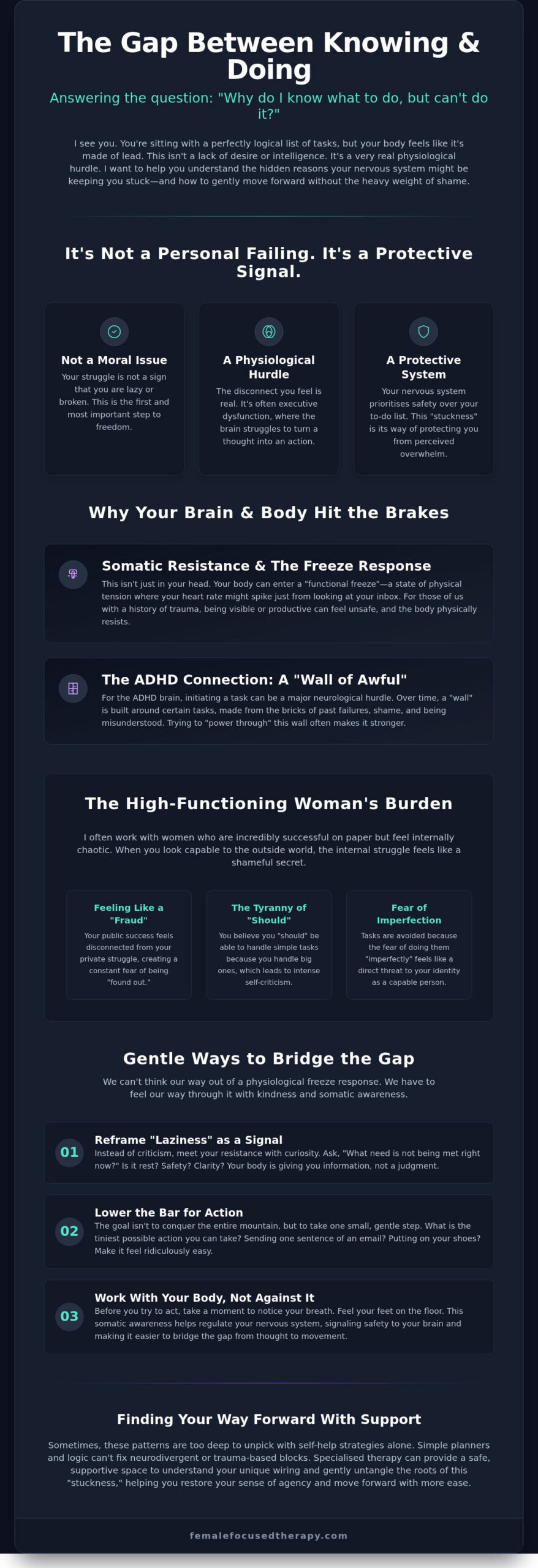
Recognising that your brain is simply hitting a roadblock is your first step toward freedom. This experience is often part of a comprehensive overview of executive dysfunction, where the brain’s management system struggles to turn a thought into an action. It’s a physiological hurdle, not a moral failing.
The High-Functioning Woman’s Burden
Many of the women who come to me for ADHD-focused therapy are incredibly successful on paper. You might be running a business, managing a household, or leading a team, yet you feel internally chaotic. There’s an immense pressure to maintain a facade of total control. This burden often looks like:
- Feeling like a “fraud” because your public success doesn’t match your private struggle.
- Believing you “should” be able to handle simple tasks because you handle big ones.
- Avoiding tasks because the fear of doing them “imperfectly” feels like a threat to your identity.
When you look capable to the outside world, the internal struggle feels like a shameful secret. This specific pressure creates a cycle where the task itself becomes a symbol of your worth. If you can’t start, you feel like you’re failing at being a “functional” adult, which only adds more weight to that leaden feeling in your limbs.
When Logic Fails to Motivate
You’ve likely asked yourself a thousand times, why do I know what to do but can’t do it? The truth is that our rational mind and our emotional mind speak entirely different languages. Your rational mind knows the steps, but your emotional mind is sensing a threat or total overwhelm. Logic alone cannot bridge that gap.
Telling yourself “it only takes five minutes” doesn’t actually help when you’re overwhelmed. In fact, it often makes it worse because it dismisses the very real friction you’re feeling. I realised long ago that logic is a poor tool for emotional resistance. We can’t think our way out of a physiological freeze response; we have to feel our way through it with kindness and somatic awareness.
Why Your Brain and Body Hit the Brakes
The knowing-doing gap is a physiological safety mechanism designed to protect your nervous system from perceived threat, exhaustion, or overwhelm. I often explain to my clients that our nervous system prioritises safety over our “to-do” list every single time. If your brain perceives a task as a threat, perhaps due to past trauma or a deep fear of judgment, it will trigger a freeze response. This is particularly true for those of us navigating ADHD or other forms of neurodivergence. You might find yourself asking, why do I know what to do but can’t do it? when the answer actually lies in your body’s attempt to keep you safe.
The Role of Executive Dysfunction and ADHD
The ADHD brain often struggles with task initiation. This is the literal neurological bridge between thinking about an action and actually moving your body to perform it. It isn’t a lack of willpower; it’s a chemical and structural hurdle. Over time, we develop what is often called a “wall of awful” around even simple tasks. This wall is built from bricks of past failures, shame, and the memory of being told we were “lazy” when we were actually struggling with our biology.
My approach to ADHD therapy focuses on understanding these brain-based blocks rather than trying to power through them. When we look at self-help strategies for executive dysfunction, we start to see that we need tools that work with our unique wiring. If you’re feeling overwhelmed by these patterns, you can always book a session to explore these blocks in a safe, supportive space.
Somatic Resistance and the Freeze Response
Sometimes, your inability to start is actually a state of “functional freeze.” This is a somatic response where your body is physically tense and your heart rate might spike just by looking at your inbox. For women who have experienced relationship trauma, taking up space or being “seen” through your work can feel inherently unsafe. Your body remembers when being visible or productive led to criticism or emotional pain.
Consequently, your nervous system hits the brakes to keep you small and protected. Notice your breath the next time you feel stuck. Is it shallow? Is your jaw clenched? These are physical signals that your body is prioritising survival over productivity. Understanding this allows us to move from self-blame toward a more compassionate, somatic awareness of our internal state.
Moving Beyond the “Lazy” Label
I want to be very clear: laziness is a myth we use to punish ourselves for having unmet needs. It is a convenient label that stops us from looking deeper into the actual mechanics of our struggle. When you find yourself stuck, asking why do I know what to do but can’t do it?, your inner critic is usually ready with a harsh answer. But calling yourself lazy is like shouting at a car for having no petrol.
In my practice, I find that what we call laziness is almost always a combination of exhaustion, fear, or a lack of support. Your system isn’t refusing to work because it’s defiant. It’s often stalling because it’s overwhelmed and under-resourced. Replacing judgement with curiosity allows us to look at what is actually standing in your way without the heavy weight of shame.
The Cost of Self-Criticism
Your inner critic is a heavy drain on the very energy you need to complete a task. Every time you berate yourself for not starting, you use up the mental fuel required for action. There is a specific physiological impact of shame on the prefrontal cortex, which is the part of the brain responsible for planning and execution.
When you feel ashamed, that part of your brain effectively goes offline to prioritise survival. This is why I prioritise self-compassion as a functional tool, not just a “nice to have” sentiment. Kindness creates the internal safety your brain needs to re-engage with the world. Without that safety, the “doing” part of your brain stays locked behind a wall of stress hormones.
Reclaiming Your Narrative
Shifting away from the painful question of why do I know what to do but can’t do it? allows you to focus on what your system needs right now to feel safe. This simple change moves you from a place of deficit to a place of support. It helps you recognise the vital difference between capacity and desire. You might want to do the task, but your current capacity might be zero.
The women who I work with often find that letting go of the “lazy” label is their biggest breakthrough. Once the shame is removed, we can finally address the practical and emotional blocks beneath the surface. You aren’t failing at life; you are simply navigating a complex nervous system that requires a different, more gentle kind of care.
Gentle Ways to Bridge the Gap
I encourage you to start by lowering the bar until it is on the floor. If you are constantly wondering, why do I know what to do but can’t do it?, then we need to change the goal of your first movement. The aim isn’t to finish the whole project or even the first page; it is simply to prove to your nervous system that taking action is safe.
We use somatic tools to shift out of that leaden freeze state. These are simple movements or breaths that tell your brain the “threat” of the task is manageable. Try pressing your big toes into the carpet and noticing the texture for ten seconds; this tiny physical anchor can help pull your brain out of a freeze state and back into the room.
Somatic Grounding for Action
Before you even look at your task list, use your breath to signal safety to your brain. A long, slow exhale through the mouth can help deactivate the fight-or-flight response that often accompanies executive dysfunction. I often find that for women with ADHD, the popular “Five-Second Rule” can feel too aggressive and high-pressure.
Instead, I prefer a “One-Somatic-Movement” approach. This might mean just rolling your shoulders or stretching your arms once. These small physical shifts help regulate your system, making focus feel more accessible. Integrating somatic movement and yoga into your daily life creates a more resilient foundation for these moments of stuckness.
Micro-Steps and Task Bracketing
Breaking tasks down into ridiculously small pieces is essential for bypassing your brain’s threat detection. If “write report” feels like a mountain, try “open document” as your entire goal for the next ten minutes. We have to learn to celebrate the start rather than just the finish. Every time you initiate a task, you are strengthening a neurological muscle.
You might also find that “body doubling” helps, which simply means having someone else in the room or on a video call while you work. It provides a gentle external anchor that can keep you on track without you feeling like a burden. If you’re ready to unpick the deeper blocks that keep you from starting, you can book a psychotherapy session to explore these patterns together.
Finding Your Way Forward with Support
Sometimes the gap between knowing and doing is simply too wide to bridge alone. This is not a sign of failure; it is a sign that the underlying cause requires more than just a new planner or a productivity hack. If you are still asking, why do I know what to do but can’t do it?, it might be time to look at the deeper emotional and neurological roots of your stuckness.
Therapy provides a safe, boundaried space to unpick the trauma or neurodivergent blocks that self-help strategies cannot reach. I work with women to rebuild that essential internal trust. My goal is to help you reach a place where “doing” becomes a natural extension of “being,” rather than a constant, exhausting battle against your own biology.
Is Intensive Therapy Right for You?
Standard weekly sessions are incredibly valuable, but sometimes they aren’t enough to break through deep-seated blocks. If you feel like you are constantly treading water, focused intensive therapy options might be a better fit. These sessions allow us to dive deeper into the somatic and psychological patterns that keep you frozen.
We move at a pace that feels steady and unhurried. Even in an intensive setting, the focus remains on your safety and comfort. We work to resolve the “freeze” response at its source, allowing your nervous system to finally relax and re-engage with your goals. This deeper work creates lasting change that surface-level fixes simply cannot provide.
Taking the Next Small Step
You deserve to live a life where your actions align with your beautiful, capable mind. If you aren’t quite ready for a full session, I invite you to explore my free therapy resources first. These tools can provide immediate, gentle support as you begin to understand your unique way of moving through the world.
When you feel ready to explore this further, you can book a consultation with me. We can chat about your experiences and see which path feels most supportive for you. It is a low-pressure way to start reclaiming your agency and moving toward the life you want to lead.
I want to leave you with one final thought: you are not broken. You are just human, navigating a complex world with a sensitive and intelligent system. With the right support and a lot of kindness, you can find your way forward at a pace that feels right for you.
Reclaiming Your Agency and Internal Peace
You aren’t broken, and you certainly aren’t lazy. I want you to remember that the disconnect you feel is often your nervous system’s way of trying to protect you from overwhelm. By shifting from self-criticism to gentle curiosity, you can start to understand the real physiological reasons behind the question, why do I know what to do but can’t do it?
We’ve explored how lowering the bar and using tiny somatic movements can signal safety to your brain. These small shifts are the foundation for rebuilding your internal trust. As a registered integrative psychotherapist and a specialist in ADHD and trauma for women, I offer a warm, empathetic space to help you navigate these complex patterns at a pace that feels right for you.
You deserve a life where your actions feel like a natural extension of your capable mind. If you’re ready to unpick the blocks that planners and willpower can’t fix, please book a session with me to start bridging the gap between your knowing and your doing.
I am here to support you in moving forward at a speed that feels steady and safe. You have everything you need within you; sometimes, we just need a little help finding the key to unlock it with kindness.
Frequently Asked Questions
Why do I have no motivation even when I know the task is important?
Lack of motivation often stems from a nervous system freeze or dopamine deficiency rather than a lack of caring. When your brain perceives a task as overwhelming or threatening, it shuts down to protect you. This isn’t a character flaw; it’s a physiological response. I often see this in high-functioning women whose systems are simply overextended and need safety before they can find energy.
Is “knowing what to do but not doing it” a symptom of ADHD?
Yes, this challenge is a core part of executive dysfunction, which is very common in ADHD. You might find yourself asking, why do I know what to do but can’t do it? while your brain struggles with “task initiation.” This is the neurological bridge between having a thought and moving your body to act. In my ADHD-focused therapy, we work on unpicking these specific brain-based blocks.
How can I stop feeling guilty for being unproductive?
You can begin by replacing judgement with curiosity and recognising that your “unproductivity” is often a sign of an unmet need. I encourage you to view your capacity as a fluctuating resource rather than a moral obligation. When you treat yourself with the same kindness you’d offer a friend, you lower the emotional pressure that actually keeps you stuck in the first place. Guilt only drains your battery further.
What is the difference between procrastination and executive dysfunction?
Procrastination is often an emotional avoidance of a specific task, whereas executive dysfunction is a broader struggle with the brain’s “management system.” While procrastination might involve choosing a more pleasant activity, executive dysfunction often feels like being physically unable to move even when you desperately want to. It affects planning, time management, and the literal ability to start or switch between tasks, regardless of how much you want to finish.
Can trauma cause me to feel stuck and unable to move forward?
Absolutely, as trauma can leave your nervous system stuck in a permanent state of high alert or “freeze.” If your body doesn’t feel safe, it will prioritise survival over productivity every time. I specialise in trauma-informed therapy to help women identify when their “stuckness” is actually a protective response to past experiences. Healing happens when we show your body that the current moment is safe for action.
How do I explain my “stuckness” to my partner or boss?
I suggest using the term “executive dysfunction” and explaining it as a temporary glitch in your brain’s “starting motor.” You might say, “I know exactly what needs to be done, but I’m currently hitting a neurological block that makes starting very difficult.” Framing it as a physiological hurdle rather than a choice helps others understand that you need support or a different approach, not more pressure or criticism.
What should I do when I feel overwhelmed by my own to-do list?
I recommend “lowering the bar until it’s on the floor” and choosing just one tiny, ridiculous micro-step. If your list feels like a threat, your brain will stay in freeze mode. By focusing on something as small as opening a laptop or putting on your shoes, you prove to your nervous system that taking action is safe. This gentle approach bypasses the brain’s internal alarm system and builds momentum.
How does somatic therapy help with getting things done?
Somatic therapy addresses the physical “freeze” response that logic cannot reach. By using breathwork, grounding, and gentle movement, we signal to your body that it is safe to move out of survival mode. I integrate these mind-body techniques into my practice to help you bridge the gap between your thoughts and your actions. This allows “doing” to become a more natural, less painful extension of your daily life.

Article by
Cheryl Kennedy MacDonald MA BA (Hons) Pg. Dip. SAC BACP
Cheryl Kennedy MacDonald is a psychotherapist specialising in women’s mental health, relationships, and life transitions. She works with women navigating trauma, relationship breakdown, identity shifts, and midlife change, helping them rebuild self-trust, emotional stability, and a clear sense of who they are and what they want.
With over 20 years’ experience working with women internationally, Cheryl is the founder of YogaBellies, a global women’s yoga school, and the creator of the Birth ROCKS method. Her work sits at the intersection of psychotherapy and embodiment, integrating evidence-based therapeutic approaches with somatic, body-based practices that support deep, lasting change.
Known for her grounded and direct approach, Cheryl moves beyond surface-level insight to address the patterns held in the body and nervous system. Her work supports women to regulate, reconnect, and respond to their lives from a place of clarity, strength, and self-respect.
She is a published author in academic journals and has written multiple books on women’s health, pregnancy, and midlife wellbeing, available on Amazon and leading book retailers worldwide.