
You’re at a dinner party when a friend makes a throwaway comment about your latest project, and suddenly, it feels like a physical blow to your chest. That familiar “stomach drop” hits, and within seconds, you’re spiralling into deep shame and wanting to withdraw. If you’ve spent your life feeling “too sensitive” while managing rejection sensitive dysphoria, I want you to know that you aren’t broken. Your brain is simply wired to process these moments with an intensity that others might never understand.
I know this pain personally, both as a woman living with ADHD and as a psychotherapist. The goal isn’t to “fix” your sensitivity, but to learn how to mother your own nervous system when the sting becomes too much. I’ve found that combining therapy with somatic awareness, like breath and gentle movement, can change everything about how we move through these internal storms.
I’ll help you understand why your body reacts so strongly and share the gentle, integrative tools I use to soothe an overwhelmed ADHD nervous system. We’ll explore how to restore your self-trust and move through social situations without the constant, heavy fear of judgment.
Key Takeaways
- Learn why rejection feels like a physical blow and how your ADHD brain processes social feedback with such high intensity.
- Discover practical somatic techniques for managing rejection sensitive dysphoria that use the breath to signal safety to your nervous system.
- Learn to identify the “RSD fog” and the habit of mind-reading so you can separate your internal reactions from the reality of the situation.
- Realise that your sensitivity is a natural byproduct of your unique wiring rather than a flaw that needs to be “fixed.”
- Understand how a collaborative, integrative approach to therapy can help you rebuild internal trust and navigate your social world with more ease.
What Rejection Sensitive Dysphoria Really Feels Like for Us
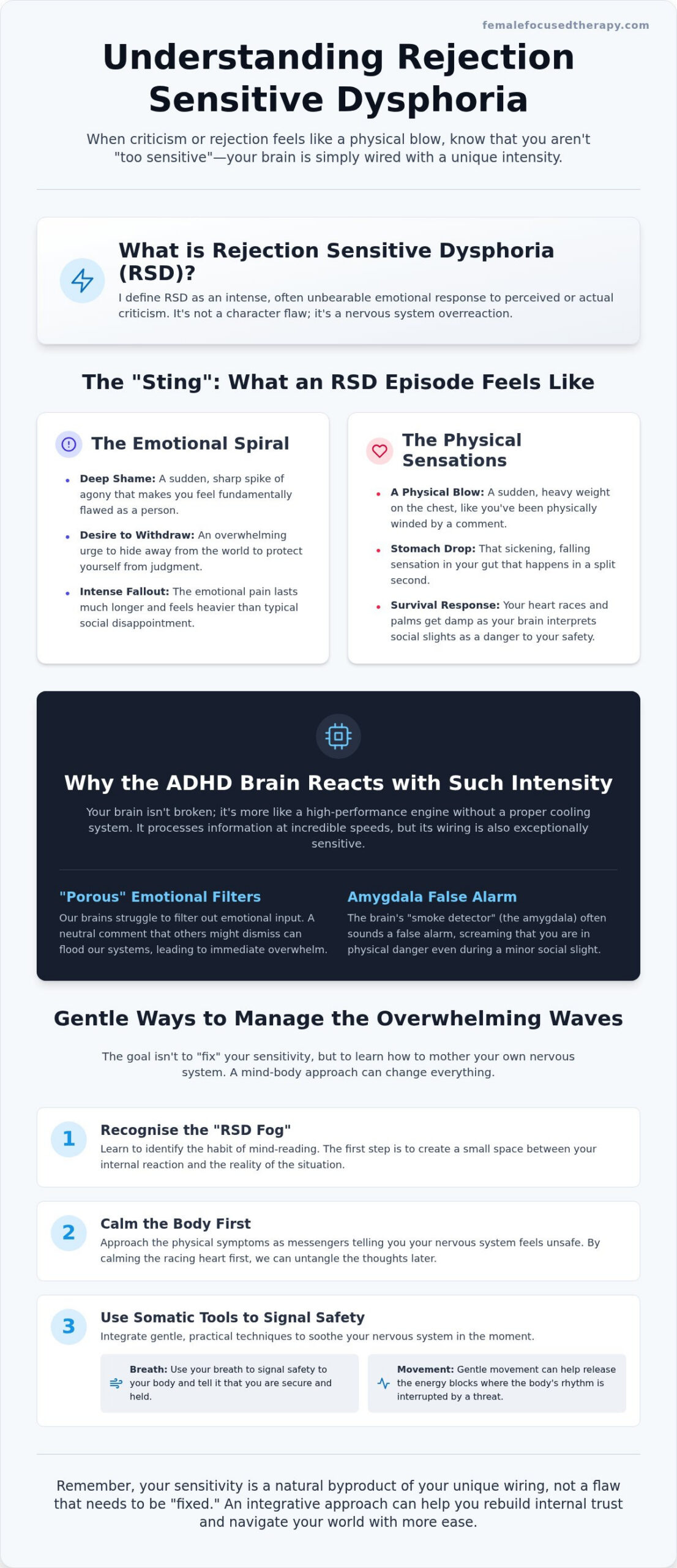
I want to start by telling you that the “sting” you feel isn’t just in your imagination. It’s real, it’s valid, and it’s incredibly draining to live with. For those of us with ADHD, rejection sensitive dysphoria (RSD) isn’t about being “thin-skinned” or overly dramatic. It’s an intense, often unbearable emotional response to perceived or actual criticism.
I define RSD as a nervous system overreaction rather than a character flaw or a sign of weakness. When this sensitivity takes over, it often shows up in our bodies as a sudden, heavy weight on the chest. It feels like you’ve been physically winded by a comment that someone else might not even notice.
When we talk about managing rejection sensitive dysphoria, we have to look at the body’s immediate reaction first. This isn’t just a mood swing; it’s a physiological event that happens in a split second. Your brain is simply trying to protect you from a pain it perceives as a threat to your very existence.
The “Sting” vs. Regular Sensitivity
I often describe this experience as an emotional allergy to the word “no” or even just a neutral expression on a friend’s face. While most people find social rejection unpleasant, for the ADHD brain, a small disappointment feels like a physical blow. It’s a visceral reaction that bypasses our logic entirely.
Recognising the difference between a bad day and an RSD episode is vital for your healing. A bad day might feel like a slow cloud of gloom, but an RSD episode is a sudden, sharp spike of agony. It hits fast, it hits hard, and it makes you want to hide away from the world to protect yourself.
I’ve noticed that this pain can lead to a “shame spiral” that’s hard to break. You don’t just feel sad that someone disagreed with you; you feel fundamentally flawed as a person. This is why the emotional fallout feels so much heavier and lasts much longer than typical social disappointment.
The Physicality of Emotional Pain
The somatic sensations of RSD are often what make it so difficult to ignore. You might feel your heart racing, your palms getting damp, or that sickening “dropped” stomach feeling. My yoga background helps me see these as energy blocks where the body’s natural rhythm is interrupted by a perceived threat.
Your brain interprets social slights as a danger to your safety, triggering an ancient survival response. This is why managing rejection sensitive dysphoria requires a mind-body approach. By learning to calm the racing heart first, we can eventually start to untangle the thoughts that keep us trapped.
When we approach this with kindness, we can see these physical symptoms as messengers. They’re telling us that our nervous system feels unsafe. Instead of fighting the feeling, we can learn to breathe through it and signal to our bodies that we are, in fact, secure and held.
Why Our ADHD Brains React with Such Emotional Intensity
I often think of the ADHD brain as a high-performance engine that lacks a proper cooling system. We process information at incredible speeds, but our wiring is also exceptionally sensitive to the environment around us. When I work with women on managing rejection sensitive dysphoria, I start by explaining that their brains aren’t broken; they are simply more porous.
Our brains often struggle to filter out emotional input. While others might dismiss a neutral email as “just business,” our internal filters are often too thin to stop the data from flooding our systems. This leads to an immediate sense of overwhelm that can be difficult to shake, as every perceived slight feels like a direct hit to our core.
The amygdala, which acts like the brain’s smoke detector, plays a massive role here. In a neurotypical brain, it might stay quiet during a minor disagreement. In ours, it sounds a false alarm, screaming that we are in physical danger. Understanding this biological “glitch” is a huge part of managing Rejection Sensitive Dysphoria without the heavy weight of self-blame.
The Burden of the “High-Functioning” Mask
I know how exhausting it is to sit through a meeting with a smile on your face while your heart is breaking inside. For many of the high-achieving women I work with, masking is a survival skill. We learn to hide the pain of perceived failure until we are safely behind closed doors, away from the judgment of others.
This constant effort to appear “fine” is a direct route to burnout. When we spend all our energy pretending we aren’t hurt, we have nothing left to actually process the emotion. This makes the next RSD episode even harder to handle because our internal reserves are already empty and our resilience is worn thin.
The History of “Not Quite Enough”
Most of us grew up hearing that we were “too much” or needed to “calm down.” These messages stick with us for decades. Over time, they prime our brains to look for any sign that we are about to be rejected again, keeping us in a state of hyper-vigilance that is physically taxing.
There’s also a deep intersection between neurodivergence and trauma. Because our nervous systems are naturally more reactive, we often experience life’s challenges more intensely than others might. This creates a cycle where past hurts make our current RSD symptoms feel even more overwhelming. If you’re tired of carrying this weight alone, you might find that exploring these patterns in a safe space brings the relief you’ve been looking for.
Recognising the Difference Between Reality and the RSD “Fog”
When the RSD fog rolls in, everything feels distorted. It’s like looking through a lens that magnifies every neutral comment into a personal attack. When I’m managing rejection sensitive dysphoria in my own life, I find it helpful to just pause and breathe. This simple act of somatic grounding creates a tiny bit of space between the initial “sting” and your reaction.
Part of managing rejection sensitive dysphoria is learning to name the experience as it happens. I often tell myself, “I am experiencing RSD right now.” By labelling it, you move the feeling from a fundamental truth about your worth to a temporary neurological event. It doesn’t make the pain vanish instantly, but it changes your relationship with it.
In my integrative therapy practice, we work on separating facts from feelings. You might feel like your friend hates you because they didn’t text back, but the fact is simply that the phone hasn’t chimed yet. Learning to spot this gap is the first step toward internal restoration and rebuilding your sense of self-reliance.
The “Mind-Reading” Trap
We often fall into the trap of “mind-reading,” where we’re certain we know exactly what others are thinking. We assume a short email or a late reply is proof of our inadequacy. I’ve spent years learning to challenge this narrative by asking myself gentle questions: “Is there any other reason they might be quiet?” or “Would I judge a friend this harshly for the same thing?”
Restoration starts when we begin to question our harshest thoughts. Instead of accepting the RSD narrative as gospel, we can treat it as a protective, albeit misguided, part of our ADHD wiring. This shift allows us to be kinder to ourselves while the emotional storm is at its peak, letting the intensity settle at its own pace.
Wait for the Wave to Pass
I always encourage my clients to wait 24 hours before reacting to a perceived slight. When your nervous system is screaming, any response you give will likely be rooted in fear rather than your true self. I’ve found that the power of rest is an underrated tool for emotional regulation; sometimes, a good night’s sleep is the only thing that can reset the amygdala.
If you find that the fog is too thick to navigate alone, specialised ADHD therapy can provide a structured way to build these coping muscles. We can work together to create a toolkit that helps you find your centre again, even when the world feels like it’s closing in and your thoughts feel overwhelming.
Gentle Ways to Manage the Overwhelming Waves of RSD
I want to share the somatic tools that help me find my centre again when the world feels too loud. While changing your thoughts is helpful, the body usually needs to feel safe before the mind can follow suit. When I am managing rejection sensitive dysphoria, I focus on calming my heart rate before I try to reason with my brain.
I incorporate somatic movement into my work because it addresses the physical “sting” directly. When you feel that sudden drop in your stomach, your nervous system is in a state of high alert. Simple grounding exercises, like the 5-4-3-2-1 technique, can help pull you out of an emotional spiral by focusing on your immediate senses.
Using the breath is one of the fastest ways to signal to your nervous system that you are safe. To settle your heart rate, inhale for a count of four, hold for seven, and exhale slowly for eight. This simple rhythm acts as a biological brake for the amygdala, allowing the intense waves of emotion to subside more quickly.
Movement also plays a vital role in releasing the emotional tension that gets trapped in our muscles. Even just a gentle stretch or shaking out your arms can help move that “fight or flight” energy through your body. Remember that rest isn’t just about sleep; it’s a sensory reset that allows your brain to recover from the exhaustion of an RSD episode.
Building a “Self-Compassion Kit”
I suggest keeping a list of “truth statements” on your phone to read when the fog rolls in. These are simple facts like “I am safe” or “This feeling will pass,” which act as an anchor during a shame spiral. It’s about learning to mother yourself in the moments you feel most rejected, rather than joining in on the internal criticism.
In our sessions, I avoid “fixing” you and instead focus on holding space for your feelings. Healing happens when we allow ourselves to feel the pain without judgment, knowing we have the tools to return to our centre. If you’re ready to build your own toolkit for managing rejection sensitive dysphoria, you can book a session with me here to start your journey.
Rebuilding Your Internal Safe Space with Professional Support
I believe that true healing happens when we feel truly seen and understood in all our complexity. For many of the women I work with, life has been a series of moments where they felt they had to hide their intensity to fit in. My Individual Psychotherapy sessions provide a non-judgmental anchor where you can finally let go of that burden and feel safe.
We work on moving you from a place of simply managing rejection sensitive dysphoria to a life where you are truly thriving. This shift involves rebuilding the self-trust that often gets eroded by years of emotional overwhelm and social anxiety. When you trust your ability to handle the “sting,” the fear of it loses its power over your daily choices and relationships.
One realistic next step I encourage you to take is booking a quiet ten-minute window for yourself today. Use this time to sit without your phone, perhaps with a cup of tea, and just acknowledge how hard you’ve been working to keep everything together. This small act of “mothering” yourself is a vital part of the restoration process and helps signal to your nervous system that you are a priority.
The Power of Integrative Therapy
I combine evidence-based modalities like CBT with mindfulness and somatic practices because I know that managing rejection sensitive dysphoria requires a whole-body approach. We don’t just talk about the thoughts; we look at how the pain sits in your muscles and your breath. We work together to unpick the roots of your sensitivity, looking at how your ADHD wiring and past experiences have created your current internal landscape.
This collaborative journey is about restoring your internal confidence and self-reliance at a pace that feels manageable for you. For some women, the traditional weekly session feels like the right rhythm for this work. For others who feel they are at a breaking point or want to make deeper progress quickly, I offer Focused Intensive options that allow for more concentrated healing and support.
Finding Your Way Forward
I am here to guide you through the transitions, the sudden stomach drops, and the exhaustion of the high-functioning mask. I want you to know that you aren’t “too much,” and you certainly aren’t alone in how deeply you feel the world. Your sensitivity is actually a reflection of your capacity for deep connection and empathy; we just need to help you find a way to carry it more lightly.
Rebuilding your internal safe space is a journey of kindness and patience, and it’s one you don’t have to walk by yourself. I’ve been in that place where the world feels too sharp, and I know the way back to a more grounded, stable version of yourself. When you feel ready to explore this path, you can book a consultation with me to see how we can begin your restoration together.
Finding Peace Within Your Sensitive Wiring
Living with a nervous system that feels everything so deeply can be exhausting, but it’s also a sign of your incredible capacity for empathy and connection. I hope you now realise that the physical pain you feel isn’t a sign that you’re broken. It’s simply your brilliant ADHD brain trying its best to keep you safe in a world that often feels too sharp.
By using somatic tools to settle your body and learning to label the “fog” as it rolls in, you can start to reclaim your sense of self. Managing rejection sensitive dysphoria is a journey of restoration rather than a quick fix. It takes time to unlearn the habit of masking and to start trusting your own internal safe space again.
As a registered integrative psychotherapist living with ADHD myself, I am here to help you navigate these emotional storms with kindness and professional insight. Book a consultation with me to explore how we can soothe your sensitive nervous system together. You deserve to feel secure, understood, and entirely at home in your own skin.
Frequently Asked Questions
Is rejection sensitive dysphoria a real medical condition?
Rejection Sensitive Dysphoria isn’t currently a formal medical diagnosis in the DSM-5-TR or the ICD-10. Instead, it’s a term used to describe the extreme emotional agony that nearly 100% of people with ADHD experience. Even without an official code, the physical pain you feel is a very real neurological event. I see it as a byproduct of how our sensitive brains process social safety and belonging.
Can you have RSD without having ADHD?
While the term is most closely linked with ADHD, similar sensitivities can appear in other forms of neurodivergence or following significant trauma. However, RSD is specifically considered a core component of the ADHD experience due to how our brains struggle to regulate emotional input. If you find yourself constantly bracing for a “blow” from others, it’s a sign that your nervous system needs extra support and kindness.
How long does an RSD episode usually last?
Unlike the long, heavy clouds of clinical depression, an RSD episode is usually intense but relatively short-lived. The sharp “sting” can last anywhere from a few minutes to a few hours. While the agony is deep, it tends to pass once your nervous system feels safe again. I find that using somatic tools can help shorten this duration by signalling to your brain that the immediate threat has passed.
Does medication help with managing rejection sensitive dysphoria?
While I don’t provide psychiatric medication management, many women find that treating their underlying ADHD helps with managing rejection sensitive dysphoria. In the UK, clinicians sometimes prescribe medications like guanfacine off-label to help regulate these intense emotional spikes. Combining medical support with integrative therapy allows you to address both the biological “false alarm” and the habit of internalised shame that often follows a spiral.
How can I explain my RSD to my partner or friends?
I suggest using metaphors like an “emotional allergy” or a “nervous system false alarm” to help others understand. You might tell your partner that a neutral face feels like a physical blow to your chest. Asking for a “pause” or a gentle preamble before a difficult conversation can also help. It’s about helping them see that your reaction is a biological event rather than a choice.
What is the difference between social anxiety and RSD?
Social anxiety is usually the persistent fear of being judged in the future, whereas RSD is the sudden, intense agony of perceived rejection in the moment. Anxiety often makes you avoid social situations entirely to stay safe. RSD hits you like a wave when you think you’ve already failed or been criticised. Both are exhausting, but RSD is a much more immediate, visceral physical experience.
Can trauma make rejection sensitivity worse for women?
Trauma definitely intensifies rejection sensitivity, especially for women who have navigated narcissistic abuse or childhood criticism. These experiences prime your nervous system to stay in a state of hyper-vigilance, making your brain more likely to interpret neutral signals as a threat. In our sessions, we work on unpicking these layers to restore your internal sense of safety and self-reliance, helping you move past the trauma.
How do I stop an RSD spiral once it has started?
To stop a spiral, you must focus on your body before your thoughts. I use the 4-7-8 breathing technique or a quick somatic stretch to shift the “fight or flight” energy. Label the feeling by saying, “This is an RSD wave,” to create a tiny bit of distance. Once the physical intensity drops, you can then use gentle questions to challenge the harsh narrative your brain has created.

Article by
Cheryl Kennedy MacDonald MA BA (Hons) Pg. Dip. SAC BACP
Cheryl Kennedy MacDonald is a psychotherapist specialising in women’s mental health, relationships, and life transitions. She works with women navigating trauma, relationship breakdown, identity shifts, and midlife change, helping them rebuild self-trust, emotional stability, and a clear sense of who they are and what they want.
With over 20 years’ experience working with women internationally, Cheryl is the founder of YogaBellies, a global women’s yoga school, and the creator of the Birth ROCKS method. Her work sits at the intersection of psychotherapy and embodiment, integrating evidence-based therapeutic approaches with somatic, body-based practices that support deep, lasting change.
Known for her grounded and direct approach, Cheryl moves beyond surface-level insight to address the patterns held in the body and nervous system. Her work supports women to regulate, reconnect, and respond to their lives from a place of clarity, strength, and self-respect.
She is a published author in academic journals and has written multiple books on women’s health, pregnancy, and midlife wellbeing, available on Amazon and leading book retailers worldwide.