
What if keeping everything going is part of why you feel so depleted? Exhaustion can sit quietly behind competence. You may still be meeting deadlines, caring for others and answering messages, while feeling tired, stretched thin or unlike yourself. From the outside, it can look as though you’re coping. Inside, even small demands may feel like too much.
I know how easy it is to turn that exhaustion back on yourself. You might wonder why you can’t manage better, or feel guilty for wanting rest. But feeling depleted doesn’t mean you’ve failed. Work, relationships, caregiving and life changes can overlap in ways that are hard to untangle, especially when you’ve been carrying a lot for a long time.
In this article, I’ll help you make gentle sense of what may be contributing to feeling depleted. I’ll also explore how rest and support can become options, not more tasks to get right. You don’t need to label yourself or have all the answers before you begin listening to what you need.
Key Takeaways
- I explore how female burnout can feel when you’re still managing daily life, without turning it into a diagnosis.
- You can consider how work, relationships, caregiving and life changes may overlap in your own experience.
- Keeping up appearances doesn’t make your exhaustion less real or mean you have enough energy to feel steady.
- You can gently notice what feels heavy or unsupported, then choose one small pause that feels realistic.
- I describe how my integrative approach, including CBT and mindfulness, can offer space to explore what feels overwhelming without rushing you.
What female burnout can feel like when you’re still functioning
You’re still answering messages and getting through the day. You may be meeting deadlines, keeping promises and remembering what everyone needs. Yet when the day finally quietens, you feel as though there’s nothing left in you. If that feels familiar, I want you to know that you don’t have to prove your exhaustion before it deserves attention.
I think of female burnout as an experience of depletion, not a label that can tell you exactly what’s happening or why. You can be capable and responsible while also feeling emotionally worn down. For example, you might finish a work deadline on time, then find that even a simple decision at home feels difficult. Getting through the task doesn’t necessarily mean you’ve had space to recover from it.
When keeping everything going starts to feel different
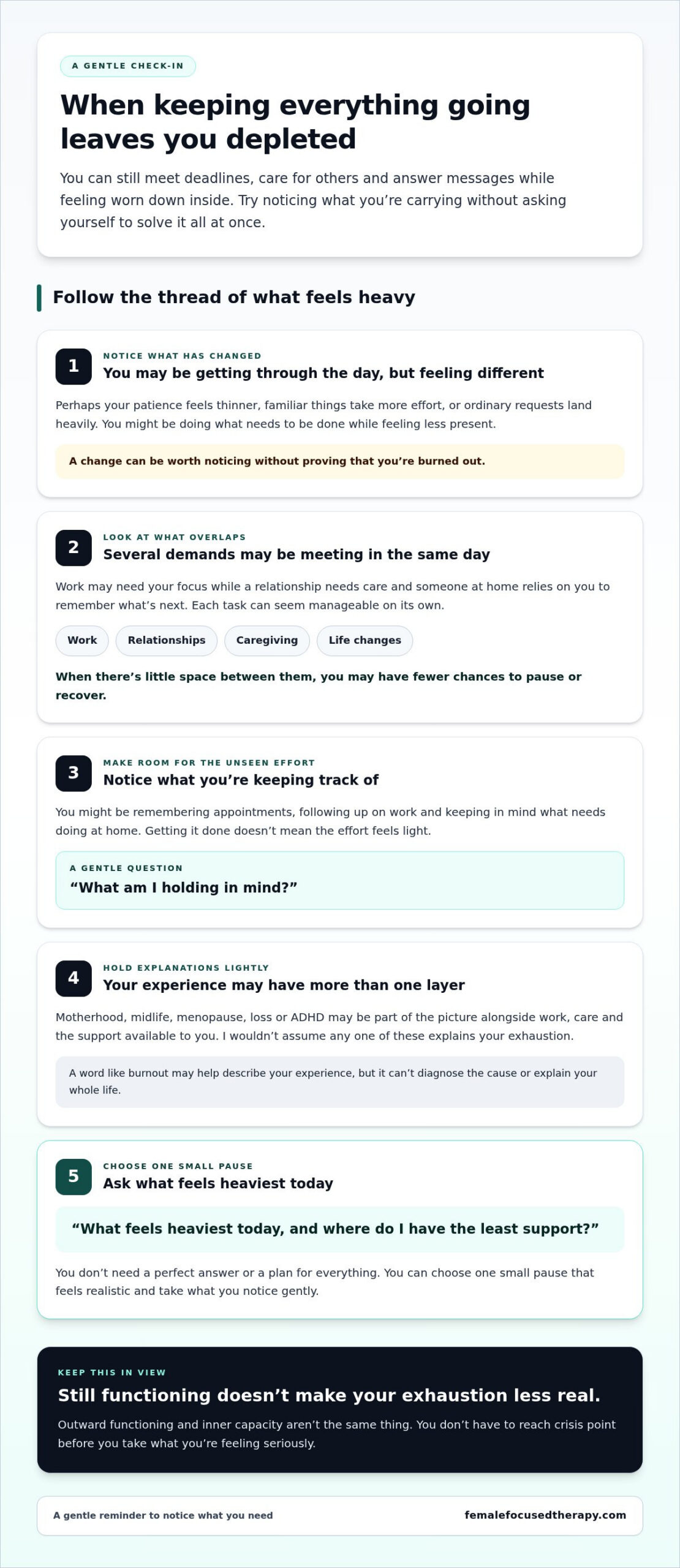
You might notice that your patience feels thinner, or that things you usually care about take more effort. Perhaps you’re doing what needs to be done, but feel less present while doing it. Or you may find that ordinary requests land heavily on a day when you’ve already given a lot. These changes can be worth noticing, but none of them alone proves you’re burned out.
Your experience may look different. I’d be curious about what has changed for you, rather than comparing your feelings with someone else’s idea of burnout. Sometimes the difference is subtle: you’re still functioning, but your capacity to meet one more demand feels smaller than it used to.
Why the word burnout may or may not fit
A word can help you describe what you’re going through, but it can’t diagnose the cause. The description of occupational burnout includes depletion, distance from work and feeling less effective. That may offer a useful starting point if your work feels connected to your exhaustion, but it won’t capture every part of your life or explain your whole experience.
Stress, health, relationships and life changes can overlap, and I wouldn’t want you to settle on one explanation too quickly. You might gently ask yourself: what feels different lately, and what am I carrying? You don’t need a perfect answer. A little curiosity can be kinder than judging yourself for not coping better.
How responsibilities and life changes can add to feeling depleted
Feeling depleted can be hard to trace to one part of your life. Work may ask for your focus, while a relationship needs care and someone at home relies on you to remember what’s next. A change you’ve chosen can still take energy to adjust to. Several pressures can overlap without one definite cause.
I’m interested in how those demands meet in your actual day. Perhaps you finish work, then move straight into sorting dinner, replying to family messages or supporting someone who’s having a difficult time. Each task may seem manageable on its own. But if there’s little space between them, you may have fewer chances to pause, notice how you feel or simply recover.
The quiet weight of being the one who remembers
You might be the person who keeps track of appointments, follows up on a work task and remembers what needs doing at home. You may look fine to others because you’re getting it done. I don’t assume that means anyone around you is at fault. I’d gently notice what you’re holding in mind, and whether you have room to put any of it down.
That quiet organising can be easy to overlook, including by you. If your attention is always turned towards what needs doing next, it can be difficult to sense when you’re tired until the day finally slows down. Your experience may be different, but the amount of unseen effort you carry is worth acknowledging.
When identity shifts or ADHD add another layer
Motherhood, midlife, menopause or loss can bring changes to your routines, relationships or sense of who you are. For those experiencing midlife transitions, exploring wellness resources such as Artemis Curated can be a gentle way to consider holistic support. If you’re also living with ADHD, managing demands may feel different at different times. I wouldn’t assume any one of these explains your exhaustion. They may be part of the picture alongside work, care and the support available to you.
If ADHD feels relevant to your experience, I share more about support for women navigating ADHD. You can take what feels useful and leave the rest; you don’t need to fit yourself to someone else’s account.
With female burnout, I find it can be helpful to look at the whole tangle, rather than asking you to identify a single cause or simply cope harder. You might pause for a moment and ask, “What feels heaviest today, and where do I have the least support?” You don’t have to solve everything at once. If you’d value an unhurried space to explore what’s going on, you can book an appointment with me.
Still functioning doesn’t mean your exhaustion isn’t real
You can keep showing up and still feel worn down. You might answer messages, get through your work and take care of what needs doing, while feeling far from steady inside. Keeping up appearances doesn’t cancel out your experience. It only shows that you’re managing some of what’s in front of you.
I don’t want you to measure how tired you’re allowed to feel by how much you can still accomplish. Outward functioning and inner capacity aren’t the same thing. You may be able to meet your responsibilities, yet have little emotional space left for choices, connection or simply being yourself.
You don’t need to reach crisis point before you take what you’re feeling seriously. You also don’t need to decide that female burnout is definitely the right description before you give yourself permission to pause and pay attention.
Why “I’m coping” can make it harder to pause
If you’re used to being capable, carrying on may feel more familiar than stopping to check in with yourself. Responsibility or habit can keep you moving, even when your energy feels low. That doesn’t mean achievement causes burnout, or that every capable woman is depleted. It may simply make your limits easier to overlook.
You might finish your errands, reply to a friend and make dinner, then realise you’ve moved through the whole day on autopilot. The tasks are done, but you feel disconnected from what you need. I’d be curious about that gap, rather than using your ability to get things done as proof that you’re fine.
Making room for uncertainty without judging yourself
Exhaustion can have different contributors, and it may take time to understand what’s happening for you. Rather than turning reflection into a search for a diagnosis, you could notice what has changed: perhaps your patience, energy or sense of connection feels different. Those observations don’t have to point to one certain cause.
I’d invite you to meet that uncertainty with kindness. You can take your feelings seriously without knowing exactly what to call them. Rest may offer a moment of breathing room, and talking with a therapist may help you explore what feels difficult, but neither is a promise to resolve every cause. For now, it may be enough to notice, without judging yourself, that something feels harder than it used to.
A gentle way to notice what you need when you feel burned out
If you’re feeling worn down, reflection doesn’t need to become another task to complete. I’d start gently, with what you can notice in this moment. Perhaps your shoulders are tight, your breathing feels shallow, or your mind keeps returning to the next thing that needs doing. You don’t need to interpret any of it straight away.
Start by noticing what your day is asking of you
You might think back to the part of the day when you felt most stretched. Was there a moment when everything seemed urgent, or when you wanted support but carried on alone? You don’t have to track every detail or work out a complete explanation.
If a question feels helpful, try asking yourself: “What feels like too much to hold alone right now?” Let the answer be simple, or let there be no answer yet. If reflecting starts to feel overwhelming, you can stop and return to the present. You’re allowed to take this at your own pace.
Choose one small pause that feels possible
A pause doesn’t need to become a new routine. You might take one unhurried breath before moving to the next task, sit somewhere quieter for a moment, or notice where your body is holding tension. There’s no special way you have to breathe, and noticing a sensation doesn’t mean you need to fix it. See whether any of these small moments feel kind and manageable for you.
Or perhaps the most useful pause is practical. You could ask someone you trust to take one task off your hands, if that feels possible in your circumstances. If asking isn’t an option right now, that doesn’t mean you’ve failed. The aim isn’t to create perfect rest, but to notice what might offer a little space.
If you’d like something gentle to explore in your own time, I’ve gathered gentle therapy resources. You can choose what feels relevant and leave the rest. Not every idea will fit every moment.
And if you’d value a steady, collaborative space to explore what’s weighing on you, I can make room for that in therapy. You don’t need to arrive with the right words or a clear explanation. You can book an appointment with me if that feels like a supportive next step.
How therapy can support you through female burnout
Therapy isn’t a requirement, and it isn’t a quick fix. It can be one possible place to slow things down and explore what’s leaving you depleted. You don’t need to arrive certain that female burnout is the right label, or with a clear plan for what should change.
What it may feel like to talk things through with me
In my work with women, I make space for you to talk about what feels difficult without rushing to label your experience. We can look together at the pressures you’re carrying, the patterns you’ve noticed and what matters to you now. You can begin wherever you are, even if all you can say is, “I don’t know why I feel this way.”
I’m a registered integrative psychotherapist, and my approach includes CBT and mindfulness. In plain terms, we might explore how your thoughts and responses connect with what’s happening in your life, while also making room to notice what you’re feeling in the present. I’ll work collaboratively with you, at a pace that feels manageable. I aim to offer a confidential, respectful space, while being clear about the professional boundaries around what you share.
Therapy doesn’t mean that every pressure will disappear, and I can’t promise a particular outcome. It can give you time to make sense of what’s going on and consider what support or changes might feel right for you.
Finding support at a pace that feels manageable
I’m based in Singapore and offer online therapy to a global clientele. If you’re considering support, you can read how I work with women and see whether my approach feels relevant to you. There’s no need to decide everything before taking a first step.
You can also find out more about my therapy practice and the support I offer. If talking things through with me feels like a possibility, you’re welcome to book an appointment. You can take your time. Even considering support, without committing to it yet, can be a gentle way of recognising that your experience deserves care.
Take one gentle step towards feeling more supported
You can keep meeting your responsibilities and still feel depleted. The pressure may come from several parts of life at once, and you don’t need to settle on a label or wait until things feel unbearable before you listen to yourself.
Perhaps you can begin by noticing what feels heaviest today, then allow yourself one small pause. It doesn’t have to solve everything. It can simply help you make a little space to hear what you need.
I’m Cheryl Kennedy MacDonald, a registered psychotherapist. In individual and online therapy, I draw on CBT and mindfulness to explore your experience collaboratively and at a pace that feels manageable. Therapy isn’t a quick fix or the only way forward, but it can offer a thoughtful space to make sense of female burnout and the pressures around it.
If you’d like to explore therapy with me, book an appointment when you feel ready. You don’t have to have all the answers first. A gentle next step is enough.
Frequently Asked Questions
Is female burnout a formal diagnosis?
I don’t use “female burnout” as a diagnosis. I use it as everyday language for feeling depleted, while recognising that it doesn’t explain what’s behind your experience. Occupational burnout is described in relation to ongoing workplace stress, but your exhaustion may involve other parts of life too. If you’re unsure what’s happening, you can begin by noticing what feels different without deciding on a label first.
Can you feel burned out even if you’re still functioning?
Yes. You can keep meeting deadlines, caring for others and handling everyday tasks while feeling emotionally worn down. Managing what’s in front of you doesn’t tell the whole story of how much energy or inner space you have left. I wouldn’t use your ability to function as proof that you’re fine. You’re allowed to take your exhaustion seriously even if others can’t see it.
What can female burnout feel like in everyday life?
It can feel different from one person to another. You might notice that you have less patience, feel disconnected from yourself or find ordinary decisions take more effort. Perhaps you finish a busy day’s tasks but struggle to settle afterwards. These experiences don’t prove that you’re burned out, and they aren’t a checklist. I’d treat them as a reason to pause and notice what feels different for you.
How is burnout different from everyday stress?
I wouldn’t draw a firm line based on one difficult day. Stress can rise around a deadline or a demanding period, while burnout is often used to describe a more persistent sense of depletion, particularly in relation to ongoing work stress. Your circumstances may be more layered than work alone. If rest doesn’t seem to bring enough breathing room, that’s worth noticing, though it doesn’t confirm a particular cause.
Can life changes or ADHD contribute to feeling overwhelmed?
They may be part of the picture, but I wouldn’t assume either is the definite cause of your exhaustion. Motherhood, midlife, menopause or loss can change your routines and sense of self. If you have ADHD, the way you experience demands may also shape what feels manageable. Your circumstances are individual. I’d be curious about how these factors sit alongside work, relationships and the support available to you.
What can I do when I feel emotionally exhausted?
Start small, rather than adding a new routine to an already full day. You could notice when you feel most stretched and ask, “What feels like too much to hold alone right now?” If it feels manageable, take a quieter moment, notice your breath or ask someone you trust for practical help. You can stop reflecting if it becomes overwhelming. You don’t need to solve everything at once.

Article by
Cheryl Kennedy MacDonald MA BA (Hons) Pg. Dip. SAC BACP
Cheryl Kennedy MacDonald is a psychotherapist specialising in women’s mental health, relationships, and life transitions. She works with women navigating trauma, relationship breakdown, identity shifts, and midlife change, helping them rebuild self-trust, emotional stability, and a clear sense of who they are and what they want.
With over 20 years’ experience working with women internationally, Cheryl is the founder of YogaBellies, a global women’s yoga school, and the creator of the Birth ROCKS method. Her work sits at the intersection of psychotherapy and embodiment, integrating evidence-based therapeutic approaches with somatic, body-based practices that support deep, lasting change.
Known for her grounded and direct approach, Cheryl moves beyond surface-level insight to address the patterns held in the body and nervous system. Her work supports women to regulate, reconnect, and respond to their lives from a place of clarity, strength, and self-respect.
She is a published author in academic journals and has written multiple books on women’s health, pregnancy, and midlife wellbeing, available on Amazon and leading book retailers worldwide.