
What if the stress you’re trying to push through is asking you to pay attention, not try harder? You may be keeping work, family or relationships running while your body feels tense and your mind won’t switch off. Stress management therapy for women isn’t only for a crisis.
It makes sense to feel unsure about slowing down when so much seems to depend on you. You might notice a tight jaw, restless sleep or a sense of always being on alert, yet still tell yourself to carry on. Everyday overwhelm deserves care, too.
I’m Cheryl Kennedy MacDonald, a registered integrative psychotherapist, and I’ve spent more than 20 years working with women through different stages of life. In this article, I’ll help you consider what stress may be telling you, how therapy can make room for your circumstances, and what a gentle next step might look like. You don’t have to judge yourself or have everything figured out before you begin.
Key Takeaways
- Notice how stress shows up in your thoughts, feelings and body without judging yourself for it.
- Stress management therapy for women can offer space to understand what’s beneath the pressure and explore what might help.
- I may draw on CBT or mindfulness, depending on what feels relevant to your circumstances.
- You don’t need to be in crisis to consider therapy; support can be a personal choice when everyday strain feels heavy.
- Start gently by noticing one stressful situation, the feeling it brings up and what you sense in your body.
When stress feels like too much, I start by listening
I know how much effort it can take to keep showing up when you’re carrying a lot. You may be getting through work, keeping track of family needs and replying to messages, while feeling as though you have very little room to breathe. From the outside, you might seem capable. Inside, you may feel tired, tense or more irritable than you’d like.
I don’t assume there’s one reason for that strain. Work pressure might overlap with caring responsibilities, relationship difficulties, ADHD or a significant change in your life. Sometimes there’s no single event to point to. The accumulation of demands can matter, too. Noticing stress isn’t a diagnosis, and it doesn’t mean you’re failing. It can be a gentle way to begin paying attention to what you need.
How stress can show up in ordinary moments
Stress is your response to demands or pressures that feel difficult to manage. It can become noticeable in small moments. You might be sitting with a cup of tea after a busy day, yet find your mind going over a conversation you wish had gone differently. Or you may notice that your jaw is tight as you answer one more work message.
You could feel restless, find it hard to concentrate or notice tension in your shoulders. These are experiences to observe, not proof of a particular condition. I’m interested in what you notice and what those moments are like for you, rather than using them to label you.
Why your circumstances matter
The same pressure can land differently depending on what else is happening in your life. Work demands may feel harder to manage alongside caregiving. Relationship strain can affect your sense of support, while a move, separation or new stage of life may unsettle familiar routines. ADHD may also be part of your wider experience, without necessarily explaining everything you’re feeling.
You can reflect privately on one question: what feels hardest to carry right now? You don’t have to share anything you’re not ready to discuss or arrive with a clear answer. I’ve worked with women through many life stages, and I make room for the context behind what you’re experiencing, not just the word “stress”.
If you’d like a broader introduction, psychological stress is one way to read about how pressure may affect thoughts and feelings. That information can’t tell you what’s happening in your specific circumstances. I’d want to understand your own experience and how it feels in your mind and body.
For a gentle exploration of the mind and body, you can also read about somatic movement and yoga for women. You don’t need to turn noticing into another task. A small moment of curiosity can be enough to begin.
How stress management therapy for women can make space
I see therapy as a space where you can slow things down and explore what your experience means to you. You don’t need to arrive with a neat explanation or a list of goals. I’ll listen to what you want help understanding, ask questions and make room for the parts of your story that feel important.
Stress management therapy for women isn’t a fixed formula or a promise of a quick fix. It’s a collaborative process shaped around your circumstances and paced in a way that feels manageable. You can bring what’s on your mind, and we can decide together what might be useful to explore. You remain part of those choices throughout.
Therapy isn’t generic advice about how you should cope; it’s a conversation shaped by what you’re living through. Advice can offer ideas, while therapy gives you room to consider how those ideas fit your life, what gets in the way and what you might want to try. There’s no expectation that you’ll leave with everything resolved.
What I mean by an integrative approach
I pay attention to your thoughts and feelings, as well as what you notice in your body. Perhaps during a difficult conversation, you realise you’re holding your breath or your shoulders have tightened. I won’t treat that response as proof of anything. It’s one part of your experience, and we can be curious about what it means to you. If you’d like to explore this mind-and-body perspective further, you can read about somatic movement and yoga for women.
What CBT and mindfulness might offer
Depending on what feels relevant, I may draw on CBT. This means exploring how your thoughts, feelings and responses connect. If you find yourself thinking, “I always get things wrong,” after a demanding day, we might look at how that thought affects your feelings and what you do next. I’m not there to dismiss your concerns or tell you to think positively. We can make room for a fuller view.
I may also draw on mindfulness, which means gently bringing your attention to the present moment. If your mind is racing through tomorrow’s tasks, you might notice the feeling of your feet on the floor or the movement of your breath. You don’t have to make stress disappear. We can simply notice what’s happening and explore what kind of support feels useful.
For general background, I sometimes point to the Office on Women’s Health guide to how stress affects women. It can offer context, but it can’t explain your experience for you. Your circumstances matter, and I’ll work with what you bring.
If you’d like to explore whether this kind of support feels right for you, you can look at booking an appointment in your own time.
How I understand the stress beneath the surface
As we explore stress, I’m curious about what’s happening around you, not just how you’re coping. Ongoing work demands can leave little room to rest. Relationship difficulties may affect whether you feel supported or settled. A major life change can unsettle familiar routines, even when it’s something you chose or hoped for.
These pressures can overlap. I won’t assume one explains everything, or that the same experience means the same thing for you as it does for someone else. I’ll listen for the parts that feel most important in your life and make space for your own understanding to take shape.
You don’t need to be in crisis to consider therapy, and you don’t have to prove that your distress is “serious enough”. Seeking support is a personal choice, not a judgement about your strength. Self-help can be useful when you want to try something on your own; therapy offers a different kind of space to look at what’s going on with someone alongside you. They don’t have to compete.
When stress overlaps with ADHD or life changes
You might be feeling overwhelmed while also navigating ADHD, menopause or another transition. I wouldn’t assume one is causing the other. I’d want to understand how each part is affecting your daily life and what feels hardest to carry right now. If ADHD is part of your experience, you can read more about my ADHD-focused therapy.
When relationship strain is part of the picture
It can be hard to feel settled when a relationship leaves you unsure how supported you are, or when tension follows you through the day. I won’t label or diagnose the other person. I’ll focus on your experience: what the strain brings up for you, what you need and what you’d like to understand more clearly.
There may also be moments when a practical resource feels helpful. The University of Illinois Chicago shares some stress management techniques you can explore independently. That can sit alongside therapy if it suits you. In our work, I’d make room for the wider story behind your stress, without expecting you to have all the answers before we begin.
How I would help you take a gentle next step
You don’t have to work out the whole story before you begin. Sometimes a small moment of noticing is enough to help you put words to what’s been weighing on you. I’d invite you to approach that moment with curiosity, not as another task to get right.
Begin with what you notice
You might think of one recent moment when stress felt present. What was happening? What feeling did you notice, and what did you sense in your body? Perhaps you felt frustrated during a busy afternoon and noticed your shoulders tightening. You don’t need to explain or fix it. Simply noticing can offer a little more understanding.
If it feels comfortable, you could pause and take an easy breath while you reflect. There’s no need to change your breathing or make yourself feel calm. This is only an optional moment of attention. If it doesn’t feel helpful, you can leave it there.
Consider what support would feel safe
You might also ask yourself what you’d hope a therapist would understand about your situation. Maybe you want space to talk through the pressure of holding everything together, or to make sense of a change that has left you feeling unsettled. You can begin with what feels manageable. You don’t need to share more than you’re ready to.
A first conversation can focus on what you want help understanding. You might start with a simple sentence, such as, “I’m not sure where to begin, but I’ve been feeling overwhelmed.” I can help you take it from there, at a pace that feels right for you. Stress management therapy for women doesn’t require you to arrive with a clear goal or a perfect account of what’s happening.
This kind of reflection isn’t a treatment or a substitute for individual professional support. It’s one gentle way to notice what’s present. If you’d like something to explore in your own time, my free therapy resources may offer a place to begin.
If you feel ready to talk about what’s been weighing on you, you can book an appointment with me. There’s no need to have everything figured out first.
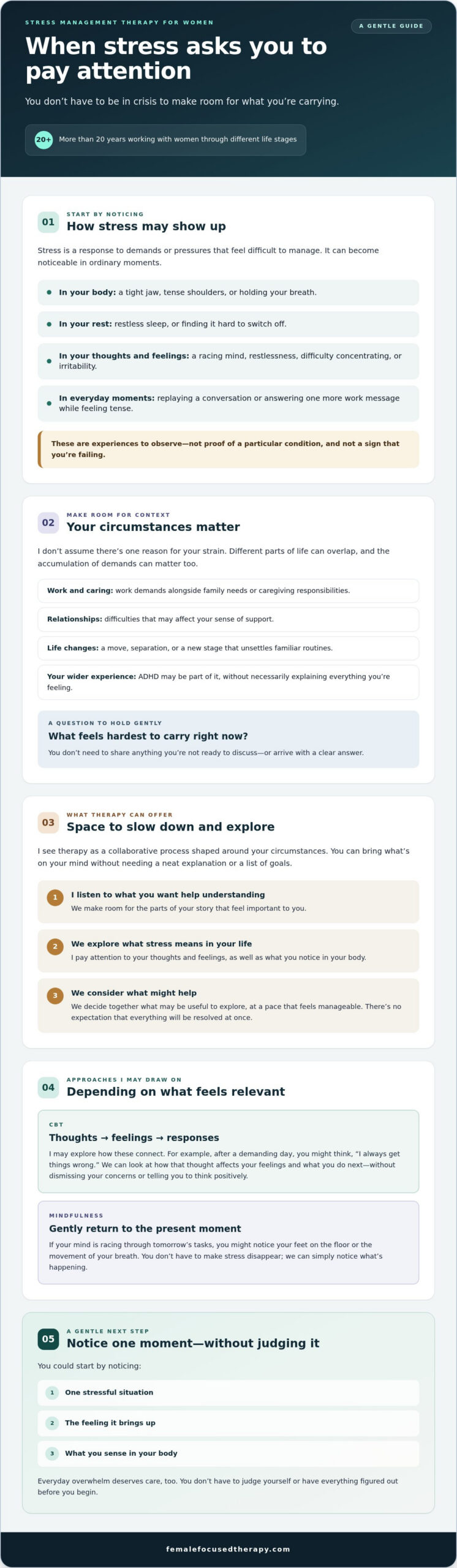
What stress management therapy with me can look like
I’m Cheryl Kennedy MacDonald, a registered integrative psychotherapist working with women. I’ve spent over 20 years supporting women through different stages of life, including times of pressure, change and rebuilding. I offer individual therapy online and in person in Singapore.
A therapy space shaped around your experience
I won’t arrive with a fixed formula for your stress. I’ll listen to what you want help understanding, and we can explore it together. That might mean looking at the demands around you, the thoughts that keep returning or what you notice in your body. The focus is your experience, not a judgement about how well you’re coping.
Stress management therapy for women can make room for the details that general advice may not account for: your relationships, responsibilities, health, history and the changes happening in your life. I may draw on approaches such as CBT or mindfulness where they feel relevant, but the work is shaped by what you bring. There’s no promised outcome or single pace you have to follow.
If you’d like to know more about my approach and the women I work with, you can visit my women-focused therapy practice.
When you feel ready to explore support
Considering therapy doesn’t mean you have to make an immediate commitment. You might simply be wondering whether talking things through could help you understand what feels heavy. You don’t need to prepare a perfect explanation or decide exactly what you want to change before you reach out.
If exploring an appointment feels like a helpful next step, you can view the booking options. You can take your time. For now, perhaps just notice what you’d most want someone to understand about the stress you’re carrying.
Take one gentle step towards feeling more grounded
Stress can be a signal to pause and listen, not a sign that you’re failing. You can begin by noticing what feels difficult, what emotions arise and how your body responds. You don’t need to solve everything at once or wait until you’re in crisis to seek support.
I’m Cheryl Kennedy MacDonald, a registered integrative psychotherapist with over 20 years of experience working with women. I offer individual therapy online and in person in Singapore. In stress management therapy for women, I make space for your circumstances and what you want help understanding, at a pace that feels manageable for you.
If you’re considering therapy, you can take a look at the booking options and decide what feels right. Explore booking a therapy appointment with me. Even a small step towards understanding yourself can matter.
If you’d like to find out more about working with Cheryl Kennedy MacDonald, you can email her at cheryl@femalefocusedtherapy.com or go ahead and book an appointment here: https://www.femalefocusedtherapy.com/book-now/. For lifestyle and yoga programmes, visit YogaBellies on www.yogabellies.com.
Frequently Asked Questions
Can stress management therapy for women help with everyday overwhelm?
Yes, therapy can be useful for everyday overwhelm, even if you’re still managing work and responsibilities. In stress management therapy for women, I make space to understand what’s contributing to the pressure and how it affects you. You might want to talk through the mental load of caregiving, tension in a relationship or difficulty switching off after work. We can explore what feels most important without assuming there’s one cause or expecting you to have everything figured out.
What happens in therapy for stress?
In therapy, I listen to what’s happening in your life and what you’d like help understanding. You might begin with a recent moment that felt difficult, then explore the thoughts, feelings and body responses connected to it. I may draw on CBT, which looks at how thoughts and responses relate, or mindfulness, which brings gentle attention to the present moment. The approach depends on what feels relevant to you, and there’s no fixed formula.
Is therapy only for women experiencing a crisis?
No, you don’t need to be in crisis to consider therapy. You might seek support because you feel stretched, unsettled or unsure how to make sense of what’s going on. I don’t expect you to prove that your distress is serious enough. Choosing therapy is personal, and you can take time to decide whether it feels right. Support can complement things you’re already doing to care for yourself, rather than replace them—read more about integrating home-based wellness and body relaxation practices into your routine.
How can I tell whether stress is affecting my wellbeing?
You may notice changes in how you feel or move through everyday life, such as finding it hard to rest, feeling more irritable or carrying tension in your body. These experiences don’t diagnose a condition, and they can have different meanings for different people. I’d encourage you to notice whether the pressure is affecting your sleep, relationships or ability to switch off, without judging yourself. If you’re concerned about your health, consider speaking with an appropriate health professional.
Can therapy help when stress is connected to ADHD or a life change?
Yes, I can make space to explore stress alongside ADHD or a life transition, without assuming one is causing the other. You might be adjusting to a new stage of life while also finding everyday demands harder to manage. I’ll listen to how these experiences affect you and what you want help understanding. I offer ADHD-focused therapy and support around menopause and midlife, as well as individual psychotherapy for women navigating change.
Does stress management therapy include mindfulness or body awareness?
It can, if those approaches feel relevant to you. I may draw on mindfulness to help you notice what’s happening in the present moment, or invite you to pay attention to body signals such as a held breath or tightened shoulders. These observations aren’t proof of a condition, and you don’t have to do anything that feels uncomfortable. I’ll work collaboratively with you, keeping the focus on your experience and what feels manageable.
Can I have therapy online if I live outside Singapore?
Yes, I offer online therapy to women beyond Singapore, as well as in-person individual therapy in Singapore. If you live elsewhere, you can contact me to discuss whether online sessions may suit your circumstances. It may help to consider practical details such as privacy, your internet connection and a place where you can speak comfortably. You don’t need to know exactly what you want to work on before getting in touch.

Article by
Cheryl Kennedy MacDonald MA BA (Hons) Pg. Dip. SAC BACP
Cheryl Kennedy MacDonald is a psychotherapist specialising in women’s mental health, relationships, and life transitions. She works with women navigating trauma, relationship breakdown, identity shifts, and midlife change, helping them rebuild self-trust, emotional stability, and a clear sense of who they are and what they want.
With over 20 years’ experience working with women internationally, Cheryl is the founder of YogaBellies, a global women’s yoga school, and the creator of the Birth ROCKS method. Her work sits at the intersection of psychotherapy and embodiment, integrating evidence-based therapeutic approaches with somatic, body-based practices that support deep, lasting change.
Known for her grounded and direct approach, Cheryl moves beyond surface-level insight to address the patterns held in the body and nervous system. Her work supports women to regulate, reconnect, and respond to their lives from a place of clarity, strength, and self-respect.
She is a published author in academic journals and has written multiple books on women’s health, pregnancy, and midlife wellbeing, available on Amazon and leading book retailers worldwide.