
What if breaking the cycle of childhood trauma doesn’t begin with getting everything right, but with noticing one small moment? You might find yourself reacting more strongly than you meant to, pulling away from someone you love, or feeling caught in a relationship pattern you hoped to leave behind. I know that can feel unsettling, especially when you worry your past is shaping who you are now.
I want you to know that noticing a pattern isn’t the same as blaming yourself. Some responses may have helped you cope at an earlier point in your life, even if they don’t feel helpful now. And I wouldn’t assume your childhood offers one simple explanation for everything you feel today.
In this article, I’ll explore how earlier experiences may show up in present-day reactions, and how you can begin to pause and choose differently with more kindness towards yourself. I’ll share gentle ways to start, including paying attention to what you feel in your body, without expecting instant change. I’m Cheryl Kennedy MacDonald, a registered integrative psychotherapist, and I’ve spent over 20 years working with women through difficult experiences and change. You can learn more about my therapy practice. You don’t have to make sense of it all at once.
Key Takeaways
- I invite you to notice when a familiar reaction or relationship pattern leaves you feeling confused or unsettled.
- Childhood experiences may shape how you respond, but they don’t define your whole story.
- Breaking the cycle of childhood trauma can begin with a small pause and a kinder choice, not perfection.
- You can take responsibility for your choices without blaming yourself for what happened to you.
- Therapy can offer space to explore your experiences at a pace that feels manageable.
When childhood patterns follow you into adult life
You might say yes when you want to say no, then feel resentful or exhausted. Perhaps you take responsibility for keeping everyone around you calm, or find yourself pulling away when a conversation feels tense. These reactions can leave you confused, tired or quietly worried. You may wonder where they came from, especially if they seem to appear before you’ve had time to think.
I use “cycle” gently here. A cycle is a familiar response or way of relating that may have been learned earlier in life and can continue into adult choices or relationships. It isn’t proof of one particular cause, and it doesn’t define what you’ll do next. Similar patterns can have different roots, so I’m careful not to treat any one reaction as evidence of a specific childhood experience.
What might feel familiar in your life now?
You might find it hard to set a boundary, even when you’re stretched thin. Perhaps you feel responsible for other people’s moods, quickly apologising to smooth over a disagreement. Or maybe you stay quiet about what you need because expressing it feels uncomfortable. I’m offering these as possibilities, not a checklist or a way to diagnose you. Your experience may look quite different.
Sometimes a response makes more sense when you notice what’s happening around it. A short message from someone you care about, for example, might leave you worrying you’ve upset them. That worry could connect with earlier experiences, current pressures or something else entirely. I can’t know the cause from one moment, and you don’t have to settle on one explanation straight away.
Family patterns can also feel complicated. You may have learned ways of coping through what you experienced or observed, but that doesn’t mean the same story is passed on in a simple or inevitable way. The term transgenerational trauma describes one way of thinking about how trauma can affect generations. I wouldn’t use it to explain every family or individual experience.
What does breaking the cycle mean to me?
For me, change means noticing a familiar response and creating room for another choice, when that feels possible. It isn’t about erasing your past, pretending harm didn’t matter or forcing yourself to confront anyone. You can understand what shaped you while still choosing what feels right for you now.
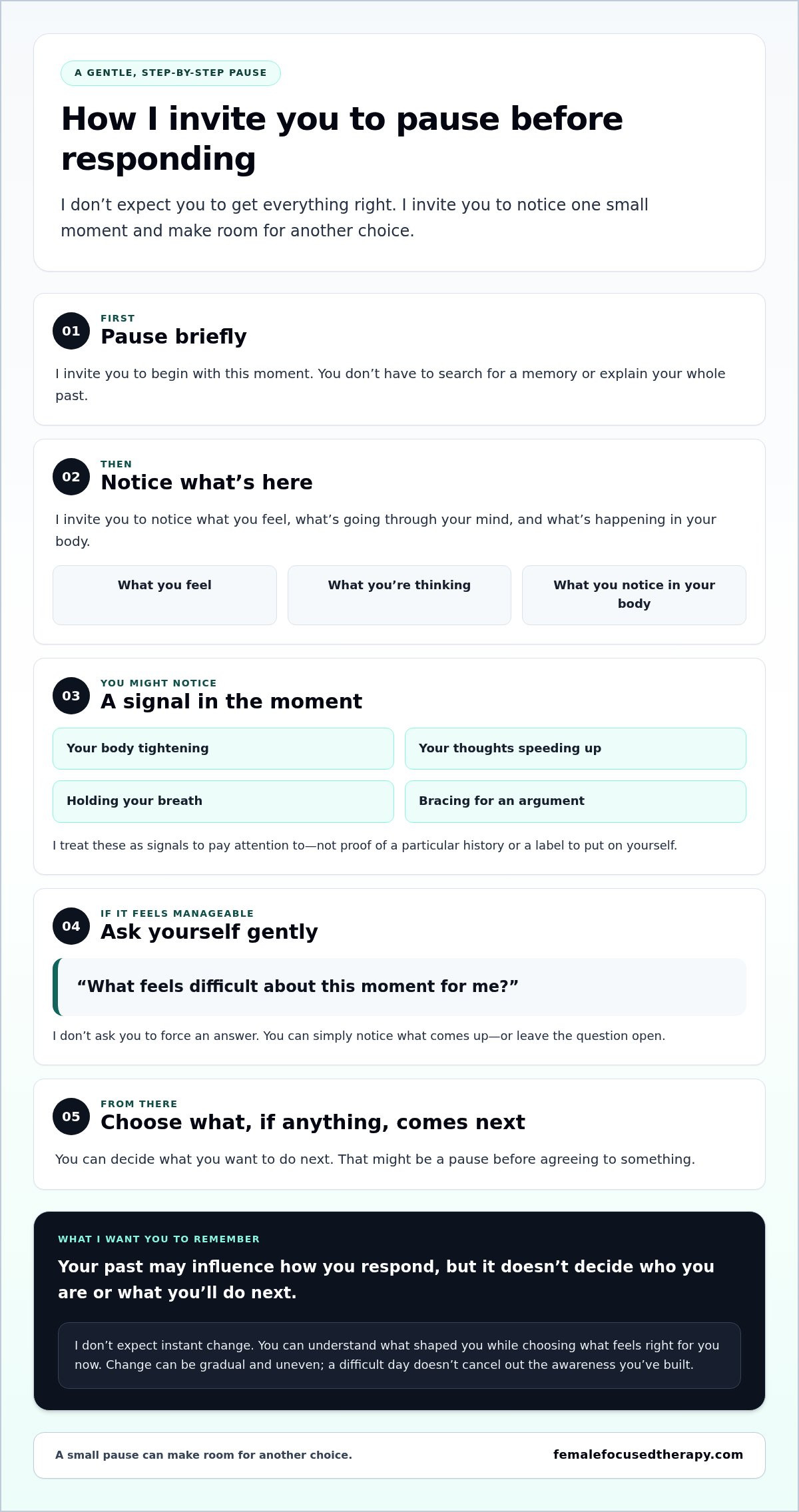
That choice might be a pause before agreeing to something, or a moment to notice tension in your body and ask yourself what you need. It may not feel easy every time. Change can be gradual and uneven, and a difficult day doesn’t cancel out the awareness you’ve built. If you’d like to explore how past experiences may affect your relationships, I also write about relationship trauma and narcissistic abuse. You don’t need every answer today.
How childhood experiences can shape responses without defining you
I think of learned responses as ways you may have found to cope with difficult moments. They can sometimes show up later, even when your circumstances have changed. That doesn’t mean your past explains every feeling or choice. I’d hold it as one possible part of a much bigger picture.
Your past may influence how you respond, but it doesn’t decide who you are or what you’ll do next.
Why an old response can appear in a new situation
You might notice yourself going quiet during a disagreement, even when you’d like to explain what you think. I wouldn’t assume one childhood experience caused your silence, or that it means something is wrong with you. I’d stay curious about what’s happening for you now, while leaving room for other influences on the moment.
Perhaps a tense tone or a change in someone’s expression brings a rush of worry before you’ve had time to work out what you’re feeling. You might notice your body tightening or your thoughts speeding up. I’d treat those as signals to pay attention to, not proof of a particular history or a label to put on yourself.
When I read about adverse childhood experiences (ACEs), I’m reminded that difficult early experiences can affect people in different ways. That context can be useful, but it can’t tell me exactly what’s happening for you. I’d also make room for your present circumstances, relationships and strengths.
How I can notice what is happening now
You don’t have to search for a memory or explain your whole past to become curious about a reaction. You could pause briefly and notice what you feel, what’s going through your mind, or what’s happening in your body. If it feels manageable, you might ask yourself, What feels difficult about this moment for me? You don’t have to force an answer.
You may simply notice that you’re holding your breath or bracing for an argument. From there, you can decide what, if anything, you want to do next. If you’re wondering how earlier experiences might affect a relationship, I share more about relationship trauma and narcissistic abuse. You can take time to understand your responses without assuming they define your whole story.
Breaking the cycle without blaming yourself or demanding perfection
You may want to understand how your past affects you now, while also worrying that doing so means blaming your family. Or perhaps you fear that recognising someone else’s difficulties could excuse behaviour that hurt you. I don’t think you have to settle every question about blame before your experience can matter.
You can hold mixed feelings. You might care about someone and still need distance, or feel unsure how to describe what happened. You don’t have to diagnose anyone, decide what they intended or reach a final conclusion before acknowledging how an experience affected you. Your understanding may shift over time. That doesn’t make what you felt less real.
Taking responsibility for your choices now is different from taking responsibility for what happened to you then. I see gentle accountability as asking what you want to do with a response today, while treating yourself with care. It isn’t blaming yourself for having learned that response or expecting yourself to change it perfectly straight away.
Can I acknowledge harm without deciding who is to blame?
I believe you can name an experience as painful without making a judgement about another person’s character or motives. You can also set a boundary because something doesn’t feel right for you, even if your understanding of the past is still unfolding. You’re allowed to take your time. You don’t need anyone else’s agreement before you listen to your own feelings.
What if I notice myself repeating a pattern?
You might realise after a tense conversation that you snapped, shut down or agreed to something you didn’t want. That moment doesn’t erase the effort you’ve made. If it feels safe and appropriate, you could pause, name what you’re feeling and consider one next step. Perhaps you return to the conversation later, clarify what you meant or offer an apology for your part without taking responsibility for everything.
Repair isn’t proof that you’ll never react in the same way again. It’s one possible way to respond after a hard moment. Progress may include noticing sooner, understanding what you need or simply being less harsh with yourself afterwards. I don’t expect a smooth, perfect path. Breaking the cycle of childhood trauma can involve trying, reflecting and beginning again.
An article called Breaking the Cycle of Childhood Trauma explores how a person’s efforts to heal may matter in family life. I’d hold that idea gently: it isn’t a demand that you prevent every difficulty or carry responsibility for everyone. Your work can begin with the choices that are yours to make.
If you’d like support thinking through those choices, I offer individual therapy in Singapore and online. You can explore booking an appointment at a pace that feels manageable to you.
Small ways I can practise a different response
I don’t think change has to begin with a grand promise to react differently from now on. It can begin with noticing one moment as it happens, or looking back on it later with a little more curiosity. Small choices can create room to practise a different response, one ordinary moment at a time.
You might move gently through noticing, naming, pausing, choosing and reflecting. I don’t mean this as a strict set of steps to get right. Some moments may allow only a pause; others may make more sense when you reflect afterwards. Breaking the cycle of childhood trauma isn’t about performing a perfect response. It’s about making a little space for what you need now.
How can I pause before an old response takes over?
If you notice a strong reaction building, see if you can name one feeling, such as worry or frustration, or notice one body signal, such as a tight jaw. You don’t need to push it away or work out why it’s there. Simply noticing can help you meet the moment with a little more care.
If it feels comfortable, take a gentle breath or feel your feet on the floor. This isn’t a cure or a way to make a difficult feeling disappear. It’s simply an option for giving yourself a moment before deciding what to do. You might then choose a manageable response: asking for time to think, saying what you need calmly, or deciding that now isn’t the right moment to continue the conversation.
Sometimes reflection can feel like too much. You’re allowed to stop, look around and return to something grounding in the present. You don’t have to revisit a memory or stay with a feeling that feels overwhelming. Support from someone you trust, or from a therapist, can help you explore at a pace that feels manageable.
How can I reflect without turning it into self-criticism?
Afterwards, I’d invite you to ask, “What did I need in that moment?” rather than “Why did I react like that?” Perhaps you needed reassurance, space or a clearer boundary. You might also notice what felt even slightly different, such as catching your reaction sooner or taking a breath before replying. The moment can still have been hard.
A difficult response doesn’t cancel your effort, and reflection isn’t a test you have to pass. If you’d like a gentle next step to take on your own, you can explore my free therapy resources. If you’d prefer to explore these patterns with me, you can book an individual therapy appointment. Breaking the cycle of childhood trauma can start with one small moment of noticing, without asking you to change everything at once.
How therapy can support breaking the cycle of childhood trauma
In my work as a registered integrative psychotherapist, I offer individual therapy as a confidential space to explore what’s happening for you at a pace that feels manageable. You don’t need to arrive with a clear account of your childhood or know exactly what you want to change. We can begin with what feels present in your life now.
I pay attention to your thoughts and feelings, as well as what you notice in your body. For example, you might talk about feeling tense before a difficult conversation, or unsure how to set a boundary. We can gently explore what you need in those moments, without assuming one cause or pushing you to revisit memories before you’re ready.
Therapy isn’t a diagnosis, a guarantee or a demand to share every detail of your past. I can’t promise a particular outcome. I can offer space to make sense of your experience, consider different responses and move at a pace that respects your sense of safety. For me, breaking the cycle of childhood trauma isn’t about forcing change. It’s about having support as you explore what feels possible now.
What might I explore with a therapist?
You might choose to look at present-day patterns, needs or boundaries, rather than beginning with childhood memories. You can share only what feels okay to share. I’ll make room for your pace, including pauses or a change of focus if something feels like too much. If you’re in Singapore, I offer individual psychotherapy in person and online.
How can I take a first step when I feel ready?
A small first step could be writing down what you hope to feel supported with. You might note a pattern you’d like to understand, or simply that you want a space to talk without having to explain everything at once. You can bring that note with you, or keep it private until you feel ready.
If you’d like to explore this with me, you can book an individual psychotherapy appointment. There’s no need to have everything worked out first. You can begin with one question, one feeling or whatever feels most manageable to you.
Let a gentler next step be enough
You don’t have to understand every part of your past before you begin making sense of the present. Childhood experiences may influence familiar reactions, but they don’t define your future. Noticing a feeling, pausing before you respond or reflecting with kindness afterwards can all be meaningful steps.
Breaking the cycle of childhood trauma isn’t about blaming yourself, confronting anyone or getting every moment right. It can mean making room for a choice that feels more fitting for you now, and beginning again when things don’t go as you hoped.
I’m Cheryl Kennedy MacDonald, a registered integrative psychotherapist. I’ve spent over 20 years working with women, and I offer individual psychotherapy in Singapore and online. Therapy can give you a confidential space to explore what’s happening at a pace that feels manageable, without pressure to share everything or expect instant change.
If you feel ready, you can book an appointment with me. You might begin by noting one thing you’d like support with. For now, let one small, compassionate step be enough.
Frequently Asked Questions
Can I break the cycle of childhood trauma without blaming my parents?
Yes, you can explore how your past affects you without deciding that someone must be blamed. I’d focus on what you experienced and how you want to respond now. Understanding the impact of an experience doesn’t mean excusing behaviour that hurt you, either. You’re allowed to have mixed feelings, set boundaries and let your understanding change over time. Your experience matters, even if you’re still making sense of it.
How do I know if childhood experiences are affecting my adult relationships?
You may notice a response that feels familiar or stronger than you expected, such as finding it hard to express a need or feeling unsettled during disagreement. That doesn’t prove childhood experiences are the cause. I’d invite you to look with curiosity at what happens, what you feel and what you need, while remembering that present-day stress and other experiences can also shape relationships.
What is the first step in breaking the cycle of childhood trauma?
A gentle first step is noticing one moment when you react in a way that leaves you feeling confused or uncomfortable. You don’t need to explain it straight away or revisit a memory. You might simply name what you feel and ask, “What do I need right now?” Breaking the cycle of childhood trauma can begin with this small pause, without expecting yourself to respond perfectly next time.
Can I heal from childhood trauma without remembering everything?
Yes, you don’t need to remember or share every detail to explore how you feel in the present. You can begin with what you notice in your relationships, thoughts or body, and decide what feels manageable to discuss. I wouldn’t encourage you to force memories or search for a particular explanation. Therapy can make room for your experience at your pace, without requiring you to tell your whole story at once.
How long does it take to break a cycle of childhood trauma?
There isn’t a set timeframe I can promise. Your experience, circumstances and needs are your own, and change may feel gradual or uneven. You might notice a small shift, such as recognising a reaction sooner, while other patterns take more time to understand. A difficult day doesn’t erase the effort you’ve made. I’d encourage you to be patient with yourself rather than treating healing as a deadline.
What happens if I notice myself repeating a pattern?
Noticing a familiar pattern doesn’t mean you’ve failed. If you can, pause and name what you’re feeling before choosing one small next step. That might mean asking for time, expressing a need or returning to a conversation later. If your response has affected someone else, you may choose to repair your part when it feels appropriate. You can reflect on what you needed, without turning the moment into a reason to criticise yourself.
Can therapy help me work through childhood trauma as an adult?
Therapy can offer space to explore how earlier experiences may connect with present-day feelings, relationships and choices, without assuming one cause or promising a particular outcome. I’m Cheryl Kennedy MacDonald, a registered integrative psychotherapist with over 20 years of experience working with women. I offer individual psychotherapy in Singapore and online. You can begin with what feels present now, and decide with me what feels manageable to explore.
If you’d like to find out more about working with Cheryl Kennedy MacDonald, you can email her at cheryl@femalefocusedtherapy.com, book an appointment with Female Focused Therapy, or explore lifestyle and yoga programmes by visiting YogaBellies.

Article by
Cheryl Kennedy MacDonald MA BA (Hons) Pg. Dip. SAC BACP
Cheryl Kennedy MacDonald is a psychotherapist specialising in women’s mental health, relationships, and life transitions. She works with women navigating trauma, relationship breakdown, identity shifts, and midlife change, helping them rebuild self-trust, emotional stability, and a clear sense of who they are and what they want.
With over 20 years’ experience working with women internationally, Cheryl is the founder of YogaBellies, a global women’s yoga school, and the creator of the Birth ROCKS method. Her work sits at the intersection of psychotherapy and embodiment, integrating evidence-based therapeutic approaches with somatic, body-based practices that support deep, lasting change.
Known for her grounded and direct approach, Cheryl moves beyond surface-level insight to address the patterns held in the body and nervous system. Her work supports women to regulate, reconnect, and respond to their lives from a place of clarity, strength, and self-respect.
She is a published author in academic journals and has written multiple books on women’s health, pregnancy, and midlife wellbeing, available on Amazon and leading book retailers worldwide.