
You know that feeling when your brain is racing, but your body feels like lead? Or perhaps you’ve spent years in talk therapy, yet that tight knot in your chest just won’t budge. I understand how exhausting it is to feel “wired but tired” while trying to navigate life’s transitions.
It’s frustrating when you’ve done the mental work but still don’t feel quite safe in your own skin. I’ve found that integrating somatic wisdom can help you heal from trauma, manage ADHD, and find a deeper sense of internal restoration. It’s about moving beyond just talking to truly feeling at home again.
In this post, I’ll show you how body based approaches to mental health for women can bridge the gap between knowing you’re safe and actually feeling it. I’ll share practical tools to calm your nervous system and help you move towards a life where you feel grounded and whole.
Key Takeaways
- I’ll help you understand why your body often holds onto tension and stress long after your mind has tried to move on.
- Discover how body based approaches to mental health for women can offer relief from the “wired but tired” feeling often linked to ADHD and burnout.
- Learn how to navigate the profound transitions of midlife and menopause by treating your physical sensations as a guide rather than an obstacle.
- Explore my gentle methods for integrating somatic awareness into our therapy sessions to help you find a deeper sense of safety in your own skin.
- I’ll share simple ways you can begin to listen to your body today, starting with the restorative power of breath and the permission to rest.
Why your body remembers what your mind tries to forget
I see so many women who can describe their history with incredible detail. They’ve done the work, they’ve been to the sessions, and they know exactly why they feel the way they do. Yet, as they speak, I notice their shoulders creeping toward their ears or their breath becoming shallow and tight in their chest.
This is what we mean when we say “the body keeps the score.” It isn’t just a catchy book title; it’s a physiological truth. Your cells and your nervous system store the impact of life’s challenges long after your logical mind has tried to file them away. You might think you’ve moved on, but your body is still reacting to an old script.
Body based approaches to mental health for women focus on this exact gap. Somatic work isn’t about ignoring your thoughts or your story. Instead, it’s about learning to listen to the physical signals your body is sending. By doing this, we can finally find peace from the inside out, bridging the distance between knowing you are safe and actually feeling it.
The language of your nervous system
Have you ever felt “wired but tired”? It’s that exhausting state where your mind is racing with a thousand to-do lists, but your body feels like lead. This isn’t just a mood. It’s a physical signal that your nervous system is stuck in a loop of high alert, unable to find the “off” switch.
I often describe the vagus nerve as your body’s internal calm-down switch. When we use body based approaches to mental health for women, we’re essentially learning how to flip that switch. By noticing where you hold tension, we can translate those physical knots into emotional insights that your brain can actually process and release.
Moving beyond the “ceiling” of talk therapy
Talking is wonderful, but it has a ceiling. Sometimes, the more we talk, the more we stay stuck in a loop of over-analysis. We try to think our way out of a feeling, but you can’t logic your way out of a deep-seated nervous system response. It’s like trying to talk a fire into putting itself out.
I remember the moment I realised my own ADHD brain needed more than just conversation. I could talk about my overwhelm for hours, but my body was still vibrating with restless energy. I needed to move, to breathe, and to settle my physical self before my mind could find clarity. My body had to lead the way.
This is especially true when healing from relationship trauma recovery. When someone has crossed your boundaries, your body often learns to stay on guard for safety. Reconnecting with your physical sensations is a vital step in rebuilding the self-trust that trauma takes away, allowing you to feel grounded in your own skin again.
How somatic approaches support your mental health
I focus on creating what I call a safe container for your emotions to move through you. For many high-functioning women, the natural habit is to suppress feelings and “power through” the day. While this helps you get things done, it often leads to a deep, physical burnout where your body simply refuses to carry on. Using body based approaches to mental health for women helps you process these trapped emotions so they don’t stay stuck in your system.
Rebuilding self-trust is a vital part of the work I do. Trauma often leaves us feeling like our bodies have betrayed us or that they are no longer a safe place to live. My approach combines evidence-based therapy with the quiet wisdom of movement and restorative rest. We work together to help you reconnect with your physical self, allowing you to trust your gut instincts and your internal signals once again.
I believe that healing shouldn’t feel like another chore on your to-do list. Instead, it’s a process of slowing down and giving your nervous system the space it needs to recalibrate. By blending traditional talk therapy with somatic awareness, we can address the root of your overwhelm rather than just managing the symptoms. If you feel ready to start this process, you can book a session with me to explore how we can work together.
Releasing the grip of narcissistic abuse
If you’ve survived a narcissistic relationship, your body spent a long time “on guard” just to get through the day. You might still find yourself scanning for danger or holding your breath without even realising it. This is your nervous system trying to protect you, but it’s exhausting to live in a constant state of high alert.
I’ll help you use somatic tools to gently discharge that stored survival energy. Reclaiming your breath is one of the most powerful ways to tell your body that the threat is over. It allows you to reclaim your sense of personal space and rebuild the boundaries that were once crossed, helping you feel secure in your own skin again.
Somatic support for the ADHD brain
I understand the “emotional itch” of the ADHD brain because I live with it too. It’s that restless, prickly feeling where your skin feels too tight or the world feels too loud. When your brain is moving at a hundred miles an hour, your body can feel like it’s struggling to keep up, leading to intense sensory overwhelm.
We use grounding and proprioception to help you feel your physical place in the world. Proprioception is simply the sense of where your body is in space, and focusing on it can be incredibly calming for a neurodivergent mind. If you’re struggling with this kind of overwhelm, ADHD-focused therapy can offer a path to feeling more settled and less reactive to the world around you.
Navigating life transitions with a mind-body perspective
Transitioning into midlife can feel like the ground is shifting beneath your feet. I believe this stage of life is a profound invitation to reconnect with your physical self. It’s often the first time many of us stop to listen to what our bodies actually need rather than just what we expect them to do or how we expect them to look.
During perimenopause and menopause, the way your body handles stress changes on a biological level. Your nervous system becomes more sensitive, and old coping mechanisms might suddenly stop working. This is why body based approaches to mental health for women are so effective; they meet you where you are physically, acknowledging the hormonal reality of your daily experience.
When your role in life shifts, whether through career changes, children leaving home, or caring for aging parents, it’s easy to lose your sense of self. I focus on helping you rebuild internal confidence by grounding you in the one thing that remains constant: your own physical presence. By learning to trust your body’s signals, you can navigate these changes with a renewed sense of self-assurance.
Menopause as a somatic experience
I view hot flushes, night sweats, and sleep changes as more than just “symptoms” to be fixed or suppressed. They are somatic signals of a body in deep transition. When we treat these experiences with curiosity rather than frustration, we can find a sense of home even as our physical selves change. I’ve found that body based approaches to mental health for women provide the stability needed to feel grounded during these turbulent years.
Somatic therapy allows you to navigate these shifts without feeling like you’re at war with your own biology. If you’re struggling to feel like yourself during this time, exploring menopause and midlife therapy can help you find stability amidst the flux. It’s about moving from a place of resistance to a place of internal restoration.
The power of gentle, somatic movement
I never ask you to do a “workout” in our sessions. Instead, we focus on a “work-in.” While traditional exercise often focuses on performance or aesthetics, somatic movement is entirely about how you feel from the inside. It’s a way of checking in with your nervous system rather than checking out of your body.
There is a significant difference between performative yoga, where you’re trying to hit a specific pose, and somatic movement. We use micro-movements to release deep-seated tension that talk therapy alone might not reach. These small, intentional shifts can move you out of a heavy emotional state in just a few minutes, reminding you that you have the power to shift your internal landscape whenever you need to.
Gentle ways to reconnect with yourself today
I want to share a few simple ways you can begin listening to your body right now. Many women I work with feel they have to “solve” their way out of stress, but the most radical thing you can do is give yourself permission to rest. I often treat this permission as a vital therapeutic intervention. It gives your nervous system a chance to finally catch up with your busy life.
Body based approaches to mental health for women start with these foundational moments of stillness and safety. You can practice grounding anywhere, even at your desk or while sitting in your car. Try noticing the weight of your feet on the floor or the way the chair supports your back. These small moments of awareness tell your brain that you are physically present and safe in this moment.
Finding your “safe place” internally
I often guide my clients through a brief visualization to find a sense of internal safety. If your whole body feels overwhelmed, try to find just one small part that feels neutral or calm right now. It might be your earlobe, your little finger, or even the tip of your nose. Resourcing is the intentional act of finding internal pockets of calm or strength to help you stay steady when life feels too big.
The restorative power of the exhale
I focus on the out-breath because a long, slow exhale sends a direct signal to your brain that the danger has passed. Take two minutes today to simply let the air fall out of your body slowly without forcing it. As you read this, notice how your shoulders feel. Are they pulled up tight, or can you let them drop just a fraction?
These tiny shifts are the building blocks of a more regulated and peaceful life. If you’re ready to integrate body based approaches to mental health for women into your own healing journey, you can book a session with me. We will work together to find a path that honors your mind, your body, and your unique story.
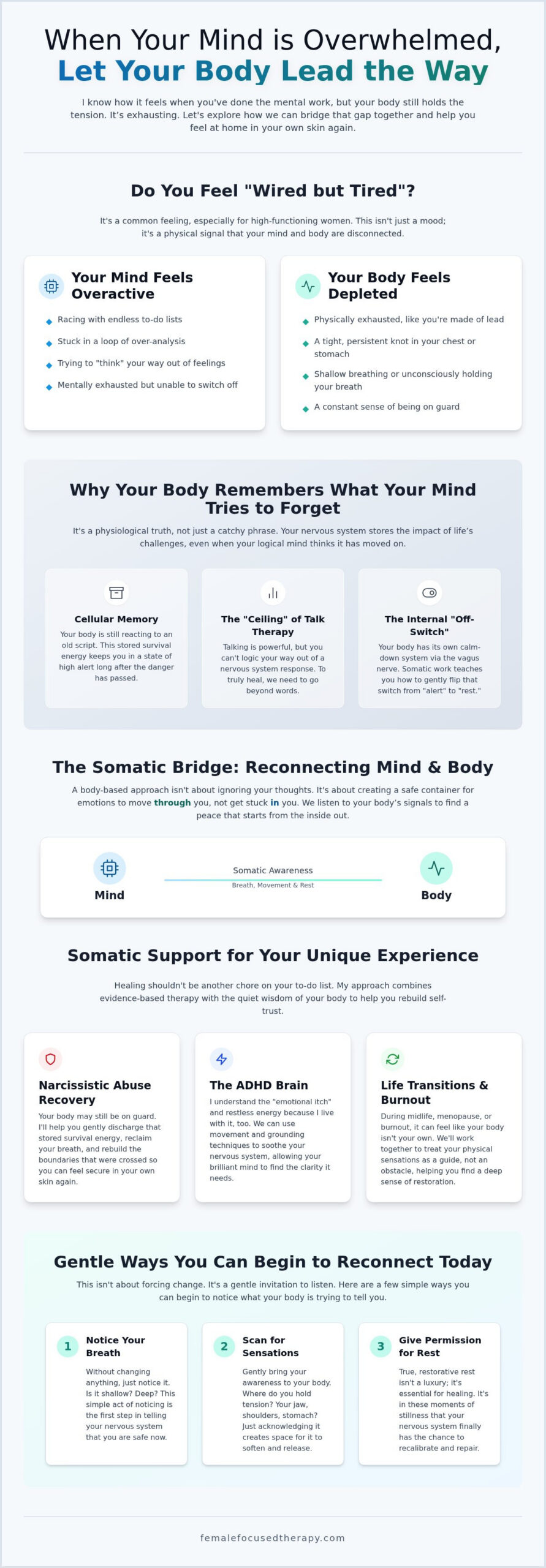
How I integrate somatic wisdom into our sessions
I offer a space where your mind and body are treated as one. When we work together, we don’t just talk about your life; we look at how your life lives within you. Whether we are meeting in person in Singapore or through online therapy, my focus remains on your internal restoration. I’ve found that integrating body based approaches to mental health for women allows for a much deeper level of healing than talk therapy alone can provide.
I always follow your lead. You are the absolute expert on your own physical experience, and my role is to act as a gentle guide as you rediscover your body’s language. We only move at a pace that feels safe and manageable for you. There is no pressure to “perform” or reach a certain state; we simply hold space for whatever is present in your nervous system.
A collaborative journey of healing
I describe our work as a partnership to rebuild your self-trust. My background as a yoga master deeply informs our clinical sessions, but this isn’t about doing poses. It’s about using somatic awareness to help you bridge the gap between knowing you are safe and actually feeling it in your bones. We use breath and micro-movements as tools to help you navigate the world with more ease.
Please be reassured that you don’t need any special skills or previous experience to start this work. You don’t need to be “good at meditating” or have a certain level of physical fitness. All you need is a willingness to be curious about your own internal world. We work together to translate physical tension into emotional insight, helping you find a sense of home within yourself again.
Your realistic next step
I invite you to take a small moment right now to breathe and check in with yourself. Notice the chair beneath you or the air on your skin. If you feel a resonance with what I’ve shared, I would love to support you on this journey toward restoration. You don’t have to navigate these transitions or the weight of your past alone.
If you feel ready to explore how we can work together, your next step is simple. You can book a consultation with me to see if we are a good fit. Whether you are dealing with the “wired but tired” feeling of ADHD or the deep impact of trauma, we can find a path forward that honours your whole self.
Finding your way back to a grounded self
I hope you feel a little more seen today, knowing that your physical overwhelm isn’t a flaw; it’s a signal. We’ve explored how your body holds onto past experiences and how body based approaches to mental health for women can help you release that stored tension. Whether you’re navigating the sensory world of ADHD or the complex shifts of midlife, your body is a wise companion on the healing journey.
My work is always about creating a safe, boundaried space where we can blend clinical expertise with somatic wisdom. I’m here to support you in rebuilding that vital sense of self-trust and internal stability. You don’t have to stay stuck in a loop of over-analysis or chronic fatigue. There is a path toward feeling truly at home in your own skin again.
If you’re ready to move forward with an approach tailored specifically to your needs as a woman, I’m here to help. Book your consultation with me to start your healing journey. You deserve to feel safe, steady, and restored.
Common questions about embodied healing
What exactly is a body-based approach to mental health?
It is a way of working that focuses on the physical sensations in your body as a gateway to emotional healing. Instead of just talking about your feelings, we look at where they live in your nervous system. These body based approaches to mental health for women help you bridge the gap between understanding your problems and actually feeling a sense of internal safety. It’s about listening to your body’s unique language.
Do I need to be good at yoga to try somatic therapy?
No, you don’t need any experience with yoga or any specific level of physical fitness to start this work. While I am a yoga master, our sessions are about somatic awareness rather than performative poses. We use very gentle movements and breath to check in with your internal state. The goal is to help you feel more comfortable in your own skin, not to master a difficult physical skill.
How can somatic therapy help with my ADHD symptoms?
It helps by addressing the sensory overwhelm and restlessness that often come with a neurodivergent brain. I use body based approaches to mental health for women to help you find grounding when your mind feels scattered. By focusing on proprioception and your physical place in the world, we can calm the “emotional itch” of ADHD. This allows your nervous system to settle, making it much easier to manage daily focus.
Is body-based therapy safe for someone with a history of trauma?
Yes, it is designed to be a safe and gentle way to process trauma. We work at a pace that you dictate, ensuring you never feel pushed beyond your capacity. I focus on creating a secure container where you can slowly reconnect with physical sensations that might have felt scary in the past. We always prioritise your comfort and boundaries, helping you rebuild the self-trust that trauma often takes away.
How is this different from a regular massage or exercise?
While massage and exercise are wonderful, somatic therapy is a clinical intervention focused on emotional processing. Massage involves someone else working on your body, whereas somatic work is about you learning to listen to your own internal signals. Exercise often focuses on external goals or “checking out,” but somatic sessions are a “work-in.” We use specific movements to release stored emotional energy and regulate your nervous system together.
Can we do somatic therapy sessions online?
Absolutely, we can do these sessions through online therapy just as effectively as in person. Because the work is about your internal awareness and gentle, self-guided movement, I can guide you through the process from wherever you feel most safe. Many women find that being in their own home environment actually makes it easier to relax and connect with their physical sensations during our time together.
How long does it take to feel the benefits of somatic work?
Many women feel a sense of relief or grounding after just one session, but long-term healing is a steady journey. Rebuilding a relationship with your body and retraining your nervous system takes time and patience. You might notice small shifts in your sleep or stress levels within a few weeks. The goal is a lasting internal restoration that helps you feel more resilient and at peace over the coming months.

Article by
Cheryl Kennedy MacDonald MA BA (Hons) Pg. Dip. SAC BACP
Cheryl Kennedy MacDonald is a psychotherapist specialising in women’s mental health, relationships, and life transitions. She works with women navigating trauma, relationship breakdown, identity shifts, and midlife change, helping them rebuild self-trust, emotional stability, and a clear sense of who they are and what they want.
With over 20 years’ experience working with women internationally, Cheryl is the founder of YogaBellies, a global women’s yoga school, and the creator of the Birth ROCKS method. Her work sits at the intersection of psychotherapy and embodiment, integrating evidence-based therapeutic approaches with somatic, body-based practices that support deep, lasting change.
Known for her grounded and direct approach, Cheryl moves beyond surface-level insight to address the patterns held in the body and nervous system. Her work supports women to regulate, reconnect, and respond to their lives from a place of clarity, strength, and self-respect.
She is a published author in academic journals and has written multiple books on women’s health, pregnancy, and midlife wellbeing, available on Amazon and leading book retailers worldwide.