
You’re sitting with your phone in your hand, heart racing as you stare at a message from your mother. You want to say no to her latest request, but that familiar, heavy pressure settles in your chest, making you feel like a “bad daughter” before you’ve even typed a word. I’ve spent years sitting with women who feel this exact same weight, and I want to help you understand why this guilt feels so paralysing.
I know how exhausting it is to be the family fixer, the one who always says yes to keep the peace while your own needs get pushed to the bottom of the list. You likely feel like you’re constantly second-guessing your decisions, wondering if you’re being selfish for wanting a life that’s separate from your family’s expectations. It’s a heavy and lonely place to be, but I want you to know that you aren’t alone.
I’ll help you understand why these patterns are so hard to break and show you how to start reclaiming your life with compassion and self-trust. We’ll look at how to calm those physical sensations, quiet the noise of criticism, and begin the gentle process of rebuilding your internal confidence so you can finally feel allowed to live for yourself.
Key Takeaways
- I’ll help you recognise the “Good Daughter” role and understand why trying to do the right thing often leaves you feeling completely empty.
- We’ll look at the fawn response in your nervous system to see how family guilt keeps adult women stuck in old, painful patterns.
- You’ll learn to distinguish between healthy compassion for your loved ones and the toxic guilt that is often used as a tool for control.
- I’ll share simple, somatic practices to help you notice the physical sensations of guilt and reclaim your power through “the pause.”
- I’ll show you how to start rebuilding self-trust so you can finally feel allowed to have a life that is truly your own.
When “Doing the Right Thing” Leaves You Feeling Completely Drained
I want to acknowledge that heavy, sinking feeling in your stomach when you even think about choosing yourself over a family demand. It is a physical weight, like a stone in your chest, that makes you feel as though you are doing something wrong just by existing as your own person. This is exactly how family guilt keeps adult women stuck in a cycle of quiet exhaustion and resentment.
You might be incredibly successful in your career, a leader in your field, or a pillar of strength for your friends. Yet, despite your intelligence and capability, one disappointed look from a parent can make you feel small and powerless again. These invisible strings of obligation pull you back every time you try to move forward, making your own needs feel like a secondary concern.
I see so many women who have spent decades being the “fixer,” the one who holds everyone else together while their own battery is on zero. You aren’t failing because you feel this way; you are reacting to a role you were likely cast in long ago. Understanding the origin of this pressure is the first step toward healing from relationship trauma and reclaiming your energy.
The Weight of the “Good Daughter” Narrative
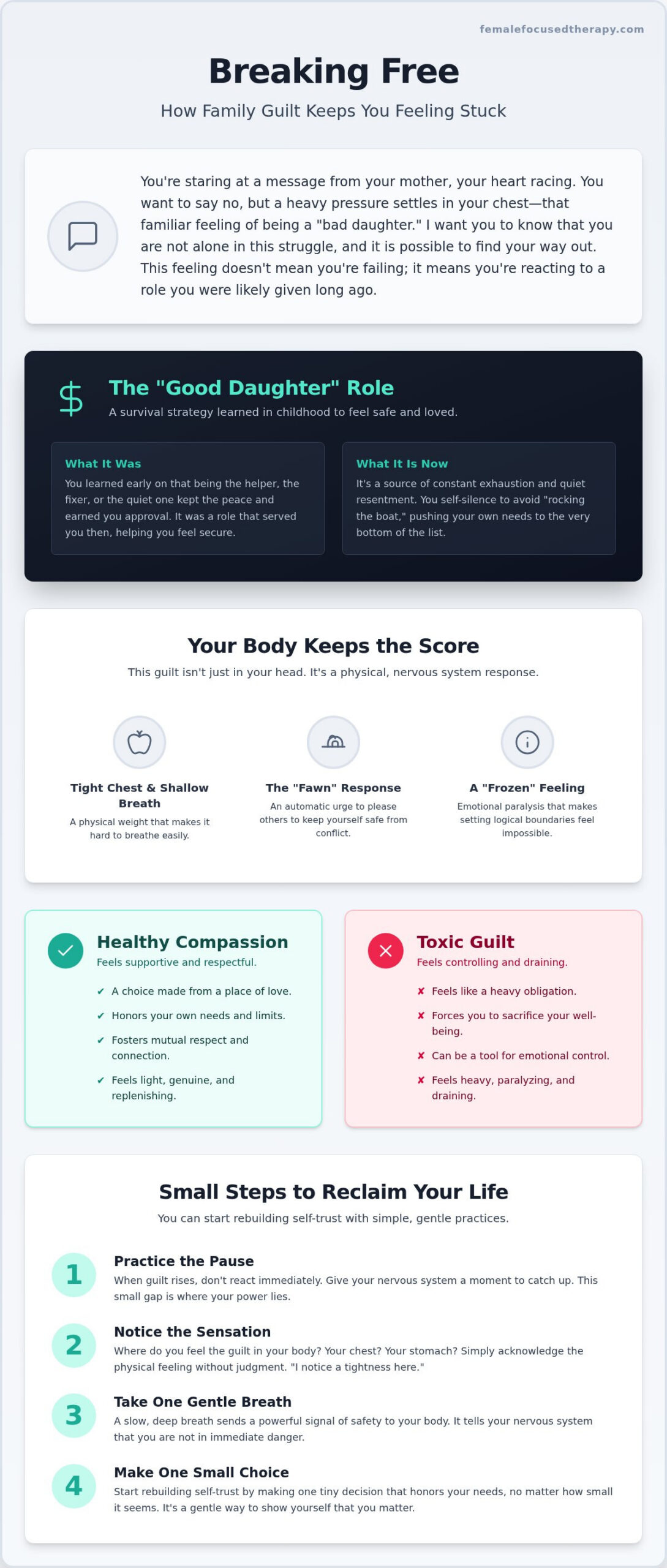
For many of us, being the “good daughter” was a survival strategy we learned as children to feel safe and loved. You learned early on that being the helper or the quiet one kept the peace and earned you approval. While this served you then, it drains you now, as you’re still self-silencing to avoid rocking the family boat.
It’s why you feel like you’re five years old the moment a family member starts to explain what is a guilt trip without even using words. That internal child is still trying to earn the “good” label, even if it means sacrificing your own peace. This persistent need to be the “fixer” becomes a primary identity that’s hard to shed, even when you’re miles away from home.
When Family Loyalty Becomes Emotional Paralysis
True loyalty is a choice made from a place of love, but for many women I work with, it feels more like emotional paralysis. If you look closely, you might find that your loyalty is actually a deep-seated fear of being rejected or abandoned. You’ve become so skilled at managing everyone else’s emotions that you’ve forgotten how to listen to the signals in your own body.
This “stuckness” doesn’t stay confined to your family life; it ripples out into every other area of your world. It’s how family guilt keeps adult women stuck in careers where they can’t say no to overtime, or in friendships where they do all the emotional heavy lifting. When you’re constantly bracing for someone else’s disappointment, you don’t have the space to trust your own intuition or build a life that feels truly yours.
Understanding Why Your Body Stays in “Good Daughter” Mode
I often describe that overwhelming urge to keep everyone happy as a “fawn” response. It’s a survival mechanism within your nervous system that prioritises keeping others calm to ensure your own safety. This is a primary reason how family guilt keeps adult women stuck; your body is literally trying to protect you from what it perceives as a threat to your connection with your family.
When you feel that familiar, heavy pressure, it isn’t just in your head. You might notice your chest tightening, your breath becoming shallow, or a “frozen” feeling in your limbs. These are physical signals of intergenerational trauma, which is often stored in our cells rather than just our memories. Your body remembers the stress of your ancestors and your own childhood, reacting as if a family disagreement is a life-threatening event.
Because your nervous system associates being “good” with being safe, “just saying no” can feel like a genuine threat. I’ve seen how this physical reaction makes logical boundaries feel impossible to maintain. If you want to Cope With Parent Guilt effectively, we have to address these somatic responses rather than just trying to think our way out of them.
The Somatic Experience of Family Obligation
Your body is incredibly skilled at remembering childhood patterns of seeking approval. If you grew up in an environment where your needs were secondary, your nervous system likely stayed in a state of high alert. This chronic stress is what fuels the “Good Daughter” role, keeping you hyper-aware of your parents’ moods and expectations.
I encourage my clients to use gentle breath and intentional rest to signal safety back to their bodies. By slowing down the physical response, you can begin to unlearn the “stuckness” that has been held in your muscles for years. It’s about teaching your body that you are safe now, even if someone else is disappointed in your choices.
ADHD and the Intensity of Family Guilt
Physical movement is a powerful tool for releasing this stored tension. For those looking for inspiration on how to incorporate fitness into their self-care routine, ChadsFit Mobile Personal Training provides a supportive model for building strength and reclaiming your physical agency in the privacy of your own home.
For my clients with ADHD, the weight of family guilt can feel even more intense. Rejection sensitivity can make even a small piece of family criticism feel like a physical blow. When your brain is wired for high sensitivity, the “noise” of family expectations can become deafening, making it even harder to trust your own intuition.
Meeting rigid family expectations is often exhausting with a neurodivergent brain that thrives on spontaneity and interest. If you find yourself constantly overwhelmed by these dynamics, exploring ADHD therapy can help you build strategies that respect your unique wiring. I offer a safe, non-judgmental space to explore these feelings in my online therapy sessions if you feel ready to start that journey of internal restoration.
Distinguishing Between Healthy Compassion and Toxic Guilt
I often tell my clients that guilt, in its healthy form, is simply a signal that we’ve acted against our own values. It’s meant to be a temporary compass that helps us make amends. But when we look at how family guilt keeps adult women stuck, we’re usually talking about something much more heavy and persistent. Toxic guilt isn’t about your values; it’s a tool used by others to maintain control and ensure your compliance with their needs over your own.
One of the most damaging patterns I see is the “you owe me” mentality. It turns a parent-child relationship into a transaction where your autonomy is the currency. You might feel a constant, nagging pressure to pay back a debt you never asked for. This dynamic often leaves long-term mental scars of guilt-tripping that affect your self-worth for decades. It’s vital to remember that while you can support a family member, you are never responsible for their emotional regulation or their ultimate happiness.
In my work with relationship trauma and narcissistic abuse, I help women identify when they are being held hostage by these emotional demands. Recognising the difference between a genuine family need and a manipulative tactic is the first step toward internal restoration. You aren’t being “bad” for wanting a life that belongs to you; you’re simply reclaiming the space you were always meant to have.
Signs Your Family Guilt is Being Used as Control
Toxic guilt is often loud, even when it’s silent. It relies on your empathy to keep you in line. You might recognise these patterns in your own family system:
- The frequent use of “After all I’ve done for you” to shut down your attempts at setting boundaries.
- Passive-aggressive displays like “rage cleaning” or the silent treatment when you don’t immediately comply with a request.
- A conditional feeling of warmth where you only feel “loved” or “good” when you are being useful or self-sacrificing.
Reclaiming Your Right to Personal Autonomy
Reclaiming your life starts with the radical idea that you can love someone deeply without agreeing to their every demand. I know this feels dangerous to your nervous system, but setting a boundary is actually an act of kindness for the relationship. It defines where you end and they begin, which is the only way a genuine connection can survive without resentment poisoning it.
Learning to sit with the discomfort of their disappointment is a practice of self-trust. It feels like a storm in your body at first, but it’s a storm you can weather. By choosing your own well-being over the temporary comfort of people-pleasing, you stop the cycle of how family guilt keeps adult women stuck and begin to live with a renewed sense of self-assurance.
Small Ways to Start Reclaiming Your Own Life Today
I’ve found that the road to freedom isn’t about one giant leap or a dramatic family confrontation. It’s about tiny, quiet shifts that happen inside you first. Because the way how family guilt keeps adult women stuck is deeply physical, our first steps toward reclaiming our lives must also be rooted in the body and the present moment.
The first step is simply to notice the sensation in your body before you say “yes” to a family request. Do you feel a sudden tightening in your throat or a sinking in your stomach? Just noticing this without judgment is a huge win. Next, I encourage you to practice “the pause.” Give yourself five minutes before responding to a text or a call. This small gap allows your nervous system to settle so you can respond from a place of choice rather than a “fawn” reaction.
You can also begin to rebuild self-trust by making one small choice just for you today, something that has nothing to do with anyone else’s expectations. After a difficult family visit, try using somatic movement to literally shake off that heavy, stuck feeling. Shaking your limbs or taking a few deep, audible exhales helps tell your body the “threat” is over. Most importantly, ensure you have a confidential space where you can process these feelings without the noise of family criticism.
Building Your Internal Compass
Reclaiming your life means learning to listen to your own intuition again, which can feel very quiet after years of prioritising others. I often suggest starting with “micro-boundaries.” These are small internal limits that no one else even needs to know about, like deciding you won’t check family messages after 8 pm. It’s about reframing “selfishness” as necessary self-stewardship; you aren’t taking away from others, you’re simply tending to your own garden so you have the energy to exist fully.
Restoring Your Energy Through Somatic Rest
When family drama feels overwhelming, simple grounding techniques can bring you back to yourself. Try placing one hand on your heart and one on your belly, feeling the rise and fall of your breath. This role of rest is vital in healing from long-term emotional obligation. Movement helps release the energy of guilt that gets trapped in our muscles, while intentional rest allows our nervous system to finally feel safe. If you feel ready to explore these patterns in a supportive environment, you can book a session with me to start your journey of restoration.
How We Can Work Together to Rebuild Your Self-Trust
I offer a warm, integrative approach because I know that untangling these complex family ties requires more than just talk. It requires a space where you feel safe enough to explore the parts of yourself that have been silenced for too long. This is how we address the ways how family guilt keeps adult women stuck, by looking at the whole picture of your life and your history.
My work is deeply informed by my own experiences as a woman with ADHD and my training in trauma-informed care. I understand that your brain and your body might react to family pressure in ways that feel overwhelming or physically painful. We’ll work together to understand these reactions without judgment, creating a bridge between your mind and your body that allows for genuine healing.
My goal is never to “fix” you, because I don’t believe you are broken. Instead, I’m here to help you find your own internal stability and peace. We’ll focus on restoring your sense of self so you can make choices that reflect who you are today, rather than who your family expects you to be. It’s about helping you find the solid ground you’ve been searching for.
I combine evidence-based tools like CBT with mindfulness and somatic practices to offer a whole-body approach to your well-being. We’ll always work at a pace that feels safe and manageable for you, ensuring you never feel rushed by the process. I specialise in supporting women through life transitions and the delicate work of relationship recovery.
Taking the First Step Toward Freedom
You don’t have to carry this weight alone anymore. It’s possible to heal and find your own voice without losing the parts of yourself that you value. I invite you to explore a new way of being, where your choices are guided by your own intuition rather than the echoes of family criticism. Healing is a steady, gentle process, and you are allowed to take that first step today.
Finding Your Way Back to Yourself
Reclaiming your life from the heavy weight of family expectations is a gentle, ongoing process. We’ve explored how family guilt keeps adult women stuck by triggering a physical fawn response that can leave you feeling paralysed. By learning to distinguish between healthy compassion and the toxic guilt used for control, you can begin to quiet the noise of criticism and listen to your own intuition once again.
I want you to remember that your needs are not a burden. Healing happens when we address both the mind and the body, using somatic movement and intentional rest to restore your internal confidence. As a registered integrative psychotherapist specialising in relationship trauma and ADHD, I am here to provide the warm, professional support you need to navigate these complex family ties.
You don’t have to carry the weight of being the “good daughter” at the expense of your own well-being any longer. If you feel ready to move forward with a renewed sense of self-assurance, I invite you to book a session with me to start reclaiming your life. You deserve a life that feels truly yours, and I would be honoured to support you in finding it.
Frequently Asked Questions
How do I stop feeling guilty for saying “no” to my family?
Start by acknowledging the physical sensation in your body before you speak. Guilt often manifests as a heavy weight in your chest, which is simply a signal from an old survival pattern. Practising “the pause” gives your nervous system time to settle, allowing you to respond from a place of choice. You aren’t being unkind by setting a limit; you’re protecting your energy so you can show up more authentically.
Is it possible to set boundaries without cutting off my parents?
Boundaries are actually designed to preserve relationships rather than destroy them. They define where you end and your parents begin, which prevents the resentment that often leads to total estrangement. You might start with internal limits, such as deciding which topics are off-limits or how long you’ll stay for a visit. By being clear about what you can give, you create a sustainable way to remain connected without losing your sense of self.
Why do I feel like a child again whenever I am around my family?
This is a somatic response where your nervous system “regresses” to a time when you felt less powerful. When you hear familiar family criticisms, your body remembers the survival strategies you used as a child to stay safe. It is why you might feel small or tongue-tied despite being a successful adult. Recognising this as a physical memory helps you stay grounded in your current, capable, and independent adult self.
How can I tell if my family guilt is toxic or just normal obligation?
Normal obligation feels like a choice based on your values, whereas toxic guilt is a tool for control. If you feel allowed to say no without fear of a major fallout, it is likely healthy compassion. However, if the guilt is paired with the silent treatment or “you owe me” statements, it is manipulative. Identifying these patterns is key to understanding How Family Guilt Keeps Adult Women Stuck in harmful dynamics.
What if my family reacts badly when I start putting myself first?
It is very common for family members to resist change when you stop playing your usual role. They might use rage or disappointment to try and pull you back into the old dynamic. Remember that their reaction is about their own inability to regulate their emotions, not a reflection of your worth. Sitting with the discomfort of their reaction is a difficult but necessary part of reclaiming your personal autonomy and long-term peace.
Can therapy really help me feel less guilty about my family?
Therapy provides a safe, confidential space to untangle the invisible strings of obligation that hold you back. I look at the root of your unique narrative and use somatic techniques to release the physical tension associated with guilt. It isn’t about “fixing” you, but about rebuilding the self-trust you need to make decisions without the constant noise of family criticism. It helps you find true internal stability and a clearer sense of self.
How does my ADHD affect the way I experience family guilt?
Rejection sensitivity can make family criticism feel physically painful and deeply personal. You might struggle more with the “noise” of expectations, making it harder to distinguish your own needs from theirs. Your neurodivergent brain might also find rigid family traditions or “rules” particularly draining. Recognising these factors allows for a more compassionate, tailored approach to your healing journey and helps you understand why you feel so overwhelmed.
What is the first step to breaking the “Good Daughter” cycle?
The first step is simply noticing the response in your body before you automatically agree to a request. Pay attention to that tight chest or shallow breath; it is your nervous system trying to keep you safe by being compliant. Once you notice it, try to give yourself just a few minutes of space before responding. This small act of self-observation is the foundation of rebuilding your internal compass and eventually reclaiming your life.

Article by
Cheryl Kennedy MacDonald MA BA (Hons) Pg. Dip. SAC BACP
Cheryl Kennedy MacDonald is a psychotherapist specialising in women’s mental health, relationships, and life transitions. She works with women navigating trauma, relationship breakdown, identity shifts, and midlife change, helping them rebuild self-trust, emotional stability, and a clear sense of who they are and what they want.
With over 20 years’ experience working with women internationally, Cheryl is the founder of YogaBellies, a global women’s yoga school, and the creator of the Birth ROCKS method. Her work sits at the intersection of psychotherapy and embodiment, integrating evidence-based therapeutic approaches with somatic, body-based practices that support deep, lasting change.
Known for her grounded and direct approach, Cheryl moves beyond surface-level insight to address the patterns held in the body and nervous system. Her work supports women to regulate, reconnect, and respond to their lives from a place of clarity, strength, and self-respect.
She is a published author in academic journals and has written multiple books on women’s health, pregnancy, and midlife wellbeing, available on Amazon and leading book retailers worldwide.