
What if the parts of yourself you’ve been told are “too sensitive” or “broken” are actually just your body’s way of trying to keep you safe? I know how heavy it feels to carry the weight of the past into your current life. You might find yourself trapped in cycles of narcissistic abuse or feeling a constant, nagging fear that the people you love will eventually leave you. It’s deeply painful to wonder why you can’t just feel “at peace” in your connections with others.
Understanding how childhood trauma shows up in adult relationships is the first step towards reclaiming your sense of self. I’ve seen so many intelligent, high-functioning women struggle with these same invisible wounds. My goal is to help you see that your feelings are real and valid. I’ll offer you a gentle path towards internal restoration, moving away from the idea of “fixing” yourself and towards a state of genuine self-assurance.
In this article, I’ll share how your early experiences shaped your nervous system’s response to intimacy. We’ll look at practical, somatic tools to help you feel grounded when you’re overwhelmed. By the end, you’ll have a clearer map of your own heart and the tools to build the stable, healthy connections you deserve.
Key Takeaways
- Learn why trauma is defined by your own internal response rather than just a specific event, helping you finally validate the struggles you face today.
- Discover how childhood trauma shows up in adult relationships through your nervous system’s natural tendency to scan for danger in moments of closeness.
- Identify common survival patterns, such as people-pleasing or hyper-independence, and understand how they once served as a necessary shield for your younger self.
- Gain practical, somatic tools to help you find the “power of the pause” and calm your body when you feel emotionally overwhelmed or triggered.
- Explore how combining psychotherapy with mind-body wisdom can help you restore your internal sanctuary and build more stable, grounded connections.
The Silent Echoes of the Past in Your Present
I often sit with women in my Singapore practice who describe their childhoods as perfectly “fine.” They had stable homes, attended good schools, and reached all the right milestones. Yet, in the quiet moments of their adult lives, they feel a persistent sense of loneliness or an inexplicable fear of intimacy. It’s confusing to have a life that looks successful on paper while your heart feels like it’s constantly braced for impact.
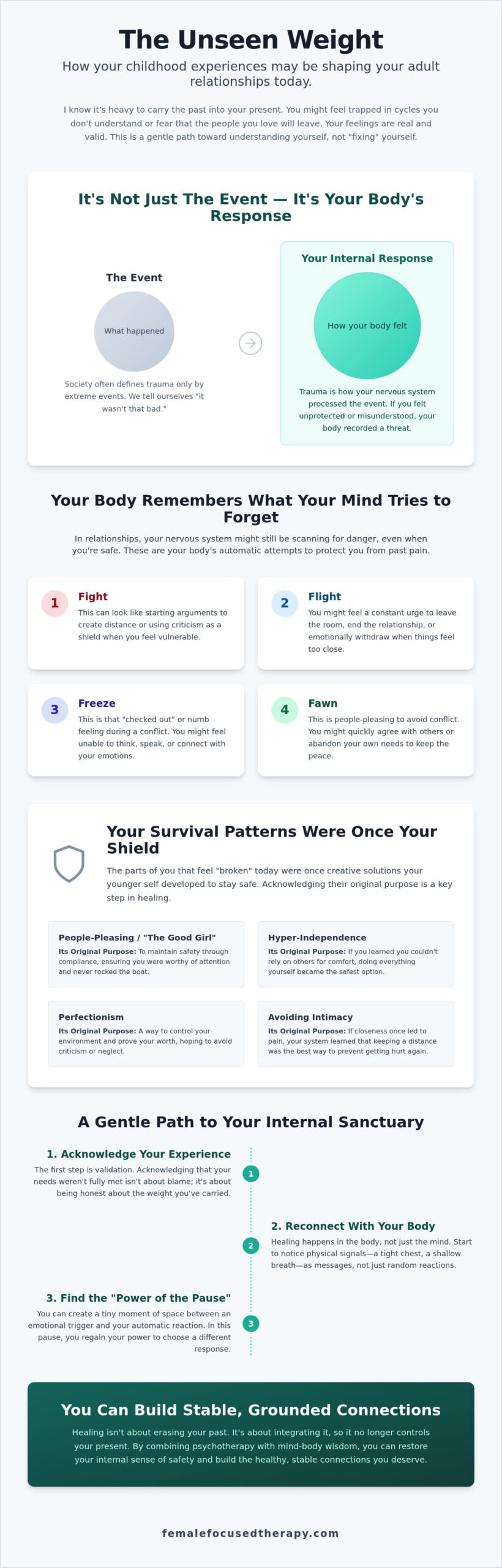
Many of us make the mistake of defining Childhood trauma only as extreme or violent events. In reality, trauma is less about the event itself and more about how your internal system processed it. If you lacked a consistent sense of being protected or understood, your body recorded that as a threat. This is exactly how childhood trauma shows up in adult relationships today, appearing as a “survival map” you didn’t even know you were following.
Your experience matters, even if it wasn’t “extreme” by society’s standards. Validation is a vital part of the healing process. When we stop comparing our pain to others, we can finally address the quiet echoes that still shape our present connections. Acknowledging that things weren’t quite right is the first step toward internal restoration.
When Your ‘Normal’ Childhood Feels Heavy
Emotional neglect is often invisible because it’s defined by what was missing, like comfort, curiosity, or emotional safety. You might have become the “good girl” or the high achiever to ensure you were worthy of attention. This pressure to be perfect is a common trauma response. It’s a way of maintaining safety through compliance, ensuring you never rocked the boat.
When you tell yourself “it wasn’t that bad,” you’re often using a survival strategy to protect your early caregivers. Acknowledging that your needs weren’t fully met doesn’t mean you’re being ungrateful. It simply means you’re being honest about the weight you’ve been carrying since you were small. This honesty is where your path to feeling “whole” again truly begins.
The Link Between Early Safety and Adult Intimacy
Our earliest years form our attachment styles, which act as the foundation for every relationship that follows. We tend to seek out what is familiar because the brain equates familiarity with safety, even when that familiarity is actually painful. This is why you might find yourself repeating cycles with emotionally distant partners, as your system tries to solve an old problem in a new setting.
I believe healing starts with acknowledging these invisible threads that tie your past to your present. My work focuses on helping you recognise these blueprints so you can begin to draw new ones. By understanding the link between your early safety and adult intimacy, you can move toward a place of genuine, grounded stability.
Why Your Body Remembers What Your Mind Tries to Forget
Trauma isn’t just a story you tell; it’s a physical state. You might be able to recount your past with a steady voice, but your body often holds the tension you’ve tried to move past. This physical imprint is often exactly how childhood trauma shows up in adult relationships, manifesting as a racing heart or a sudden urge to withdraw when things get too close.
When you’re with your partner, your nervous system might be constantly scanning their face or tone for signs of rejection. Recent research from the University of Georgia shows how these early experiences continue to echo through our adult romantic connections. Your brain might say you’re safe, but your body is still waiting for the other shoe to drop.
Have you ever noticed your chest tightening or your breath becoming shallow during a minor disagreement? These aren’t just random reactions. They’re your body’s way of protecting you from a perceived threat that feels very real. Integrating somatic awareness into our work allows us to address these physical signals directly rather than just talking about them.
Your Nervous System’s Role in Conflict
Our bodies have four main ways of responding to stress: fight, flight, freeze, and fawn. In a relationship, this might look like starting an argument or literally walking out of the room. You might also “shut down” or go numb when your partner tries to get close. This is your freeze response taking over, designed to protect you from emotional pain.
I often see women who feel “checked out” during conflict, unable to find their words or even their feelings. This is your nervous system trying to keep you safe by helping you disappear internally. I use gentle breath and movement techniques to help you stay present and grounded. We work together to help your body finally understand that the danger is in the past.
The Somatic Language of Relationship Anxiety
Identifying where you hold relationship stress is the first step toward releasing it. You might carry it in your jaw, your gut, or your shoulders. Cognitive understanding is a great start, but it doesn’t always reach the parts of the brain that control these survival responses. Healing requires moving from just thinking about the past to releasing it from your tissues.
Moving from cognitive insight to somatic release helps restore your mind-body connection. This process is how you begin to build genuine self-trust and internal stability. If you’re ready to move beyond just talking and start feeling more grounded in your body, you can explore these sessions with me.
Recognizing the Patterns: How Trauma Manifests Today
I see many women who have built incredible lives in Singapore, excelling in their careers while feeling completely lost in their private lives. You might find that your success is actually a form of protection. When you’ve learned that you can only rely on yourself, hyper-independence becomes a shield against the pain of being let down again. “I don’t need anyone” is often a quiet way of saying “I’m too afraid to need anyone.”
This is a core way how childhood trauma shows up in adult relationships. It isn’t always about visible chaos; sometimes it’s about the rigid walls we build to stay safe. You might also find yourself falling into the role of the people-pleaser, where you believe that your value lies in how much you can do for others. Compliance feels like safety because it avoids conflict, but it leaves you feeling invisible and drained.
There is also the magnetic pull toward partners who are emotionally unavailable or even narcissistic. If you grew up having to earn love or chase attention, a stable partner can actually feel “boring” to your nervous system. You’ve been wired for the high-intensity pursuit, making a calm, healthy connection feel unfamiliar and even suspicious. Healing involves teaching your body that “boring” is actually the sound of safety.
The Fear of Being Seen and the Need to Hide
For many high-functioning women, vulnerability feels like a direct threat to their survival. You might wear a mask of perfection, ensuring that no one sees the “messy” parts of your internal world. I’ve worked with many clients who feel like they are performing their lives rather than living them. I’m here to help you gently lower that shield in your own time, creating a space where you can finally be seen without fear.
In our relationship trauma and narcissistic abuse sessions, we explore these masks. We look at how being “the strong one” has served you, while acknowledging the exhaustion it causes. It’s about finding the courage to be human again, rather than just useful.
Boundaries: Why They Feel Selfish Instead of Healthy
If you’ve spent your life managing other people’s emotions, setting a boundary can feel like an act of aggression. You might feel a wave of guilt the moment you say “no” to a partner or friend. This stems from the belief that your worth is tied to your compliance. Learning that a boundary is a bridge, not a wall, is a transformative part of internal restoration.
A healthy boundary actually tells people how to love you well. It protects the relationship from the resentment that builds when you over-extend yourself. Rebuilding your self-worth outside of being “useful” allows you to stand firm in your needs. You deserve connections where your “no” is just as respected as your “yes.”
Moving from Survival to Safety: Practical First Steps
I want to offer you a few gentle ways to begin this process of internal restoration. It’s easy to feel like you need to “fix” everything at once, especially when you start to see how childhood trauma shows up in adult relationships. I promise you that healing happens in the small, quiet moments of choosing yourself over your old survival patterns.
One of the most powerful tools I share with my clients is the “pause.” When you feel triggered, your body is essentially reliving a past threat. By stopping for just five seconds and taking a deep, conscious breath, you signal safety to your lizard brain. This tiny gap allows you to move from a reactive state to a grounded one.
These small, realistic shifts are much more effective than trying to overhaul your entire personality. We aren’t looking for a quick fix. We’re looking to build a sustainable sense of internal safety that allows you to show up differently in your connections with others.
Grounding Yourself When Emotions Feel Overwhelming
A simple somatic exercise I often recommend is the “5-4-3-2-1” technique. When relationship anxiety spikes, name five things you can see and four things you can touch. This pulls your awareness out of the trauma loop and back into the safety of the present moment. It’s a way of telling your body that you are here, right now, and you are safe.
I also want to remind you that physical rest is a vital part of the healing journey. Your nervous system is doing heavy work, and it needs time to recalibrate. It’s perfectly normal to experience natural contractions in your progress. Having a bad day doesn’t mean you’ve failed; it just means you’re human and your body is processing.
Choosing One Small Boundary to Practice
Start by identifying one small “non-negotiable” with kindness. This might be as simple as saying, “I need ten minutes of quiet when I get home from work.” Learning to communicate your needs without the “trauma apology” is a huge milestone. You don’t need to say sorry for having a limit or a preference.
As you practice these small shifts, you’ll notice your intuition beginning to wake up. You’ve likely spent years ignoring that inner voice to keep the peace. Now, we’re working to rebuild that self-trust and internal reliance. If you’re ready to explore these somatic tools in a safe, boundaried space, you can book an individual psychotherapy session with me.
Rebuilding Your Internal Sanctuary with Professional Support
I provide a warm, boundaried space for you to explore the parts of your story that feel too heavy to carry alone. In my practice, I combine traditional psychotherapy with somatic wisdom, acknowledging that your body holds the truth of your experiences. We work together to understand how childhood trauma shows up in adult relationships, moving at a pace that feels manageable for your nervous system.
Whether we meet in person in Singapore or through online therapy, my goal is your internal restoration. We often explore the “mother wound” and how early caregiving patterns influence your current choice in partners. This work isn’t about blaming anyone; it’s about understanding the blueprint you were given so you can finally choose a different path.
I believe that healing requires a multidisciplinary approach. We don’t just talk about your history; we listen to the physical sensations that arise when you think about your connections. This helps us bridge the gap between knowing something is wrong and actually feeling safe enough to change it.
What to Expect in Our Sessions Together
Our time together is focused entirely on your specific needs as a woman. We’ll navigate the complexities of relationship trauma with expert guidance that is both compassionate and grounded. I’m not here to “fix” you, but to hold space while you rediscover your own strength.
During our sessions, we might focus on:
- Identifying the somatic triggers that cause you to shut down or withdraw.
- Understanding the link between your early attachment and current relationship anxiety.
- Practical tools to help you stay grounded during high-stress transitions.
- Reclaiming your voice and your body’s sense of peace.
This multidisciplinary approach ensures that we are healing both the mind and the body, creating a foundation for lasting change. For those looking to support their recovery through naturopathic care, westridgeholistic.com offers holistic wellness services that focus on root-cause healing. You’ll find that as your internal world becomes more stable, your external relationships begin to follow suit.
Your Next Step Toward Restoration
You don’t have to carry the weight of your past alone. Recognizing how childhood trauma shows up in adult relationships is a brave first step, but you deserve support for the journey ahead. I invite you to a space where your experiences are validated and your privacy is strictly protected.
If you feel ready to begin this work, I offer a calm invitation to book a session with me. Finding the right therapist in Singapore who truly understands the nuances of your life is essential. I am here to walk with you toward a future where your relationships feel like a sanctuary rather than a source of stress.
Your Path Toward Internal Restoration
Recognising how childhood trauma shows up in adult relationships is the beginning of a profound journey toward self-trust. You’ve seen how your body carries the past and why those old survival maps once felt necessary. It’s not about fixing something broken; it’s about restoring the internal sanctuary you’ve always deserved.
I’ve helped many women navigate these invisible threads through my work as a Registered Integrative Psychotherapist. By combining a specialist focus on relationship trauma and narcissistic abuse with a gentle mind-body somatic approach, we can move beyond mere talk therapy. We’ll work together to calm your nervous system and build the stable, healthy connections you’ve been longing for.
If you feel ready to explore these patterns in a safe space, I invite you to book a session with me today. You don’t have to navigate this transition alone. There is a peaceful, grounded version of yourself waiting to be rediscovered, and I’m here to walk beside you.
Frequently Asked Questions
Can childhood trauma really affect my relationships if I don’t remember it?
Yes, your body often remembers what your mind has suppressed to protect you. Trauma is stored in the nervous system and the tissues of the body rather than just as a cognitive memory. This is exactly how childhood trauma shows up in adult relationships, appearing as physical sensations like a tight chest or a sudden urge to flee when things get emotionally close. Your body is simply trying to keep you safe.
Is it possible to heal from trauma while still in a relationship?
It’s absolutely possible to heal while staying with your partner. In fact, a relationship can provide a safe “laboratory” to practice setting boundaries and expressing your needs in real-time. I work with women to help them find their internal stability so they can show up differently in their connections. You can learn to build safety within yourself while navigating the world with another person.
How do I know if my partner is the problem or if it’s my trauma?
Discerning between your own triggers and a partner’s behavior is a delicate process. I help you calm your nervous system so you can see the situation with more clarity. When you aren’t in a state of constant “fight or flight,” it becomes much easier to distinguish between a trauma response and genuine red flags in a partner’s actions. We work to build that internal discernment together.
What is the difference between a trauma response and my actual personality?
Your personality is who you are when you feel safe and grounded. Trauma responses, like people-pleasing or hyper-independence, are survival strategies your younger self adopted to stay safe. As we work on internal restoration, you’ll find that these rigid patterns begin to soften, allowing your true, authentic self to emerge more naturally. It’s about rediscovering who you are without the weight of the past.
How long does it typically take to see changes in my relationship through therapy?
Every woman’s journey is unique, but many of my clients notice small, significant shifts within the first few sessions. Healing isn’t a quick fix, but as you learn to regulate your nervous system, you’ll find you can handle conflict with more ease. We focus on steady, manageable progress rather than rushing. This unhurried pace allows your body to truly integrate the changes we’re making.
Does ‘somatic movement’ mean I have to do yoga in my therapy session?
Somatic movement doesn’t mean we’ll be doing a full yoga class during our time together. It simply means we pay attention to the physical sensations in your body. We might use gentle breathwork or subtle movements to help you feel more grounded and safe. My background as a yoga master informs this work, but it’s always tailored to your comfort level and specific needs.
Can I work on my childhood trauma even if my parents are no longer around?
You can absolutely heal from the past even if your parents are no longer here. The work we do is about your internal relationship with your younger self and your own nervous system. We focus on how those early experiences live within you today, allowing you to find peace and closure within your own heart. It’s about reclaiming your present life from the old echoes.
How do I find a trauma-informed therapist in Singapore who specializes in women’s issues?
Finding a therapist in Singapore who understands the unique challenges women face is vital. Look for a practitioner who is a registered integrative psychotherapist and has specific experience in relationship trauma. I offer a warm, boundaried space in Singapore and online, combining evidence-based psychology with somatic wisdom to support your journey. This integrated approach helps address how childhood trauma shows up in adult relationships through both mind and body.

Article by
Cheryl Kennedy MacDonald MA BA (Hons) Pg. Dip. SAC BACP
Cheryl Kennedy MacDonald is a psychotherapist specialising in women’s mental health, relationships, and life transitions. She works with women navigating trauma, relationship breakdown, identity shifts, and midlife change, helping them rebuild self-trust, emotional stability, and a clear sense of who they are and what they want.
With over 20 years’ experience working with women internationally, Cheryl is the founder of YogaBellies, a global women’s yoga school, and the creator of the Birth ROCKS method. Her work sits at the intersection of psychotherapy and embodiment, integrating evidence-based therapeutic approaches with somatic, body-based practices that support deep, lasting change.
Known for her grounded and direct approach, Cheryl moves beyond surface-level insight to address the patterns held in the body and nervous system. Her work supports women to regulate, reconnect, and respond to their lives from a place of clarity, strength, and self-respect.
She is a published author in academic journals and has written multiple books on women’s health, pregnancy, and midlife wellbeing, available on Amazon and leading book retailers worldwide.