
What if you can take your self-doubt seriously without deciding, right now, what to call it? You may be replaying conversations, wondering if you remembered them correctly, or feeling anxious after raising a concern. It makes sense to want clarity, and to worry about getting the label wrong.
Gaslighting describes a repeated pattern that can leave you questioning your memory, judgement or sense of what’s real. But a disagreement, even a painful one, isn’t automatically gaslighting. I’m Cheryl Kennedy MacDonald, a registered integrative psychotherapist with over 20 years’ experience supporting women through relationship and life challenges. Finding clarity can take time.
In this article, I’ll help you make sense of what may be happening without diagnosing anyone, notice how the experience could be affecting your trust in yourself, and consider a gentle next step at your own pace. You don’t need to prove a label before you’re allowed to pay attention to how you feel.
Key Takeaways
- Gas lighting describes a repeated pattern that can leave you questioning your memory or experience, not every disagreement.
- Notice whether interactions leave you feeling increasingly confused, anxious or unsure of your own judgement.
- When you feel unsettled, you can pause and write down your recollection if that feels helpful.
- You can consider the pattern and its effect on you without diagnosing the other person.
- Therapy can offer space to explore confusing relationship experiences, boundaries and self-trust at your own pace.
What gaslighting can feel like when you begin doubting yourself
You replay a conversation while making tea, driving home or trying to fall asleep. You remember raising a concern, but now you’re wondering whether you said it clearly, remembered it properly or made too much of it. That uncertainty can feel lonely, especially when you’d usually trust your own recollection.
I use gaslighting to describe a repeated pattern of responses that can leave you questioning your experience, memory or judgement. The word matters less than noticing what keeps happening and how it affects you. What is gaslighting? offers a broader overview, including how the term is used in different contexts.
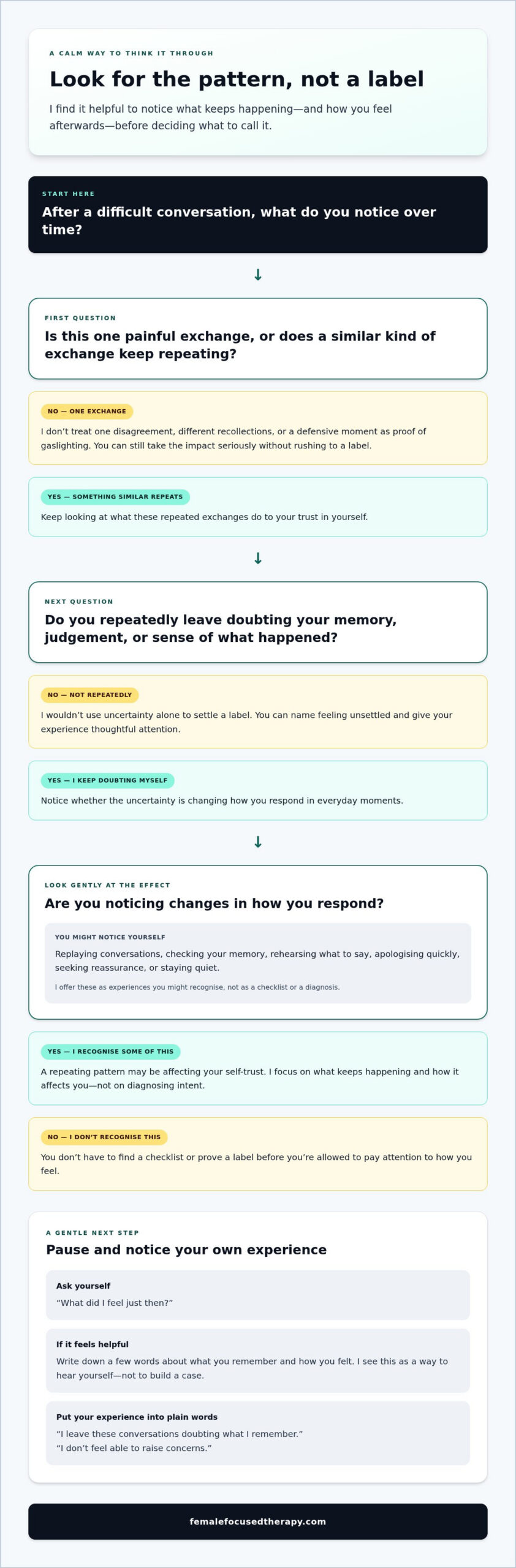
A single disagreement, or two people remembering the same conversation differently, doesn’t by itself establish gaslighting. People can misunderstand one another, become defensive or recall details differently. I look for a pattern rather than treating one difficult exchange as proof.
Gaslighting is about a repeated pattern that erodes trust in your experience, not one isolated misunderstanding. That distinction can help you stay curious without dismissing your feelings or rushing to a verdict.
When a conversation leaves you questioning what happened
You might bring up a comment that hurt you and hear, “I never said that,” or be told you’re too sensitive whenever you explain its impact. If this happens repeatedly, you may start rehearsing what to say, checking your memory or staying quiet to avoid another unsettling conversation. I can’t know someone’s intentions from an example, but I can take seriously how the pattern leaves you feeling.
Why the word gaslighting can feel difficult to use
You may worry that naming gaslighting means accusing someone unfairly, exaggerating or getting the label wrong. You don’t have to settle that question before paying attention to yourself. You can notice that you feel confused or anxious after certain conversations, and consider whether the same kind of exchange keeps happening. Your feelings deserve thoughtful attention, even while you’re unsure what to call the experience.
Sometimes it helps to describe what you notice in plain language: “I leave these conversations doubting what I remember,” or “I don’t feel able to raise concerns.” You’re naming your experience, not making a diagnosis. In my work supporting women through relationship trauma and narcissistic abuse, I make room for this uncertainty without asking you to reach a conclusion before you’re ready.
You can begin with one gentle question: what happens to your sense of yourself after these interactions? You don’t need a perfect account or a definitive label. Noticing your response is a meaningful place to start.
How gaslighting can affect your memory, feelings and self-trust
Self-trust can feel less steady when you repeatedly come away from conversations unsure what you remember or whether your feelings make sense. You might first feel confused, then start checking your words and reactions for mistakes. Over time, that uncertainty may follow you into ordinary moments, such as deciding whether to ask for help or say that something has upset you.
Repeatedly having your experience questioned or brushed aside may make it harder to rely on your own judgement. You might begin looking outside yourself for reassurance before deciding what you think or need. That doesn’t mean your memory is unreliable, or that every uncertain moment points to gaslighting. It’s a possible response to an ongoing relational experience, not a diagnosis.
Repeated doubt can make even familiar feelings seem as though they need someone else’s permission. Gas lighting can affect the way you relate to your own reactions, but your uncertainty doesn’t prove what someone else intended. I’d keep the focus gently on what you notice in yourself, rather than treating every feeling as evidence for or against a label.
The quiet ways self-doubt can show up
You may notice yourself apologising quickly before you’ve had time to work out what you feel. Perhaps you replay a conversation, seek reassurance from someone you trust, or hesitate before expressing a need because you’re not sure it’s reasonable. These moments don’t form a checklist, and they can have different meanings. I offer them simply as experiences you might recognise.
Making room for your own feelings again
After an interaction, you could pause for a moment and ask yourself, “What did I feel just then?” You don’t need to prove anyone wrong or decide what the exchange means. You might notice tension, sadness, anger or uncertainty, then let that be information about your experience. If the effects feel tied to an ongoing relationship, I offer a space to explore relationship trauma and narcissistic abuse with care.
Try giving yourself a little time before correcting or dismissing your reaction. You could write down a few words about how you felt, if that feels useful, and return to them later with kindness. The aim isn’t to build a case; it’s to practise hearing yourself again. If you’d like to explore what’s happening at your own pace, you can book an individual therapy appointment with me.
Gaslighting or a painful disagreement: how to hold the difference
It can be hard to know what to make of a conversation that leaves you unsettled. I find it helpful to look beyond the question of who remembers an event correctly. The way you and someone close to you respond to different memories, and what happens over time, may offer more to reflect on than one exchange on its own.
A painful disagreement can involve frustration, hurt or defensiveness. A recurring pattern may feel different if you repeatedly leave conversations doubting your perception or feeling unable to raise concerns. That difference is reflective guidance, not a test. It can’t diagnose someone or tell you exactly what’s happening in your relationship.
When two people remember an event differently
You might remember a plan being agreed, while the other person remembers the conversation differently. A respectful disagreement can leave room for both accounts: you can explain what you recall, hear the other perspective and accept that you don’t agree. I can’t decide whose memory is correct from the outside, and you don’t have to settle that question to notice how the conversation feels.
Even a tense exchange may allow space to return to the subject later, clarify what each of you understood or acknowledge that the difference remains. A mismatch in memory, by itself, doesn’t show deliberate manipulation. It’s the wider context and the effect on you that may be worth considering.
When the same doubt keeps returning
You may want to notice whether similar conversations keep leaving you unsure of what you saw, heard or meant. For instance, a concern about a shared decision might repeatedly turn into a discussion of whether you’re remembering it properly, rather than a conversation about the concern itself. Recurrence can matter, but it doesn’t prove intent or establish a diagnosis.
Gas lighting is often used to name a pattern that can unsettle trust in your own experience. You can hold that possibility lightly. Rather than judging someone from a single behaviour, you might reflect on what happens across different conversations and how you feel afterwards. Do you feel able to speak and be heard, even when you disagree? Or are you increasingly reluctant to bring things up?
I might think about the difference in this way:
- One disagreement: You each describe an event differently; the possible effect may be frustration or hurt, while both perspectives can still be discussed.
- A repeated pattern: Similar exchanges keep returning; you may find yourself more unsure of your recollection or hesitant to express a concern.
These examples aren’t a scorecard. Context, repetition and impact matter more than any single moment, and even a repeated pattern can have more than one explanation. You’re allowed to seek support while you’re still unsure what label fits. I offer a collaborative space to explore the impact of confusing relationship experiences, including through my work with relationship trauma and narcissistic abuse. You can begin with what you’ve noticed, without reaching a final verdict.
What I might do when I feel unsettled after an interaction
After a difficult conversation, you might feel tense, muddled or unsure what to do next. I don’t believe you need to follow a perfect plan or work everything out straight away. You can choose one small thing that feels manageable, leave the rest for later, or do nothing just now.
If the phrase Gas lighting comes to mind, you don’t have to decide whether it fits before caring for yourself. Feeling unsettled is enough reason to pause and notice what’s happening for you. The steps below are choices, not a test, and they can’t guarantee what will happen next.
Pause and notice what is happening in you
If it feels comfortable, take a moment to notice what’s present. You might recognise a tight jaw, a held breath, a racing thought or a strong feeling. There’s no need to change it or make yourself calm. You can simply name what you notice, or turn your attention to something ordinary around you.
You could also make a private note of what you remember, using a few simple words. For example: “I asked about the plan, and I felt confused afterwards.” A note can help you make space for your own recollection, but it doesn’t prove what happened or require you to reach a conclusion.
Choose a next step that feels manageable
You might decide to wait before responding, speak with someone you trust, or talk with a therapist. You don’t have to share every detail. You can start with a simple description, such as, “I’m feeling unsettled after a conversation and would like help thinking it through.” Choose what feels right for you, and leave other options open.
Sometimes a small pause is enough for the moment. At another time, it may feel useful to look back at your note or notice whether similar interactions are affecting your sense of steadiness. You’re allowed to move slowly. I wouldn’t ask you to confront someone, leave a relationship or disclose more than you want to.
- Pause: Give yourself time before deciding what to do next.
- Notice: Name a feeling or physical sensation, if that feels helpful.
- Record: Write down your own recollection privately, only if it supports you.
- Reach out: Consider a trusted person or therapist when you’re ready.
If you’re worried about your immediate safety, I’d encourage you to seek appropriate support from someone you trust or a relevant local service. You don’t need to manage that concern alone, and you can choose what feels safe to share. You can ask for support before you feel certain what to call your experience.
If you’d like a thoughtful space to explore what’s been happening at your pace, you can book an individual therapy appointment with me. There’s no need to arrive with a label or a complete account. You can begin with what feels unsettled today.
How therapy can help you make sense of gaslighting experiences
You don’t need to arrive in therapy with a settled explanation for what’s happening. You might come with a few moments you keep turning over, a feeling that your perspective has become harder to trust, or questions about what you need in a relationship. We can start there, without deciding on a label or trying to make your experience fit one.
What I can explore with you in therapy
As a registered integrative psychotherapist, I support women as they make sense of relationship experiences and their impact. We can explore what feels confusing, what boundaries matter to you, and how you relate to your own feelings and perspective. I won’t assume a diagnosis or promise a particular outcome. The pace and focus can be shaped around what feels manageable for you.
Sometimes it helps to look at what happens before, during and after a difficult interaction. You might notice that you hold back a need, feel unsettled afterwards, or struggle to find words for what bothered you. We can stay with those details gently, without turning therapy into a search for proof. The aim is to make room for your experience and consider what support might feel useful.
Gas lighting can leave you questioning yourself, but therapy doesn’t require you to prove that a particular word applies. We can explore the uncertainty itself and what you want to feel clearer about. I work with women in Singapore and online, and I bring over 20 years of experience supporting women through relationship and life challenges.
Taking a first step when you feel ready
You might find it useful to think about what you’d want from a first conversation. Perhaps you’d like space to talk through one confusing situation, or to understand how a relationship is affecting your sense of steadiness. You don’t have to prepare a complete history or disclose more than feels right. Individual psychotherapy is one possible way to explore these questions with support.
My therapy practice offers a place to begin exploring what’s been weighing on you. You can take your time deciding whether support feels right. You deserve to have your experience met with care, even while you’re still working out what to call it. If you feel ready, you can book an appointment. A small first step is enough; you don’t need to have everything figured out beforehand.
If you’d like to find out more about working with Cheryl Kennedy MacDonald, you can email her at cheryl@femalefocusedtherapy.com, go ahead and book an appointment at Female Focused Therapy, or for lifestyle and yoga programmes, visit YogaBellies.
Take your next step at your own pace
As you move forward, you might ask yourself what would make an ordinary day feel a little more like your own. Perhaps it’s choosing a small boundary, making time for something you enjoy, or speaking with someone who helps you feel grounded. You can start with what matters to you now.
Gas lighting may be part of the language you use to understand an experience, but your life is bigger than any one term. I hope you can turn some of your attention towards what you want to nurture next, even if that’s only a small change.
If you’d like support as you find your way forward, you can arrange an appointment with me. There’s no need to have a plan for everything. One thoughtful step, chosen by you, is enough for today.
Frequently Asked Questions
Is gaslighting always intentional?
I can’t determine someone’s intentions from your account alone. If you’re trying to make sense of an interaction, it may help to separate what you observed from what you’re guessing the other person meant. You could ask yourself what you need now, such as space, a clearer boundary or a calm conversation with someone you trust. You can make choices based on the effect on you, without proving intent.
Can gaslighting happen in a relationship without physical abuse?
Yes. Gaslighting refers to psychological interactions, so physical harm isn’t required. I also wouldn’t treat every disagreement or hurtful comment as abuse. You might consider whether you feel able to express a different view, ask for clarification or take time to think. If you’re feeling unsafe, I’d encourage you to seek appropriate support from someone you trust or a relevant local service, choosing what feels safe to share.
How is gaslighting different from lying or manipulation?
A lie is an untrue statement; manipulation is behaviour that influences your choices or understanding. Gaslighting is used for a particular kind of repeated behaviour that can make you question your own account of events. The words can overlap, and I can’t sort out a relationship from one example. You might find it more useful to describe the specific interaction and its effect than to decide which term fits.
What should I do if I think someone is gaslighting me?
You could give yourself a little time before replying, then note the date, what you recall and how you felt, if keeping a private record feels useful. Treat it as a way to organise your thoughts, not proof or a reason to confront anyone. You might share only the broad outline with someone you trust or a therapist. If you have a safety concern, seek appropriate support at a pace that feels safe.
Can gaslighting make you doubt your memory?
It can contribute to doubt about your recollection, particularly if you find yourself repeatedly revisiting conversations. Memory can also feel patchy for ordinary reasons, so uncertainty about a detail doesn’t tell you by itself what has happened. You might note which parts you remember clearly and which feel uncertain, then consider how the situation is affecting your daily choices and confidence. You don’t need to force certainty before reflecting on that impact.
Can therapy help after a gaslighting relationship?
Therapy can give you space to talk through what feels difficult now and consider what might help you feel more grounded in your own perspective. In individual psychotherapy, I can explore these questions with you without requiring a label or promising a particular result. I offer individual psychotherapy for women in Singapore and online. You can choose what to discuss, and I’ll follow your pace as we consider what feels useful.

Article by
Cheryl Kennedy MacDonald MA BA (Hons) Pg. Dip. SAC BACP
Cheryl Kennedy MacDonald is a psychotherapist specialising in women’s mental health, relationships, and life transitions. She works with women navigating trauma, relationship breakdown, identity shifts, and midlife change, helping them rebuild self-trust, emotional stability, and a clear sense of who they are and what they want.
With over 20 years’ experience working with women internationally, Cheryl is the founder of YogaBellies, a global women’s yoga school, and the creator of the Birth ROCKS method. Her work sits at the intersection of psychotherapy and embodiment, integrating evidence-based therapeutic approaches with somatic, body-based practices that support deep, lasting change.
Known for her grounded and direct approach, Cheryl moves beyond surface-level insight to address the patterns held in the body and nervous system. Her work supports women to regulate, reconnect, and respond to their lives from a place of clarity, strength, and self-respect.
She is a published author in academic journals and has written multiple books on women’s health, pregnancy, and midlife wellbeing, available on Amazon and leading book retailers worldwide.