
The fear of aging as a woman can hold more than worry about wrinkles or changing health. It may also touch a fear of becoming less visible, or the ache of wondering whether you’re losing a former version of yourself.
You might feel uneasy about changes in your body, appearance or energy, while also feeling that you should simply accept them. I understand how mixed those feelings can be. I’m Cheryl Kennedy MacDonald, a registered integrative psychotherapist, and I’ve spent more than 20 years supporting women through life’s changes.
I want to help you make sense of what your fear may be carrying, without judging you or asking you to fix it. Changes in health and identity, alongside the messages you’ve absorbed about women and ageing, can all shape what you feel. You can listen gently, at your own pace, and make room for uncertainty, grief, relief or curiosity. You don’t have to feel only one way about getting older.
Key Takeaways
- The fear of aging as a woman can hold different feelings, including uncertainty, dread or reluctance. It may surface in ordinary moments.
- Consider whether a change brings grief for a former role, expectation or sense of self, without assuming grief explains everything.
- Notice how messages about appearance, worth, work and visibility sit alongside your own values.
- Pause gently to name what you feel, notice where you feel it in your body, and consider what might help in that moment.
- Therapy can offer space to explore your experience at your own pace, with attention to both emotions and bodily awareness.
When Fear of Aging as a Woman Starts to Feel Personal
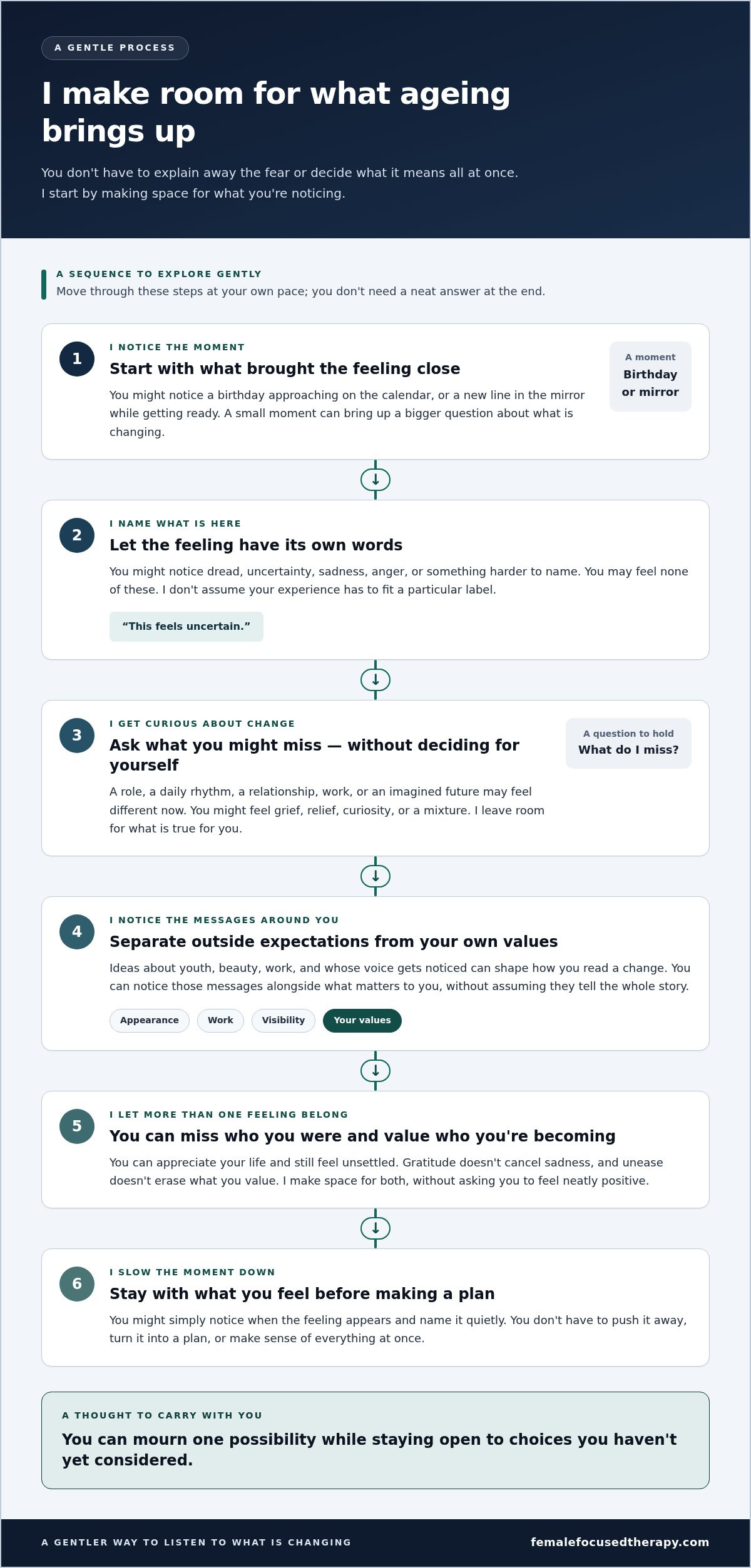
Maybe the thought of getting older catches you off guard. You feel a flicker of dread, or a reluctance to look too closely at what may be changing. Perhaps you’re not sure what the feeling is asking of you. You don’t need to make sense of it all at once.
I understand that fear of aging as a woman can feel deeply personal because it touches more than a number. It may brush against your sense of who you are, how you’re seen, or what you imagine lies ahead. You might feel grateful for your life and still uneasy about getting older. Those feelings can sit side by side.
It might begin with something ordinary. You see a birthday approaching on the calendar, or notice a new line in the mirror while getting ready for the day. The moment itself may be small, yet it can bring up a bigger question: what is changing, and how do I feel about it? I wouldn’t assume the answer is the same for you as it is for anyone else.
I sometimes use a word as a reference point, not a label: Gerascophobia: The Fear of Aging. Reading about intense fear of aging may offer language for the experience, but it doesn’t tell you what your feelings mean or define your personal response.
The feelings that can sit beneath the fear
Alongside fear, you might notice uncertainty, sadness, anger or a sense of being left behind. Perhaps a milestone makes you wonder whether a possibility has passed, or whether you’re measuring yourself against a version of life you expected to have by now. You may feel none of these things, or something harder to name. I want to leave room for your experience rather than tell you what you should feel.
Why it can be hard to admit
You may feel pressure to be grateful, look youthful, or seem effortlessly confident about change. That pressure can make honest uncertainty feel exposing, as if naming it means you’re shallow or ungrateful. I don’t see it that way. Feeling afraid of aging isn’t vanity or failure; it’s a feeling that deserves to be met with care.
You can appreciate the life you have and still feel unsettled by the thought of change. Gratitude doesn’t cancel sadness, and unease doesn’t erase what you value. I want you to have space for both, without judging yourself for not feeling neatly positive.
For now, you don’t have to turn the feeling into a plan or push it away. You might simply notice when it appears and name it, even quietly: “This feels uncertain.” That little moment of honesty can be a gentler place to begin than asking yourself to feel differently.
What Your Fear of Aging May Be Asking You to Grieve
When I listen to women talk about getting older, I don’t assume that fear has one meaning. Sometimes it sits alongside grief for something that has changed. Sometimes it points to uncertainty about what comes next, or to a part of yourself you’re trying to understand. And sometimes it may not feel like grief at all.
Change can bring several emotions at once. You might feel relief about leaving an old role and sadness about what it gave you, too. These feelings don’t cancel each other out. They can simply be part of making sense of a life that’s still unfolding.
For me, grief for change isn’t the same as wishing away your whole life. You can miss a past version of yourself and still value the person you are becoming. That distinction can make room for tenderness, rather than turning the feeling into a judgement about whether you’re grateful enough.
A changing sense of self
Your sense of who you are may shift as motherhood, work, relationships or a new life stage changes your daily life. You might miss the freedom you had before caring for others, or feel unsure of yourself after a change in work. These are possibilities, not rules. You may also feel curious about what’s emerging, even as you feel sad about what has changed.
A familiar role can quietly shape how you spend your time and understand your worth. If that role changes, you may find yourself asking what matters to you now. You don’t need a clear answer straight away. Curiosity can sit beside sadness without either feeling being the final word on who you are.
When the future feels less open
As you get older, your sense of time may feel different. You might look at a path you imagined and wonder whether it’s still possible, or notice that your priorities have shifted. That can bring disappointment, but it doesn’t mean your life has become fixed. You’re allowed to mourn one possibility while remaining open to choices you haven’t yet considered.
I don’t want to offer forced optimism or tell you that every door stays open in exactly the same way. Some things do change; some plans may need to be rethought. But a changed future isn’t an empty one. It can hold meaning, connection and new direction, even if you can’t see the shape of those things yet.
If the fear of aging as a woman feels tangled up with a changing sense of self, you might gently ask, “What do I miss, and what still matters to me?” Take a quiet moment to notice what comes up, without needing to act on it. If you’d like company as you explore life transitions, I offer support for women through menopause and midlife. You can also book a therapy appointment if talking it through feels right for you.
How Ageism and Life Changes Can Shape Women’s Fears
I don’t see fear of aging as a woman as something that appears in isolation. Ideas about youth, beauty, work and whose voice gets noticed can shape how you interpret a change in your body or the way people respond to you. Those messages may affect you strongly, lightly, or not in the same way they affect someone else.
You might hear that looking younger is something to strive for, or that your value depends on being attractive, productive or endlessly capable. A message like that can make an ordinary change feel loaded. A new line on your face might seem to say something about your worth, even though it can’t measure who you are or what you bring to your relationships and work.
Social messages can influence how you feel about aging, but they don’t define your experience or your worth. I find it helpful to notice the difference between what you’ve been taught to fear and what you actually value. You may care about appearance, and that’s not something I’d shame you for. You can also question whether the standards you’re measuring yourself against feel like your own.
The messages you absorb about getting older
You may notice youth-focused expectations in the way age is spoken about at work, in adverts, or in everyday conversations. Perhaps you feel pressure to seem energetic, polished or adaptable, while worrying that a visible change will affect how others see you. I can’t know how these messages land for you. You might feel their weight, resist them, or find they matter more in some settings than others.
When a thought such as “I’m becoming less relevant” appears, I’d gently ask: is this what I believe about myself, or is it a fear shaped by how I think I’m expected to look or perform? You don’t have to settle the question immediately. Noticing it creates a little space between an external expectation and your own sense of what matters.
Midlife, menopause and changes in the body
Perimenopause, menopause and midlife can bring changes in how you feel physically or emotionally, but your experience is personal. You might feel unsettled, relieved, curious, or a mix that shifts from day to day. I wouldn’t assume hormones explain every change in mood, or that every woman connects this life stage with fear. Your relationships, health, work and circumstances may all be part of the picture.
If you’re trying to understand how this stage fits into your wider life, I offer support through menopause and midlife. In a reflective conversation, you can explore what’s changing for you without being told what you ought to feel. You might begin by noticing which messages about age sound like your own values, and which ones leave you feeling smaller.
How I Can Help You Listen to Fear Without Rushing It Away
I don’t see reflection as a way to make fear disappear. I see it as a chance to meet what’s here with a little more kindness. If the fear of aging as a woman feels close today, you don’t have to explain it perfectly or find a solution before you’re ready.
You might begin with one small pause. Notice what you’re feeling, then see whether you can sense where it sits in your body. It could feel like tightness in your chest, a knot in your stomach, or nothing you can easily name. That sensation doesn’t prove what caused the fear. It’s simply part of what you’re noticing right now.
A small moment of noticing
You could ask yourself, “What feels most tender about this change?” There’s no right answer, and you don’t need to go further than feels manageable. If it feels comfortable, let your next breath arrive a little more slowly. If not, leave the breath alone. You can stop, look around the room, or return to this reflection another time.
I often find that a gentle question is more useful than pressing yourself to think positively. Perhaps the tender part is uncertainty about your health, a change in how you see yourself, or something you can’t quite put into words. You might jot down a few words, rest quietly, or share a little with someone you trust. Choose what feels steady enough for you.
Making room for mixed feelings
Listening doesn’t require you to feel grateful about every part of getting older. You can appreciate the people and experiences in your life while feeling afraid, sad or frustrated about change. You might enjoy a birthday meal with people you love and still feel unsettled when the milestone makes time more noticeable. Neither feeling has to cancel the other.
I’d invite you to let both truths be present for a moment: “I value what I have, and I’m uneasy about what’s changing.” You don’t need to resolve that tension or turn it into a lesson. Acceptance, as I understand it, isn’t approval or forced positivity. It can simply mean allowing your feelings to exist without telling yourself off for having them.
Writing, rest or a trusted conversation may help you stay alongside a feeling without becoming overwhelmed by it. You can choose a small amount of time, then pause. If your attention moves elsewhere, that’s all right. You’re not failing at reflection. You’re allowed to return to ordinary life, and come back to the question when you feel ready.
If you’d like a steady space to explore what this fear means for you, I offer individual therapy in person in Singapore and online. You can book an appointment with me if that feels like a helpful next step.
Finding Support for Fear of Aging as a Woman
If the fear of aging as a woman feels difficult to hold on your own, therapy may offer space to understand what it means for you. I wouldn’t approach it as something you need to eliminate, or promise that talking will change how you feel. I can make room for your questions, your emotions and the parts of the experience that are still unclear.
What it can feel like to explore this in therapy
I want our conversation to follow what feels important to you, at a pace that feels manageable. You don’t need a polished explanation before beginning. You might arrive with one thought, a vague unease, or a sense that something has shifted. I can start with what you bring, without forcing a neat answer.
In my integrative approach, I pay attention to both what you’re thinking and what you notice in your body. You might talk about a change that feels unsettling and notice that your shoulders have tightened as you describe it. That response doesn’t prove what the feeling means. It can simply help us stay curious about your experience, rather than treating your body as a puzzle with one definite answer.
You remain part of the conversation. You can tell me what feels useful, slow down, or leave a subject for another time. Support isn’t about my telling you how to feel about getting older. It’s about having room to hear yourself more clearly, including when your feelings are mixed or still taking shape.
A gentle next step if you want support
I work with women through life changes, and you can learn more about my psychotherapy work. I aim to meet your concerns with care and curiosity, without assuming what aging means for you or how you should feel about it.
You don’t need to have everything worked out before you speak about it. You might simply notice one question you’d like to explore, or take a quiet moment to check in with yourself today. There’s no need to rush towards certainty. You can begin wherever you are and let your understanding take shape in its own time.
Let Yourself Meet This Change at Your Own Pace
You don’t have to decide today what getting older means for you. You can let the question stay open and notice what feels important in this season of your life. Your feelings may shift as you listen, or they may simply become easier to hold with care. There’s no single right way to feel.
Perhaps your next step is small: give yourself a quiet moment, write down one thought, or let someone you trust know you’ve been reflecting. You’re not required to turn uncertainty into confidence overnight. A kinder relationship with yourself can begin with meeting this feeling without judgement.
If you’d like support as you explore what this means for you, you can book an appointment with me. You can arrive with questions, uncertainty, or no polished words at all. For now, let yourself take the next step at a pace that feels right for you.
Frequently Asked Questions
Is it normal to fear aging as a woman?
Feeling uneasy about aging can be a recognisable response, though it won’t feel the same for everyone. Your concerns might come and go, or become more noticeable around a birthday, a health worry or a change in your daily life. I’d pay attention to whether the fear is affecting your sleep, choices or relationships. That can help you decide whether you’d like extra support, without treating the feeling as a flaw.
Why do I feel sad when I think about getting older?
Sadness may be connected to something specific you feel is changing, but it doesn’t automatically mean you regret your life. Try naming what the sadness is attached to, such as a changed routine, a relationship that feels different or an expectation you no longer share. You could write down what you miss and what still feels important to you. You don’t have to turn either answer into a decision.
Can menopause make fear of aging feel more intense?
It can feel more present for you during perimenopause or menopause, but there isn’t one explanation that fits everyone. You might notice that worries feel sharper during a period of physical change, poor sleep or extra pressure in another part of life. If you’re concerned about changes in your body or mood, you could note what you’ve noticed and discuss it with a healthcare professional.
Does being afraid of aging mean I’m vain?
No. Caring about your appearance doesn’t make you vain, and fear about aging can also involve questions about health, independence or how you want to be treated. You might feel unsettled by a recent photograph, for example, without that being the whole story. I’d try replacing self-criticism with a kinder question: “What matters to me about this?” Your answer can be personal and complicated.
How can I talk to someone about my fear of getting older?
You can begin simply, without explaining everything. You might say, “I’ve been thinking about getting older, and I’d like you to listen rather than offer solutions.” Choosing a calm moment and someone you trust may make the conversation feel easier. You can also decide what you’re comfortable sharing and stop there. You’re allowed to ask for company without having to make a case for why the feeling matters.
Can therapy help me understand my feelings about aging?
Therapy can give you room to explore your feelings and what may be influencing them, without promising that fear will disappear. You could bring a recent moment when the worry surfaced, such as a conversation or a change in your routine, and begin there. I’d follow your concerns at a pace that feels manageable. You don’t need a clear goal or a polished explanation before starting.
If you’d like to find out more about working with Cheryl Kennedy MacDonald, you can email her at cheryl@femalefocusedtherapy.com or go ahead and book an appointment here: https://www.femalefocusedtherapy.com/book-now/ or lifestyle and yoga progammes, visit YogaBellies on www.yogabellies.com
Article by
Cheryl Kennedy MacDonald MA BA (Hons) Pg. Dip. SAC BACP
Cheryl Kennedy MacDonald is a psychotherapist specialising in women’s mental health, relationships, and life transitions. She works with women navigating trauma, relationship breakdown, identity shifts, and midlife change, helping them rebuild self-trust, emotional stability, and a clear sense of who they are and what they want.
With over 20 years’ experience working with women internationally, Cheryl is the founder of YogaBellies, a global women’s yoga school, and the creator of the Birth ROCKS method. Her work sits at the intersection of psychotherapy and embodiment, integrating evidence-based therapeutic approaches with somatic, body-based practices that support deep, lasting change.
Known for her grounded and direct approach, Cheryl moves beyond surface-level insight to address the patterns held in the body and nervous system. Her work supports women to regulate, reconnect, and respond to their lives from a place of clarity, strength, and self-respect.
She is a published author in academic journals and has written multiple books on women’s health, pregnancy, and midlife wellbeing, available on Amazon and leading book retailers worldwide.