
What if supporting your partner with ADHD didn’t mean becoming the one who remembers everything? If reminders, unfinished tasks and missed plans are gathering on your side of the relationship, it’s understandable to feel tired, resentful or unsure how to raise it. Forgetfulness may not mean a lack of care, while still making room for the impact on you.
I know ADHD from my own life as an adult woman and from my work as a psychotherapist. You can find more about my work supporting women here. I also know that no two people experience ADHD in exactly the same way. You can care deeply about your partner and still feel worn down by the extra responsibility you’ve taken on.
I’ll help you understand how ADHD-related patterns can shape everyday moments, and how to talk about what you need without blame or shame. I’ll also explore ways to share responsibility without slipping into a parent-child dynamic, so supporting your partner doesn’t mean losing touch with yourself.
Key Takeaways
- Notice how attention, organisation or follow-through may affect everyday moments, without assuming you know the reason behind every interaction.
- Separate the impact of a missed task from what you imagine it means about your partner’s care for you.
- When you talk about a concern, describe one event, how it affected you and what support might help, without labelling your partner.
- Learning how to support a partner with adhd can include finding shared ways to manage responsibilities while keeping your own needs in view.
- Therapy can help you explore your feelings and relationship patterns, without making your partner’s diagnosis or behaviour the goal.
How ADHD Can Shape the Everyday Moments in Your Relationship
You can love your partner and still feel overlooked, overloaded or unsure what to do next. Perhaps you’re keeping track of plans, waiting for a household task to be finished, or trying to raise a concern without it turning into an argument. If you’re tired, that doesn’t mean you care any less. It may mean the everyday balance between you needs attention.
I understand ADHD as a difference that can affect attention, organisation and following through. That can make shared routines harder to manage, from remembering an errand to returning to a task after an interruption. You can find a general overview of Attention deficit hyperactivity disorder (ADHD), but an overview can’t tell you exactly what’s happening between you and your partner.
A missed task may fit an ADHD-related pattern, but it doesn’t prove what either of you feels. A difficulty linked with ADHD is not, by itself, a judgement about how much your partner loves or cares for you. And understanding a possible difficulty doesn’t mean you have to pretend its effect on you is small. Both things can be true at once.
When forgotten plans start to feel personal
You might agree that your partner will pick up something for dinner, then find it hasn’t happened. The practical problem is real, but so may be the hurt: you were counting on them, and now you’re left to adapt. If this happens repeatedly, you may start to wonder whether your needs matter. Your partner, meanwhile, may feel ashamed or misunderstood. Over time, both of you can feel unseen, even if neither intended to cause hurt.
Why the same moment can feel different to each of you
You may see an unfinished task and think, “I can’t rely on you.” Your partner may experience the task differently, perhaps losing track of it or struggling to return to it after getting distracted. That possibility doesn’t explain every interaction, and it doesn’t tell you who is at fault. It can give you a gentler question to begin with: “What happened for each of us in that moment?”
Curiosity isn’t the same as excusing the impact. If plans are often forgotten, you may still feel disappointed or end up carrying more of the practical load. As you consider how to support a partner with adhd, try holding both experiences in view: what may be difficult for your partner, and what the repeated pattern is asking of you. I find that distinction can make space for a clearer conversation, without deciding in advance what a missed plan means.
If you want to explore how ADHD may connect with your experience, I share more about ADHD-focused support. For now, you might simply notice one recent moment that left you feeling hurt or overburdened. Name the event and your feeling quietly to yourself. You don’t have to settle the whole meaning of it before you can begin to understand what happened between you.
How to Understand ADHD Patterns Without Excusing Their Impact
After a difficult moment, it’s easy for your mind to fill in the gaps. You might think, “They forgot because I’m not important,” while your partner may have a different account of what happened. I can’t know the reason from one missed commitment, and neither can you. ADHD may be part of a wider pattern, but one behaviour isn’t proof of ADHD, and it can’t explain every interaction.
What executive-function difficulties may look like at home
Executive function is the set of skills that helps you plan, start and complete everyday tasks. For example, you and your partner might agree to attend a shared appointment, but the details don’t get added to a calendar or remembered on the day. That could relate to difficulty with planning or follow-through, but it could also have another explanation. A single example can’t diagnose anyone.
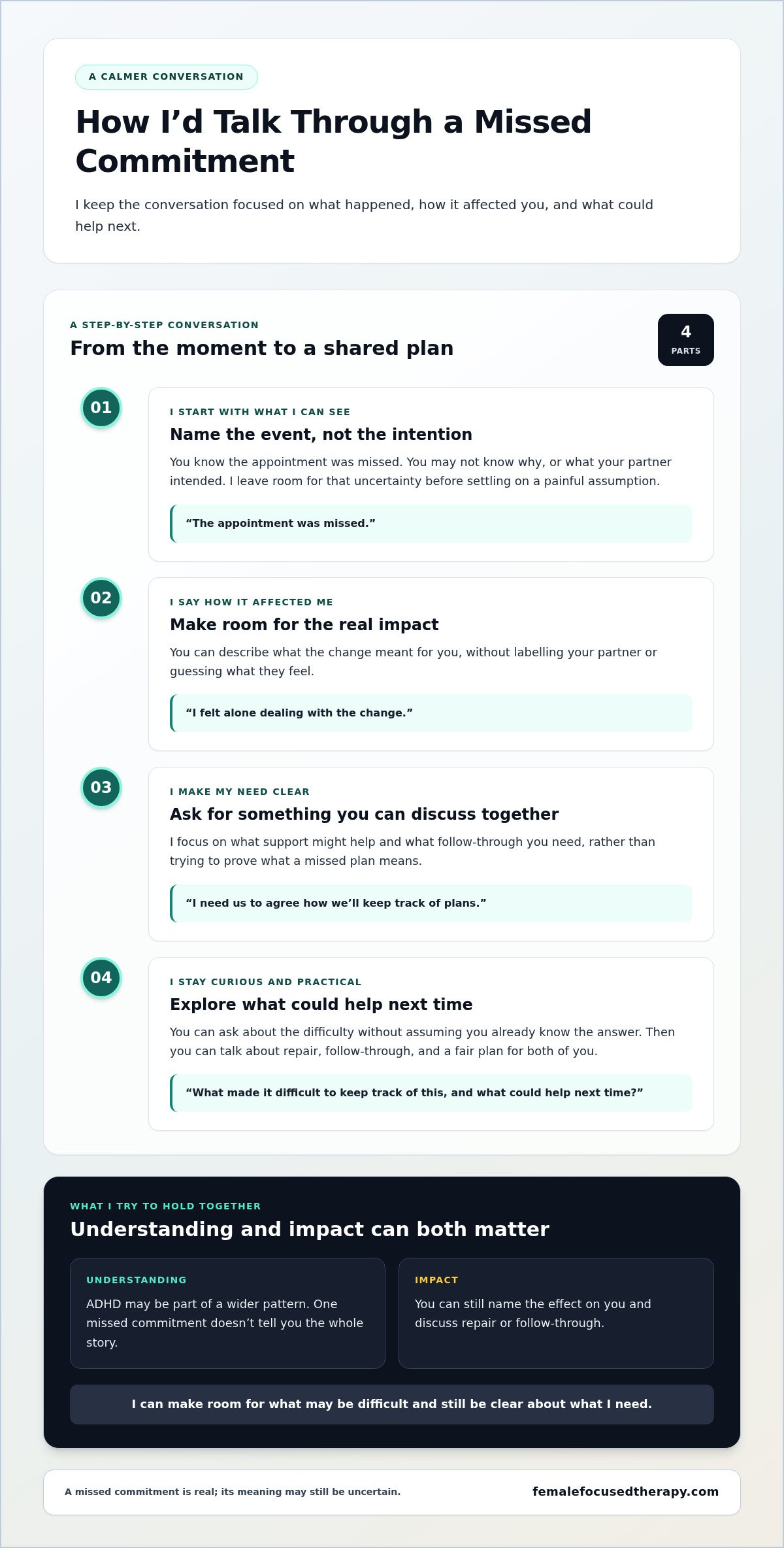
I find it helpful to stay with what you can see rather than reach for a label. You know that the appointment was missed, and you know how that affected your day. You may not know what was happening for your partner, or what they intended. Leaving room for that uncertainty isn’t dismissing your feelings. It’s a way to pause before a painful assumption hardens into the only possible story.
Context can help you understand what happened, but it doesn’t remove the need for repair or follow-through. Your partner’s experience matters, and so does the effect on you. Understanding ADHD doesn’t mean accepting every repeated difficulty without discussion. It can help you respond to the real situation, rather than blame either of you for something you haven’t yet understood.
How to separate intent, impact and responsibility
Try separating three things: what happened, how it affected you, and what you need now. You might say, “The appointment was missed. I felt alone dealing with the change, and I need us to agree how we’ll keep track of plans.” This doesn’t claim to know your partner’s motivation. It gives both of you something clear to respond to, including a chance to talk about repair.
Then make space for a curious question. Instead of asking, “Why don’t you care enough to remember?”, you could ask, “What made it difficult to keep track of this, and what could help next time?” The answer may reveal a practical obstacle, or it may not. Either way, you can still discuss what follow-through you need and what a fair plan looks like for both of you.
If you’re wondering how to support a partner with adhd, I’d hold compassion and accountability together. I’m an adult woman with ADHD, and I know experiences differ; my perspective can’t tell you exactly what is happening in your relationship. You can explore more about ADHD-focused support while staying attentive to your own experience. If you’d value a space to reflect on the patterns between you, you can book an appointment.
How to Talk About ADHD Without Sliding into Blame or Parenting
It can be hard to raise a concern when you’re worried it will sound like criticism. You may soften your words until your need disappears, or come in already carrying frustration from several past disagreements. I’d try to choose one concern and one calm moment, rather than asking a single conversation to resolve the whole relationship.
A simple sequence can help you stay clear and kind: choose a time when neither of you is rushing, describe one specific event, say how it affected you, then ask what might help. You’re not responsible for managing your partner’s response. You can make room for their perspective without giving up your own.
A gentle way to raise one recurring concern
Try naming what happened, not what you think it says about your partner’s character. You might say, “When the laundry was left for me to finish last night, I felt frustrated and alone with the task. Next time, I need us to agree who’s finishing it.” This gives your partner something specific to respond to, without labelling them as careless or unreliable.
You could then ask, “How did it look from your side?” Listening to the answer doesn’t mean you have to withdraw your request. You can acknowledge what you hear and still be honest about the effect on you. I find it helps to stay with that one situation, rather than reopening every old hurt before either of you has had a chance to feel heard.
If you notice the conversation getting heated, it’s all right to pause and return to it later. You might say, “I want us to understand each other, and I need a short break before we carry on.” A pause isn’t a punishment or a way to avoid the issue. It can give you both a little space to settle and come back with more care.
Making shared plans that do not depend on constant reminders
Once you’ve talked about the concern, choose one routine to work on together. You might agree to put household jobs in a shared calendar, set one reminder, or use a simple list in a place you both see. The important part is that you both choose the system and help maintain it. If you’re the only one updating it, the reminder can quietly become another responsibility for you.
Treat the plan as an experiment, not a test of love. If it doesn’t help, you can talk about what got in the way and adjust it together. Teamwork means sharing responsibility, not making one partner the project manager. That can be a useful guide as you work out how to support a partner with ADHD while staying connected to your own needs.
If a conversation keeps turning into the same painful pattern, I offer couples and relationship therapy as a space to explore what’s happening between you. You can book an appointment if that feels like a helpful next step.
How to Offer Support While Keeping Your Own Needs in View
You can care about what your partner finds difficult and still feel frustrated by the effect on you. I want to make room for both truths. Understanding ADHD doesn’t ask you to ignore your limits, accept an arrangement that leaves you depleted, or pretend repair isn’t needed after something goes wrong.
Before offering more help, pause and notice what you can genuinely manage. Are you offering because it feels like a choice, or because you’re worried everything will fall apart if you don’t step in? That question isn’t a test of your kindness. It can help you tell the difference between support that feels sustainable and taking on more than you have capacity for.
The difference between helping and carrying everything
For me, support means agreeing how to share a responsibility, not silently taking it over. If the bins need to go out, you might agree that your partner takes them out and you handle another household job. You can offer help with a plan, while leaving ownership shared. Setting a limit on what you can do isn’t punishment or a withdrawal of love.
It can be tempting to check, remind and follow up because you want to prevent stress for both of you. But if you become responsible for noticing and managing every task, the arrangement may work only by asking more of you. I’d ask whether the support is helping you act as partners, or leaving you to carry the responsibility in a different form.
Noticing when you need more support too
You may notice that you’re tense before asking for help, or that resentment is building around small daily tasks. Those feelings deserve attention. They don’t make you uncaring; they may be telling you that something needs to change. Try naming one need clearly: “I can help with dinner tonight, but I can’t be responsible for planning every meal this week.”
Your boundary doesn’t have to settle every practical detail at once. It can simply give you both a clearer place to begin. You can listen to your partner’s response and still honour what you have capacity for. I believe your emotional experience matters in its own right, not only as a way to keep the relationship running smoothly.
Working out how to support a partner with adhd includes asking what care can look like without asking you to disappear inside it. If you find yourselves caught in repeated relationship patterns, couples therapy and relationship support can offer space to explore them together. If you’d like to reflect on what’s happening in your relationship, you can book an appointment.
When Support for an ADHD-Affected Relationship Could Include Therapy
You don’t have to wait until everything feels unmanageable to seek support. Therapy can give you a steady place to understand your feelings and look at the patterns shaping your relationship. It isn’t a way to diagnose your partner, make them change, or decide who is to blame. It can help you hear yourself more clearly and consider what you need.
How individual support can help you find your footing
In individual therapy, the focus can stay with you, whether or not your partner attends. You might explore where you feel overwhelmed, what boundaries would help, and how to trust your own sense of what is sustainable. You can take these questions at a pace that feels manageable, without needing to have every answer before you begin.
If ADHD is part of your own experience as a woman, I offer ADHD-focused therapy. I’m an adult woman with ADHD myself, and I know that each person’s experience is different. That lived understanding informs my work, but it doesn’t mean I assume I know what you’re feeling. Your story stays at the centre.
Individual support can also help you separate what you can take responsibility for from what isn’t yours to carry. You might practise saying what you need, sit with complicated feelings, or notice when you’ve started to doubt yourself. None of this requires you to make a decision about your relationship straight away. Sometimes the first step is simply having room to think.
How couples therapy can make room for both perspectives
If you and your partner are both willing, couples therapy can offer a shared space to look at how you communicate and what happens when the same difficulties return. You can each describe your experience, listen to what the other person understood, and explore new ways of responding. The aim isn’t to make one person the problem. It’s to understand the pattern between you and consider what each of you might contribute to changing it.
Therapy can’t promise a particular outcome, and it shouldn’t ask you to dismiss your limits. It can help you approach difficult conversations with more care, while making space for frustration, tenderness and uncertainty. I work with women through relationship challenges, and I know how important it can be to feel listened to without being pushed towards a quick answer.
For one small next step, you might write down what you hope a supportive space could help you understand. If you’d like to explore how to support a partner with adhd together, you can book an appointment with me.
If you’d like to find out more about working with Cheryl Kennedy MacDonald at Female Focused Therapy, you can email her at cheryl@femalefocusedtherapy.com, book an appointment directly on the website, or explore lifestyle and yoga programmes by visiting YogaBellies.
Take one gentle step towards a steadier relationship
Your next step doesn’t need to solve everything. You might simply pause and ask yourself what would help you feel more supported this week, then give that need words. Caring for your partner and listening to yourself can belong in the same relationship.
Learning how to support a partner with adhd can also mean making space for your own perspective. I’m Cheryl, a registered integrative psychotherapist and an adult woman with ADHD. My work includes ADHD-focused therapy for adult women, as well as couples and intimacy therapy. I bring my professional experience and lived understanding to this work, while remembering that your experience is your own.
If you’d like a calm space to explore what’s happening for you, you’re welcome to take a first step towards an appointment. You don’t need to have everything worked out before you begin. A little more understanding of yourself can be a meaningful place to start.
Frequently Asked Questions
Is ADHD an excuse for hurtful behaviour in a relationship?
No. ADHD may offer context for some behaviour, but it doesn’t make the hurt you feel unimportant or remove the possibility of repair. I’d pay attention to what happens after you explain the impact: can you both discuss what would help, and does anything shift over time? If a behaviour feels frightening or unsafe, focus first on your safety and seek support you trust.
Can reminders help without making me feel like my partner’s parent?
Yes, if you both agree to them and your partner takes an active role. You might ask, “Would a calendar alert help, and would you be happy to set it up?” That keeps you from becoming the person who remembers to remind them. If reminders feel uncomfortable, try discussing what would make the system feel more mutual, rather than adding more prompts by default.
How can I talk about ADHD if my partner becomes defensive?
Try starting with the specific concern, rather than telling your partner what ADHD means about them. You could say, “I’m not trying to label you. I want to talk about how we handle plans.” If the conversation gets tense, you can suggest returning to it later. You don’t have to persuade your partner to accept a label in order to speak about what you need.
Should I attend my partner’s ADHD therapy sessions?
Only if your partner wants you there and the therapist agrees a joint session fits the work. Your partner’s individual sessions are their space, so don’t assume an invitation or ask them to report back on private conversations. If you want help discussing a shared issue, you can raise the idea of a separate couples session. Your own individual therapy is another way to explore your experience independently.
Can couples therapy help when one partner has ADHD?
It can offer a shared place to explore how you communicate, what tends to happen during disagreements, and what each of you wants to change. It isn’t a way to diagnose or control either partner, and it can’t promise a particular outcome. I offer couples and intimacy therapy for relationship concerns, with room for both perspectives. Learning how to support a partner with ADHD can also include exploring what support feels workable to you.
What if my partner does not want to talk about ADHD?
You can respect that they may not be ready to discuss ADHD, while still speaking about specific relationship needs, such as how you divide household responsibilities or make plans. Try keeping the conversation focused on what affects you, rather than insisting on a label. If your partner continues to avoid the subject, you can still seek individual support to clarify your boundaries and choices.

Article by
Cheryl Kennedy MacDonald MA BA (Hons) Pg. Dip. SAC BACP
Cheryl Kennedy MacDonald is a psychotherapist specialising in women’s mental health, relationships, and life transitions. She works with women navigating trauma, relationship breakdown, identity shifts, and midlife change, helping them rebuild self-trust, emotional stability, and a clear sense of who they are and what they want.
With over 20 years’ experience working with women internationally, Cheryl is the founder of YogaBellies, a global women’s yoga school, and the creator of the Birth ROCKS method. Her work sits at the intersection of psychotherapy and embodiment, integrating evidence-based therapeutic approaches with somatic, body-based practices that support deep, lasting change.
Known for her grounded and direct approach, Cheryl moves beyond surface-level insight to address the patterns held in the body and nervous system. Her work supports women to regulate, reconnect, and respond to their lives from a place of clarity, strength, and self-respect.
She is a published author in academic journals and has written multiple books on women’s health, pregnancy, and midlife wellbeing, available on Amazon and leading book retailers worldwide.