
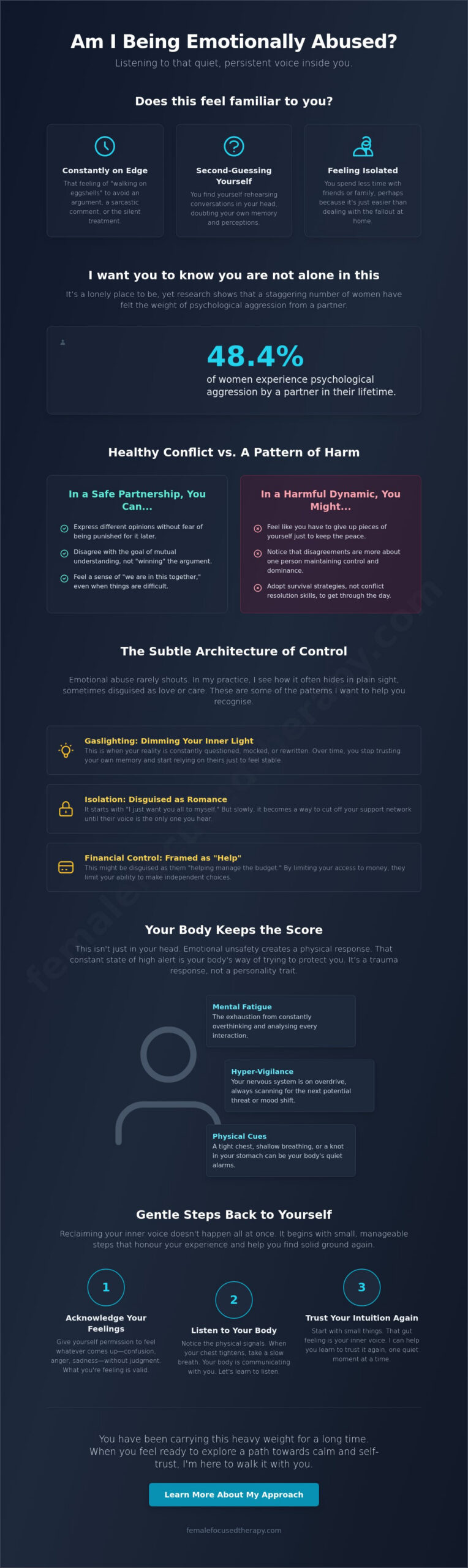
What if that heavy, sinking feeling in your chest during the quiet moments at home isn’t just everyday exhaustion? You might be asking yourself, “am I being emotionally abused,” because your gut is trying to tell you something your mind isn’t quite ready to accept yet. It’s a lonely place to be, yet research shows that 48.4% of women experience psychological aggression by a partner in their lifetime.
I understand how it feels to live in a state of constant self-doubt, where you’re always walking on eggshells to avoid an outburst or a cold shoulder. You spend so much energy trying to fix the relationship that you’ve lost sight of your own needs. I’m here to help you move through this fog of emotional unsafety and show you how to begin trusting your own intuition again.
In this article, we’ll look at the subtle signs of psychological aggression and the difference between normal relationship hurdles and a truly unhealthy dynamic. We’ll explore how to find your inner calm and create a safe path forward that honours your worth and your peace of mind.
Key Takeaways
- I’ll help you untangle the heavy confusion of asking “am I being emotionally abused” by validating the very real feelings you carry in your quietest moments.
- You’ll learn to recognise the subtle patterns of control and isolation that often hide behind the guise of a partner’s affection or protection.
- We’ll explore why your brain and body process emotional harm as valid trauma, even when there are no physical bruises to see.
- I’ll share how your nervous system reacts to the constant state of walking on eggshells and how to begin listening to those vital physical cues.
- You will find gentle, manageable steps toward internal restoration, helping you move away from self-doubt and back toward trusting your own inner voice.
The quiet erosion of self: Understanding the feeling of walking on eggshells
I want to start by acknowledging how heavy this confusion feels for you. It is a weight that sits in your chest during the quietest parts of the day, making it hard to focus on anything else. You might be searching “am I being emotionally abused” because you’ve reached a point where your own thoughts feel like they’re betraying you. I see this so often in my work with high-functioning, intelligent women who seem to have it all together on the outside but feel like they are breaking on the inside.
Emotional abuse is a persistent pattern of behaviour designed to gain and maintain power over another person. Unlike physical violence, it often leaves no visible marks, which makes it far easier to dismiss or minimise. In my practice, I see how these dynamics create deep internal fractures. You might be excelling in your career or managing a complex household, yet behind closed doors, you are slowly losing your sense of self-worth. Understanding Psychological Abuse is the first step in realising that what you’re feeling is valid and real.
Why the ‘fog’ makes it so hard to see clearly
Gaslighting is the primary tool used in these dynamics to make you doubt your own reality. I often describe it as a slow dimming of your internal light. It doesn’t happen all at once; it’s a gradual process where your perspective is constantly challenged, mocked, or rewritten by someone else. Over time, you stop trusting your own memory and start relying on theirs just to survive the day.
You might find yourself constantly rehearsing conversations in your head before you speak. You’re trying to find the “perfect” way to say something to avoid a blow-up, a sarcastic comment, or a week of the silent treatment. This mental fatigue is a hallmark of living in an emotionally unsafe environment. It’s an exhausting way to live, and it’s important to recognise that this hyper-vigilance isn’t a personality trait. It’s a response to trauma.
The difference between healthy conflict and a pattern of harm
Healthy relationships allow for disagreement without the fear of retaliation. In a safe partnership, you can express a different opinion or say “no” without worrying about being punished later. Disagreements in these spaces aim for mutual understanding, even if you don’t end up agreeing on the specific issue. There is a sense of “we are in this together,” even when things are difficult.
When I work with women in relationship trauma and narcissistic abuse recovery, I look for the power imbalance rather than just the argument itself. Abuse is about control and dominance. Conflict, while uncomfortable, is ultimately about resolution and connection. If you feel like you’re constantly losing pieces of yourself just to keep the peace, that isn’t conflict. It’s a survival strategy.
The subtle architecture of control: Recognizing the patterns in your daily life
I want to walk you through the patterns that often hide in plain sight. These aren’t always loud or obvious. Sometimes they’re wrapped in the language of care or concern. You might still be asking, “am I being emotionally abused,” because the person hurting you is also the one who claims to love you most.
Isolation often starts with a sweet sentiment: “I just want you all to myself.” It sounds romantic at first. However, it quickly turns into a cage. They might suggest you stay home instead of seeing your family because they “miss you too much.” This isn’t about love. It’s about slowly cutting off your support network until they are the only voice you hear.
Financial control is another subtle brick in this wall. It’s often disguised as “helping you manage the budget” or taking over the bills because you’re “too busy.” By limiting your access to money, they limit your ability to make independent choices. Recognising these patterns as relationship trauma is the first step toward reclaiming your agency.
It’s a widespread issue that stays hidden in the shadows. Data from early 2026 indicates that 24 people per minute are victims of intimate partner violence in the U.S. alone. Many of these cases involve the psychological tactics we’re discussing here. Understanding What is emotional abuse? can provide the objective proof your mind needs to start believing your gut.
The cycle of ‘hoovering’ and intermittent reinforcement
The “honeymoon” phase after a blow-up is what keeps you stuck. They might bring gifts, offer deep apologies, or promise that things will be different this time. I explain this to my clients as a chemical addiction to these rare moments of kindness. This “hoovering” creates a trauma bond that is incredibly difficult to break alone.
Your brain begins to crave the relief of the reconciliation. This makes the periods of abuse feel like a price worth paying for the temporary peace that follows. It’s a physiological loop that’s hard to exit without professional support.
Humiliation disguised as ‘just a joke’
Have you ever been mocked in front of friends, only to be told you’re “too sensitive” when you get upset? Humiliation is often disguised as “just a joke.” These sarcastic comments are specifically designed to erode your social confidence. They make you feel like you can’t trust your own reactions.
If you feel small or “less-than” when they are around, your intuition is speaking to you. Trust that feeling. If these patterns resonate with you, we can explore these feelings together in a safe, non-judgmental space. You deserve to feel safe in your own home and your own skin.
Beyond the bruises: Why emotional harm is real and valid trauma
I hear many women say, “But he never hit me,” as a way to minimise what they’re going through. It’s a phrase that often signals deep confusion and a desire to give the benefit of the doubt. You might be asking “am I being emotionally abused” because there are no physical marks to point to. Yet, the absence of bruises doesn’t mean the damage isn’t there. It just means the wounds are tucked away where the world can’t see them.
Healing starts with validating that your pain is real and significant. According to data published in early 2026, 48.4% of women have experienced psychological aggression by an intimate partner. This is nearly half of all women. Your experience isn’t an outlier or an overreaction. It’s a serious form of relationship trauma that deserves to be acknowledged and treated with compassion.
Your brain actually processes emotional pain in the same way as physical pain. When you’re belittled or isolated, the same neural pathways light up as if you’d been physically injured. Because there’s nothing to see in the mirror, the recovery process can feel longer and more complex. You’re trying to heal a wound while often being told it doesn’t exist. This conflict between your reality and what you’re being told can be incredibly taxing on your spirit.
The ‘Invisible’ impact on your mental health
Living in a state of emotional unsafety creates chronic stress. This isn’t just a “bad patch” in a relationship. It’s an environment that prevents you from thriving and growing. I often see women losing their sense of identity and their personal interests. You might find you’ve stopped doing things you love because you’re too exhausted from managing the mood of someone else.
This constant pressure can lead to deep-seated anxiety and depression. It’s like trying to run a marathon while carrying an invisible backpack full of stones. Eventually, your nervous system gets overwhelmed. You aren’t “failing” at managing your life. You’re reacting normally to a situation that is fundamentally draining your resources.
Addressing the ‘I’m too sensitive’ myth
Being told you are “too sensitive” is a classic deflection tactic. It shifts the blame from the person causing the harm onto your reaction to it. I view sensitivity very differently. I see it as a strength. It’s your early warning system, a finely tuned internal compass that tells you when something is wrong.
Your feelings are data points, not something to be “fixed” or ignored. If something feels wrong, it’s because your intuition is trying to protect you. Instead of trying to dampen your sensitivity, we can learn to listen to what it’s telling you about your safety. Trusting that voice again is a vital part of your journey toward internal restoration.
Listening to your body: How your nervous system reacts to emotional unsafety
Your body often knows the truth before your mind is ready to accept it. I want you to pay attention to the physical sensations of “walking on eggshells” as you move through your day. If you are constantly asking yourself, “am I being emotionally abused,” your nervous system might already be shouting the answer through tension and fatigue. Your physical self is a loyal witness to your lived experience.
Chronic tension in your shoulders or a permanent “pit” in your stomach are more than just signs of a busy life. They are signals from your body that you don’t feel safe in your own environment. Healing involves bringing your body back into a state of rest and safety. This is difficult to achieve when you are always on high alert, waiting for the next shift in your partner’s mood.
I believe that internal restoration starts with acknowledging these physical cues. Your body is trying to protect you by keeping you ready for a threat. Recognising that this state of hyper-vigilance is a response to your environment, not a personality flaw, is a powerful step toward clarity. You deserve to live in a body that feels relaxed and at peace.
The ADHD connection: Emotional intensity and vulnerability
For women with ADHD, emotional dysregulation can make these dynamics even more confusing. Rejection Sensitivity Dysphoria (RSD) is an intense emotional response that many neurodivergent women experience. This sensitivity can unfortunately be weaponised by an abusive partner to make you feel like your reactions are the primary problem in the relationship.
I help neurodivergent women separate their ADHD symptoms from their partner’s behaviour. It is vital to understand that your brain’s unique wiring doesn’t justify someone else’s lack of kindness or respect. You aren’t “too much,” and your emotional intensity is not an excuse for someone to mistreat you. Learning to trust your own perception is essential for your recovery.
Somatic markers of a toxic environment
Notice what happens when you hear their key in the door. Does your breath become shallow? Do you find yourself bracing your core or clenching your jaw? Digestive issues and frequent headaches are often linked to long-term emotional distress that has nowhere else to go. These are somatic markers of a toxic environment that your mind might be trying to rationalise away.
I use movement and breath as tools to help you reconnect with your body’s wisdom. Reclaiming your physical space and calming your heart rate are essential steps in finding your way back to yourself. If you are ready to explore these somatic signals and begin your journey toward safety, you can book a psychotherapy session with me to start that work.
Reclaiming your inner voice: Small steps toward safety and self-trust
I am not here to tell you what to do. My role is to help you find your own way through the fog. If you’ve been asking yourself, “am I being emotionally abused,” the very act of seeking clarity shows immense strength. The goal of our work together is internal restoration, where you begin to trust your own instincts again.
Finding a safe, non-judgemental space to talk is a courageous first step. You aren’t alone in this journey. On a single day in 2025, over 84,146 survivors were served by domestic violence programs across the US. You don’t have to have all the answers today. Healing isn’t a race; it’s a process of coming back to yourself. Trust the next breath and allow yourself the space to breathe.
Building a ‘Reality Team’ of trusted voices
Isolation is a powerful tool of control. Breaking that cycle is vital for your mental health. Reconnect with friends or family members who make you feel like “yourself” again. These are the people who remind you of your worth and your history before the confusion set in. They help you hold onto the person you were before you started walking on eggshells every day.
Keeping a private journal can also help you track the “flicker” of reality. When you write things down, it becomes harder for someone else to gaslight you. It provides a record of your truth that you can return to when you feel yourself starting to second-guess your own memory. I also recommend seeking professional support to help untangle the fog that emotional unsafety leaves behind; for example, you can learn more about Blue Oak Counselling to see how a dedicated practice can assist. A therapist can provide an objective perspective that is free from the biases of your relationship.
Creating a sanctuary for your own mind
Find small moments of peace that belong only to you. Whether it’s a walk, a book, or a quiet bath, these moments are yours alone. I believe that rest is a radical act of self-preservation in these dynamics. It allows your nervous system to step out of high alert and into a space of reflection. When we rest, we give our minds the chance to process the signals our bodies have been sending us.
You deserve a life where you feel grounded and respected. If you are still wondering, “am I being emotionally abused,” please know that your feelings are enough of a reason to seek support. One realistic next step is booking a quiet consultation to explore your feelings safely. We can look at your situation together, at your pace, without any pressure to make life-altering decisions before you’re ready.
Finding your way back to your own truth
You’ve taken a brave step today by simply sitting with these words and reflecting on your own experience. Acknowledging the subtle patterns of control and learning to listen to the somatic signals in your body are the first movements toward internal restoration. If you are still asking yourself, “am I being emotionally abused,” please know that your feelings are a valid starting point for seeking clarity and peace.
I work as a Registered Integrative Psychotherapist, providing a trauma-informed, gender-centric approach for women who feel lost in the fog of relationship distress. My goal is to offer a safe, confidential space in Singapore or online where you can speak without fear or judgement. We’ll work together to help you reconnect with your intuition and rebuild the confidence that may have been eroded over time.
If you feel ready to find your voice again, I am here to listen. Book a confidential session here.
You don’t have to carry the weight of this confusion on your own anymore. There is a path forward that leads to a life of calm and self-assurance. Trust that you are worthy of respect, and remember that your peace is always worth protecting.
Frequently Asked Questions
How do I know if it’s emotional abuse or just a bad relationship?
The main difference lies in the balance of power and the presence of fear. In a bad relationship, you might argue frequently, but you still feel safe to express your needs and disagree. Emotional abuse involves a persistent pattern of control where you feel diminished, silenced, or afraid of your partner’s reaction. If you find yourself constantly asking “am I being emotionally abused” because you feel trapped or less like yourself, it is likely a pattern of harm.
Can emotional abuse happen in a relationship that isn’t physical?
Yes, emotional abuse is a standalone form of trauma that doesn’t require physical violence to be valid. It’s about the systematic erosion of your self-worth through tactics like gaslighting, isolation, and humiliation. Many women spend years in emotionally unsafe environments without ever being hit, yet the internal fractures and psychological impact are just as real. Your pain doesn’t need a physical bruise to be considered significant or worthy of support in your healing journey.
Is it possible that I am the one being emotionally abusive?
It’s common for women in these dynamics to worry about their behaviour, especially if they’ve started snapping or shouting back. I often find that what looks like “abusive” behaviour is actually a desperate survival response to long-term mistreatment, often called reactive abuse. If you’re self-reflecting and worried about your impact on others, that level of empathy usually suggests you aren’t the primary driver of a controlling dynamic. You are simply reacting to an unsafe environment.
What should I do if my partner refuses to acknowledge their behavior?
You cannot force someone to see a reality they aren’t ready or willing to accept. If your partner denies or minimises their behaviour, I encourage you to stop trying to convince them and start focusing on your own well-being. Their refusal to acknowledge the harm doesn’t make your experience any less real. In these moments, I help you build a “reality team” of trusted voices who can validate your truth while you decide your next steps.
How does emotional abuse affect a woman’s mental health long-term?
Long-term emotional unsafety can lead to complex trauma, chronic anxiety, and a deep loss of identity. You might feel a persistent sense of “brain fog” or find it impossible to make simple decisions without second-guessing yourself. I also see many somatic symptoms, such as digestive issues or chronic fatigue, as the body remains in a state of high alert. Rebuilding your internal confidence and self-reliance is a central part of the healing process after these experiences.
Can a relationship recover after emotional abuse has occurred?
Recovery is only possible if the person using abusive tactics takes full, consistent accountability for their actions without blaming you. This requires deep, long-term therapeutic work and a genuine desire to change the power dynamic. However, in many cases, the lack of empathy makes true change very difficult. I focus on helping you find clarity on whether the environment is truly safe enough for you to stay and grow without losing yourself again.
What are the first steps to take if I think I’m being emotionally abused?
The first step is to gently acknowledge your own feelings without judgement. I suggest reaching out to a trusted friend or a professional who understands the nuances of psychological trauma. Keeping a private, secure journal of events can also help you hold onto your reality when things feel confusing. You don’t need to have a full plan to leave immediately; you just need to start building a small, safe circle of support around yourself.
How can therapy help me if I’m in an emotionally unsafe relationship?
Therapy provides a confidential space where your voice is finally heard and believed. I use an integrative approach to help you regulate your nervous system and move out of a constant state of hyper-vigilance. We work on internal restoration, helping you untangle the “am I being emotionally abused” question while rebuilding the self-trust you need to make healthy choices. It is about finding your way back to the woman you were before the fog set in.

Article by
Cheryl Kennedy MacDonald MA BA (Hons) Pg. Dip. SAC BACP
Cheryl Kennedy MacDonald is a psychotherapist specialising in women’s mental health, relationships, and life transitions. She works with women navigating trauma, relationship breakdown, identity shifts, and midlife change, helping them rebuild self-trust, emotional stability, and a clear sense of who they are and what they want.
With over 20 years’ experience working with women internationally, Cheryl is the founder of YogaBellies, a global women’s yoga school, and the creator of the Birth ROCKS method. Her work sits at the intersection of psychotherapy and embodiment, integrating evidence-based therapeutic approaches with somatic, body-based practices that support deep, lasting change.
Known for her grounded and direct approach, Cheryl moves beyond surface-level insight to address the patterns held in the body and nervous system. Her work supports women to regulate, reconnect, and respond to their lives from a place of clarity, strength, and self-respect.
She is a published author in academic journals and has written multiple books on women’s health, pregnancy, and midlife wellbeing, available on Amazon and leading book retailers worldwide.