
What if the mental exhaustion you feel isn’t a personal failure, but the heavy cost of trying to fit a neurodivergent brain into a neurotypical world? As a therapist living with ADHD, I know that finding the right adhd therapy can be the difference between feeling broken and finally feeling seen. You might be exhausted from years of masking your symptoms, feeling as though you’re constantly running just to stay in the same place.
I understand how lonely it feels when traditional talk therapy doesn’t quite click with your experience of rejection sensitivity or executive dysfunction. You deserve a space that acknowledges your brilliance while holding your struggles with kindness. I promise to show you how we can shift the focus from fixing a deficit to understanding your unique needs and restoring your mind-body connection.
In this article, I’ll share how a heart-centred approach can help you move from chronic overwhelm to a life of clarity. We’ll explore ways to regulate your emotions and reduce the shame that often follows a diagnosis, helping you find a sense of internal stability and self-compassion that lasts.
Key Takeaways
- Understand why traditional talk therapy often misses the mark and how specialised adhd therapy provides a space that truly honours your unique neurosignature.
- Learn how I combine science-backed psychological tools with somatic themes like breath and movement to help you regulate your emotions from the inside out.
- Discover how identifying Rejection Sensitive Dysphoria (RSD) can help you navigate the complexities of your relationships and professional life with more ease.
- Find out why seeking a neuro-affirming practitioner is essential for moving past the mental exhaustion caused by years of masking your true self.
- Explore practical ways to work with your brain rather than against it; helping you trade chronic overwhelm for a sense of grounded clarity.
Why ADHD therapy for women needs a different lens
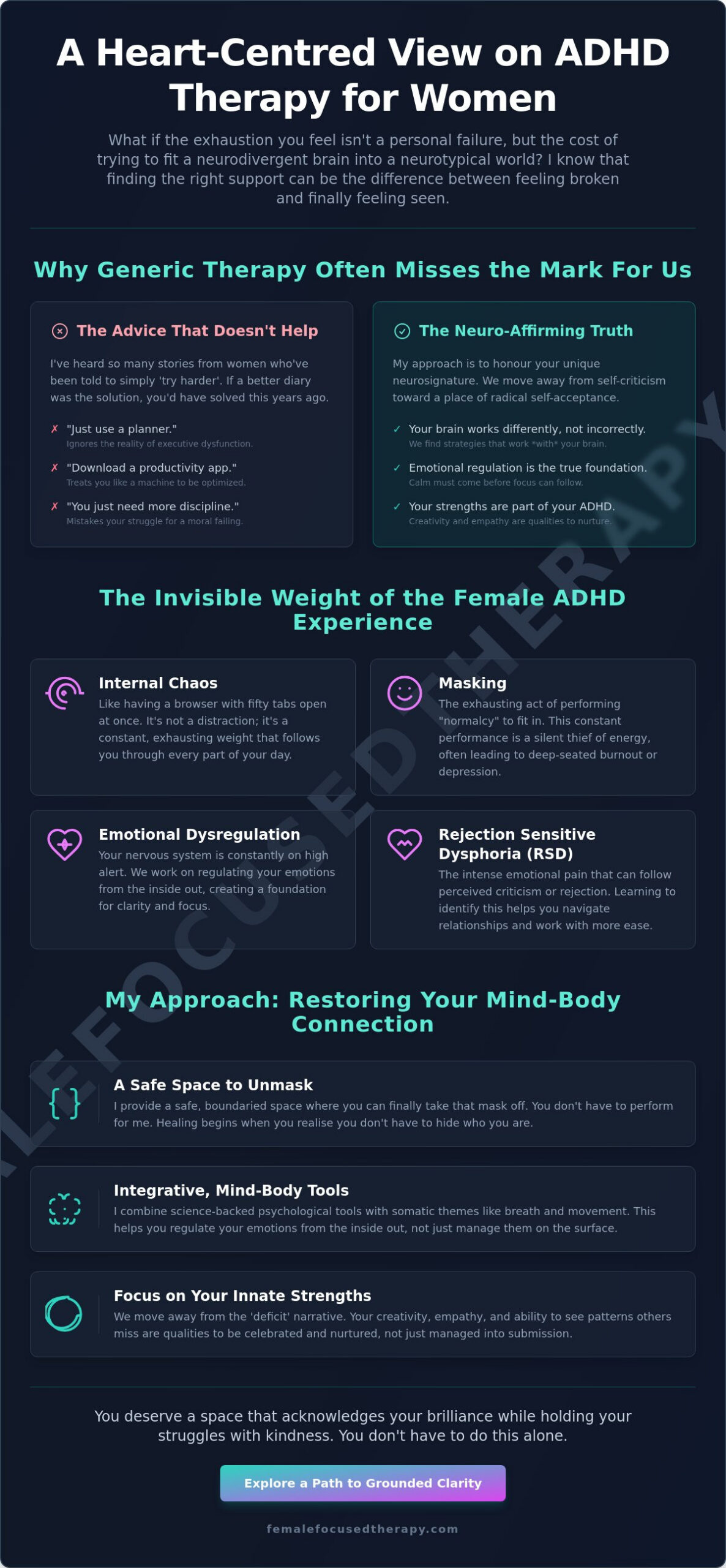
I know exactly how it feels when your brain resembles a browser with fifty tabs open. Every tab is playing a different piece of music, and you can’t quite find the one you need to close. For many of the women I work with, this internal noise isn’t just a distraction; it’s a constant, exhausting weight that follows them through every part of their day.
In my practice, I view adhd therapy as a collaborative, heart-centred space. It isn’t about fixing a broken part of you. Instead, we work together to explore your unique neurosignature. We look at how your specific brain processes information and where the friction points actually lie in your daily life. This is a journey of discovery rather than a clinical correction.
It’s very common for women to reach adulthood or even midlife transitions before they understand why life feels so much heavier for them than for others. While you can find a comprehensive overview of ADHD that lists history and general symptoms, these often fail to capture the female experience. We aren’t always the hyperactive children the textbooks describe. Often, we’re the ones quietly drowning in internal chaos while appearing perfectly composed on the outside.
Most people assume therapy is simply about managing symptoms. While finding practical ways to navigate the day is helpful, my focus is on restoring your sense of self. We move away from the “deficit” narrative and toward a place of internal restoration. It’s about learning to trust your intuition again after years of feeling like you’re getting everything wrong.
The invisible weight of masking
Masking is the exhausting act of performing “normalcy” to fit into neurotypical expectations. You learn to smile, nod, and over-prepare just to hide the fact that you’re struggling to keep up. This constant performance is a silent thief of energy. It’s no surprise that years of masking often lead to deep-seated burnout or a heavy sense of depression.
In our sessions, I provide a safe, boundaried space where you can finally take that mask off. You don’t have to perform for me or pretend you have it all together. We look at the cost of this performance and find ways to help you live more authentically. Healing begins when you realise you don’t have to hide who you are to be worthy of support.
When ‘just try harder’ isn’t the answer
I’ve heard so many stories of women being told to “just use a planner” or download a new productivity app. If a better diary was the solution, you’d have solved this years ago. This kind of advice is frustrating because it ignores the reality of executive dysfunction. It makes you feel like your struggle is a moral failing or a lack of discipline.
We move away from that self-criticism toward a place of radical self-acceptance. I focus on your innate strengths rather than just the areas where you feel you fall short. Your creativity, your empathy, and your ability to see patterns others miss are all parts of your ADHD brain. These are qualities to be celebrated and nurtured, not just managed into submission.
Science-backed paths to managing your ADHD brain
I don’t believe in a one-size-fits-all approach to adhd therapy. My work is integrative, blending evidence-based tools with a deeply trauma-informed perspective. We look for a rhythm that feels sustainable for your specific life rather than forcing you into a rigid structure that only adds to your stress. One of the most important lessons I’ve learned, both personally and professionally, is that emotional regulation is the foundation for everything else.
If your nervous system is constantly on high alert, no amount of focus tips or productivity hacks will stick. Exploring Science-backed paths to managing your ADHD helps us understand the biology of your brain, but our work focuses on how that biology feels in your body. We prioritise finding calm first, which naturally allows clarity and focus to follow in its own time.
Cognitive Behavioural Therapy (CBT) with a twist
CBT is simply about noticing the link between your thoughts and the feeling of being completely overwhelmed. I adapt these traditional tools to be neuro-affirming rather than compliance-based. We aren’t trying to “fix” your thoughts to make you more productive for others; we’re tackling the harsh inner critic that ADHD so often fuels. By identifying these patterns, you can begin to replace self-blame with a much kinder, more realistic internal dialogue.
Mindfulness and the ADHD mind
For many of us, sitting still feels nearly impossible, and that’s okay. Mindfulness in my practice isn’t about traditional meditation or clearing your mind. It’s about creating a tiny, precious gap between an intense feeling and your reaction to it. This space gives you the agency to choose how you respond to the world around you, rather than feeling like you’re constantly at the mercy of your impulses.
Somatic movement: healing through the body
This is where I find the most profound shifts happen for women. I incorporate somatic movement and yoga to help regulate your nervous system directly. Breath and gentle, intentional movement can quiet the physical “buzz” that often accompanies neurodivergence. By connecting the mind and body, we can finally release the physical tension that executive dysfunction leaves behind in our muscles and joints.
If you’re ready to explore a path that respects both your mind and your body, you might find it helpful to schedule a time to talk about your needs. Together, we can find the strategies that actually work with your brain, not against it.
Why generic therapy often misses the mark for us
I’ve spoken to so many women who spent years in traditional talk therapy without seeing real change. Often, their previous therapists were focused on treating the anxiety or depression that appeared on the surface. While those feelings are very real, they are often just the symptoms of an unsupported brain that needs specialised adhd therapy.
When therapy is too generic, it misses the visceral experience of things like Rejection Sensitive Dysphoria (RSD). RSD makes a simple piece of feedback feel like a crushing blow to your soul. It’s an intense emotional pain that affects our closest relationships and how we show up at work. If a therapist doesn’t understand this, you can end up feeling even more misunderstood.
My practice bridges the gap between clinical expertise and lived experience. I know what it’s like to navigate a world that wasn’t built for your specific rhythm. We address the deep-seated trauma of growing up feeling like you were always “too much” or somehow “not enough” for the people around you. This isn’t just about focus; it’s about healing your relationship with yourself.
The intersection of ADHD and trauma
I use a trauma-informed approach because neurodivergent women often carry a unique kind of developmental trauma. This stems from years of being misunderstood or criticised by teachers, parents, or partners. It creates a state of hyper-vigilance that often feels like a permanent part of your personality, making it hard to ever truly relax.
Life transitions like menopause can significantly amplify these ADHD symptoms as oestrogen levels drop. This can leave you feeling like your previous coping mechanisms have vanished overnight. Our work focuses on rebuilding trust in your own intuition. I want to help you realise that you weren’t “wrong” all those years; you were simply navigating a neurotypical world without the right support.
Emotional regulation vs. productivity
I will always prioritise your emotional well-being over the length of your to-do list. In a world obsessed with output, it’s easy to think that better executive function is the only goal of therapy. But you can’t organise your way out of a dysregulated nervous system. If you’re in a state of fight-or-flight, a new planner won’t help.
Feeling safe in your body is the essential first step to better clarity. When you feel grounded, your brain finally has the capacity to plan and focus. We learn how to ride the waves of emotional intensity without feeling like you’re drowning in the surf. This shift allows you to move through your day with a sense of internal stability that no app can provide.
What to look for in an ADHD-focused therapist
I believe it is so important to find a practitioner who truly “gets” the neurodivergent experience. You shouldn’t have to spend your sessions explaining how your brain works; you should spend them being understood. When you are searching for adhd therapy, I suggest looking for someone who is neuro-affirming rather than just “aware” of the condition.
A neuro-affirming therapist sees your brain as a natural variation of the human experience rather than a collection of deficits to be cured. They won’t try to force you into neurotypical boxes or judge you for your executive dysfunction. Instead, they will help you build a life that actually fits your unique neurosignature. A specialised approach to adhd therapy should feel like a massive relief, not another chore on your to-do list.
Finding a therapist who can work with both your mind and your body is also invaluable. Since ADHD often manifests as physical restlessness, sensory overload, or a constant “buzz” in the nervous system, talk therapy alone can feel incomplete. You need a therapeutic space that feels safe, grounded, and responsive to your sensory needs.
Questions to ask your potential therapist
Before you commit to a practitioner, I encourage you to ask a few direct questions to see if they are the right fit for you. Their answers will help you determine if they have the specialised knowledge you deserve. You might consider asking:
- Do you have specific experience working with women and ADHD?
- How do you incorporate somatic or body-based practices into your sessions?
- What is your stance on neurodivergence; is it something to fix or something to support?
Finding your ‘safe space’ in Singapore or online
Whether you are looking for support locally in Singapore or from elsewhere, online therapy can be a game-changer for busy women. It allows you to stay in an environment where you already feel comfortable, which is vital for managing your sensory needs. You can control the lighting, choose your favourite chair, and avoid the “transition cost” of travel that often makes appointments feel stressful.
The most important factor in your healing journey is the “click” you feel with your therapist. Trust your gut feeling about a practitioner. If you feel like you have to mask your symptoms during a session, that person might not be the right guide for you. You deserve a space where you can take the mask off and be exactly who you are without judgment.
If you’re ready to work with someone who truly understands the complexities of the neurodivergent female brain, I invite you to book a session with me today. Together, we can create a path toward clarity that respects your energy and your intuition.
How I support neurodivergent women in my practice
I don’t just see your ADHD; I see who you are beneath the layers of overwhelm and exhaustion. My approach to adhd therapy is built on the belief that you are already whole. We aren’t looking to strip away your personality to make you more compliant. Instead, we’re uncovering the brilliant, capable woman who has been hidden under the noise for too long.
Finding the right adhd therapy is about more than just managing a to-do list. In our sessions, you’ll find a blend of deep listening, somatic tools, and practical insight. I know that some days you’ll have the energy to dive deep into your history. Other days, you might just need a quiet space to regulate your nervous system.
We work at a pace that respects your energy levels and the specific life transitions you are navigating. Your next step doesn’t have to be a giant leap; it can be a gentle conversation. I am here to hold space for you while you find your own rhythm again.
An integrative, heart-centred approach
I weave my background as a yoga master into our psychological work because the body often holds the tension that the mind can’t express. An integrative session might involve exploring a difficult emotion through talk and then using a specific breath practice to release the physical weight of that feeling. It’s about creating a comprehensive mind-body connection.
We focus on restoration and rebuilding your internal confidence. For many women, ADHD has eroded their self-trust over decades. My goal is to help you reclaim that trust. We look for the small, sustainable shifts that make your daily life feel more manageable without adding to your mental load.
Ready to explore a different way of being?
You are not broken, and you certainly don’t need to be “fixed.” You’ve simply been trying to operate with a set of instructions that wasn’t written for your brain. Healing is a journey of coming home to yourself and finally accepting that your way of being is valid and valuable.
I invite you to book a quiet moment for yourself to see if we’re a fit. There is no pressure to have everything figured out before we speak. This is simply an invitation to be seen and heard in a way that honours your neurodivergent experience.
Book a consultation with me today and let’s begin the process of finding your calm amidst the chaos.
Taking your first step toward internal clarity
Moving from chronic overwhelm to a life of clarity isn’t about working harder or finding a better app. It’s about unlearning the shame of masking and finally understanding your unique neurosignature. A heart-centred, trauma-informed approach helps you regulate your emotions and restore your internal confidence.
As a Registered Integrative Psychotherapist with lived experience as an adult woman with ADHD, I know how vital it is to feel truly seen. My goal is to provide a neuro-affirming space where you can explore adhd therapy without the weight of judgment. Together, we’ll find the somatic and psychological tools that resonate with your specific life and energy.
You don’t have to navigate this chaos alone. If you’re ready to start this journey of restoration, I invite you to book your initial ADHD-focused consultation with me here. You deserve to live with a sense of grounded stability and self-compassion. I’m here to support you in coming home to yourself.
Frequently Asked Questions
What exactly is ADHD therapy, and how is it different from coaching?
ADHD therapy focuses on the emotional roots and psychological impact of being neurodivergent, whereas coaching usually centres on productivity systems. In my practice, I help you explore the underlying shame, trauma, and mental exhaustion that often prevent those systems from working. We look at the “why” behind your struggles, helping you heal your relationship with yourself rather than just ticking off a to-do list.
Can therapy help if I was only diagnosed with ADHD as an adult woman?
Yes, therapy is incredibly helpful for processing the complex mix of relief and grief that often follows a late diagnosis. Many women I work with feel a deep sense of sadness for the years they spent struggling without the right support. We use our sessions to reframe your past experiences and build a future that finally honours how your brain actually works.
Do I need a formal diagnosis to start ADHD-focused therapy with you?
You don’t need a formal medical diagnosis to begin working with me in my practice. I support many women who are self-diagnosed or simply suspect they have ADHD and are struggling with the associated emotional overwhelm. Our work focuses on your lived experience and the specific challenges you face today; providing a safe space to find clarity regardless of a clinical label.
How long does it typically take to see progress in ADHD therapy?
Progress is a personal journey, but many women feel a sense of relief after just a few sessions of specialised adhd therapy. While deep internal restoration and unlearning years of masking takes time, we often find immediate ways to help you feel more grounded. We always work at a pace that respects your energy levels and the current transitions in your life.
Can therapy help with the emotional outbursts and RSD I experience?
Yes, we specifically address the intense emotional waves and Rejection Sensitive Dysphoria (RSD) that often accompany ADHD. We use integrative tools to help you create a tiny, precious gap between an intense feeling and your reaction to it. This shift helps you navigate your relationships and professional life with much more internal stability and far less self-criticism.
Is your ADHD therapy available online for women outside of Singapore?
I offer adhd therapy through online sessions to women globally, providing a safe and confidential space regardless of your geographical location. This is often the most accessible option for busy women who need to manage their sensory needs by staying in a familiar environment. You can access professional support from the comfort of your own home at a time that suits you.
How do yoga and somatic movement actually help with ADHD symptoms?
Somatic movement and yoga help by directly regulating your nervous system to quiet the physical “buzz” that often comes with neurodivergence. These practices aren’t about perfecting a pose; they’re about learning to listen to your body’s signals and releasing stored tension. By calming your physical body, you create the mental capacity needed for better focus and much clearer executive function.
What should I expect during our first ADHD-focused session together?
Our first session is a gentle, unhurried space where we get to know each other and explore your history. I’ll ask about your current struggles and what you hope to achieve through our collaborative work together. It’s a chance for you to see if my heart-centred approach feels like the right fit for your needs and your intuition.

Article by
Cheryl Kennedy MacDonald MA BA (Hons) Pg. Dip. SAC BACP
Cheryl Kennedy MacDonald is a psychotherapist specialising in women’s mental health, relationships, and life transitions. She works with women navigating trauma, relationship breakdown, identity shifts, and midlife change, helping them rebuild self-trust, emotional stability, and a clear sense of who they are and what they want.
With over 20 years’ experience working with women internationally, Cheryl is the founder of YogaBellies, a global women’s yoga school, and the creator of the Birth ROCKS method. Her work sits at the intersection of psychotherapy and embodiment, integrating evidence-based therapeutic approaches with somatic, body-based practices that support deep, lasting change.
Known for her grounded and direct approach, Cheryl moves beyond surface-level insight to address the patterns held in the body and nervous system. Her work supports women to regulate, reconnect, and respond to their lives from a place of clarity, strength, and self-respect.
She is a published author in academic journals and has written multiple books on women’s health, pregnancy, and midlife wellbeing, available on Amazon and leading book retailers worldwide.