
What if the reason you feel like a “failed adult” isn’t because you’re broken, but because you’ve been trying to follow a manual written for a completely different brain? I know that heavy weight of chronic sensory overwhelm and the exhaustion that comes from years of masking. Finding an adhd psychotherapist who truly gets it is the first step toward realising you aren’t failing; you’re just navigating a world that wasn’t built for you.
I understand this deeply because I’ve been there myself. With the number of women newly diagnosed with ADHD nearly doubling between 2020 and 2022, you’re certainly not alone in this late-life discovery. It’s draining to be professionally capable yet feel like you’re constantly underwater in your private life. You deserve a space where you don’t have to explain why things feel “too much.”
I will help you navigate the search for a therapist who sees your ADHD not as a problem to be solved, but as a life to be supported. We’ll look at how to find a professional who understands the intersection of neurodivergence and the female experience, focusing on internal restoration rather than just a diagnosis.
Key Takeaways
- Understand why the “paralysis of choice” happens when searching for support and how to navigate the fear of being misunderstood.
- Identify the specific markers of an adhd psychotherapist who uses a trauma-informed lens to support your unique neurodivergent world.
- Learn why an integrative approach focuses on rebuilding your self-trust rather than simply trying to “fix” your productivity.
- Discover how connecting with your body through somatic work can help manage the daily sensory overwhelm that often leads to burnout.
- Feel empowered to take the next step toward a therapeutic relationship built on safety, validation, and internal restoration.
Why the search for an ADHD psychotherapist feels so heavy
Searching through a sea of clinical names and dry qualifications feels nearly impossible when your executive function is already at its limit. I know that looking at a directory can trigger a total shutdown. You aren’t just looking for a degree; you’re looking for a person who won’t ask you to “try harder” at things that already feel like climbing a mountain.
Many of the women I work with have spent years being told their struggles were just anxiety or a lack of self-discipline. It’s terrifying to open up to a neurotypical practitioner only to have your lived experience dismissed as a personality flaw. I see you as a whole person with a rich, complex life, not just a set of symptoms to be managed or a problem to be fixed.
We often wait until we’ve hit a wall of burnout before we seek ADHD-focused Therapy. By that point, the “paralysis of choice” is at its peak. You’ve spent so long pretending to be okay that the idea of explaining yourself to a stranger feels like one task too many. You deserve a space where your neurodivergence is met with validation, not skepticism.
The exhaustion of high-functioning masking
If you’ve spent your life being “the reliable one” or “the high achiever,” masking becomes your default mode. You’ve perfected the art of looking calm while your internal world is a storm of sensory input and racing thoughts. The cost of this performance is immense. It’s a heavy tax on your nervous system that eventually leads to deep, soul-level fatigue.
Traditional therapy often misses the struggle because you’re so good at presenting a version of yourself that seems fine. You need someone who looks beneath the surface of your professional success to see the chaos you’re managing at home. My goal is to help you peel back those layers in a safe, gentle way, so you don’t have to carry that weight alone anymore.
When “typical” therapy advice falls short
Standard tools, like those often found in certain psychotherapeutic approaches for ADHD, can sometimes feel like another list of chores you’re bound to fail at. If a therapist suggests a simple planner as the solution to your executive dysfunction, it shows they don’t understand how our brains actually work. It can feel patronising and deeply frustrating.
As an adhd psychotherapist who also lives with ADHD, I know that “just doing it” isn’t the problem. The problem is the invisible barrier between knowing what to do and actually being able to start. We need strategies that respect your energy levels and your sensory needs, rather than trying to force your brain into a neurotypical box that will never fit.
Essential qualities to look for in a therapist for neurodivergent women
Finding an adhd psychotherapist who understands your world means looking for more than credentials. It’s about finding someone who knows your neurodivergence doesn’t exist in a vacuum. You need a space where your history is respected.
Years of navigating a world not built for your brain often leaves a layer of trauma. A trauma-informed approach is vital here. It acknowledges that your symptoms are often survival strategies you’ve used for decades.
A therapist who understands trauma knows that forgetfulness or disorganisation can be tied to your sense of safety. They won’t just give you a list of tasks. Instead, they’ll help you unpick the shame of being told you’re “too much.”
I believe a supportive relationship should feel warm but boundaried. You need someone relatable and human, not a cold observer. You aren’t a case study to be solved or a problem to be fixed.
Research from 2025 shows 80% of adults with ADHD have co-occurring conditions. This is why I prioritise an integrative perspective. We look at your whole nervous system, not just your brain.
When you look for professionals who diagnose and treat ADHD, check if they see these complex layers. It makes a difference when your therapist understands how anxiety or mood disorders intersect with neurodivergence.
The value of an integrative, female-focused approach
Hormonal shifts play a huge role in how we experience ADHD. I’ve seen how the drop in oestrogen during perimenopause makes symptoms feel much heavier. It often leads to a brain fog that standard hacks don’t touch.
This is why I offer life transitions and menopause therapy. Gender-centric framing ensures your safety. You won’t have to waste time educating your therapist on your cycle or life stage.
Evaluating the “vibe” and relational safety
Trust your intuition when you first meet a potential adhd psychotherapist. That initial vibe is your nervous system checking for resonance. It’s a vital part of finding a place where you can be yourself.
If you feel a sense of ease, it’s a sign you can finally stop masking. Relational safety is where the real work of internal restoration begins. You deserve to be seen without having to translate your life.
If you feel ready to explore this kind of space, you can book an initial session with me. We can see how we might work together on your journey toward self-trust and stability.
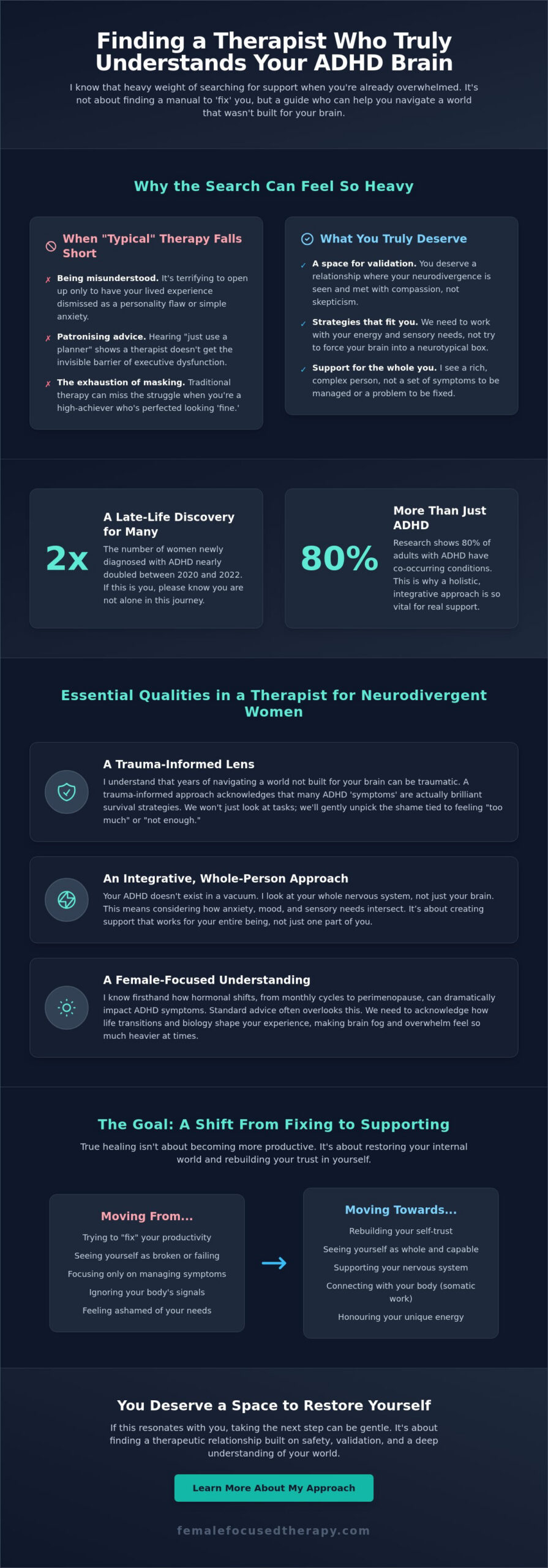
Moving beyond “fixing” to a trauma-informed, integrative approach
I don’t see ADHD as a broken cog in a machine that needs oiling. Many clinical spaces focus purely on productivity hacks, but as an adhd psychotherapist, I know that being “productive” doesn’t mean much if you’re still drowning in shame. Integrative therapy is a journey of restoration where we bring together different therapeutic tools to support your mind, body, and spirit as one connected system.
We shift the focus from “how do I get more done?” to “how do I trust myself again?” After years of forgetting keys, missing deadlines, or feeling “too much,” your self-trust is often shattered. We work on rebuilding that internal foundation so you can move through the world with more ease and less self-criticism. It’s about finding a rhythm that actually works for you, not one you’ve been told you “should” have.
There is also a significant link between neurodivergence and relationship trauma and narcissistic abuse. When you’ve spent your life doubting your own perceptions because of ADHD, you can become more vulnerable to people who exploit that self-doubt. Healing involves unpicking these patterns and learning to listen to your own intuition once more, ensuring you feel safe in your relationships and within yourself.
Rebuilding internal confidence and self-reliance
The “shame spiral” is a familiar place for many of us. It’s that heavy, sinking feeling that follows a mistake or a period of overwhelm. We move away from asking “what is wrong with me” and start asking “what do I need right now.” This shift is powerful. It changes you from being a victim of your symptoms to being the compassionate guardian of your own well-being.
Addressing the sensory side of neurodivergence
Our brains don’t just process thoughts differently; they process the world differently. Sensory processing issues are often the root of emotional overwhelm. If the lights are too bright or the room is too loud, your nervous system stays in a state of high alert. This constant background noise makes it impossible to regulate your emotions or find a sense of peace.
In my ADHD-focused therapy options, I prioritise creating a sensory-safe space. This might mean adjusting your environment during online sessions or using somatic tools to calm a dysregulated system. When your body feels safe, your mind can finally begin to rest and heal. We work together to identify your specific sensory triggers and build a life that respects those needs.
How somatic work and mindfulness support the ADHD brain
Most clinical approaches treat ADHD as if it stops at the neck. As an adhd psychotherapist and yoga master, I know that your neurodivergence lives in every fibre of your being. When your mind is racing, your body often follows suit, leading to that familiar feeling of being “wired but tired.”
We live in a culture that prizes constant doing. For an ADHD brain, “non-doing” can feel like a threat to your productivity or even your safety. But rest isn’t a reward for finishing your to-do list; it’s the essential fuel that allows your nervous system to reset and recover from the day’s demands.
Somatic themes: Breath, movement, and rest
Somatic work isn’t about complex exercises or pushing yourself further. It’s about finding simple ways to drop back into your physical self when the world feels too loud. You might try a specific breathing pattern or a gentle stretch to signal to your brain that you are safe and grounded in this moment.
My work with somatic movement and yoga for women focuses on these gentle, supportive shifts. Trying harder is rarely the answer for a nervous system that is already running on empty. Sometimes, the most courageous and productive thing you can do is simply breathe and allow your body to be.
Mindfulness for the “busy” mind
If you’ve ever tried to sit still for twenty minutes and felt like you were failing at mindfulness, please know that the problem isn’t you. Traditional meditation can be incredibly difficult for an ADHD brain. We can reimagine mindfulness as “noticing” while moving, walking, or engaging in a simple sensory task.
True healing happens in both the mind and the body, working together rather than in conflict. By using awareness to catch the early signs of overwhelm, like a tight chest or a clenched jaw, you can intervene before you reach the point of burnout. If you’re ready to explore these tools, you can book an individual psychotherapy session to start your journey.
Beginning your journey toward internal restoration and self-trust
You’ve spent years trying to fit into a world that wasn’t built for you. I want you to know that you are ready to stop fighting your own brain. This isn’t about finding a new version of yourself, but about making peace with the one who has been here all along. As an adhd psychotherapist, I’m not here to “fix” you, because I don’t believe you are broken.
I work as a guide to help you find your own answers. The path forward is calm and unhurried. We don’t need to rush toward a solution or a set of productivity goals. Instead, we move at a pace that respects your nervous system and your lived experience. Healing is a steady unfolding, not a race to a finish line.
Restoring self-trust is the core of our work together. After a lifetime of feeling “too much” or “not enough,” it takes time to believe in your own intuition again. We will create a space where your neurodivergence is supported, allowing you to move from a state of constant survival into one of internal stability and quiet confidence.
What to expect in our first session together
When we first meet, the atmosphere is gentle and entirely non-judgmental. You can let go of the need to mask or perform for a while. I understand how exhausting it is to keep up appearances, so this is a place where you can simply be. We’ll talk about what brought you here and what you hope to find in our time together.
If you’d like to know more about my own story and why I feel so passionately about this work, you can visit my about me page. I find that sharing a bit of my own background helps build that initial bridge of relational safety. Our focus will always remain on your unique needs, ensuring the work feels relevant to your daily life and your personal pace.
Ready to find your grounded space?
The most important thing to remember is that you don’t have to do this alone. Reaching out is often the hardest part of the process, especially when your executive function is low. I’ve put together a finding a therapist in Singapore guide to help you navigate the search for support with more ease and less overwhelm.
You deserve to feel supported in a way that honours your neurodivergent world. When you feel ready, I invite you to reach out for a quiet conversation. We can explore how adhd psychotherapist support can help you rebuild your confidence and find a sense of grounded peace. There is no pressure and no rush; I am here whenever you are ready to begin.
Embracing your neurodivergent world with confidence
You’ve carried the weight of masking and burnout for a long time. Finding an adhd psychotherapist who truly understands your neurodivergent world is about more than managing symptoms. It’s about reclaiming your self-trust and learning to work with your body rather than against it. We’ve explored how a trauma-informed, integrative approach can move you away from the shame of “failing” and toward a life of internal restoration.
As a Registered Integrative Psychotherapist specialised in women’s neurodivergence, I bring my own lived experience with ADHD into our work. I know that healing happens in both the mind and the body. We’ll use somatic tools and calm insight to help you find your grounded space, ensuring you feel seen and supported at every step. You don’t have to navigate this transition alone.
When you feel ready to take that next step toward a life that feels authentic and manageable, I am here to guide you. Book a gentle introductory session with me here. You deserve a therapeutic relationship built on safety, validation, and a deep understanding of your unique path.
Frequently Asked Questions
How is an ADHD psychotherapist different from a regular counsellor?
An adhd psychotherapist brings a deep understanding of neurodivergent brain wiring that a general counsellor might not have. I focus on how executive dysfunction and sensory processing specifically impact your daily life as a woman. This specialised perspective means you don’t have to spend your sessions explaining why standard advice like “just using a planner” doesn’t work for you.
Do I need a formal diagnosis before starting ADHD therapy with you?
You don’t need a formal diagnosis to begin working with me. Many women I support are in the “suspecting” phase or have self-diagnosed after years of feeling misunderstood by the world. My role is to help you navigate your current struggles and rebuild your self-trust, regardless of whether you have a clinical report from a psychiatrist.
Can therapy help with the emotional intensity I feel as a woman with ADHD?
Therapy is incredibly effective for managing the emotional intensity and rejection sensitivity that often come with ADHD. We work on validating your feelings rather than dismissing them as being “too much.” I’ll help you develop practical somatic tools to calm your nervous system when emotions feel all-consuming or overwhelming.
What does an integrative approach to ADHD actually look like in practice?
In my practice, an integrative approach means we look at your mind and body as one connected system. We might combine traditional talk therapy with gentle somatic movement or specific breathing techniques. This helps regulate a dysregulated nervous system, which is often the root of ADHD-related overwhelm and chronic burnout.
Do you offer online therapy for ADHD if I am not in Singapore?
I offer online therapy to women all over the world, so you don’t need to be based in Singapore to work with me. Virtual sessions allow you to stay in your own sensory-safe environment while we talk. This can be especially helpful for neurodivergent women who find travelling to appointments overstimulating or draining.
How long does it usually take to see improvements in my overwhelm?
While everyone’s journey is unique, many women feel a sense of relief after the very first session simply by being heard and validated. Real, lasting change in how you manage overwhelm usually happens over several months of consistent work. We move at a steady, unhurried pace that respects your energy levels and avoids adding to your fatigue.
Is ADHD therapy suitable for women going through menopause?
ADHD therapy is particularly helpful during menopause because hormonal shifts can significantly dial up your symptoms. When oestrogen levels drop, executive function often takes a hit, making life feel much harder than it did before. I specialise in this intersection, helping you navigate these transitions with compassion and gender-specific strategies.
Can you help me if I suspect I have ADHD but am also dealing with past trauma?
I frequently work with women who are navigating both ADHD traits and the echoes of past trauma. These two experiences are often deeply entwined and cannot be separated. As an adhd psychotherapist, I use a trauma-informed lens to ensure our work feels safe, grounded, and focused on your internal restoration.

Article by
Cheryl Kennedy MacDonald MA BA (Hons) Pg. Dip. SAC BACP
Cheryl Kennedy MacDonald is a psychotherapist specialising in women’s mental health, relationships, and life transitions. She works with women navigating trauma, relationship breakdown, identity shifts, and midlife change, helping them rebuild self-trust, emotional stability, and a clear sense of who they are and what they want.
With over 20 years’ experience working with women internationally, Cheryl is the founder of YogaBellies, a global women’s yoga school, and the creator of the Birth ROCKS method. Her work sits at the intersection of psychotherapy and embodiment, integrating evidence-based therapeutic approaches with somatic, body-based practices that support deep, lasting change.
Known for her grounded and direct approach, Cheryl moves beyond surface-level insight to address the patterns held in the body and nervous system. Her work supports women to regulate, reconnect, and respond to their lives from a place of clarity, strength, and self-respect.
She is a published author in academic journals and has written multiple books on women’s health, pregnancy, and midlife wellbeing, available on Amazon and leading book retailers worldwide.