
You are sitting in the quiet of your baby’s nursery, surrounded by soft blankets, but your heart is racing as if you are in immediate danger. Instead of the “pregnancy glow” everyone promised, you feel a cold, tight knot of dread in your chest. This physical panic can make you feel completely disconnected from the life growing inside you.
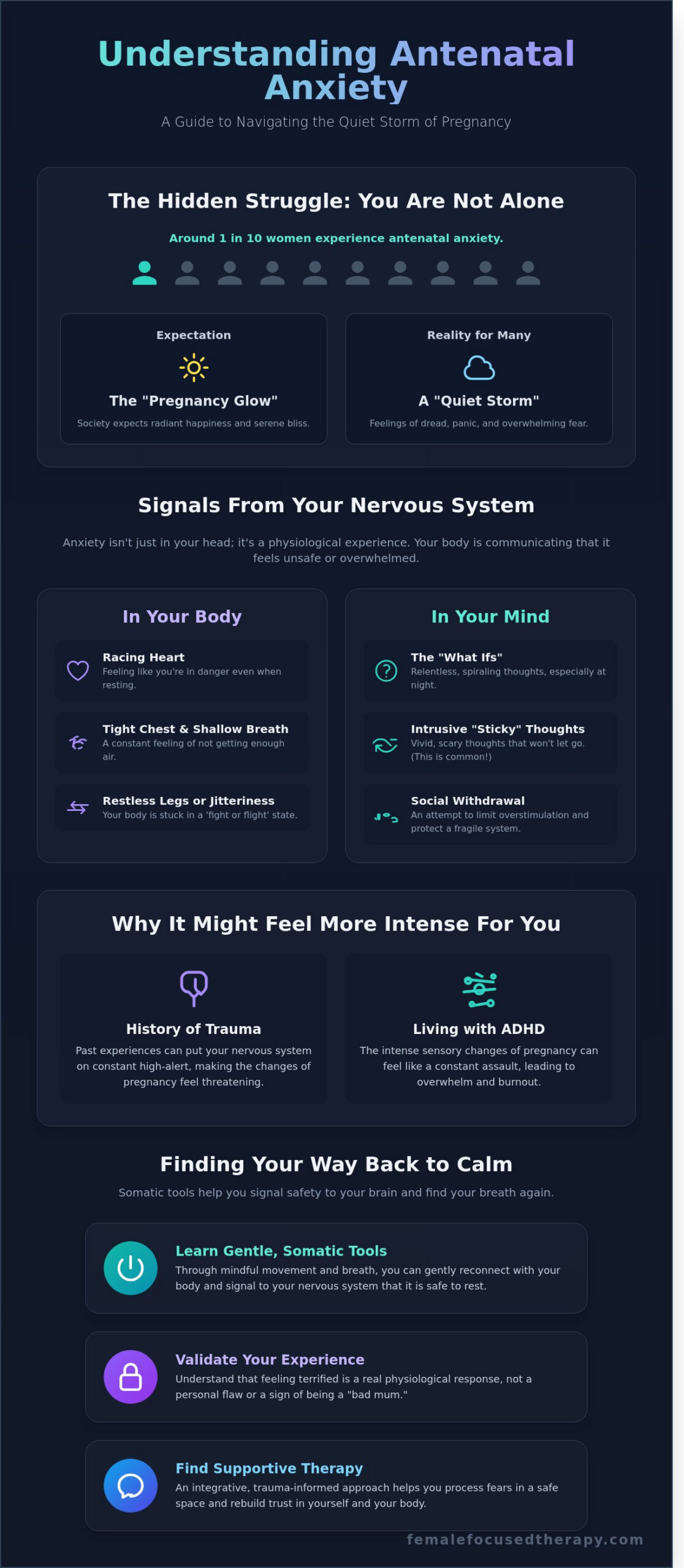
It is incredibly lonely to feel this way when the world expects you to be blooming. According to data from the PANDAS Foundation, around 10% of women struggle with antenatal anxiety, yet the shame often keeps us silent. You might feel “broken” because of intrusive thoughts about your baby’s safety, but I promise you are not alone.
I will help you understand this heavy weight and offer somatic, trauma-informed ways to find your breath again. We are going to look at practical ways to calm your nervous system and build a safe, non-judgmental space to process your fears. Together, we can move toward a place of groundedness and self-trust.
Key Takeaways
- Validate your experience by understanding that feeling terrified is a real physiological response, not a personal flaw or a sign of being a “bad mum.”
- Identify the “what ifs” keeping you awake as signals from your nervous system, allowing you to recognise the signs of distress without the weight of clinical labels.
- Explore how a history of trauma or living with ADHD can intensify antenatal anxiety, particularly when pregnancy sensory changes feel like a constant assault.
- Learn gentle, somatic tools involving movement and breath to help you signal safety to your brain and find your breath again.
- Discover how an integrative approach to therapy can help you rebuild self-trust and ensure you don’t have to navigate this heavy season alone.
The Quiet Storm: Why Antenatal Anxiety Feels So Isolating
I want to start by sitting with you in that heavy silence. Everyone tells you this is the happiest time of your life. They expect a glow, but you feel a cold, sharp dread instead. It’s incredibly isolating to feel terrified when the world expects you to be radiant.
I want you to know right now that your anxiety is a real, physiological experience. It’s not a personal flaw. It certainly doesn’t mean you’re a “bad mum” or that you won’t love your baby. You’re navigating a massive biological shift, and your feelings are valid and heard.
We live in a society that puts immense pressure on women to perform happiness during pregnancy. I see the exhaustion in my clients who spend their days “masking” their panic at work or in social circles. You’re holding it all together while your internal world feels like it’s crumbling. I see you, and I understand how draining that performance is.
Moving Beyond the Glow: My Experience with Clients
I often work with high-achievers who feel completely derailed by these new, scary feelings. These are women used to being in control, yet Pregnancy-related anxiety can make even the simplest tasks feel insurmountable. It’s a specific challenge that doesn’t care how successful you are in your career or personal life.
The “happiness trap” created by pregnancy marketing makes your internal distress feel even louder. When every advert shows a serene woman in soft lighting, your own racing heart feels like a betrayal. I define antenatal anxiety as a common but under-discussed part of the maternal journey that requires a gentle, specialised approach.
The Physicality of Fear in Pregnancy
This anxiety isn’t just in your head; it lives in your body. You might feel a tight chest, restless legs, or a shallow breath that never quite reaches your belly. These sensations can be frightening, especially when you’re already hyper-aware of every change happening inside you. It’s like your body is constantly bracing for a threat you can’t name.
It’s important to recognise that your body is trying to protect you. Your nervous system is doing its job, even if the “alarm” feels like it’s stuck on high. Antenatal anxiety is a heightened state of survival that requires a somatic approach to calm. By understanding these physical cues, we can begin to gently signal to your system that it’s safe to rest.
If you’re feeling overwhelmed, please know that you aren’t alone in this. We can work together to find a sense of safety again. You can book a session to begin exploring these feelings in a safe, non-judgmental space.
Female Focused Therapy with Cheryl Kennedy MacDonald
Registered Integrative Psychotherapist & Yoga Master
Web: www.femalefocusedtherapy.com
Yoga Resources: www.yogabellies.com
Book a Consultation: Schedule Here
Recognising the Signs of Antenatal Anxiety Without the Labels
I often tell the women I work with that we shouldn’t view symptoms as boxes to be ticked on a clinical form. Instead, I see them as signals from your nervous system. When you’re experiencing antenatal anxiety, your body is trying to communicate that it feels unsafe or overwhelmed.
This often manifests as the “what ifs” that keep you wide awake at 3:00 am. You might find yourself spiralling into thoughts about your baby’s development or whether you’ll actually be able to cope once they arrive. It isn’t just a simple worry; it feels like a relentless loop that refuses to switch off.
Living in this state of high alert is physically draining. Your body is stuck in a survival mode, pumping out cortisol as if there’s a constant threat nearby. I’ve noticed that many women begin to withdraw socially during this time. This isn’t because they’ve become “antisocial,” but because their brain is trying to limit overstimulation to protect a fragile nervous system.
Intrusive Thoughts: The Scariest Part for Many
I want to normalise the scary thoughts that so many women are terrified to speak out loud. You might have a sudden, vivid image of something bad happening to you or the baby. Please know that having a thought about harm doesn’t mean you want to cause harm. In fact, it usually means you care deeply about safety.
There is a distinct difference between a passing pregnancy worry and a “sticky” thought. A sticky thought is one that won’t let go, no matter how much you try to rationalise it. It feels intrusive and heavy, often creating a sense of shame that keeps you isolated from the people who love you.
The Physical Red Flags I Look For
Often, your body knows you’re struggling before your mind catches up. I look for constant muscle tension, especially in the jaw, neck, or shoulders. You might find it impossible to find a “rest” state. Even when you’re lying down, your body feels like it’s vibrating or ready to bolt.
You might notice a “buzzing” or “fluttering” in your chest that disrupts your appetite or sleep patterns. These physical signs can be even more pronounced for women with ADHD. Their nervous systems are already wired to be highly sensitive to sensory input and internal hormonal shifts.
Research published in 2018 identified several risk factors for antenatal anxiety, noting that prevalence rates in some studies reach as high as 25%. Recognising these patterns early allows us to bring the body back into balance. If you feel like you’re vibrating with worry, we can explore somatic movement and yoga to help ground your system and find a sense of calm again.
When Your Past or Your Brain Adds to the Overwhelm
In my work as a therapist and through my own experience with ADHD, I’ve noticed that pregnancy doesn’t just add new feelings. It often amplifies what’s already there. If you’re living with neurodivergence or a history of trauma, antenatal anxiety can feel like a heavy, suffocating layer on top of an already busy mind. It’s as if your internal volume has been turned up to a level that feels impossible to sustain.
I find that women with ADHD or a background of complex trauma often experience these months more intensely. Your nervous system is already finely tuned to your environment. When you add the massive physiological shifts of pregnancy, that sensitivity can shift from a superpower into a source of deep distress. Understanding why your body is reacting so strongly is the first step toward finding a sense of calm.
Taking a trauma-informed lens helps us see that your anxiety isn’t a flaw. It’s often a protective mechanism. Your brain is trying to keep you safe in a situation where you feel a loss of control. By Recognising the Signs of Antenatal Anxiety through this perspective, we can begin to untangle your past experiences from your current reality.
ADHD and the Sensory Overload of Pregnancy
I often see women with ADHD struggle with the physical “clutter” of pregnancy symptoms. The constant nausea, the itchiness of stretching skin, or the feeling of a baby moving can feel like a relentless sensory assault. It’s not just “morning sickness”; it’s a total disruption of your ability to process information.
Hormonal shifts, particularly the rise in progesterone and oestrogen, can make your usual ADHD coping mechanisms feel less effective. You might find your executive function takes a significant hit, leaving you feeling scattered and unable to manage daily tasks. Please know that your neurodivergent brain is still a wonderful, creative brain. It’s simply struggling to regulate itself under a massive biological load right now.
The Echo of Past Trauma in the Present
If you have a history of relationship trauma or narcissistic abuse, the loss of autonomy in pregnancy can feel incredibly unsafe. Survivors often carry a specific type of hyper-vigilance into their journey. You might find yourself constantly scanning for threats or feeling “on edge” without a clear reason why.
Pregnancy can sometimes trigger old survival patterns that you thought you had moved past years ago. This isn’t a sign of regression. It’s a sign that your body remembers feeling powerless and is trying to guard you. Healing involves the gentle rebuilding of self-trust. We work on reconnecting with your body’s signals at a pace that feels safe, helping you realise that you are in control of your boundaries and your choices today.
Soothing Your Nervous System: Somatic Tools for Expectant Mums
I often tell the women I work with that anxiety isn’t just a “thought” problem. It’s a physical experience. When your heart is hammering and your breath is shallow, your brain receives a constant signal that you’re in danger. Because antenatal anxiety is so deeply rooted in your physical sensations, I believe the path to feeling better must involve the body too. We can’t always think our way out of a panic attack, but we can move our way through it.
I know how frustrating it is when people tell you to “just relax.” It feels like another chore on an already exhausting list. For most of us, total relaxation feels impossible when we’re worried about our baby or our future. Instead of aiming for perfect calm, I encourage you to look for “a bit of ease.” This might mean dropping your shoulders by 10 percent or unclenching your jaw for five seconds. These small shifts signal safety to your brain without the pressure of “fixing” your feelings.
Living in a high-sensory environment like Singapore can make this harder. The humidity, the noise of the MRT, and the constant pace of the city can keep your nervous system on high alert. I suggest creating a “sensory sanctuary” at home. This might involve dimming the lights, using a weighted blanket, or simply sitting in silence for a few minutes to let your system settle after a busy day.
Grounding Exercises for the Panic Moments
When the waves of antenatal anxiety feel like they might pull you under, you need tools that work quickly. These three exercises are designed to ground your energy and reset your internal alarm system:
- The Sigh of Relief: Take a deep breath in through your nose. When you reach the top, take a second, shorter “sip” of air to fully expand your lungs. Then, let out a very long, slow exhale through your mouth. This double inhale helps re-inflate the tiny air sacs in your lungs and stimulates the vagus nerve, which carries about 80 percent of the calming signals from your body to your brain.
- The Warm Touch: Place one hand on your chest and the other on your growing belly. Focus on the warmth of your palms. This simple act of self-soothing can lower cortisol levels and help you feel more connected to yourself and your baby.
- The Gentle Sway: If you feel “buzzy” or restless, try standing up and swaying slowly from side to side. Rhythmic movement helps discharge the “fight or flight” energy that gets trapped in our muscles when we feel stressed.
Creating a Rhythm of Rest
I want you to view rest as a vital part of your prenatal care, just as important as your vitamins or scans. There is a significant difference between “sleeping” and “resting your nervous system.” While sleep is essential, your nervous system also needs conscious moments of stillness to recover from the day’s demands. I often recommend somatic movement as a way to gently release tension without needing a full workout.
You don’t need hours of free time to find this rhythm. I encourage my clients to take 5-minute “micro-breaks” throughout the day. Whether you’re at your desk or in a quiet corner of a cafe, these moments are a chance to check in. Ask yourself, “What does my body need right now?” Sometimes the answer is just a glass of water or a few deep breaths. These small acts of self-attunement help you rebuild trust in your body’s ability to cope.
If you need a professional space to explore these feelings and find your way back to balance, you can book a session with me here.
Finding Your Way Back to Self-Trust with Support
I want you to know that you don’t have to fix this alone. Antenatal anxiety can feel like being lost in a thick fog, but therapy isn’t about me dragging you out of it. It is about me holding the lantern while you find your own way back to solid ground. You aren’t broken, and you don’t need to be cured. You simply need a safe space to be heard.
I use an integrative approach because your mind and body are speaking the same language of distress right now. We combine traditional talk therapy with somatic wisdom. Simply talking about fear doesn’t always settle the racing heart or the tight chest. By noticing how your body carries tension, we can find ways to release it together.
Data from the Perinatal Mental Health Project indicates that addressing both physical and emotional symptoms can lead to a 40 percent faster improvement in maternal wellbeing. We work to gently peel back the layers of shame that so often accompany these feelings. My goal is to help you rebuild a sense of inner safety.
I want to offer a gentle reminder that your worth as a mother is not defined by your anxiety levels today. Navigating antenatal anxiety is a journey that requires patience, not perfection. You are already enough, exactly as you are, even on the days when the “overwhelm” feels heavy.
The Role of Integrative Psychotherapy
I focus on creating a confidential, professional space where every part of your experience is welcome. Whether it’s the intrusive thoughts or the physical exhaustion, we look at it all without judgement. We work together to manage the daily pressure and prepare for your transition into motherhood at a pace that feels sustainable for you.
For many women, finding a therapist in Singapore who understands women’s unique needs can be life-changing. It provides a dedicated hour each week where the focus is entirely on your healing. This support allows you to process the massive identity shift that pregnancy brings while feeling held and validated.
Your Next Small Step Toward Calm
I invite you to take one realistic step today. It doesn’t have to be a grand gesture. Perhaps it is just a longer exhale as you sit in your chair or a quiet moment of self-compassion where you tell yourself, “I am doing my best.” These tiny moments of reconnection add up over time.
If you feel ready to explore these feelings in a deeper way, you can reach out for a consultation. We can discuss how to help you feel more regulated and supported throughout your pregnancy. Please remember that a calmer, more grounded future is possible for both you and your baby.
Stepping Into a More Grounded Pregnancy
You don’t have to carry the weight of these racing thoughts by yourself. We’ve looked at how somatic tools can settle your nervous system and why your history might be making this chapter feel more intense. It’s about learning to listen to your body and recognizing that these feelings are a signal, not a permanent state of being. You deserve to feel safe in your body as you prepare for your new arrival.
Navigating antenatal anxiety requires a gentle, specialized approach that honors your unique story. With over 20 years of experience as a Registered Integrative Psychotherapist, I’ve spent two decades supporting women through trauma and ADHD. I bring my Scottish-born warmth to my practice in Singapore, offering a safe space to process these deep transitions. You can find your way back to a sense of peace, clarity, and connection.
When you’re ready to take that first step toward feeling like yourself again, I’m here to walk with you. Book a gentle consultation with me to start rebuilding your self-trust. You’ve got this, and you don’t have to do it alone.
Common Questions About Antenatal Anxiety
Is it normal to have intrusive thoughts about my baby during pregnancy?
Yes, it is very common to experience intrusive thoughts during pregnancy. Research published in the Journal of Obsessive-Compulsive and Related Disorders shows that 100 percent of new parents have these unwanted, scary thoughts about their babies at some point. I want you to know that having a thought is not the same as having an intention; it is often just your brain’s overprotective way of scanning for potential danger.
Can antenatal anxiety affect my baby’s development?
While prolonged stress is something we want to manage together, your body has incredible ways of protecting your baby. A 2017 study by the University of Zurich found that the placenta can produce an enzyme that partially buffers the baby from the mother’s stress hormones. Managing your antenatal anxiety is about your own wellbeing and comfort as much as it is about the pregnancy itself.
How is antenatal anxiety different from the usual pregnancy worries?
Antenatal anxiety is different because it feels persistent and physically overwhelming rather than fleeting. While 80 percent of women report some pregnancy worry, clinical anxiety usually involves physical symptoms like a racing heart or sleep loss that lasts for more than 14 days. I see it as the difference between a passing cloud and a storm that refuses to clear.
Will I automatically get postnatal depression if I have antenatal anxiety?
You will not automatically develop postnatal depression, though having anxiety now does increase the statistical likelihood. The Royal College of Psychiatrists notes that about 50 percent of women with antenatal mental health challenges may experience postnatal issues. However, seeking support now is the most effective way to build your resilience and reduce that risk for the future.
What are the most effective non-medication treatments for pregnancy anxiety?
I find that an integrative approach combining Cognitive Behavioural Therapy (CBT) with somatic practices is incredibly effective for managing antenatal anxiety. The NHS recommends talking therapies as a first line of support, and I often weave in gentle breathwork to help settle your nervous system. Focusing on your exhales can physically signal to your brain that you are safe in this moment.
How can I explain my anxiety to my partner when I don’t fully understand it myself?
You can explain it as an overactive alarm system that you cannot simply switch off. Tell them that your body feels like it is in a constant state of high alert, even when there is no immediate threat. It helps to share that 1 in 10 women experience this, so they understand it is a recognised health condition rather than a personal failing.
When should I seek professional help for my pregnancy fears?
You should seek professional help if your fears interfere with your ability to eat, sleep, or function for more than 2 weeks. If you find yourself avoiding appointments or feeling a sense of dread that stops you from connecting with your daily life, please reach out. I am here to help you navigate these feelings in a safe, non-judgmental space.

Article by
Cheryl Kennedy MacDonald MA BA (Hons) Pg. Dip. SAC BACP
Cheryl Kennedy MacDonald is a psychotherapist specialising in women’s mental health, relationships, and life transitions. She works with women navigating trauma, relationship breakdown, identity shifts, and midlife change, helping them rebuild self-trust, emotional stability, and a clear sense of who they are and what they want.
With over 20 years’ experience working with women internationally, Cheryl is the founder of YogaBellies, a global women’s yoga school, and the creator of the Birth ROCKS method. Her work sits at the intersection of psychotherapy and embodiment, integrating evidence-based therapeutic approaches with somatic, body-based practices that support deep, lasting change.
Known for her grounded and direct approach, Cheryl moves beyond surface-level insight to address the patterns held in the body and nervous system. Her work supports women to regulate, reconnect, and respond to their lives from a place of clarity, strength, and self-respect.
She is a published author in academic journals and has written multiple books on women’s health, pregnancy, and midlife wellbeing, available on Amazon and leading book retailers worldwide.