
You might be reading this in a quiet moment, when no one else is around. On the outside, you’re doing everything you’re supposed to. You’re planning, preparing, and telling everyone how excited you are.
But inside, there’s a quiet, heavy feeling. A disconnect between the joyful picture of pregnancy everyone talks about and the flat, anxious, or sad reality you’re living in. If you’re wondering why you feel so miserable when you’re meant to be happy, I want you to know you’re not alone in this.
Beyond the Glow: When Pregnancy Feels More Heavy Than Happy
I hear this so often from the intelligent, capable women I work with. You’re used to managing everything, to achieving and succeeding. But this feels different. This isn’t just tiredness; it’s a deep emotional exhaustion that has you feeling empty, even as your body is so full.
Well-meaning friends might say, “Oh, it’s just the hormones.” But that word can feel so dismissive, can’t it? It minimises the very real weight of what you’re carrying. This isn’t just a chemical blip; it’s a profound emotional experience that deserves to be seen and held with care.
According to Antenatal depression, this is a well-documented area of ongoing research and practical application.
The Silent Struggle of the ‘Perfect’ Pregnancy
The pressure to be a glowing, grateful mother-to-be can be immense. It can force your true feelings underground, creating a profound sense of isolation. You might find yourself performing a role for your partner, family, and colleagues, and the effort it takes to maintain that mask is depleting your already low reserves.
Recognising the difference between physical pregnancy fatigue and this deep emotional depletion is a crucial first step. One is in your body; the other feels like it’s in your soul. It’s the feeling that you’re just going through the motions of a life that is no longer truly your own.
Moving from Self-Blame to Self-Compassion
I want to gently say that these feelings are not a reflection of your ability to be a good mother. They are not a sign of failure. They are a sign that this transition is asking more of you than you ever imagined, and you are trying to navigate it without a map.
Together, we can begin to unpack all the ‘shoulds’ that are weighing you down. The idea that you ‘should’ be happy, ‘should’ be grateful, ‘should’ be enjoying every moment. My work at femalefocusedtherapy.com is to create a space where those ‘shoulds’ can be set down, and your real feelings can finally have a voice.
Understanding the Emotional Landscape of Your Pregnancy
What you might be experiencing has a name: antenatal depression. But a clinical label doesn’t capture the reality of it, does it? It doesn’t describe the fog that makes simple decisions feel impossible, or the quiet dread that settles in when you think about the future.
Pregnancy is a monumental identity shift. It’s not just about a baby; it’s about the birth of a mother. This process can act as a catalyst, stirring up unresolved feelings from your own past. It’s a time when your own needs, history, and sense of self come into sharp focus, often in uncomfortable ways.
Research published by Perinatal Depression signs and treatment shows that this is a well-documented area of ongoing research and practical application.
When Anxiety and Low Mood Become Your Constant Companions
Perhaps you’re finding that intrusive thoughts about the baby’s health or your ability to cope are stealing your peace. Or maybe you feel a persistent, low-level anxiety humming in your body—a tightness in your chest or a knot in your stomach that we so often dismiss as ‘just part of pregnancy.’
These are more than just mood swings. When the sadness or anxiety is persistent, when it colours everything and stops you from connecting with yourself or your partner, it’s a sign that you need more support. This is your emotional health signalling that it needs attention.
The Impact of Your Own Story
For many women, pregnancy can unexpectedly trigger memories and feelings related to their own childhood or past relationships. If you’ve experienced a difficult family dynamic or have a history of relationship trauma, this time can feel particularly vulnerable.
There can be a deep-seated fear of repeating patterns you swore you would break. A core part of my work is helping women navigate this, to understand that your past does not have to define your future as a mother. It’s about learning to parent yourself with kindness as you prepare to parent your child.
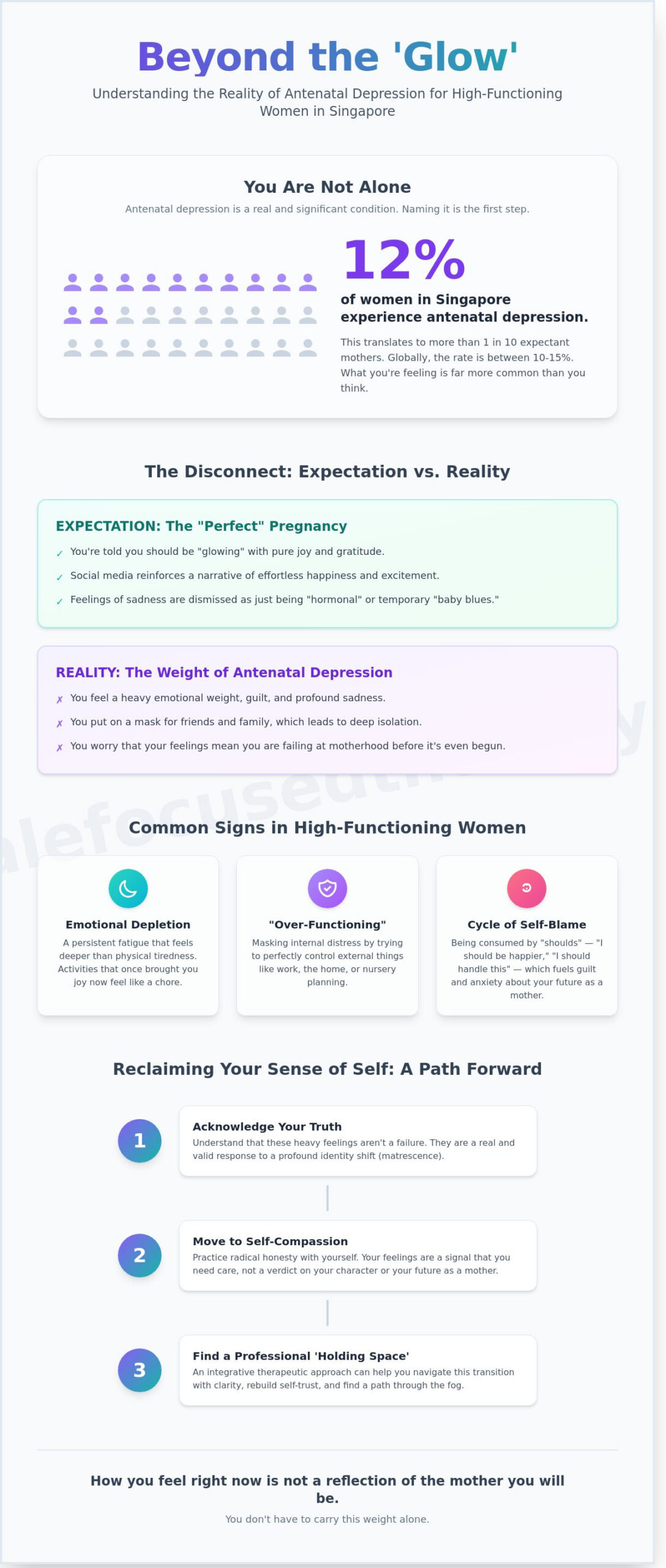
Why Capable, High-Functioning Women Often Suffer in Silence
There’s a unique barrier that comes with being competent. You might think, “I’m successful at work, I manage my life, I should be able to handle this.” This belief keeps so many women struggling alone, convinced that asking for help is an admission of defeat.
You might use ‘busy-ness’ as a way to avoid the quiet moments when the heavy feelings surface. The thought of stopping can feel terrifying. I often hear the objection, “I don’t have time to be depressed.” But the truth is, you don’t have time not to address it. Your wellbeing matters.
The Mask of ‘Doing Fine’
If you’ve always been the ‘strong one’ in your family or friendship group, reaching out can feel almost impossible. The fear of being judged, misunderstood, or seen as ungrateful can be paralysing, especially for women navigating big life transitions in high-pressure environments.
I want you to hear this: admitting you’re struggling is not a weakness. It is an act of profound strength and self-respect. It’s the first step toward finding your footing again. The experience of antenatal depression is common, but your story is unique.
Reclaiming a Sense of Yourself While Preparing for Motherhood
So where do you begin? Not with a grand gesture, but with a small, quiet shift. It might start with simply acknowledging to yourself, without judgement, “This is really hard right now.” That honesty is a powerful starting point.
The goal isn’t to erase the hard feelings, but to create enough space around them so they don’t consume you. It’s about finding moments of stillness, even if it’s just three conscious breaths while you wait for the kettle to boil. These small acts of somatic grounding can tether you to the present moment when your mind is racing ahead.
Small, Sustainable Steps Forward
Could you try externalising the thoughts that feel too heavy to carry? Writing them down in a journal, without any need for them to be perfect or poetic, can release some of their power. You don’t have to solve anything; you just have to let the words out.
And perhaps you could re-evaluate your standards. Right now, ‘good enough’ is a much kinder and more sustainable goal than ‘perfect.’ Giving yourself permission to do less, to rest more, and to let go of non-essential tasks isn’t lazy; it’s a vital way of rebuilding your emotional reserve.
Finding Support That Actually Supports You
Think about who in your life can simply listen without trying to fix you. Sometimes what we need most isn’t advice, but a safe space to be messy and uncertain. If that person doesn’t exist in your circle right now, that is what therapy is for.
A therapist provides a boundaried, objective perspective that friends and family can’t. It’s a space dedicated entirely to you, where you can speak the unspeakable truths about your experience with antenatal depression without fear of judgement.
How We Can Navigate This Together
My role as a therapist is not to give you answers, but to sit with you in the questions. It’s to offer a steady, compassionate presence while you find your own way through. My approach is integrative, combining practical tools with a deep, Scottish warmth.
Therapy provides the ‘holding space’ you might be missing. It’s a confidential container for your fears, your grief for the self you’re leaving behind, and your anxieties about the mother you are becoming. The goal isn’t to ‘fix’ a symptom, but to help you reconnect with your whole self.
A Safe Space for Your Feelings
When you work with me, either online or in Singapore, you will be met with kindness and respect. We move at a pace that feels right for you, focusing on rebuilding the self-trust that may have been eroded by this experience.
I offer a trauma-informed way of working, which you can read more about here if you wish: who I work with. The aim is for you to feel heard and seen, so you can face motherhood with more clarity and less fear.
Your Gentle Next Step
If this resonates, the next step doesn’t have to be big. It can simply be a moment of acknowledgement. A quiet nod to yourself that says, “I see how much I’m struggling, and maybe it’s time to let someone else help carry this.”
When you feel ready, I’m here.
If you’d like to find out more about working with Cheryl Kennedy MacDonald, you can email her at cheryl@femalefocusedtherapy.com or go ahead and book an appointment here: https://www.femalefocusedtherapy.com/book-now/

Article by
Cheryl Kennedy MacDonald MA BA (Hons) Pg. Dip. SAC BACP
Cheryl Kennedy MacDonald is a psychotherapist specialising in women’s mental health, relationships, and life transitions. She works with women navigating trauma, relationship breakdown, identity shifts, and midlife change, helping them rebuild self-trust, emotional stability, and a clear sense of who they are and what they want.
With over 20 years’ experience working with women internationally, Cheryl is the founder of YogaBellies, a global women’s yoga school, and the creator of the Birth ROCKS method. Her work sits at the intersection of psychotherapy and embodiment, integrating evidence-based therapeutic approaches with somatic, body-based practices that support deep, lasting change.
Known for her grounded and direct approach, Cheryl moves beyond surface-level insight to address the patterns held in the body and nervous system. Her work supports women to regulate, reconnect, and respond to their lives from a place of clarity, strength, and self-respect.
She is a published author in academic journals and has written multiple books on women’s health, pregnancy, and midlife wellbeing, available on Amazon and leading book retailers worldwide.