
You’ve just finished explaining, for the tenth time, why a certain situation felt so painful, only to be met with a blank stare or told you’re “too sensitive” again. It’s a heavy, hollow feeling that settles in your chest when the person you love most simply cannot see your reality. I know how exhausting it is to live in that space where your truth feels like a ghost.
You might feel like you’re fading away, or perhaps you’ve started experiencing physical aches and chronic fatigue from the sheer effort of trying to be heard. If this sounds familiar, you’re likely searching for answers about what is cassandra syndrome in relationships. It isn’t a formal medical diagnosis, but a very real description of the emotional deprivation that can happen when your needs aren’t being met in a neurodiverse partnership.
I will help you understand why you feel so unheard and, more importantly, how to begin your journey of internal restoration. We’re going to look at the unique dynamics of Autism Spectrum Disorder in relationships and explore gentle, somatic tools to help you trust your own intuition once more.
Key Takeaways
- Explore the connection between the Greek myth of Cassandra and your own experience of having your reality dismissed or ignored.
- Identify the hidden emotional and physical signs of affective deprivation, including chronic loneliness, brain fog, and second-guessing your own memory.
- Understand what is cassandra syndrome in relationships and how communication gaps in neurodiverse partnerships can cause deep distress without any ill intent.
- Learn simple somatic grounding tools to help you return to your body and rebuild the self-trust that has been eroded over time.
- Discover how finding a safe, validated space through integrative therapy can support your journey toward internal restoration and healing.
What is Cassandra Syndrome? Validating your silent struggle
I often talk with women who feel like they are shouting into a thick, soundproof wall. You tell your partner how you feel, you explain why you are hurting, and yet, nothing changes. It isn’t just that they disagree; it’s that they don’t seem to perceive your reality at all. This experience is the heart of what is cassandra syndrome in relationships.
In my therapy room, I see this pattern frequently. It is a specific type of distress that occurs when one partner’s emotional needs and perceptions are consistently dismissed or ignored. This isn’t about one person being “bad” and the other being “good.” Instead, it is a painful relational dynamic that leaves you feeling invisible and, eventually, physically exhausted.
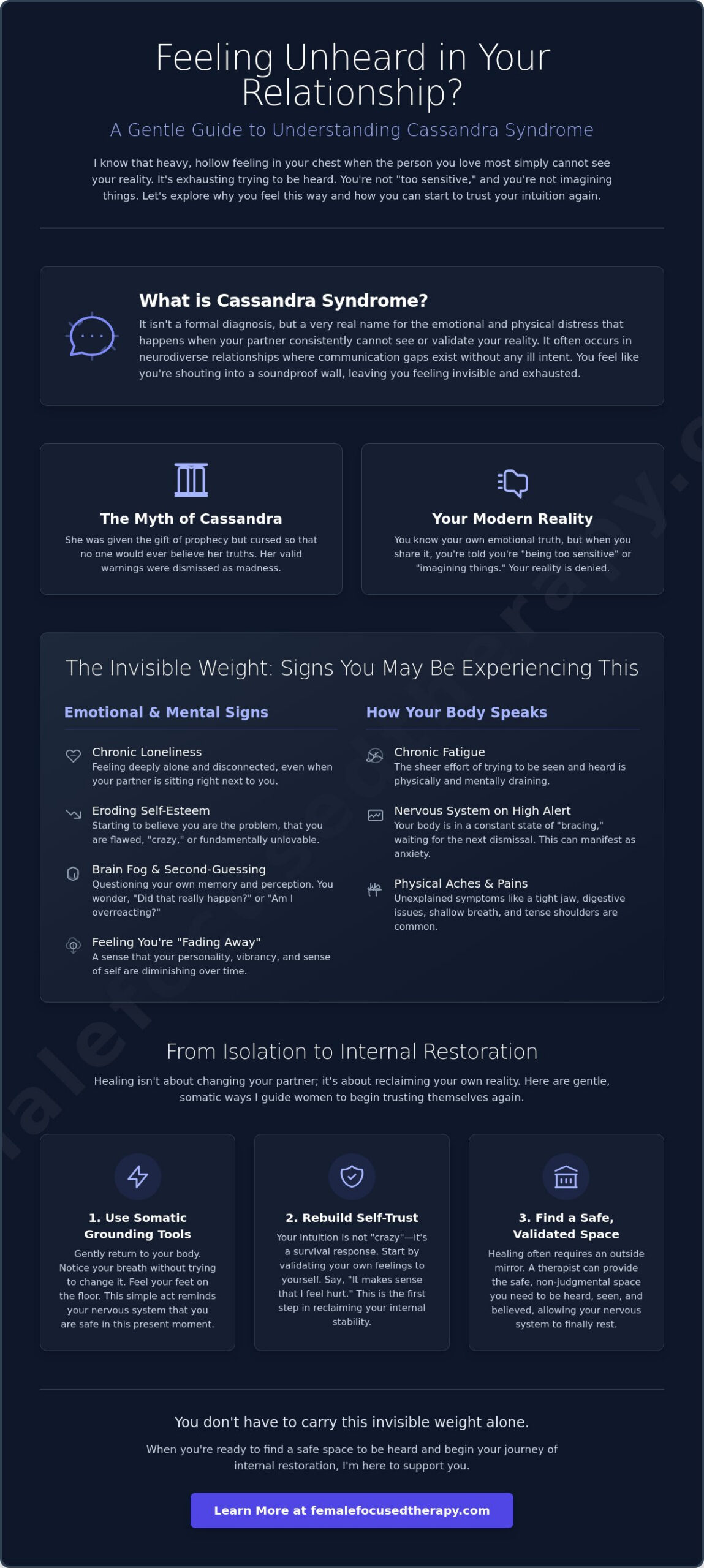
The term comes from the Cassandra metaphor in Greek mythology. Cassandra was given the gift of seeing the future, but she was cursed so that no one would ever believe her. In a modern relationship, this translates to knowing your truth and feeling your pain, yet being told you’re “too sensitive” or that you are imagining things.
The myth vs. your modern reality
The myth mirrors the modern woman’s experience with startling accuracy. When you are repeatedly disbelieved by your partner, you might turn to friends or family for support. Often, they don’t see the problem because your partner may be high-functioning or “perfect” in public. This leaves you in a lonely double-blind.
You love this person, yet they cannot see you. You start to wonder if you really are the problem. I want to tell you right now that your intuition is not “crazy.” It is a survival response. Your body is trying to tell you that something is fundamentally misaligned. When your reality is denied, your nervous system stays in a state of high alert.
Beyond the labels: AfDD and OTRS
While Cassandra Syndrome isn’t a formal psychiatric diagnosis in manuals like the DSM-5-TR, psychologists often use other terms to describe this weight. You might hear the term Affective Deprivation Disorder (AfDD). This simply means you are being “starved” of the emotional connection and empathy required for a healthy bond.
Another term is Ongoing Traumatic Relationship Syndrome (OTRS). This highlights that the distress isn’t from a single event, but from the cumulative trauma of being unheard. If you’ve experienced relationship trauma before, this can feel even more debilitating and confusing.
In my work, I focus on the reality of your experience rather than just the labels. You aren’t imagining this; you are reacting to a genuine lack of emotional oxygen. This is a relational dynamic, not a defect in your character. Understanding this is the first step toward reclaiming your sense of self and your internal stability.
The invisible weight: Signs you are experiencing Cassandra Syndrome
You might feel like a shadow of the person you used to be. It often starts with a quiet, chronic loneliness that settles into your bones. Even when you’re sitting right next to your partner, you feel miles apart. Over time, your self-esteem begins to erode because your thoughts and feelings are never mirrored back to you. You might feel like you’re “fading away” from your own life.
Then there’s the mental fog. When your reality is constantly questioned, you start to second-guess your own memory. You might wonder if you actually said what you remember saying, or if you really are being “too sensitive.” This is the “crazy-maker” dynamic. Your perfectly justified emotional reactions to being ignored are held up as proof that you are the unstable one. Understanding what is cassandra syndrome in relationships involves looking at these subtle, internal shifts.
I see this pattern so often in my work with women. It’s a heavy, invisible weight that you carry every day. You’re high-functioning at work or with the children, but inside, you’re crumbling. You are exhausted from the sheer effort of trying to make yourself understood by someone who seems neurologically unable to meet you there.
How your body speaks when you are not heard
Your nervous system is waiting for the next dismissal. These somatic signals are your body’s way of telling you that your environment is costing you too much. In my somatic movement work, we focus on listening to these quiet signals. Learning to breathe deeply again is a radical act of reclaiming your space.
The social isolation of the “Good Man” dynamic
This is perhaps the most isolating part of the experience. To the outside world, your partner might seem like a “good man.” He’s responsible, perhaps successful, and helpful to the neighbours. When you try to explain your deep loneliness to friends, they might say, “But he’s so nice!” or “At least he doesn’t shout.”
This is a form of community gaslighting. It makes you feel even more alone because your private pain is invisible to everyone else. It’s incredibly traumatising to be suffering in a relationship that the rest of the world thinks is perfect. If you need a space where your truth is believed without question, we can explore these feelings together in a safe, professional setting.
Navigating the neurodiverse gap in your relationship
I want to be very clear about one thing. In many cases, the pain you feel isn’t because your partner is trying to hurt you. Instead, it’s often a result of a profound neurological mismatch. As a woman living with ADHD, I understand how neurodivergence can create unintended barriers in intimacy. My own brain sometimes processes information in ways that others might find confusing or distant.
When we look at what is cassandra syndrome in relationships, we’re often looking at the intersection of two different ways of being in the world. It isn’t necessarily about a lack of love. It is about a lack of shared emotional language. One partner may be neurotypical, while the other might be on the autism spectrum or have ADHD. This creates a gap that feels impossible to bridge without the right tools.
You might feel like you’re shouting across a canyon. You’re asking for connection, but your partner is focused on facts, logic, or their own internal world. This isn’t intentional neglect, but for you, the impact is a deep sense of exile. You are left alone with your feelings while your partner remains seemingly untouched by your distress.
The mismatch of “Affective Empathy”
Psychologists often distinguish between cognitive empathy and affective empathy. Cognitive empathy is the ability to understand that someone else is upset. Your partner might know you’re crying, but they don’t “feel” the emotional pull to comfort you. This is affective empathy, and some neurodivergent brains process it differently.
It’s like a language barrier that has left you feeling completely isolated. You are speaking the language of emotional nuance and shared feeling. They are speaking the language of literal interpretation and problem-solving. Neither is wrong, but without a translator, you end up feeling starved for the “gut-level” connection that makes a relationship feel safe.
Why traditional couples therapy might have failed you
Many women tell me they’ve tried traditional couples therapy and came out feeling worse. This usually happens because standard therapy assumes both partners have the same emotional “wiring.” Exercises like active listening often fail because they rely on both people being able to read between the lines of emotional subtext.
If a therapist doesn’t understand neurodiversity, they might accidentally validate your partner’s “logical” stance while pathologising your emotional needs. This just reinforces the Cassandra dynamic. You leave the session feeling even more invisible. To find a way forward, you need an approach that respects both neurotypes. If you’ve felt let down before, exploring couples therapy Singapore with a neuro-informed lens can offer a much-needed shift in perspective.
From isolation to internal restoration: Reclaiming your reality
Healing doesn’t begin with your partner finally “getting it.” It starts when you stop waiting for their permission to feel real. When you’ve spent years explaining your pain to someone who cannot see it, your own sense of truth becomes fragile. Understanding what is cassandra syndrome in relationships is only the beginning; the real work lies in returning to your own centre.
The first step in this journey is finding external validation. You need a safe space where your story is believed without question. Once you feel heard, we can move into somatic grounding. This means using your breath and gentle movement to return to your body. It’s about teaching your nervous system that you are safe, even when you are misunderstood by the person closest to you.
You also need to learn the art of boundary setting. This isn’t about “fixing” the relationship, but about protecting your emotional energy. You stop pouring your heart into a space that cannot hold it. Finally, you begin rebuilding self-trust. You start honouring your intuition as a factual source of information, rather than something to be debated or dismissed.
Restoring your sense of self
I often see women in my therapy room who have spent years “auditioning” for their partner’s empathy. You perform your pain, hoping this time they will see the tears and react with the comfort you crave. It’s an exhausting cycle that leaves you hollow. I want to help you stop that performance and find your worth elsewhere.
Restoration involves finding joy and identity completely outside of your relationship dynamic. It’s about remembering who you were before you became a ghost in your own home. I’ve spent years refining how who I work with can rediscover that spark of self-reliance and internal stability, regardless of their partner’s response.
The power of somatic movement
Your body holds the weight of every ignored word and every dismissed feeling. You might feel a literal heaviness in your chest or a persistent tightness across your shoulders. Through somatic movement and yoga, we can begin to release that “Cassandra weight” gently and intentionally.
Try this simple grounding exercise right now. Sit with your feet flat on the floor and your spine soft. Inhale for a count of four, then exhale slowly for a count of eight. As you breathe out, imagine the tension leaving your jaw and shoulders. This long exhale tells your brain that the emergency is over. You are here. You are real. You are safe.
If you are ready to stop feeling invisible and start your journey of restoration, you can book a session with me today to begin reclaiming your truth.
Finding a safe space to heal and be heard
I want you to take a deep breath and feel the weight of your feet on the floor. If you’ve spent years feeling like your reality is up for debate, the most radical thing you can do is trust yourself. I know how heavy that silence is, but I want you to know you are not alone. Your feelings are valid, and your experience is real.
My work is about bridging the gap between your mind’s confusion and your heart’s pain. When you’ve been told your feelings are “wrong” for so long, you need more than just talk. You need a space where your nervous system can finally settle. This is where integrative therapy helps us move from cognitive understanding to genuine somatic peace.
I provide a warm but boundaried space for women navigating the unique complexities of neurodiverse relationships. It’s a confidential sanctuary where you don’t have to defend your truth or explain why you’re hurting. We focus specifically on what is cassandra syndrome in relationships and how the lack of emotional mirroring has impacted your sense of self.
My approach to relationship trauma
I combine evidence-based tools like CBT with mindfulness and a deep, trauma-informed perspective. My focus is often on relationship trauma and narcissistic abuse, helping women untangle the web of confusion that comes from being consistently unheard. We look at how these patterns have settled into your body and your beliefs.
We work toward your internal restoration. This isn’t about “fixing” your partner or forcing a specific outcome for your marriage or partnership. Instead, it’s about ensuring you feel solid, whole, and capable of trusting your own mind again. Your healing is the priority, regardless of the path your relationship takes in the future.
In our sessions, I use a multidisciplinary approach that respects the mind-body connection. We might explore how your breath has become shallow or how your muscles have stayed braced for impact. By addressing both the psychological and the physical, we create a more sustainable path toward feeling “real” again.
Taking the first step toward yourself
I encourage you to listen to that small, persistent voice inside you—your “inner Cassandra.” That part of you knows the truth and has been trying to protect you all along. You don’t have to carry this invisible weight by yourself anymore. There is immense power in finally being seen by a professional who understands this specific dynamic.
If you feel ready, I invite you to reach out for a gentle, confidential consultation. There is no pressure to have all the answers or to make big life changes today. We can simply start by letting you tell your story in a place where it will be held with kindness and belief. You can book now to begin this journey back to yourself.
Stepping back into the light of your own reality
Living with the weight of being unheard is exhausting, but it doesn’t have to be your permanent state. We’ve explored how identifying the signs of affective deprivation and understanding the neurodiverse gap can help you stop second-guessing your own mind. True healing begins when you move from that external void back into your own body through somatic awareness and self-trust.
I know that understanding what is cassandra syndrome in relationships is often the first moment of relief you’ve felt in years. As a Registered Integrative Psychotherapist specialising in relationship trauma and neurodivergence, I offer a safe space for women globally through online therapy. My goal is to help you feel seen and supported as you rebuild your internal stability and confidence.
If you’re ready to be heard without question, I’m here to hold that space for you. You can book a gentle, confidential consultation with me to begin your healing. Trust that quiet part of you that knows the truth; it’s the most powerful part of who you are.
Frequently Asked Questions
Is Cassandra Syndrome a real medical diagnosis?
Cassandra Syndrome is not a formal medical diagnosis listed in the DSM-5-TR or ICD-11. Instead, it is a term used by therapists to describe the very real emotional and physical distress experienced by partners of neurodivergent individuals. I use it to validate your experience of being unheard, even if there isn’t a clinical code for it yet. It helps us name the pattern of affective deprivation you are feeling.
Can men experience Cassandra Syndrome too?
While anyone in a relationship lacking emotional reciprocity can experience these feelings, my work focuses specifically on the female experience. Men can certainly feel isolated or ignored in their partnerships too, and for those who want to work on their own emotional or physical presence, you might check out Lisa Welsh. However, the unique social pressures on women to be the “emotional anchors” of a family often make this dynamic particularly heavy for us. I focus on creating a safe, gender-specific space for your restoration.
How do I know if I have Cassandra Syndrome or if I am being gaslit?
It can be difficult to tell the difference because the impact on you is often the same. Gaslighting is typically a deliberate attempt to gain power and control by making you doubt your sanity. In contrast, what is cassandra syndrome in relationships often stems from a neurological mismatch where the partner isn’t trying to hurt you, but simply cannot perceive your emotional state. Both require deep healing and boundary setting.
Does my partner need an official ASD diagnosis for me to feel this way?
No, your partner does not need a formal diagnosis for your pain to be valid. Many adults in the UK grew up when neurodivergence was less understood, so they may be undiagnosed. If you are experiencing chronic loneliness and a lack of emotional mirroring, the impact on your nervous system is real. We focus on your feelings and needs rather than labelling your partner without their involvement.
Can a relationship survive Cassandra Syndrome?
A relationship can survive if both people are willing to do the work. It requires moving away from blame and toward a neuro-informed understanding of how you both communicate. However, the relationship’s survival depends on both partners acknowledging the distress. If you are the only one trying to bridge the gap, my focus remains on helping you reclaim your own sense of self and stability.
What is the first thing I should do if I feel like I am suffering from this?
The first thing you should do is find a space where your story is believed without question. Breaking the isolation is vital because the “void” of being unheard can make you feel like you’re disappearing. Reach out to a trusted friend or a therapist who understands neurodiversity. Validating your reality outside of the relationship helps you stop “auditioning” for empathy that your partner may not be able to give.
How does ADHD play into the Cassandra Syndrome dynamic?
ADHD can complicate this dynamic through hyperfocus or emotional dysregulation. A partner with ADHD might be so focused on a task that they seem to ignore your presence entirely. It isn’t a lack of love, but a difference in how their brain prioritises attention. I see this often in my practice, as ADHD can lead to a cycle of intense connection followed by long periods of unintentional emotional absence.
Why do I feel so much physical pain when my relationship is struggling?
Your body holds the stress of being constantly dismissed. When you feel unsafe or invisible, your nervous system stays in a state of high alert. This “bracing” leads to physical symptoms like jaw pain, headaches, or chronic fatigue. I use somatic techniques to help you release this stored tension. Your physical pain is a factual signal that your emotional needs are not being met.

Article by
Cheryl Kennedy MacDonald MA BA (Hons) Pg. Dip. SAC BACP
Cheryl Kennedy MacDonald is a psychotherapist specialising in women’s mental health, relationships, and life transitions. She works with women navigating trauma, relationship breakdown, identity shifts, and midlife change, helping them rebuild self-trust, emotional stability, and a clear sense of who they are and what they want.
With over 20 years’ experience working with women internationally, Cheryl is the founder of YogaBellies, a global women’s yoga school, and the creator of the Birth ROCKS method. Her work sits at the intersection of psychotherapy and embodiment, integrating evidence-based therapeutic approaches with somatic, body-based practices that support deep, lasting change.
Known for her grounded and direct approach, Cheryl moves beyond surface-level insight to address the patterns held in the body and nervous system. Her work supports women to regulate, reconnect, and respond to their lives from a place of clarity, strength, and self-respect.
She is a published author in academic journals and has written multiple books on women’s health, pregnancy, and midlife wellbeing, available on Amazon and leading book retailers worldwide.