
You’re sitting at your desk, but your mind is miles away, stuck in a loop of “what-ifs” while your jaw stays clenched and your stomach feels like it’s tied in knots. I’ve been there too, and I know how exhausting it is to feel disconnected from your own body’s signals. That’s why I want to share the Mind-Body Practices That Help Women Reduce Anxiety that can help you move from constant overwhelm back into a state of calm.
It’s hard to trust your intuition when your nervous system is stuck in survival mode. You aren’t alone in this, and it isn’t something you just have to “put up with.” My goal is to help you quiet that mental noise and find your way back to a place of genuine internal restoration and emotional stability.
We’re going to look at gentle, gender-focused somatic techniques and mindfulness tools that actually work for our unique experiences. You’ll learn how to release physical tension and build a toolkit for daily stress that helps you feel calm, steady, and much more like yourself again.
Key Takeaways
- I’ll show you why anxiety often feels like a physical “performance” and how mind-body tools help you bridge the gap between your mind and body.
- Learn how specific Mind-Body Practices That Help Women Reduce Anxiety work with your Vagus nerve to gently shift you from survival mode into a state of rest.
- We’ll compare different techniques so you can decide whether quiet mindfulness or active somatic movement is better for your current level of stress.
- Discover how to create a manageable daily ritual using my “Minimum Effective Dose” approach, which takes just five to ten minutes.
- Understand how an integrated approach to healing helps you move past “fixing” symptoms to truly restore your sense of self-trust and confidence.
Why Anxiety Feels Different in a Woman’s Body
I often talk to women who are incredibly successful on the outside but feel like they’re vibrating with tension on the inside. You might be the person everyone relies on, yet you feel like you’re constantly performing a role just to keep your head above water. To me, mind-body interventions are more than just relaxation techniques. They’re essential tools that bridge the gap between your psychological insights and your physical sensations.
For many of the women I work with, anxiety isn’t a constant baseline. It often spikes during significant life transitions like menopause or midlife. These shifts don’t just happen in your mind; they’re deeply biological. The goal of using Mind-Body Practices That Help Women Reduce Anxiety isn’t about a quick fix. It’s about internal restoration. This means moving away from simply “managing” symptoms and instead rebuilding a sense of self-assurance from the inside out.
The Intersection of Trauma and the Nervous System
If you’ve lived through relationship trauma or narcissistic abuse, your body often keeps a record of that experience. Even when you’re safe now, your nervous system might still be stuck in an alarm state. I’ve found that while traditional talk therapy is vital, it sometimes isn’t enough to quiet the physiological “shouting” of a traumatised body.
We have to work on creating a safe space within yourself before you can truly engage with the world again. This involves:
- Acknowledging that your body’s “fight or flight” response is trying to protect you.
- Learning to complete the natural stress response that was interrupted during difficult times.
- Building a foundation of internal trust so you can rely on your own reactions again.
Recognising the ‘Overwhelmed’ State in Daily Life
How often do you find yourself with your shoulders up by your ears or your jaw tightly clenched while doing something as simple as checking emails? These are physical cues that your nervous system is dysregulated. Many of the high-functioning women I see have become experts at ignoring these signals. We push through the shallow breath and the restless legs because we feel we have to stay productive.
Learning to use Mind-Body Practices That Help Women Reduce Anxiety starts with listening to your intuition. Your intuition is often the first thing to notice when you’re overwhelmed. When you start to reconnect with these physical signals, you stop reaching a breaking point and start finding a steady, manageable rhythm instead.
The Science of Somatic Release and Your Nervous System
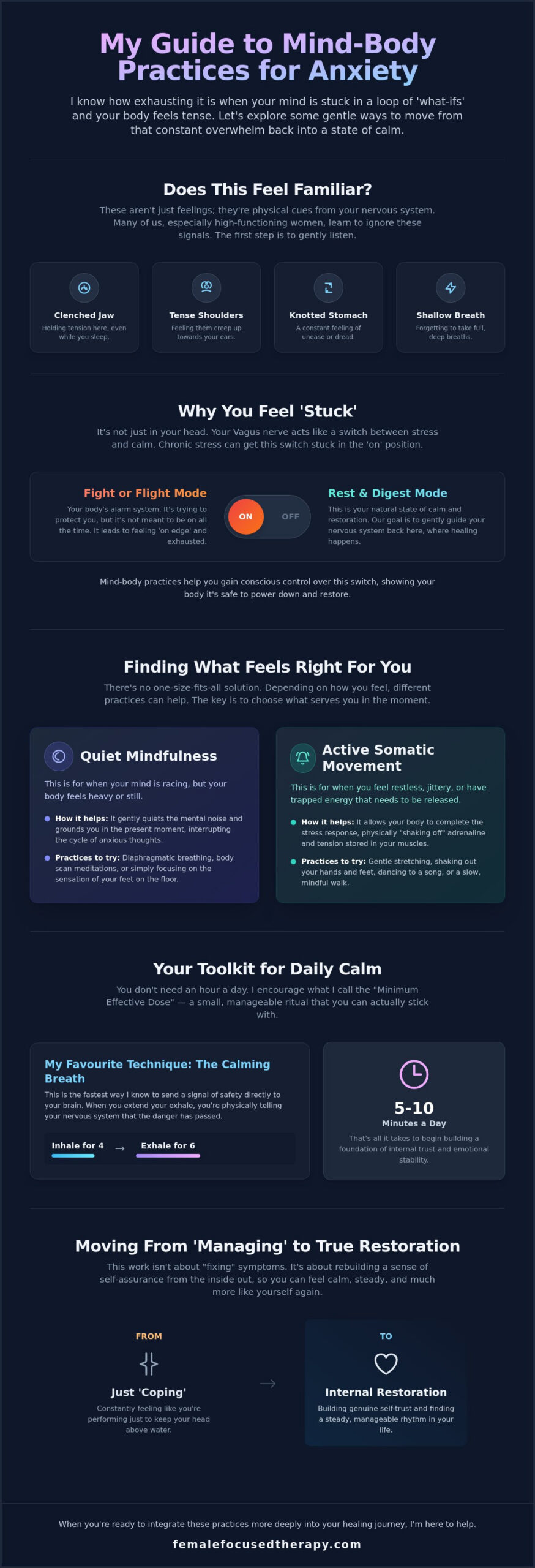
I often tell my clients that your Vagus nerve is the most important part of your anatomy you’ve never thought about. It’s the highway of your nervous system, responsible for switching you between “fight or flight” and “rest and digest.” When you’re living with chronic stress, that switch can get stuck. You feel perpetually “on,” even when you’re physically exhausted. This is where Mind-Body Practices That Help Women Reduce Anxiety become essential tools for resetting that internal toggle.
Somatic experiencing is a way of letting your body finish the story of a stressful event. In the wild, animals shake off the adrenaline after a narrow escape. As women, we’re often taught to “keep calm and carry on,” which means that energy stays trapped in our muscles. There is a strong Evidence Base for Mind-Body Interventions showing that gentle movement and release are clinically effective for regulating these trapped responses.
As an adult woman living with ADHD, I know that mental noise can feel physically painful. When your brain is moving at a hundred miles an hour, somatic grounding is often the only way to find a sense of stillness. I’ve learned to view rest not as a luxury for the idle, but as a productive therapeutic act. It’s the time when your body actually does the work of repair and restoration.
Breath as an Anchor for Emotional Stability
Most of us spend our days “chest breathing.” These shallow, rapid breaths send a constant signal to your brain that you’re in danger. By shifting to diaphragmatic breathing, you physically pull yourself out of a panic state. I’ve seen how a simple 3-minute breathwork practice can alter your heart rate variability, which is a key marker of how well your body handles stress. Extending your exhale so it is longer than your inhale is the fastest way to signal to your brain that you are safe.
Understanding the Mind-Body Feedback Loop
Your thoughts and your physical sensations are in a constant conversation. An anxious thought triggers a spike in cortisol, which makes your heart race; then, your brain notices the racing heart and invents even more worries to explain it. Over time, high cortisol levels can disrupt everything from your sleep to your hormonal balance. Learning to notice these physical sensations without judgment helps you break that loop before it spirals into a full panic. If you feel ready to explore these patterns together, we can start that journey in a safe, supportive space.
Comparing Mind-Body Practices: From Mindfulness to Somatic Movement
I often hear from women who feel they’ve “failed” at meditation because they couldn’t stop their thoughts. If your nervous system is on high alert, sitting in silence can actually feel threatening. I prefer to contrast static meditation with somatic movement and yoga. When your body is screaming to move, we should listen to it rather than forcing it to be still.
It’s important to match the practice to your current emotional state. For acute anxiety, where your heart is racing and you feel panicky, static mindfulness is often too difficult. You might need active Mind-Body Practices That Help Women Reduce Anxiety that involve rhythmic shaking or swaying to discharge that energy first. This allows your system to settle naturally.
For chronic, low-level stress, more reflective practices can help you uncover the underlying patterns of your worry. I take an integrative approach that blends traditional psychotherapy with these holistic tools. This ensures we’re addressing both the cognitive and the physical sides of your experience, helping you feel more whole and grounded.
If you have ADHD like I do, the “I can’t sit still” objection is something I hear all the time. You don’t have to sit still to be mindful. We can find ways to ground your energy that respect your brain’s need for stimulation while still providing the calm you crave. It’s about adapting the practice to fit you, not the other way around.
Yoga and Movement for Trauma Recovery
Gentle, restorative yoga is often much more effective for anxiety than a high-intensity class that might inadvertently mimic the stress response. In my work, I emphasize the role of choice. Reclaiming agency over how you move is vital, especially if you’re recovering from relationship trauma or abuse. It’s a way of saying “this is my body, and I am in control.”
Movement helps you process emotions that are “stuck” in your physical tissues. By moving with intention, you give those old feelings a path out of your body. This isn’t about flexibility or hitting a perfect pose; it’s about creating a sense of internal safety and rebuilding the trust you have in yourself.
Mindfulness for the Modern, Busy Brain
I want to move beyond the myth of the “empty mind.” Mindfulness is simply about being present with the chaos rather than fighting it. It’s a way of observing your busy brain without getting caught in the whirlwind of “what-ifs.” You learn to see the thoughts as they pass, like clouds in the sky, without being swept away by them.
I’m a big fan of “micro-mindfulness” for those moments between meetings or during parenting transitions. You can find stillness in thirty seconds just by noticing the temperature of the air on your skin or the weight of your feet. For women facing major life changes, guided imagery can also be a wonderful tool to build a sense of emotional stability and resilience.
Creating Your Personal Ritual for Emotional Stability
I’ve seen so many women try to start a complex hour-long meditation routine only to give up by day three. When we’re already overwhelmed, a “wellness to-do list” just feels like another burden. I recommend starting with what I call the “Minimum Effective Dose.” Just five to ten minutes of Mind-Body Practices That Help Women Reduce Anxiety can be enough to signal to your nervous system that it’s time to settle.
The easiest way to make this stick is by layering. You might practice a few minutes of diaphragmatic breathing while your morning coffee is brewing or do a quick somatic stretch right after you brush your teeth. By weaving these moments into your existing day, they become a natural part of your life rather than an extra chore you have to “find time” for.
It’s also vital to listen to your body’s changing needs. Your capacity for certain practices will shift depending on your menstrual cycle or where you are in perimenopause. Some days you’ll need active movement to discharge tension; other days, a restorative rest is the most therapeutic thing you can do. If you miss a day, be gentle with yourself. Self-compassion is the foundation of any sustainable healing journey.
Grounding Techniques for ADHD and Neurodivergence
For those of us with ADHD, sensory overwhelm can hit hard and fast. I often use the 5-4-3-2-1 technique to manage ADHD-related sensory overwhelm. You simply notice five things you can see, four you can touch, three you can hear, two you can smell, and one you can taste. This pulls your brain out of the “noise” and back into the present moment.
Don’t feel you have to be perfectly still to be mindful. Rhythmic movement or even “fidgeting” can be a powerful form of active grounding. You can also tailor your environment to support your nervous system. Soft lighting, noise-cancelling headphones, or a weighted blanket can make a world of difference in how safe and settled you feel in your own space.
Journaling and Reflective Practice
I often suggest “body-scan journaling” to my clients. Instead of just writing about your day, take a moment to track where you feel anxiety in your body. Is it a tightness in your chest or a knot in your stomach? Putting these sensations into words helps you externalise your internal critic. It moves the anxiety from being “who you are” to being something you are simply experiencing.
Gratitude is another tool I use frequently, but not as a shallow platitude. It’s a way of neurologically re-wiring your brain to notice safety and support. When you intentionally look for small moments of ease, you’re teaching your nervous system that it doesn’t always have to be on guard. If you’d like to build a ritual that feels right for your unique life, I’m here to help you find that balance through individual therapy.
Integrating Mind-Body Healing into Your Therapeutic Journey
I believe that true healing comes from more than just talking about your problems. It’s about integrating the Mind-Body Practices That Help Women Reduce Anxiety that we’ve discussed into a professional, supportive framework. My integrative approach isn’t about “fixing” what’s broken. It’s about restoring the parts of you that have been buried under layers of stress and overwhelm. I want to help you find your way back to the steady, confident woman you know is still in there.
In our culture, we’re often taught to look for a quick fix for our symptoms. If we have a headache, we take a pill; if we’re anxious, we want it to just go away. But restoration is different. It’s a gentle, unhurried process of coming back to yourself. It involves listening to your intuition and trusting that your body knows how to heal when given the right environment. This is why a trauma-informed perspective is so essential. Your body needs to feel safe before it can let go of the alarm state it’s been carrying.
I always encourage you to trust your own pace. There is no “right” way to heal, and there is certainly no timeline you need to stick to. Some weeks you might feel ready to dive deep into somatic work, and other weeks you might just need a safe space to breathe and be heard. Both are equally valid parts of the process. My role is to hold that space for you with patience and kindness.
Working with a Registered Integrative Psychotherapist
Working with an integrative psychotherapist means you get a blend of evidence-based modalities tailored to your unique needs. In a session, we might start with CBT to look at your thought patterns, then move into a mindfulness practice to ground you in the present. We always include somatic awareness to check in with how your body is responding to the conversation. Many of my clients find that online therapy is a wonderful way to keep this work consistent while staying in a comfortable environment.
I specifically support women through narcissistic abuse recovery using these tools. When you’ve been through a relationship where your reality was constantly questioned, rebuilding self-trust is the most important work you can do. We use Mind-Body Practices That Help Women Reduce Anxiety to help you reconnect with your physical “gut feelings.” This helps you learn to trust yourself again after someone else has spent years trying to make you doubt your own mind.
Your Next Step Toward Calm
You don’t have to handle this overwhelm on your own. I’ve seen so many women find their way back to a sense of calm and clarity, and I know it’s possible for you too. Whether you’re managing ADHD, midlife transitions, or the aftermath of a difficult relationship, there is a path forward that doesn’t involve constant struggle. You deserve to feel settled and secure in your own skin.
If you feel ready to take a step toward internal restoration, I invite you to explore my free resources or book a consultation. We can talk about what’s been happening for you and see how an integrated approach might help you find your steady ground again. Healing happens in the body and the mind, at a pace that is right for you.
Finding Your Path Back to Internal Trust
I know how heavy the mental noise can feel when you’re trying to hold everything together. We’ve explored how anxiety lives in your body and why somatic release is such a vital part of the healing process. By using Mind-Body Practices That Help Women Reduce Anxiety, you can move from a state of constant alarm to one of genuine emotional stability.
Whether you’re navigating the shifts of menopause, recovering from relationship trauma, or managing the sensory overwhelm of ADHD, remember that you don’t have to do this alone. As a Registered Integrative Psychotherapist and Yoga Master with over 20 years of experience, I’ve seen how powerful it is when we combine psychological insight with physical grounding.
You deserve to feel safe in your own skin and to trust your intuition once again. If you’re ready to move beyond just “managing” your symptoms and start the journey of true internal restoration, I’d love to support you. Book your consultation with Cheryl Kennedy MacDonald to begin your journey toward internal restoration.
Healing happens one breath at a time, at the pace that feels right for you.
Frequently Asked Questions
How do mind-body practices actually help reduce anxiety?
Mind-body practices work by calming your nervous system and signalling to your brain that you are safe. When you engage in Mind-Body Practices That Help Women Reduce Anxiety, you are physically lowering your heart rate and reducing cortisol levels. This creates a shift from the “fight or flight” mode into a state of “rest and digest,” allowing your mind to follow the body’s lead into a place of genuine calm.
Can somatic movement help with ADHD symptoms in adult women?
Yes, somatic movement is incredibly effective for managing the physical restlessness and sensory overwhelm that often comes with ADHD. As someone living with ADHD myself, I’ve found that rhythmic, intentional movement helps to ground excess energy. It provides the stimulation your brain craves while teaching your body how to find a steady, quiet centre amidst the mental noise.
I can’t sit still to meditate; are there other ways to practice mindfulness?
Mindfulness doesn’t have to mean sitting in silence; it can be practiced through any activity where you are fully present. You might try “walking mindfulness,” where you focus on the sensation of your feet hitting the ground. Even washing the dishes or stretching can be mindful if you are noticing the temperature of the water or the pull of your muscles without judgment.
How long does it take to see results from these anxiety reduction techniques?
You can often feel a physical shift, such as a slower heart rate or relaxed jaw, after just three to five minutes of focused practice. While the immediate effects are helpful for acute stress, the deeper work of rebuilding internal trust usually takes a few weeks of consistent, small efforts. Many women I work with report feeling a shift in their overall baseline after a few weeks of daily micro-practices.
Is yoga effective for healing from relationship trauma or narcissistic abuse?
Yoga is a powerful tool for trauma recovery because it allows you to reclaim agency over your own body. After narcissistic abuse, you might feel disconnected from your physical self or your intuition. Gentle Mind-Body Practices That Help Women Reduce Anxiety, like restorative yoga, help you create a safe internal space where you can slowly begin to trust your own sensations and boundaries again.
What is the quickest grounding technique for when I feel a panic attack coming on?
The quickest way to ground yourself is usually the 5-4-3-2-1 sensory technique. Immediately stop and name five things you can see, four you can touch, three you can hear, two you can smell, and one you can taste. This process forces your brain to switch from internal panic to external observation, which physically disrupts the escalating anxiety response.
Why does my anxiety always feel like a physical weight in my chest or stomach?
Your body and mind are inextricably linked, so your nervous system often expresses emotional distress through physical sensations. The “weight” you feel is often muscle tension or a change in your digestive system caused by a spike in stress hormones. It’s your body’s way of sounding an alarm, and learning to listen to these cues is the first step toward releasing that pressure.
Do I need special equipment or a yoga studio to start these practices?
You don’t need any special equipment, expensive leggings, or a studio membership to begin this work. Most of the techniques I teach can be done in your living room, at your desk, or even while sitting in your car. All you really need is a few minutes of quiet and the willingness to be present with yourself exactly as you are.

Article by
Cheryl Kennedy MacDonald MA BA (Hons) Pg. Dip. SAC BACP
Cheryl Kennedy MacDonald is a psychotherapist specialising in women’s mental health, relationships, and life transitions. She works with women navigating trauma, relationship breakdown, identity shifts, and midlife change, helping them rebuild self-trust, emotional stability, and a clear sense of who they are and what they want.
With over 20 years’ experience working with women internationally, Cheryl is the founder of YogaBellies, a global women’s yoga school, and the creator of the Birth ROCKS method. Her work sits at the intersection of psychotherapy and embodiment, integrating evidence-based therapeutic approaches with somatic, body-based practices that support deep, lasting change.
Known for her grounded and direct approach, Cheryl moves beyond surface-level insight to address the patterns held in the body and nervous system. Her work supports women to regulate, reconnect, and respond to their lives from a place of clarity, strength, and self-respect.
She is a published author in academic journals and has written multiple books on women’s health, pregnancy, and midlife wellbeing, available on Amazon and leading book retailers worldwide.