
Last night, you might have found yourself staring at your partner, feeling like they were speaking a language you just couldn’t translate. If you’ve been searching for couples therapy for neurodivergent partners, you already know how exhausting it is to feel like your relationship is “broken” simply because your brains are wired differently. You’re not failing; you’re just living in a space that wasn’t built for your specific neurological needs.
I understand how heavy the domestic friction feels, especially when executive function differences or sensory overloads start to feel like personal attacks. You might be experiencing deep emotional burnout from constant masking or trying to “translate” your feelings into a format your partner understands. It’s a lonely place to be, but I want you to know that there’s a path toward restoration.
I’ll help you discover how neurodivergent-affirming therapy helps you bridge the communication gap and build a relationship that honours both your brains. We’ll explore practical tools to manage sensory differences and look at the “double empathy problem” to explain those confusing breakdowns. You’ll learn how to build a partnership where you both feel safe, grounded, and truly seen.
Key Takeaways
- Understand why standard relationship advice often fails you and how I help you shift the focus from “fixing” behaviour to creating genuine nervous system safety.
- Discover how the “Double Empathy Problem” reframes communication breakdowns as a mutual translation issue rather than a personal failing.
- Explore how couples therapy for neurodivergent partners focuses on collaborative solutions that honour how both of your brains actually work.
- Learn how I use somatic tools to help you regulate your emotions so you can navigate difficult moments without feeling overwhelmed.
- Find out how to build a sustainable future by creating a personalised manual for your relationship that values authenticity over masking.
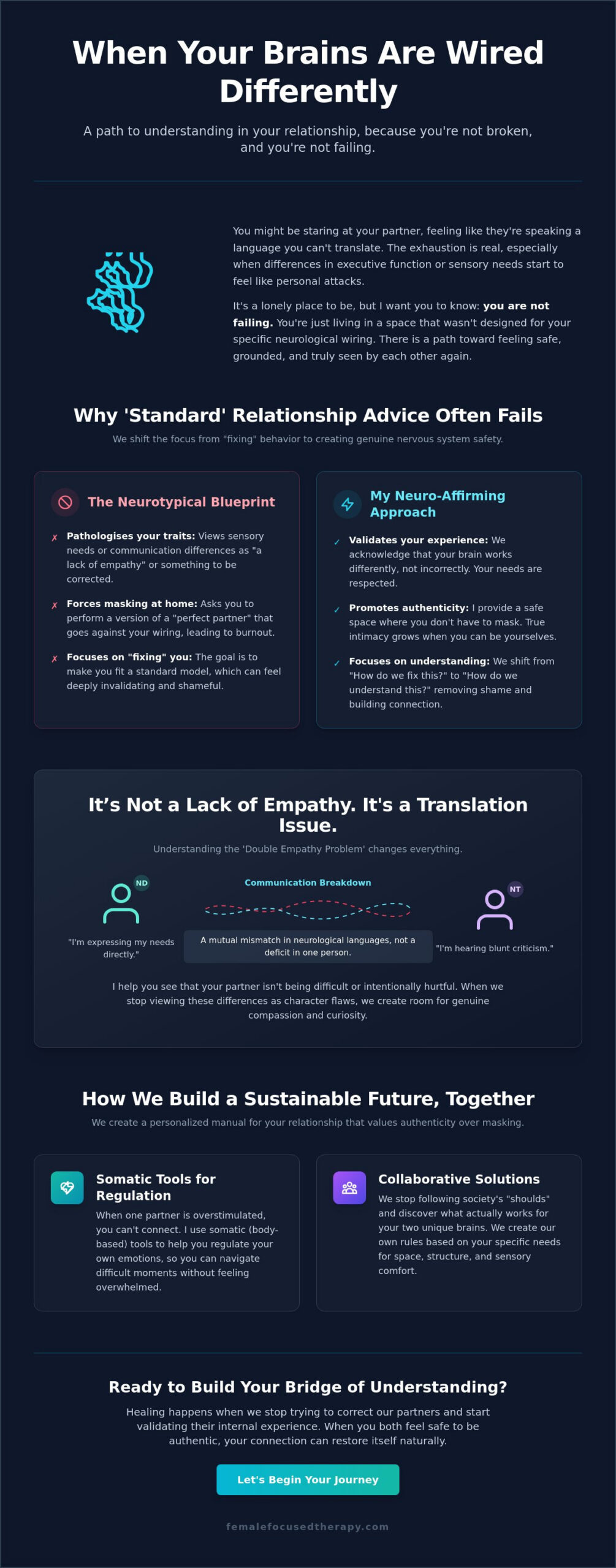
Why ‘Standard’ Relationship Advice Often Fails Neurodivergent Couples
I often see couples who walk into my room feeling like they’ve failed. They’ve usually spent months or years in traditional counselling, only to leave feeling more misunderstood than when they started. The problem isn’t your relationship; it’s often that the therapist didn’t understand the fundamental role of neurobiology in how we love and connect.
Standard advice can be actively harmful when it ignores how your brain processes the world. Being told to “just make more eye contact” or “stop fidgeting while your partner speaks” can be physically distressing for an autistic person. These aren’t just habits to break; they are sensory needs that require respect rather than correction.
In my work with couples therapy for neurodivergent partners, we start from a completely different place. We acknowledge that your brain works differently, not incorrectly. I focus on the very real ways that ADHD and Autism impact your intimacy, your chores, and your shared energy levels.
The Trap of the ‘Neurotypical’ Blueprint
Following standard relationship “rules” often leads to a cycle of burnout and deep resentment. If you’re constantly trying to perform a version of “the perfect partner” that doesn’t fit your wiring, you’ll eventually run out of fuel. This “masking” in your own home is exhausting and creates a barrier to true intimacy.
Many therapists mistakenly pathologise neurodivergent traits as a “lack of empathy” or “emotional coldness.” This is why Understanding the ‘Double Empathy Problem’ is so transformative. It reframes the struggle as a mutual mismatch in communication styles rather than a deficit in one person’s character.
I help you dismantle all the “shoulds” you’ve been carrying for years. We stop looking at how a relationship “should” look according to society and start finding what actually works for your two unique brains. We create our own rules based on your specific needs for space, structure, and sensory comfort.
Validation Over Correction
We shift the goal from “how do we fix this?” to “how do we understand this?” This change in perspective removes the heavy layer of shame that often settles over neurodiverse couples. When we stop viewing differences as problems to be solved, we can start viewing them as landscapes to be mapped.
I provide a safe, non-judgmental space where you don’t have to mask your traits to be heard or respected. You don’t need to perform for me; you just need to be yourself. Neurodivergent-affirming couples therapy acts as a specialized translation service that helps you bridge the gap between different brain types.
Healing happens when we stop trying to correct your partner and start validating their internal experience. It’s about building a bridge of understanding that honours both of your nervous systems. When you both feel safe to be your authentic selves, the connection begins to restore itself naturally.
Understanding the ‘Double Empathy Problem’ in Your Relationship
The Double Empathy Problem suggests that communication breakdowns are a two-way street between different neurotypes. It’s a concept that completely reframes how we look at conflict. Instead of one partner being “wrong” or “deficient,” we see two people who are simply speaking different neurological languages.
I help you see that your partner isn’t being “difficult” or intentionally hurtful. They are processing the world through a lens that might be entirely foreign to you. When we stop viewing these differences as character flaws, we create room for genuine compassion and curiosity.
As a woman with ADHD, I personally understand how executive function gaps can feel like a lack of care. I know the shame of forgetting a task that felt important to someone else. In our sessions, I share these insights to help you distinguish between a “brain glitch” and a lack of love.
We also look at how sensory processing affects your ability to connect. If one partner is overstimulated by noise or touch, they cannot be fully present. Understanding these physical limits is a crucial part of couples therapy for neurodivergent partners.
Reframing Conflict as a Translation Error
Many of your arguments are likely “neurolanguage” gaps. One of you might communicate literally, while the other relies on subtext and inference. This mismatch is a breeding ground for misinterpretation and defensiveness. I help you identify these gaps before they escalate into a full-blown crisis.
We work on practical examples of translating your needs. Instead of saying “you never help,” a neurotypical-friendly request might be “I feel overwhelmed by the kitchen; can we set a timer for ten minutes of tidying?” This clarity reduces the cognitive load for everyone involved.
Executive Function and the ‘Mental Load’
Chores and schedules are often the biggest flashpoints for neurodivergent couples. ADHD forgetfulness or autistic inertia can make the “mental load” feel incredibly lopsided. This often leads to a “parent-child” dynamic that is toxic to romance and mutual respect.
We develop strategies that account for how your brains actually function. This might mean using shared digital boards or visual cues that don’t rely on memory alone. If you feel stuck in these patterns, you might find it helpful to explore how we can work together to build a more balanced partnership.
Moving away from the parent-child dynamic requires rebuilding trust. We focus on small, sustainable wins that prove you can rely on one another. By honouring your differences, we can create a domestic life that feels supportive rather than draining.
How Neurodivergent-Affirming Therapy Differs from Traditional Counselling
I believe that therapy should be a collaborative “hunt” for solutions. It isn’t a lecture on your behaviour or a place where I tell you how to act more “normal.” In couples therapy for neurodivergent partners, we prioritise your nervous system safety over any idea of “correct” social performance.
We often spend a lot of time unpicking relationship trauma that has built up over years of misunderstanding. This is especially true for those who received a late-diagnosis. Discovering you have ADHD or are Autistic in your 40s can feel like a massive relief, but it also means re-evaluating every argument you’ve ever had through a new lens.
My sessions are structured to be low-demand. I want to reduce the cognitive load on both of you so you can actually focus on each other. If you need to pace, use a fidget toy, or look away while you speak, that is perfectly okay. We focus on what makes you feel grounded rather than what looks “polite” to the outside world.
Standard vs. Neurodivergent-Affirming Frameworks
Traditional counselling often pushes for “eye contact” as a sign of respect or active listening. For many of my clients, forced eye contact is physically painful and makes it impossible to process what their partner is saying. We swap these outdated rules for sensory comfort, allowing you to listen in the way your brain actually functions.
We also reframe “bluntness.” In a neurodivergent context, being direct isn’t being rude; it’s often an act of love because it removes the anxiety of guessing. Neurodivergent-affirming therapy views the “problem” as the environment or the gap between your needs, not as a flaw in either person.
The Role of Lived Experience
Working with a therapist who is also neurodivergent changes the power dynamic in the room. I’m not a clinical observer looking at you from the outside. I live this life too. My own ADHD means I know exactly how it feels when your brain just won’t “start,” regardless of how much you love your partner or how important the task is.
This shared understanding helps us build back the self-trust that has been eroded by years of being misunderstood. If you’ve been told your perceptions are “wrong” or “dramatic” for years, it’s hard to trust your own intuition. I use an integrative approach that combines clinical evidence with a deep, human understanding of the neurodivergent experience.
We aren’t just talking about feelings; we are looking at the mechanics of your life. We look at rest, sensory diets, and how to protect your energy as a couple. This mind-body perspective ensures that the changes we make in couples therapy for neurodivergent partners are sustainable for the long term.
Somatic Tools for Emotional Regulation and Connection
I believe that healing isn’t just a mental exercise. For many of us, especially those living with neurodivergence, the body holds onto tension and stress in ways that words simply cannot reach. In couples therapy for neurodivergent partners, we must address the nervous system directly to create lasting change.
I integrate somatic movement and yoga to help you regulate during those moments when a conversation starts to feel “too much.” We work on recognising the “flicker” of a sensory overload long before it erupts into a full-blown argument. These tools aren’t just for our sessions; they are designed for you to use in your own living room.
When you learn to spot the physical signs of rising distress, you gain the power to pause. This isn’t about suppressing your feelings; it’s about giving your body the safety it needs to stay present. By honouring these physical cues, we move away from reactive cycles and toward intentional connection.
The ‘Pause and Breathe’ for Neurodivergent Brains
Standard breathing exercises can sometimes backfire for ADHD or autistic people. If you struggle with interoception, being told to “focus on your breath” can actually increase your anxiety. We use modified grounding techniques that respect your unique sensory profile instead.
We focus on physical anchors, like the weight of your feet on the floor or the texture of a cushion. This helps create a “sensory-safe” zone where you can discuss difficult topics without your brain going into survival mode. It’s about making the environment support your connection, not hinder it.
De-escalating the ‘ND Meltdown’ or ‘Shutdown’
Identifying the physical signs of a nervous system “red zone” is a vital skill. You might notice your partner’s voice becoming monotone, or perhaps you feel a sudden, intense need to leave the room. Recognising these signals in yourself and each other allows you to intervene before you reach the point of no return.
We explore co-regulation strategies that support your partner without over-stimulating them. Sometimes, the best support isn’t a hug or a long talk; it might be sitting in silence in the same room or dimmed lighting. If you’re ready to find tools that actually work for your relationship, you can book a session with me here.
The “aftercare” process is just as important as the de-escalation itself. Once the nervous system has settled, we need a gentle way to reconnect without re-triggering the original conflict. We build a routine that allows you both to feel safe and cared for after the storm has passed.
This restoration phase is where trust is rebuilt. By acknowledging the physical toll of a meltdown or shutdown, you show your partner that you see their struggle. This shared understanding is the foundation of a relationship that honours both your brains.
Building a Sustainable Future: Your Journey with Female Focused Therapy
My goal is to help you rebuild internal confidence so you can trust your own relationship intuition again. When you’ve spent years feeling like you’re “getting it wrong,” it’s easy to lose sight of your own wisdom. We work together to create a “Relationship Manual” that is unique to your two brains, moving away from generic advice that doesn’t fit your wiring.
I offer couples therapy in Singapore and online to support you wherever you are in the world. You don’t have to keep struggling in silence or feeling like you’re failing at being a partner. There is a way to feel connected and understood that doesn’t involve masking or changing who you are at your core.
Engaging in couples therapy for neurodivergent partners is about more than just solving arguments. It’s about creating a sustainable lifestyle where both of you can thrive. We look at the big picture, from your sensory needs to how you share the mental load, ensuring your home is a place of restoration rather than a source of stress.
What to Expect in Our Sessions
You can expect a gentle, unhurried pace that allows for deep processing and genuine insight. I know that neurodivergent brains often need more time to transition between topics or to find the right words for complex emotions. We never rush the process; we move at the speed of your nervous system to ensure you both feel safe.
We focus heavily on your strengths as a couple rather than just looking at your “deficits.” Every relationship has its own unique magic, and we want to amplify what already works. I integrate mindfulness and CBT in a way that feels natural and supportive, never clinical, cold, or detached from your human experience.
While we work on the relationship dynamic, some individuals find that structured, one-on-one support for their ADHD is also beneficial; to see how programmes from Collins Psychology can complement your growth, find out more.
Taking the First Step Toward Clarity
Seeking help is an act of bravery and a profound gesture of self-compassion for your relationship. It takes courage to admit that the current path isn’t working and to ask for a new map. I’m here to walk that path with you, providing a grounded and safe space for your growth and internal restoration.
If you feel ready to see if we are the right fit for your journey, you can book a consultation through my online portal. This is a chance for us to connect and discuss how we can tailor our work to your specific needs. It’s a low-pressure way to start your journey toward a more stable and fulfilling partnership.
I want to leave you with one final reassurance. Your neurodivergence is a beautiful part of your love story, not a barrier to it. Different wiring doesn’t mean you are less capable of deep, lasting intimacy; it just means you deserve a relationship that honours the way you’re built and celebrates your authentic selves.
Finding a Way Forward Together
We’ve explored how shifting from a “deficit” model to a neuro-affirming one can change the entire atmosphere of your home. You now understand that communication breakdowns are often just translation errors between different brain types and that your body holds the key to staying regulated during stress. As a registered integrative psychotherapist with my own lived experience of ADHD, I know that your relationship isn’t a problem to be solved; it’s a connection to be nurtured with the right tools.
Embracing couples therapy for neurodivergent partners means choosing a path that respects your unique wiring rather than trying to overwrite it. My trauma-informed, gender-centric approach ensures that you both feel safe and validated as we build your unique “Relationship Manual.” You don’t have to keep trying to fit into a neurotypical blueprint that was never designed for your specific needs.
You deserve to feel safe, seen, and truly understood in your most intimate space. Healing is a journey of restoration, and I would be honoured to help you navigate it with kindness, patience, and clarity.
Frequently Asked Questions
What is couples therapy for neurodivergent partners?
It is a specialised form of support that focuses on the unique neurobiology of your relationship rather than just generic communication tips. I help you bridge the gap between different brain types, such as ADHD or Autism, by focusing on nervous system safety and mutual translation.
How do I know if my relationship needs neurodivergent-specialised therapy?
You might need this support if you feel like you and your partner are constantly speaking different languages or if traditional counselling has left you feeling “broken.” If sensory overloads, executive function gaps, or emotional burnout are causing daily friction, a neuro-affirming approach is often the missing piece.
Can couples therapy help if only one partner is neurodivergent?
Yes, this approach is highly effective for “mixed-neurotype” couples where one partner is neurodivergent and the other is neurotypical. I focus on the Double Empathy Problem, helping both of you understand that communication breakdowns are a mutual mismatch rather than one person’s fault or deficit.
What happens if my partner doesn’t have a formal diagnosis yet?
I work with many couples where one or both partners are self-diagnosed or simply suspect they might be neurodivergent. A formal piece of paper isn’t required for us to start using neuro-affirming tools and somatic strategies that respect how your brains actually process the world.
How is this different from standard marriage counselling in Singapore?
Standard counselling in Singapore often focuses on social norms and behavioural correction, which can feel invalidating for neurodivergent people. My approach to couples therapy for neurodivergent partners prioritises your internal restoration and sensory needs, ensuring you don’t have to mask to be heard.
Is online therapy effective for neurodivergent couples?
Online therapy is often the preferred choice for neurodivergent couples because it allows you to stay in your own sensory-safe environment. Being in your own home reduces the cognitive load of travel and new surroundings, making it easier for you to engage deeply in our work together.
How long does it typically take to see progress in neurodiverse therapy?
While every couple is unique, many people start feeling a shift in their dynamic after 12 to 20 sessions. Progress in this specialised work isn’t about a quick fix but about building a sustainable foundation of mutual understanding and practical, nervous-system-based tools.
What if my partner is resistant to the idea of ‘neurodivergent’ labels?
We don’t have to use labels if they feel uncomfortable or restrictive for you or your partner. I focus on the underlying traits, sensory needs, and communication styles that are causing friction, helping you find a common language that feels respectful and safe for both of you.

Article by
Cheryl Kennedy MacDonald MA BA (Hons) Pg. Dip. SAC BACP
Cheryl Kennedy MacDonald is a psychotherapist specialising in women’s mental health, relationships, and life transitions. She works with women navigating trauma, relationship breakdown, identity shifts, and midlife change, helping them rebuild self-trust, emotional stability, and a clear sense of who they are and what they want.
With over 20 years’ experience working with women internationally, Cheryl is the founder of YogaBellies, a global women’s yoga school, and the creator of the Birth ROCKS method. Her work sits at the intersection of psychotherapy and embodiment, integrating evidence-based therapeutic approaches with somatic, body-based practices that support deep, lasting change.
Known for her grounded and direct approach, Cheryl moves beyond surface-level insight to address the patterns held in the body and nervous system. Her work supports women to regulate, reconnect, and respond to their lives from a place of clarity, strength, and self-respect.
She is a published author in academic journals and has written multiple books on women’s health, pregnancy, and midlife wellbeing, available on Amazon and leading book retailers worldwide.