
What if the “explosive” emotions you’ve been shaming yourself for are actually a neurological response rather than a personality trait? I know how it feels when a tiny spark turns into a forest fire in seconds, leaving you exhausted and full of regret. This experience of adhd emotional dysregulation is something I see in about 80% of the neurodivergent women I support in my clinical practice.
You’re likely tired of the constant masking and the strain that reactivity puts on your most precious relationships. It’s heavy to carry the weight of chronic self-blame while trying to keep your head above water in a fast-paced environment like Singapore, where the pressure to stay “composed” is always on.
I’ll help you understand why your brain reacts with such intensity and how to find calm through somatic awareness and breath. Together, we’ll explore how to ground yourself in the moment and start the gentle process of rebuilding self-trust so you can feel at home in your own skin again.
Key Takeaways
- Discover why your emotions often feel like they go from zero to a hundred in seconds and how this “volume” issue is a core part of the female ADHD experience.
- Understand the “top-down” struggle in your brain that makes adhd emotional dysregulation feel like driving a high-powered car with overly sensitive brakes.
- Uncover the heavy internal cost of masking your true self and why you might be “over-functioning” by carrying the weight of everyone else’s feelings.
- Learn why we can’t always “think” our way into calm and how gentle somatic movement can help you ground your body when emotions feel overwhelming.
- Shift your perspective from “fixing” your ADHD to rebuilding self-trust through a therapeutic approach that honours your unique, big-hearted way of feeling.
Understanding the Intensity of ADHD Emotional Dysregulation in Women
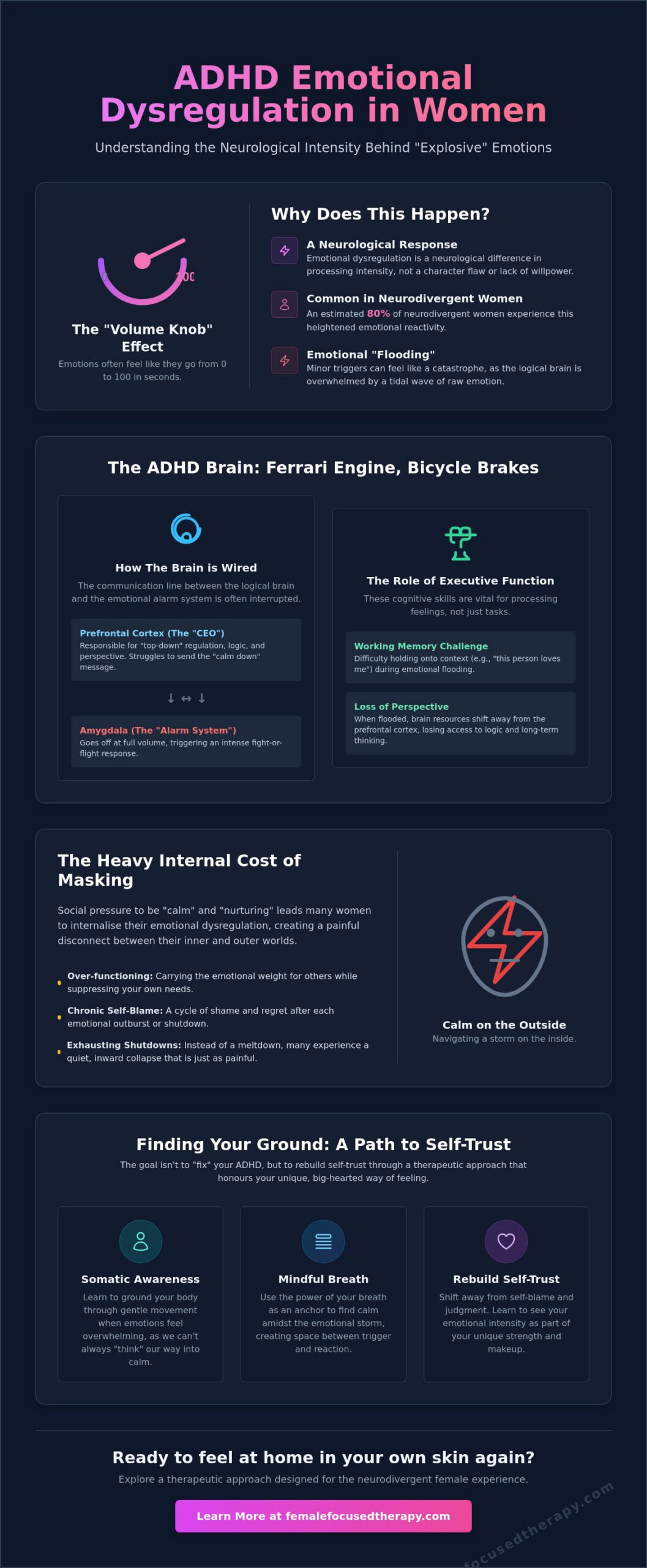
For many of the women I see in my practice here in Singapore, life often feels like a series of unpredictable and intense weather patterns. You might find yourself waking up in a calm state, only for a small trigger to send you into a sudden whirlwind of distress. I often describe this experience as a struggle with the brain’s internal volume knob. While most people can gradually turn their feelings up or down, our brains tend to jump from zero to a hundred in a matter of seconds.
It’s vital to understand that What is Emotional Dysregulation? fundamentally comes down to how our brains are wired. Emotional dysregulation is a neurological difference in processing intensity. This isn’t a character flaw or a lack of willpower, even if you’ve been told your whole life that you’re “too sensitive” or “difficult.” It’s a core component of adhd emotional dysregulation that impacts how we perceive and respond to the world around us.
The All-or-Nothing Reality of ADHD Feelings
Living with ADHD often means existing in an all-or-nothing emotional state. There’s rarely a middle ground where feelings are just “fine.” I’ve experienced this myself many times, where a minor piece of feedback doesn’t just feel like a small blip; it feels like a total catastrophe. We call this “flooding,” and it truly feels as though your logical brain has been submerged by a tidal wave of raw emotion.
This intensity is why we often feel “too much” compared to our neurotypical peers. Where they might see a small hurdle, we see a mountain. This biological response is part of our unique makeup. When we understand this, we can begin to move away from judgment and toward a place of self-compassion. You can learn more about how I support women with these challenges on my ADHD support page.
Why We Often Internalise the Overwhelm
In my work with women, I see a recurring pattern of internalised shame. From a young age, many of us are socialised to be the “nurturers” and to remain “calm” at all costs. While others might be allowed to show outward frustration, women often feel they must hide their adhd emotional dysregulation to fit in or be liked. This leads to a quiet, painful “shutdown” rather than a visible meltdown.
This internalisation is exhausting. It creates a cycle of chronic self-blame that many of my clients carry for decades. You might look “together” on the outside while navigating a storm on the inside. Recognising that this inward collapse is a response to overwhelming sensory and emotional input is the first step toward rebuilding your self-trust. It’s about acknowledging that your internal world is valid, even when it feels heavy.
Why Our ADHD Brains Struggle to Regulate Big Emotions
I often describe the ADHD brain as a car with a Ferrari engine but bicycle brakes. You have this incredible, high-speed capacity for thought and feeling, but the mechanism to slow down or stop is often incredibly sensitive or slow to engage. This isn’t a character flaw; it’s a fundamental difference in how your brain is wired to process the world around you.
In neurotypical brains, the prefrontal cortex acts like a calm CEO, managing the “top-down” regulation of the amygdala, which is our emotional alarm system. With ADHD and emotional dysregulation, that communication line is often interrupted. Your alarm goes off at full volume, and your “logical” brain can’t quite get the message through to turn it down.
This struggle becomes even more pronounced during major life shifts. I see many women in Singapore who find their ADHD symptoms flare up during perimenopause or menopause. When our oestrogen levels drop, it directly impacts dopamine production, making those “brakes” feel even less reliable than they used to be. It can feel like you’re losing your grip on your reactions just when you need them most.
The Role of Executive Function in Feeling
Our executive functions aren’t just about finishing to-do lists or staying organised; they’re vital for processing how we feel. Working memory is what allows us to hold onto the context of a situation in the heat of the moment. It helps us remember that while we’re angry right now, this person loves us and “this too shall pass.”
When you’re emotionally flooded, your brain’s resources shift away from the prefrontal cortex. You lose access to your logic and perspective. In the ADHD therapy work I do with women, we focus on recognizing this “flooding” before it takes over. We look at how to rebuild that tiny gap, that “pause,” between a feeling and a reaction.
How Our Nervous System Responds to Triggers
I find it helpful to think about the “Window of Tolerance.” This is the physiological space where you can handle life’s ups and downs without feeling completely overwhelmed or shutting down.
ADHD often keeps us living right at the very edges of this window. It doesn’t take much, perhaps a sharp word from a partner or a missed deadline at work, to push us into a “fight or flight” response. We jump from zero to a hundred in seconds because our nervous system is already primed for high alert.
If you’ve also experienced childhood trauma, your window might be even narrower. Your nervous system has learned to stay on guard for safety, making big emotions feel even more threatening than they actually are. If you’re feeling constantly pushed to your limit, we can explore gentle ways to widen that window together in a safe, supportive space.
The Heavy Cost of Masking and Emotional Over-functioning
For many of the women I see in my practice, the day starts with a quiet decision to perform. This is what we call masking. It is the exhausting effort to appear composed and ‘normal’ while you feel like you are drowning internally. You might smile through meetings in Raffles Place and keep your voice steady, even when your internal world feels like a chaotic storm. Masking is often a survival strategy used to hide the reality of adhd emotional dysregulation from colleagues and friends, but it comes at a staggering personal cost.
I often see this manifest as emotional over-functioning. This happens when you instinctively take on the feelings and responsibilities of everyone else to avoid conflict or keep the peace. You become the emotional sponge for your family or your team, which leaves no room for your own needs. This relentless pressure often leads to occupational burnout, especially in Singapore where the culture of ‘always being on’ is so prevalent. By the time you reach my sofa, you are often beyond ‘tired’ and moving into a state of total depletion.
A common objection I hear is the belief that being ‘sensitive’ is a weakness or a character flaw. I want to offer a different perspective. In reality, your sensitivity is a sign of a highly tuned nervous system. While adhd emotional dysregulation can feel like an unpredictable tide, that same intensity is what allows you to be incredibly empathetic, creative, and intuitive. It is not something that needs to be ‘fixed,’ but something that needs to be understood and supported with kindness.
Moving Beyond Chronic Self-Blame and Shame
I want to help you see that your emotional intensity is deeply tied to your capacity for empathy. When an emotional outburst happens, the ‘shame spiral’ that follows is often far more damaging than the event itself. You might spend days replaying the moment and criticising your character. I encourage you to pause and replace the question ‘what is wrong with me?’ with ‘what does my nervous system need right now?’ This shift allows us to move away from judgment and toward a place of gentle self-regulation. It is about learning to breathe through the storm rather than punishing yourself for its existence.
Recognising the Link to Relationship Trauma
It is also important to understand how emotional dysregulation can make us vulnerable to certain relationship dynamics. When we don’t trust our own reactions, we become easier targets for narcissistic abuse. You might find yourself ‘gaslighting’ your own feelings, wondering if you are just being ‘too much’ or ‘too sensitive.’ I often work with women to heal from relationship trauma by rebuilding that lost sense of self-trust. Learning to validate your own emotional experience is the first step in creating boundaries that protect your peace and your energy.
Gentle Somatic Strategies to Find Your Emotional Grounding
When you are in the middle of an emotional surge, the logical part of your brain often goes offline. I have learned through my own journey with ADHD that we simply cannot think our way out of a physiological response. Navigating adhd emotional dysregulation requires more than just logic; it requires a physical return to safety.
This is why I integrate somatic movement and breathwork into my therapeutic approach. Your nervous system speaks the language of sensation, not just words. When your body feels under threat, we need to use physical anchors to signal that the storm is passing. These tools are not about fixing you, but about supporting your body through the intensity.
Using Breath and Movement to Settle the Mind
One of the quickest ways to signal safety to your vagus nerve is through a simple sighing breath. Take a deep inhale through your nose and let out a long, audible sigh through your mouth. This physical release helps down-regulate your system when you feel the prickle of overwhelm starting to rise.
I often suggest gentle rhythmic movement, like swaying from side to side or slowly pacing, to discharge the restless energy that comes with adhd emotional dysregulation. These movements help process the adrenaline that builds up when we feel flooded. You can explore more of these techniques in my somatic movement work, which focuses on gentle reconnection.
Creating a Safe Space for Your Feelings
When the storm hits, try to name what is happening without judging yourself for it. Saying “I am feeling flooded right now” or “My body feels very tight” shifts you from being the emotion to observing it. This small bit of distance can make the experience feel less like a permanent state and more like a passing weather pattern.
In a high-pressure environment like Singapore, finding a low-stimulation space is vital for an ADHD brain. I encourage you to set a boundary with yourself to step away from the noise, dim the lights, or put on noise-cancelling headphones. Giving yourself permission to rest is a necessary part of managing your wellbeing.
These strategies are about meeting yourself with the kindness you deserve. If you feel ready to explore how we can work together to manage these waves, you can book a session with me here.
Rebuilding Self-Trust Through ADHD-Focused Therapy
Healing from adhd emotional dysregulation isn’t about trying to make you “less ADHD.” It’s about learning to trust your own internal compass again. For many women I work with in Singapore, these big emotions have felt like an unpredictable storm for decades. You may have spent years being told your feelings are “too much,” which often leads to a deep fracture in your self-trust. My goal is to help you mend that connection through specialized ADHD support.
I provide a boundaried and professional space where we can look at these intense feelings safely. In this environment, your emotions don’t have to sweep you away; we hold them together. You don’t have to navigate this sense of overwhelm alone anymore. Having a therapist who truly understands the neurodivergent brain makes a world of difference in how you view yourself.
We focus on reclaiming your confidence. This process involves acknowledging the validity of your experiences while finding grounded ways to move through the world. It’s a journey of coming home to yourself, where your unique brain is no longer seen as a problem to be fixed, but as a system to be understood and nurtured.
How an Integrative Approach Supports Your Growth
My method is warm but structured, combining traditional Cognitive Behavioural Therapy (CBT) with somatic practices. This means we don’t just talk about your feelings; we notice how they sit in your body. We work at a pace that feels safe and sustainable for your nervous system. I believe that true healing happens when the mind and body are in sync, especially when managing adhd emotional dysregulation.
We move away from a life of constant reacting. Instead, we work toward responding to life’s challenges with clarity and calm. By integrating breathwork and movement into our sessions, we help your body learn that it’s safe to slow down. This mind-body connection is a powerful tool for regaining control over your emotional landscape.
Taking Your First Step Toward Emotional Clarity
Your neurodivergence is a part of your unique brilliance, not a flaw. If you’d like to get a sense of who I am and how I work, I encourage you to look at my about me page. You’ll feel a bit of my Scottish warmth and see how my own experiences as a woman with ADHD shape my practice. It’s important that you feel a genuine, human connection with your therapist.
When you’re ready, I invite you to reach out for a gentle consultation. We can talk about what you’re facing and see if we’re a good fit for one another. You deserve to feel grounded and confident in your own skin. You can book a session here to begin this journey toward clarity together.
Cheryl Kennedy MacDonald is a registered integrative psychotherapist and yoga master based in Singapore, specializing in therapy for women. She provides support for ADHD, trauma, and relationship recovery.
Contact: cheryl@femalefocusedtherapy.com
Websites: Female Focused Therapy | YogaBellies
Finding Calm Within the Storm
I know how exhausting it feels when your internal world feels like a tempest you can’t control. We’ve explored why the female ADHD brain experiences such intense highs and lows, and how the constant pressure to mask these feelings often leads to deep burnout. It’s important to remember that your sensitivity isn’t a flaw; it’s a part of your neurobiology that simply needs a different kind of care. You aren’t “too much,” and you’re certainly not failing.
By integrating gentle somatic strategies and ADHD-focused support, you can begin to move away from the cycle of emotional over-functioning. As a Registered Integrative Psychotherapist and Yoga Master specializing in ADHD and trauma for women, I’ve seen how a mind-body perspective helps my clients in Singapore navigate adhd emotional dysregulation with more grace and far less self-blame. You don’t have to weather these storms alone or keep pretending they’re not happening.
When you’re ready to stop just surviving and start feeling truly grounded in your own skin, I’m here to hold that space for you. You deserve a professional environment where your experiences are validated and your healing is paced to suit your specific needs. Please book a confidential therapy session with me to start rebuilding your self-trust. You have the strength to find your way back to yourself, and I’d be honoured to guide you there.
Frequently Asked Questions
Is emotional dysregulation a formal symptom of ADHD?
Emotional dysregulation isn’t currently listed as a core diagnostic symptom in the DSM-5, which is the manual doctors use for diagnosis. However, research by Dr. Russell Barkley shows that 90% of adults with ADHD experience significant emotional challenges.
I find that for many women I work with, these intense feelings are the most difficult part of their daily lives. Even if it’s not on the official checklist yet, your experience of these “emotional storms” is a very real and valid part of your neurodivergence.
How can I tell the difference between ADHD and Bipolar disorder emotions?
The main difference is found in how long the moods last and what triggers them. ADHD emotions are typically “reactive” to something happening right now, like a perceived rejection, and they usually resolve within 2 to 3 hours.
Bipolar disorder involves mood states like mania or depression that persist for at least 4 to 7 days, regardless of your environment. In my practice, I help women track these patterns to understand whether they’re navigating a temporary reaction or a longer clinical episode.
Can therapy really help with ADHD emotional outbursts?
Therapy is a vital tool for navigating adhd emotional dysregulation because it provides a safe space to process your specific triggers. I use an integrative approach that helps you spot the physical signs of an emotional “storm” before it breaks.
This awareness allows us to work together on rebuilding your self-trust. By understanding your nervous system, you can find calmer ways to respond to stress instead of feeling like you’re constantly being swept away by your feelings.
What should I do immediately when I feel an ADHD meltdown coming on?
You should immediately change your sensory input to ground your nervous system. I often recommend the “ice dive” method, where you splash very cold water on your face, or a simple 5-minute rhythmic breathing exercise.
These actions signal your brain to move out of the “fight or flight” mode that leads to a full meltdown. By shifting your physical state, you give your mind the chance to catch up and regain a sense of safety.
Why does my ADHD make me feel so sensitive to criticism (RSD)?
Your brain is wired to feel perceived rejection or failure as actual physical pain. This is known as Rejection Sensitive Dysphoria (RSD), and Dr. William Dodson notes that 99% of people with ADHD experience this intensity.
It’s not that you’re “too sensitive” or weak. It’s a neurological hypersensitivity that makes a small critique feel like a deep wound, which is why your reactions can feel so overwhelming to yourself and others.
Is medication the only way to manage ADHD emotional dysregulation?
Medication isn’t the only solution, though it can be a helpful part of your toolkit for managing adhd emotional dysregulation. I’ve seen many women find peace through a combination of psychotherapy, somatic movement, and lifestyle changes.
While medication can help regulate dopamine levels, therapy helps you develop the emotional intelligence to manage life’s inevitable ups and downs. I believe in a holistic approach that looks at both the mind and the body for sustainable healing.
How do hormonal changes like menopause affect ADHD emotions?
Oestrogen levels drop significantly during menopause, which directly interferes with how your brain produces and uses dopamine. Since dopamine is already a challenge for us, this shift can make your emotions feel much more volatile and unpredictable.
In my Singapore practice, I often help women navigate these changes by adapting their self-care and therapeutic goals. Understanding that your hormones are impacting your brain chemistry can help you be more compassionate with yourself during this transition.
Can somatic yoga help with ADHD overwhelm?
Somatic yoga is incredibly effective for ADHD because it focuses on the felt sense of the body rather than achieving perfect poses. By engaging in gentle, rhythmic movement, you can soothe your overactive nervous system and reduce the feeling of being “flooded.”
It’s a practice I personally rely on to find my center when life feels chaotic. These movements help you move out of your head and back into your body, which is essential for managing the sensory overload that often comes with ADHD.

Article by
Cheryl Kennedy MacDonald MA BA (Hons) Pg. Dip. SAC BACP
Cheryl Kennedy MacDonald is a psychotherapist specialising in women’s mental health, relationships, and life transitions. She works with women navigating trauma, relationship breakdown, identity shifts, and midlife change, helping them rebuild self-trust, emotional stability, and a clear sense of who they are and what they want.
With over 20 years’ experience working with women internationally, Cheryl is the founder of YogaBellies, a global women’s yoga school, and the creator of the Birth ROCKS method. Her work sits at the intersection of psychotherapy and embodiment, integrating evidence-based therapeutic approaches with somatic, body-based practices that support deep, lasting change.
Known for her grounded and direct approach, Cheryl moves beyond surface-level insight to address the patterns held in the body and nervous system. Her work supports women to regulate, reconnect, and respond to their lives from a place of clarity, strength, and self-respect.
She is a published author in academic journals and has written multiple books on women’s health, pregnancy, and midlife wellbeing, available on Amazon and leading book retailers worldwide.