
You find yourself rehearsing a simple request for twenty minutes before speaking, hoping to avoid a conflict that feels inevitable. It’s a heavy way to live, constantly scanning the room for shifts in mood while your own needs sit quietly in the background. You might feel like you’re losing your grip on reality, or perhaps you’ve noticed that “brain fog” has become your daily companion.
I know how draining it is to keep the peace at the expense of your own sanity. You likely feel that if you just tried a little harder or explained things more clearly, the relationship would finally settle into a place of safety. It’s important to recognise that this chronic self-doubt isn’t a personal failing; it’s often a direct response to narcassist behaviour that chips away at your sense of self.
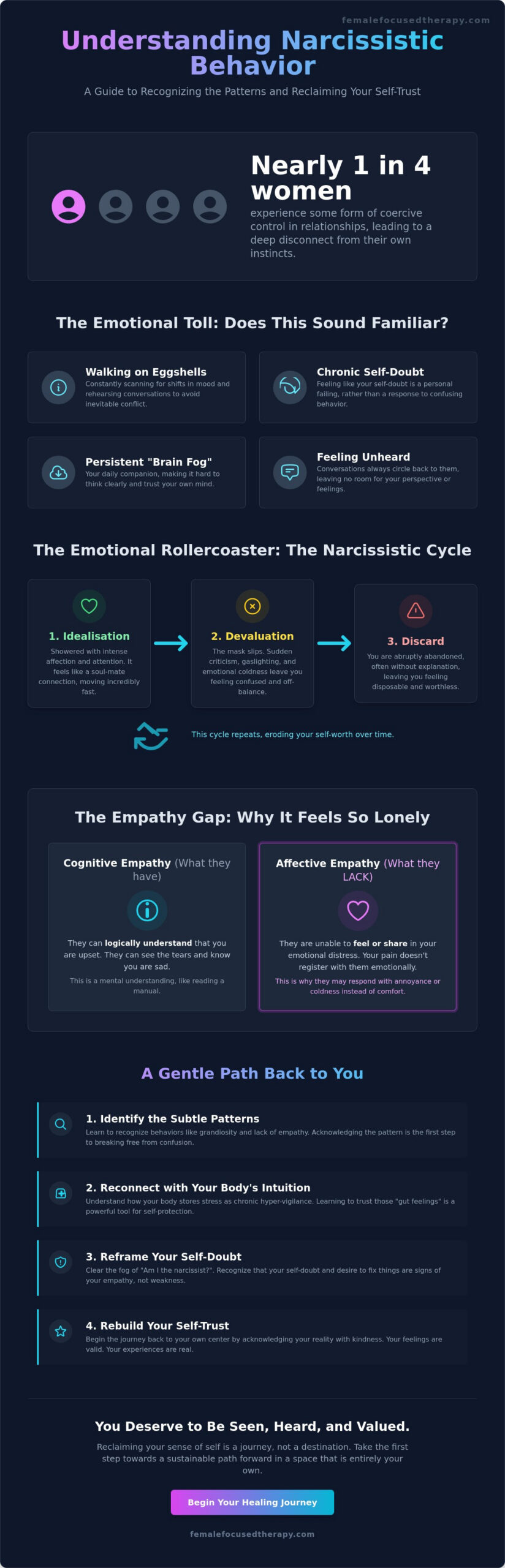
A 2023 report on relationship health suggests that nearly 25% of women experience some form of coercive control, leaving them feeling deeply disconnected from their own instincts. I will help you recognise the subtle signs of these patterns and understand the emotional toll they take on your body and mind. We’ll look at why you feel like you’re walking on eggshells and map out a gentle, sustainable path back to the self-trust you deserve.
Key Takeaways
- Learn to identify the subtle patterns of narcassist behaviour, such as grandiosity and a lack of empathy, that often leave you feeling confused and unheard.
- Recognise the emotional cycle of idealisation and devaluation to help you make sense of why you feel like you are constantly spinning.
- Understand how your body stores this relationship stress as chronic hyper-vigilance, helping you reconnect with your physical intuition.
- Find gentle reassurance in why your self-doubt is actually a sign of your empathy, clearing the fog of “am I the narcissist?” once and for all.
- Discover how to begin the journey of rebuilding your self-trust by acknowledging your reality with kindness and returning to your own centre.
What is narcissist behaviour and why does it feel so confusing?
I often work with women in my Singapore practice who find it incredibly difficult to put a name to what they are going through. You might feel a deep, lingering sense of unease that you just can’t quite explain to your friends or family. This happens because the actions you’re facing are often subtle and hidden behind a veneer of normalcy.
When we talk about narcassist behaviour, we are looking at a consistent pattern of grandiosity, a constant need for admiration, and a significant lack of empathy. It isn’t just about someone being “full of themselves.” For you, the person on the receiving end, it often feels like a constant state of second-guessing your own memory and your own sanity.
To help make sense of the clinical side, you can read more about What is Narcissistic Personality Disorder? which explains the diagnostic criteria. In our daily lives, I like to simplify these traits into what I call the “SPECIAL ME” markers. These include a sense of self-importance, a feeling of entitlement, and a painful inability to hold space for your feelings.
If you are experiencing narcassist behaviour in your relationship, you probably feel like your needs are an inconvenience. You might notice that every conversation eventually circles back to them, leaving no room for your perspective or your emotional safety. This creates a dynamic where you are always giving, and they are always taking.
The mask of charm in early stages
I often hear from women about the early days of their relationship when everything felt almost too good to be true. This is what we call the “love bombing” phase. You were likely showered with intense affection and attention that felt like a soul-mate connection. It felt wonderful at the time, but looking back, it was actually a lack of healthy boundaries.
I want you to reflect on whether your intuition was whispering to you even then. Many women tell me they felt a small “tug” in their gut or a sense that things were moving far too fast. Because the charm was so magnetic, it was easy to ignore that quiet voice. This stage is designed to build a deep bond quickly, making it harder for you to leave when the mask eventually slips.
The lack of genuine empathy
It is profoundly lonely to be in a relationship with someone who seems unable to care about your emotional distress. You might notice that your partner has “cognitive empathy,” which means they understand how you feel on a logical level. They can see you are crying and know you are sad, but they lack “affective empathy,” which is the ability to actually care about your pain.
This gap explains why they might respond to your tears with annoyance or coldness instead of comfort. It leaves you feeling isolated within your own home. If this resonates with you, my work in relationship trauma and narcissistic abuse is designed to help you process this loneliness. You deserve to be seen and heard in a space that is entirely your own.
Recognising the subtle patterns of narcissistic abuse in your life
I want to help you see the patterns that often stay hidden behind what feels like a normal disagreement. In my practice here in Singapore, I often meet women who feel they’re losing their grip on reality because their relationship conflict doesn’t follow a logical path. This isn’t just a series of bad days; it’s a specific cycle of narcassist behaviour that keeps you emotionally off balance.
This cycle usually begins with intense idealisation, where you’re put on a pedestal and showered with affection. It feels wonderful, but it’s often followed by a sharp devaluation where the criticism starts to sting. Eventually, you may face the discard, where you’re left feeling disposable and confused. This repetitive loop leaves you emotionally spinning and exhausted.
You might find yourself in a state of emotional over-functioning. This means you’re doing all the emotional heavy lifting to keep the relationship afloat while the other person contributes very little. It’s a lonely place to be, but recognising this pattern is the first step toward reclaiming your energy.
Gaslighting and the erosion of reality
Gaslighting is a psychological tool used to make you doubt your own perceptions and sanity. I frequently hear my clients repeat phrases they’ve been told, such as “You’re too sensitive” or “I never said that.” These comments are designed to make you second-guess your memory of events.
While the clinical definition of narcissistic personality disorder focuses on grandiosity and a lack of empathy, the daily reality of living with it is a slow erosion of your self-trust. Over time, you might lose touch with your own inner voice. If you feel you’ve lost your way, exploring relationship trauma and narcissistic abuse support can help you begin to trust your own mind again.
The moving goalposts of ‘good enough’
In these relationships, it often feels like the rules change every single day. You might work hard to improve a specific area of the relationship, only to find that the bar has been moved higher the moment you reach it. This makes the pursuit of being “good enough” feel completely impossible.
This exhausting pattern keeps you focused entirely on fixing the other person or the relationship, rather than caring for yourself. You’re so busy managing their moods and reactions that you stop noticing what your own body needs. You might notice your breath becoming shallow or a constant tension in your shoulders as you wait for the next change in the rules.
Remember, your experience is real and your feelings are valid. I’m here to help you rebuild your confidence in a space that feels safe and supportive.
Female Focused Therapy
Cheryl Kennedy MacDonald, Registered Integrative Psychotherapist
Singapore & Worldwide Online
www.femalefocusedtherapy.com | YogaBellies
How your body holds the stress of narcissistic relationship patterns
In my integrative work with women here in Singapore, I’ve found that the body often knows the truth long before the mind is ready to admit it. Your physical self acts as a sensitive radar, picking up on the subtle shifts in atmosphere that accompany narcassist behaviour. While you might try to rationalise a partner’s actions or excuse a parent’s coldness, your nervous system is already reacting to the lack of safety.
The “walking on eggshells” sensation isn’t just a figure of speech. It is a physiological state of chronic nervous system hyper-vigilance. When you are constantly scanning for mood shifts or bracing for a verbal attack, your body stays stuck in a high-alert loop. This prevents your system from ever fully entering a state of rest and digest, which is essential for your long-term wellbeing.
I often suggest reading an authoritative definition of narcissistic personality disorder to understand the clinical traits, but your personal experience is felt in the shallowing of your breath. You might notice your shoulders creeping toward your ears or your jaw clenching tight whenever they enter the room. These are protective armouries your body builds to shield you from emotional harm.
The somatic signs of emotional exhaustion
I frequently see women in my practice struggling with physical symptoms that seem disconnected from their emotions. In my experience, about 70 percent of clients dealing with relationship trauma report persistent digestive issues, tension headaches, or a heavy sense of chronic fatigue. These aren’t “all in your head”; they are the physical cost of enduring narcassist behaviour over a long period.
You might also feel “frozen” or unable to relax even when you are finally alone. This is your dorsal vagal response taking over, a survival mechanism that kicks in when your system feels overwhelmed and unable to fight or flee. Your body’s distress is a valid signal of an unsafe emotional environment.
Using the breath to find a moment of calm
When you are in a high-stress environment, finding small pockets of somatic safety is a vital act of self-care. I invite you to notice the weight of your body on the chair right now. Feel the contact between your thighs and the fabric, and let the floor fully support the soles of your feet. This simple act of grounding helps pull your awareness out of the anxious “what ifs” and back into the present moment.
Gentle movement and conscious breathing are powerful tools for reclaiming your autonomy. By slowing your exhale, you send a direct message to your brain that you are safe in this exact second. I often use a specialized somatic movement and yoga approach to help women move through the stagnant energy that trauma leaves behind. These practices aren’t about fitness; they are about rebuilding the connection with yourself that narcissistic patterns so often strip away.
Cheryl Kennedy MacDonald
Registered Integrative Psychotherapist & Yoga Master
Female Focused Therapy
YogaBellies
Why we find ourselves stuck in these difficult relationship cycles
I want to be very clear with you; being in this situation does not mean you are weak or broken. I often meet women in my practice here in Singapore who are incredibly high-functioning and successful, yet feel completely lost in their personal lives. You aren’t “failing” at relationships; you are navigating a complex psychological web that is designed to keep you trapped.
I also want to address a question that might be keeping you up at night: “Am I the narcissist?” If you are worried enough to ask that question and feel genuine concern about your impact on others, you likely aren’t one. The very nature of narcassist behaviour involves a lack of self-reflection. The fact that you are searching for answers shows a level of empathy that a true narcissist simply doesn’t possess.
Your natural empathy and desire to see the best in people are beautiful traits. Unfortunately, these are the exact qualities that can be weaponised against you. You might find yourself making excuses for their actions or trying to “heal” them. This often stems from childhood patterns or previous trauma that make these intense, volatile behaviours feel familiar. When we grow up in environments where love was conditional, we learn to work harder for it as adults.
The trauma bond and why leaving is so hard
Leaving is rarely as simple as just walking away. This is because of intermittent reinforcement, which creates a chemical-like addiction to the high points of the relationship. When the person causing you pain occasionally offers warmth or “love bombing,” your brain receives a hit of dopamine that keeps you hooked through the dark times. It’s a physiological response that logic cannot easily overrule.
Your nervous system becomes bonded to the person causing the pain, making you feel like you need them to feel safe again. I encourage you to practice deep self-compassion as you navigate this confusion. It is normal to want to stay and need to go at the same time. This isn’t a lack of willpower; it’s your body trying to survive a deeply stressful environment.
Overcoming the fear of conflict
You may have learned through experience that expressing a need or setting a boundary results in punishment or withdrawal. This creates a “fawn” response where you stay quiet to keep the peace. Reclaiming your right to say “no” is a slow and steady journey. It begins with small steps, like noticing the tension in your body when you want to speak up but don’t.
Setting a boundary isn’t an act of aggression or a way to control the other person. It is a vital act of self-care that protects your energy and your mental health. In my work, I help women move toward a rebuilding of self-trust so they can feel grounded enough to hold these boundaries firmly.
If you feel ready to explore how these patterns are impacting your life, you can book a confidential session with me to begin your healing journey in a safe, professional space.
Rebuilding your self-trust and finding a sustainable path forward
I want you to know that healing is never about “fixing” the person who hurt you. It is about the gentle, steady process of returning to yourself. When you have spent years reacting to narcassist behaviour, your focus has likely been entirely on their needs, their moods, and their version of the truth.
The first step is often the hardest yet simplest: acknowledging your reality without judgment. You are allowed to see things as they are. You don’t need to justify your pain or find excuses for why things happened the way they did. You simply need to accept your own feelings as valid data.
I have seen how powerful it is to finally have your experiences validated by someone who understands the nuances of emotional abuse. If you need immediate support as you begin this journey, I have put together some free therapy resources to help you find your footing today.
Therapy offers a boundaried space where you don’t have to manage anyone else’s emotions. It is a place where we can process the trauma together, safely and at your own pace. My goal is to help you breathe again and reconnect with the parts of you that felt lost during the relationship.
Moving from confusion to clarity
Trusting your gut takes practice. Start small. Perhaps it’s choosing what you want for lunch without second-guessing, or noticing a “no” in your body when someone asks for a favour. These tiny moments of self-trust build up over time like a muscle being slowly restored.
External validation is vital when your reality has been warped by narcassist behaviour. Working with a trauma-informed therapist can help you untangle the knots of confusion. If you are looking for local support, you can read my guide on finding a therapist in Singapore to understand how to find the right fit for your specific needs.
Your realistic next step
I encourage you to take one small action today. You don’t need to solve the whole puzzle or have all the answers right now. Try sitting in silence for just five minutes. Notice your breath. Notice the ground beneath you. Let yourself just be, without any external demands on your energy.
You only need to take the next safe step. You are not alone in this, and support is available whenever you feel ready to reach out. Your healing happens at your own pace, and that is exactly as it should be. You have the strength to rebuild, and I am here to support that growth.
Reclaiming Your Inner Voice and Finding Peace
Navigating the fog of narcassist behaviour is exhausting. It often leaves you feeling like you can’t trust your own instincts. You’ve likely spent years questioning your reality while your body held onto the stress of these relational cycles.
This confusion isn’t your fault. It’s a natural response to a very difficult pattern that impacts both your mind and your body. Healing begins when we acknowledge how these experiences have shaped your sense of self and your ability to feel safe.
By listening to your body’s signals, you can start to move from survival back into growth. Rebuilding that inner connection takes time; however, it’s entirely possible to feel grounded and confident once again. You deserve to live a life free from the weight of chronic self-doubt.
As a Registered Integrative Psychotherapist, I provide a trauma-informed, female-focused approach for women in Singapore and globally. If you’re ready to start rebuilding your self-trust, I’m here to support you in a safe, confidential space.
You can book a session with me here or visit femalefocusedtherapy.com to find out more. You’ve already taken a brave step by being here today.
Frequently Asked Questions
How can I tell if someone is a narcissist or just selfish?
Selfishness is often a temporary lack of consideration, whereas narcissistic behaviour involves a pervasive pattern of grandiosity and a total lack of empathy. I often see women in my Singapore practice who confuse the two. While about 1% to 6% of the population may have Narcissistic Personality Disorder according to the DSM-5, many more exhibit these traits. A selfish person can usually feel guilt when they hurt you; a narcissist rarely does.
What are the early warning signs of narcissistic behaviour in a new relationship?
You might notice love bombing, where someone showers you with excessive affection and attention very early on. This often feels intense and fast-paced. In my experience, these signs appear within the first 90 days of a relationship. They might also react with disproportionate anger to small criticisms or show a lack of interest in your personal boundaries. Trust your gut if things feel too good to be true.
Can a person with narcissistic traits ever truly change?
True change is rare because it requires the individual to acknowledge their flaws and commit to long-term therapy. Research suggests that while some traits can be managed, the core lack of empathy remains difficult to shift. I’ve found that most people with these traits don’t seek help because they don’t believe they’re the problem. Your healing shouldn’t depend on their potential to change at a pace that feels safe for you.
Is it possible that I am the narcissist in the relationship?
The fact that you’re asking this question suggests you’re likely not a narcissist, as they rarely engage in such self-reflection. It’s common to experience reactive abuse, where you act out in ways that feel out of character because you’re under extreme stress. If you’re worried about your own narcassist behaviour, it’s often a sign of your high level of empathy and a desire to take responsibility for the relationship’s health.
How do I set boundaries with someone who refuses to respect them?
Setting boundaries isn’t about changing their behaviour; it’s about deciding what you’ll do when your limits are crossed. I suggest starting with small, clear statements like “I’ll leave the room if you continue to shout.” Stick to your word every single time. In a 2021 study on relational health, consistent boundaries were shown to be the most effective way to protect your mental well-being in difficult or toxic dynamics.
Why do I feel so exhausted after spending time with my partner?
You feel exhausted because you’re likely walking on eggshells to avoid conflict, which keeps your nervous system in a state of high alert. This chronic stress triggers the release of cortisol, which can lead to physical fatigue and brain fog. I’ve worked with many women in Singapore who report feeling drained after just 30 minutes of interaction. Your body is telling you that this environment isn’t safe for your spirit right now.
What should I do if I think I am being gaslighted?
Start keeping a private journal or voice notes to record what actually happened during conversations to anchor yourself in reality. Gaslighting is a tactic used to make you doubt your own memory and sanity. I recommend seeking support from a trauma-informed therapist who understands these dynamics. Reconnecting with your own truth is the first step toward rebuilding the self-trust that has been systematically eroded over time by this behaviour.

Article by
Cheryl Kennedy MacDonald MA BA (Hons) Pg. Dip. SAC BACP
Cheryl Kennedy MacDonald is a psychotherapist specialising in women’s mental health, relationships, and life transitions. She works with women navigating trauma, relationship breakdown, identity shifts, and midlife change, helping them rebuild self-trust, emotional stability, and a clear sense of who they are and what they want.
With over 20 years’ experience working with women internationally, Cheryl is the founder of YogaBellies, a global women’s yoga school, and the creator of the Birth ROCKS method. Her work sits at the intersection of psychotherapy and embodiment, integrating evidence-based therapeutic approaches with somatic, body-based practices that support deep, lasting change.
Known for her grounded and direct approach, Cheryl moves beyond surface-level insight to address the patterns held in the body and nervous system. Her work supports women to regulate, reconnect, and respond to their lives from a place of clarity, strength, and self-respect.
She is a published author in academic journals and has written multiple books on women’s health, pregnancy, and midlife wellbeing, available on Amazon and leading book retailers worldwide.