
What if the feeling that your life is falling apart is actually the moment your body is finally asking you to listen? You likely feel like an invisible member of the sandwich generation, squeezed between the needs of ageing parents and your growing children. It’s exhausting to manage the physical upheaval of perimenopause alongside the sudden weight of past traumas that you thought were long buried. Many women I work with in Singapore find that midlife therapy is the first step toward feeling like themselves again.
I agree that this stage of life can feel like a storm you weren’t prepared for, especially as the average age of menopause in Singapore is 51, often arriving just as family demands peak. I promise to help you understand why it feels so overwhelming and how somatic-integrated therapy can help you rebuild a deep sense of self-trust. You don’t have to just “get through it” on your own; there is a way to find your footing again.
We will explore how to manage the intersection of ADHD and midlife while using somatic awareness to reconnect with your body and find your way back to emotional stability and clarity. I will guide you through understanding these shifts so you can move forward with a stronger sense of self.
Key Takeaways
- Understand why you feel so overwhelmed by the “sandwich generation” pressures of balancing care for your children and your ageing parents.
- Discover how the hormonal shifts of perimenopause and menopause can impact your mental wellbeing and how to differentiate this transition from clinical depression.
- Learn how midlife therapy provides a safe, compassionate space to navigate these profound changes and begin rebuilding your self-trust.
- Explore the power of somatic awareness and why listening to your body’s signals is a vital step toward emotional healing and clarity.
- Find out how an integrative approach, combining psychotherapy with rest and movement, can help you move forward with a stronger sense of self.
The Invisible Weight: Why Midlife Feels So Heavy for Women Today
You might be here because you feel a heavy fog that doesn’t lift with a weekend away or a change in routine. It’s a quiet, persistent weight that makes you wonder where the “you” went in the midst of everyone else’s needs. I see this often in my practice. Women who have spent decades being the “glue” for their families suddenly find that the glue is starting to dry out.
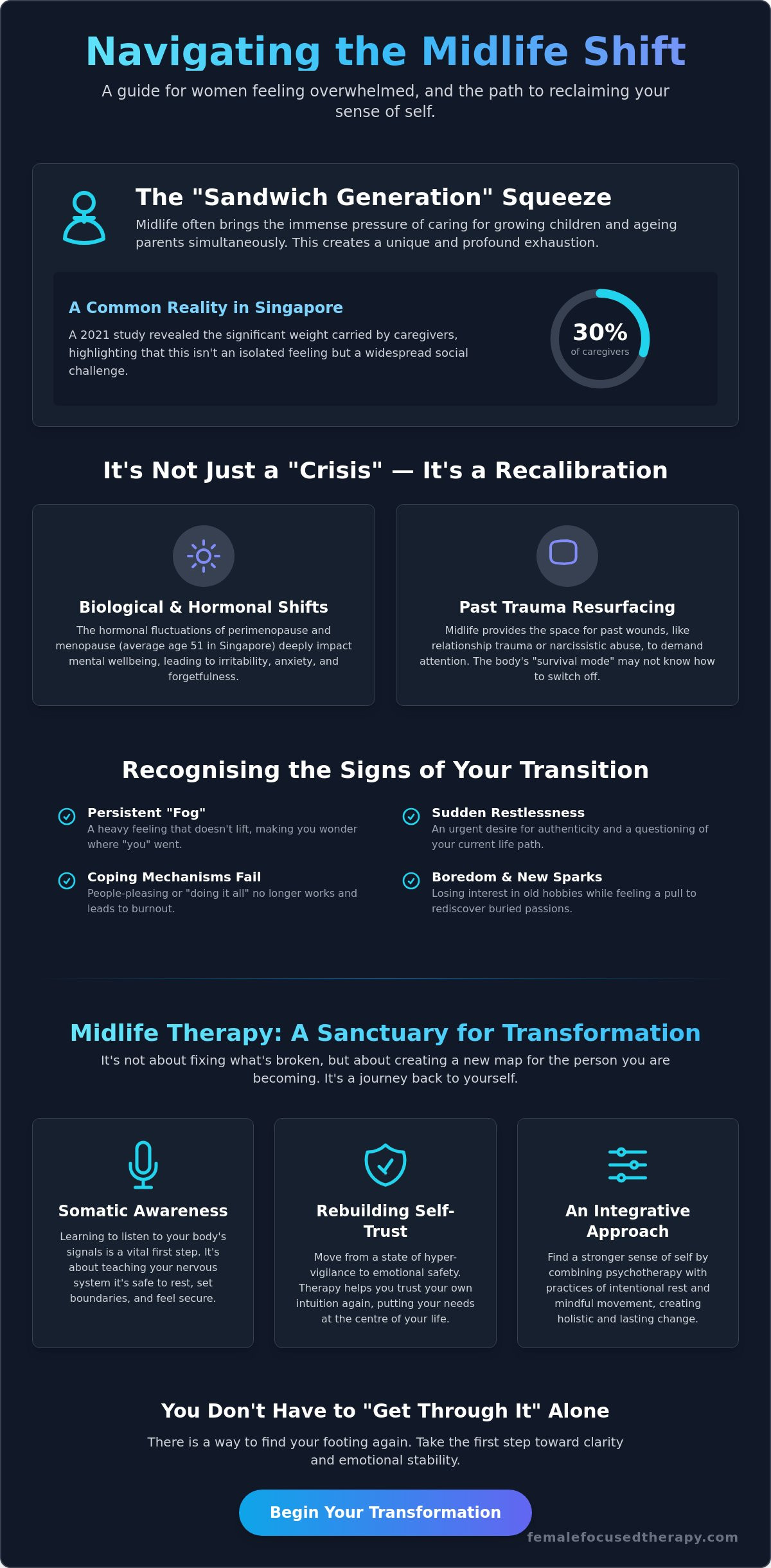
I view midlife therapy as a sanctuary rather than a clinical process. It isn’t about fixing a broken version of yourself. It’s about acknowledging that the map you’ve used for years no longer matches the terrain you’re walking on. In Singapore, this transition is often intensified by the “sandwich generation” pressure. You’re likely managing the needs of growing children while navigating the health concerns of ageing parents.
A 2021 study by the Singapore University of Social Sciences highlighted that nearly 30 percent of caregivers in Singapore fall into this category. This creates a unique kind of exhaustion. When you’ve spent years emotionally over-functioning, your old coping mechanisms like people-pleasing or “doing it all” start to fail. They don’t work anymore because your soul is asking for something deeper than just being useful to others.
Recognising the Signs of a Midlife Transition
The shift often starts with a move from “doing” for others to “questioning” for yourself. You might feel a sudden restlessness or a desire for authenticity that feels almost urgent. This isn’t about a stereotypical “crisis.” While understanding the term ‘midlife crisis’ can help us see the historical context of these feelings, what you’re experiencing is likely a profound internal realignment.
You might find yourself bored with things that used to interest you. Or perhaps you feel a sudden spark to rediscover parts of yourself you buried in your 20s. This transition is a call to move away from performance and toward presence. It’s about learning to breathe through the discomfort of change rather than trying to outrun it.
The Impact of Relationship Trauma at Midlife
For many women I work with, midlife is when past wounds finally demand attention. Relationship trauma or years of narcissistic abuse often resurface during this stage. When the distractions of early career or young children fade, the echoes of gaslighting can become louder. You might finally have the space to realise that your “survival mode” is no longer necessary, yet your body doesn’t know how to turn it off.
The process of rebuilding self-trust is central to midlife therapy. It involves moving from a state of constant hyper-vigilance to a state of emotional safety. We work together to help you trust your own intuition again. This isn’t just a mental shift; it’s a somatic one. It’s about teaching your nervous system that it is safe to be seen, safe to have boundaries, and safe to put your own needs at the centre of your life.
Beyond the “Crisis”: Understanding the Biological and Emotional Shifts
I often hear from women who feel like they are losing their grip on a life they once managed with ease. You might find yourself feeling suddenly irritable, forgetful, or anxious for no apparent reason. It is common to label this a “crisis,” but I prefer to see it as a profound biological and emotional recalibration. It is not a decline, but a necessary developmental stage that requires a new kind of map.
When our oestrogen levels begin to dip, it directly affects the chemical messengers in our brain that keep us feeling steady. This isn’t just “in your head,” it is a physiological event that impacts your mental wellbeing. I see midlife as a “second puberty,” a time where the body and mind demand we stop and pay attention. Psychotherapy at midlife offers a safe, grounded space to explore these shifts without the fear of being judged or “fixed.”
In my practice, I find that midlife therapy is less about solving a problem and more about reclaiming a sense of self. We are moving away from the roles we have played for others and towards a more authentic version of ourselves. It is an opportunity to re-evaluate your identity and rebuild your self-trust from the ground up.
Perimenopause and Your Mental Health
The transition into menopause is often accompanied by “brain fog” and an emotional intensity that can feel quite frightening. A 2022 study published in The Lancet found that the transition to menopause is associated with a 40% increased risk of depression. This is often exacerbated by sleep disruption, which erodes our emotional resilience and makes daily life feel like an uphill struggle.
I believe that understanding the link between your physical body and your mood is the first step toward healing. My approach to menopause therapy for women in Singapore focuses on validating these experiences. We work together to find ways to soothe your nervous system, using both talk therapy and somatic practices like gentle breathwork to help you feel more at home in your changing body.
ADHD and the Midlife Transition
It is incredibly common for women to receive an ADHD diagnosis for the first time during midlife. You may have spent decades “white-knuckling” your way through life, using high levels of effort to mask your struggles. However, as oestrogen levels drop, the dopamine in our brains also fluctuates, often making previously manageable ADHD symptoms feel suddenly chaotic.
Managing the overwhelm of neurodivergence alongside career demands or family transitions can feel like too much to carry. I understand this personally and professionally, and I know how life-changing it is to finally understand why your brain works the way it does. We don’t need to pathologise your experience; instead, we can find ways to work with your unique brain rather than against it.
If you feel like your internal compass is spinning, you don’t have to navigate this transition alone. You can reach out for a confidential chat to see how we can find your clarity again.
Female Focused Therapy & YogaBellies
Cheryl Kennedy MacDonald
Registered Integrative Psychotherapist & Yoga Master
Singapore & Worldwide Online
www.femalefocusedtherapy.com
www.yogabellies.com
Common Misconceptions: Is It a Crisis or a Call for Change?
I often hear the term “midlife crisis” used as a punchline. We’ve been conditioned to think this stage is just about a desperate attempt to claw back our youth through impulsive purchases or radical lifestyle shifts. In my experience, this narrative is quite damaging because it dismisses the very real, very valid internal shifts you’re experiencing. It isn’t about losing your youth; it’s about outgrowing a version of yourself that no longer fits.
Many women come to me feeling a deep sense of unrest despite having “checked all the boxes.” You might have the career, the family, and the home in Singapore you worked so hard for, yet you feel hollow. This happens because we often try to “fix” the external life to solve an internal ache. If the foundation of your life was built on childhood patterns or the need to please others, no amount of external rearranging will bring peace. This is where midlife therapy becomes a space for genuine internal reconnection.
Our early experiences play a massive role in how we navigate this period. If you grew up needing to be the “good girl” or the high achiever to feel safe, midlife often acts as a pressure cooker. The strategies that helped you survive your 20s and 30s can start to feel like a cage. I help you look at these conditioned parts of yourself with compassion, rather than judgment, so you can decide which parts you want to carry forward.
Midlife Transition vs. Clinical Depression
It’s vital to distinguish between a natural transitionary period and clinical depression. Sadness in midlife is often a signal that change is required, rather than a sign that you are “broken.” However, the biological shifts are real. Research into Menopause & Midlife Health shows how fluctuating hormones can impact our emotional baseline. I use a trauma-informed perspective to help you understand if your feelings are a medical concern or a soul-level “call to action.”
In our sessions, we work to separate your “conditioned self,” the version of you that does what is expected, from your “true self.” When you stop performing for the world, the heavy fog of exhaustion often begins to lift. We look at your nervous system, using breath and somatic awareness to find safety in the present moment. This clarity allows you to see that your feelings aren’t a crisis to be managed, but an invitation to live more authentically.
Why We Often Fear This Stage
Societal ageism can make us feel like we’re becoming invisible as we age. In a fast-paced society like Singapore, there is a lot of pressure to remain “productive” and youthful. This fear of disappearing often keeps us stuck in old, exhausting habits. I want to help you reframe this stage as a powerful beginning. It’s a time to reclaim the “Wise Woman” archetype, where your value is based on your insight and boundaries rather than your utility to others.
Choosing midlife therapy is an act of reclaiming your power. We move away from the idea that your best years are behind you and instead focus on the wisdom you’ve gathered. By acknowledging the grief of what’s passing, we make room for a future built on self-trust and genuine joy. You aren’t fading; you are finally arriving.
Reconnecting with Yourself: Practical Steps for Emotional and Somatic Healing
I have seen so many women arrive for midlife therapy in Singapore feeling completely disconnected from their physical selves. We often live entirely in our heads, managing schedules and navigating the “always-on” culture of our city. This mental overload forces the body to go into a state of quiet survival. I want you to know that your body has been keeping the score all along.
Somatic awareness is simply the practice of listening to what your body is telling you. It is about noticing the tight knot in your stomach before a meeting or the way your breath catches when you feel overlooked. In my practice, I view rest as a radical act of self-preservation. It is not a luxury or something you earn after completing a to-do list; it is a fundamental requirement for your nervous system to stay regulated.
Traditional talk therapy is deeply valuable, but sometimes words aren’t enough to reach the places where we store trauma or chronic stress. This is why I integrate breath and movement into our sessions. When we move, we give those trapped emotions a way out. It allows us to process the “unspoken” weight of midlife transitions without needing to find the perfect sentence to describe it.
The Role of Somatic Movement
You don’t need a complicated routine to begin this work. Incorporating somatic movement and yoga into your day can be as simple as five minutes of gentle stretching on your balcony or mindful breathing while commuting on the MRT. These movements aren’t about fitness; they are about feeling.
If you feel stuck in a “fight or flight” loop, your breath is your most accessible tool. I often suggest the 4-7-8 technique to help signal safety to the brain. Moving your body helps unlock the emotional tension that talk therapy alone might miss. It creates a bridge between your physical sensations and your emotional clarity, helping you feel grounded when life feels chaotic.
Creating a Sustainable Self-Care Practice
True self-care in midlife goes much deeper than the occasional bubble bath. It is about soul-level nourishment and the courage to set firm boundaries. In Singapore, many of the women I work with are “emotional over-functioners” who take on everyone else’s stress. Setting boundaries is how you plug those “energy leaks” that leave you feeling depleted by 3 PM every day.
I encourage you to find a safe space where you can be fully yourself, without the masks of “mother,” “daughter,” or “professional.” This might be a quiet corner of your home or a dedicated hour in therapy. Identifying what truly drains you is the first step toward preservation. When you protect your energy, you aren’t being selfish; you are ensuring you have the capacity to live with intention.
If you are ready to move from feeling overwhelmed to feeling grounded, I am here to help. You can book a session to begin your journey of reconnection.
Contact Female Focused Therapy
Cheryl Kennedy MacDonald is a registered integrative psychotherapist and yoga master helping women navigate life transitions with clarity and compassion. Based in Singapore and working with women globally.
Website: www.femalefocusedtherapy.com | About Cheryl
How Therapy Supports Your Transformation: Finding Your Way Back to You
You might feel like you have lost your bearings, but I am here to help you find them again. My work is built on the belief that you already have the strength inside you; we just need to clear the path. I use an integrative approach that looks at you as a whole person, rather than just a set of symptoms. This means combining Cognitive Behavioural Therapy (CBT) to manage those racing thoughts with psychodynamic work to understand the roots of your patterns. We also include somatic practices to help you reconnect with your body’s wisdom.
In our sessions, I offer a blend of evidence based techniques tailored to your specific needs. CBT helps us tackle the immediate anxiety that often accompanies change. Psychodynamic therapy allows us to look at the “why” behind your reactions. Somatic work, involving breath and awareness, ensures we are not just talking about healing but feeling it in your nervous system too. This holistic method is why midlife therapy can be so effective for long term change.
When we meet, whether it is in my Singapore office or via a secure online link, you will find a space that is warm and empathetic. It is also a boundaried, professional environment. This structure provides the safety you need to explore difficult feelings without fear of judgement. My goal for our work together is for you to walk away with clarity, confidence, and a much stronger sense of self. We work so you can move forward with a renewed sense of purpose.
I support women through in person sessions in Singapore and through online therapy for those living globally. This flexibility ensures you can access support regardless of your schedule or location. Whether you are an expat navigating a new culture or a local professional balancing a career and family, I provide a steady hand to guide you through this transition.
The Journey of Rebuilding Self-Trust
We will work closely to quiet that harsh inner critic that often grows louder during life transitions. Midlife therapy is not about a quick fix; it is about making change feel safe and sustainable. We move at a pace that respects your boundaries and your capacity for growth. I believe your history matters because it shaped you, but it does not have to define your future. We look at those past experiences to understand them, then we focus on who you want to be in this next chapter.
Taking the First Step Toward Healing
It takes immense courage to admit you need support, and you deserve to feel well. You do not have to navigate these shifting tides alone. I offer a calm, reassuring space where your voice is the most important one in the room. If you feel you need a more concentrated period of support to break through old blocks, I invite you to explore focused intensive therapy options for deeper work. You have the right to seek a life that feels authentic and grounded.
Charting a Path That Feels Like Home
You don’t have to navigate this transition alone or feel like you’re losing your way. Midlife is often less of a crisis and more of a call to strip away the expectations that no longer serve you. It’s a chance to listen to your body and mind with a new level of kindness.
We’ve explored how biological shifts and emotional weights impact women aged 25 to 65. Through midlife therapy, we can work together to process the heavy layers of over-functioning and trauma. I bring my experience as a Scottish-born psychotherapist and Yoga Master to help you find balance here in Singapore.
We’ll focus on somatic healing and rebuilding that vital sense of self-trust at a pace that feels right for you. You deserve to feel grounded and clear as you move forward into this new season of life. I’m here to provide a safe, warm, and professional space for your transformation whenever you’re ready.
Book a session with me to start your journey back to yourself
Frequently Asked Questions
What exactly is midlife therapy and how is it different from general counselling?
Midlife therapy focuses specifically on the unique psychological and physiological shifts women face between ages 40 and 60. Unlike general counselling, which might address a broad range of life issues, I look at your experience through the lens of this specific transition. We explore how hormonal changes, shifting family roles, and career plateaus intersect. It’s about rebuilding self-trust when the roles you’ve played for decades no longer feel like a good fit.
How do I know if I am having a midlife crisis or if I am actually depressed?
A midlife crisis often feels like a sudden, restless urge for change, while depression is a persistent state of low mood that affects your daily functioning. Research from The Lancet suggests that life satisfaction often follows a U-shape, dipping for many in their 40s. If you’ve felt hopeless or lost interest in things you love for more than 14 days, it might be clinical depression. I’ll help you untangle whether you’re seeking a new direction or need support for your mental health.
Can therapy help with the emotional symptoms of perimenopause and menopause?
Yes, midlife therapy is incredibly effective for managing the anxiety, irritability, and “brain fog” that often accompany perimenopause. About 20 percent of women experience significant mood disturbances during this hormonal transition. I use an integrative approach to help you regulate your nervous system through breath and somatic awareness. We work together to validate your experience so you don’t feel like you’re losing your mind while your body is changing.
I was recently diagnosed with ADHD at 45; can midlife therapy help me manage this?
Receiving an ADHD diagnosis in your 40s is a life-altering moment that I understand deeply from my own experience as a woman with ADHD. Midlife therapy provides a safe space to grieve the years you spent wondering why things felt so hard. We focus on practical strategies that work for a neurodivergent brain, especially as declining estrogen levels can make ADHD symptoms feel more intense. It’s about moving away from self-blame and toward a life that actually fits how your mind works.
Is it normal to feel like I want to leave my career or relationship during midlife?
It’s very common to feel a strong desire to change everything when your current life no longer reflects who you’ve become. This period is often a reckoning where the masks we’ve worn for others start to slip. I won’t tell you what to do, but I’ll provide a grounded space to explore these feelings before you make major decisions. We’ll look at whether you’re seeking an escape or a genuine evolution of your identity.
How long does midlife therapy typically take to start feeling like myself again?
Most women I work with start to feel a sense of relief and clarity after 6 to 12 weekly sessions. Healing isn’t a linear process, so the total time depends on your specific history and what you want to achieve. We move at a pace that feels safe and sustainable for you. My goal is to help you build the internal tools you need so you can eventually navigate life’s transitions with your own compass.
Do you offer online midlife therapy if I am not based in Singapore?
I offer online sessions to women all over the world, bringing my integrative approach to you wherever you are. Whether you’re an expat in Asia or living in the UK, we can connect through a secure and confidential video platform. All my fees are processed in Singapore Dollars (S$), and I ensure our sessions fit into your timezone. This flexibility allows you to prioritise your wellbeing without the added stress of a commute.
What is the “integrative approach” you use in your psychotherapy sessions?
My integrative approach means I combine traditional talk therapy with somatic practices like breathwork and movement. I don’t believe we can heal the mind while ignoring the body, especially during midlife. We might use Cognitive Behavioural Therapy to challenge old thought patterns while also using mindfulness to settle your nervous system. This holistic method ensures we’re addressing your challenges from every angle, helping you find a deeper sense of balance and self-trust.

Article by
Cheryl Kennedy MacDonald MA BA (Hons) Pg. Dip. SAC BACP
Cheryl Kennedy MacDonald is a psychotherapist specialising in women’s mental health, relationships, and life transitions. She works with women navigating trauma, relationship breakdown, identity shifts, and midlife change, helping them rebuild self-trust, emotional stability, and a clear sense of who they are and what they want.
With over 20 years’ experience working with women internationally, Cheryl is the founder of YogaBellies, a global women’s yoga school, and the creator of the Birth ROCKS method. Her work sits at the intersection of psychotherapy and embodiment, integrating evidence-based therapeutic approaches with somatic, body-based practices that support deep, lasting change.
Known for her grounded and direct approach, Cheryl moves beyond surface-level insight to address the patterns held in the body and nervous system. Her work supports women to regulate, reconnect, and respond to their lives from a place of clarity, strength, and self-respect.
She is a published author in academic journals and has written multiple books on women’s health, pregnancy, and midlife wellbeing, available on Amazon and leading book retailers worldwide.