
What if the ADHD meaning for women isn’t about being unable to focus, but rather about the bone-deep exhaustion of trying to focus on everything, all at once, perfectly? I know that heavy feeling of spinning plates while your internal world feels like a storm of half-finished thoughts and endless “shoulds.” You might look successful and put-together to everyone else, yet inside, you’re constantly fighting to keep your head above water.
I understand this journey deeply, both as a psychotherapist and as an adult woman living with ADHD myself. I want you to know that your struggle isn’t a character flaw or a sign that you’re failing at being a woman. It’s a biological reality that often looks less like hyperactivity and more like a hidden, exhausting internal battle. My hope is to help you finally make sense of your own experience and find some much-needed clarity.
We’ll look at how masking hides your true self from the world, why social and domestic roles can feel so uniquely overwhelming, and how you can begin to move from constant self-criticism toward a path of self-compassion and effective support.
Key Takeaways
- Understand why the clinical ADHD meaning often misses the mark for us by focusing on external hyperactivity rather than the internal intensity you live with every day.
- Discover how the hidden “performance” of masking leads to chronic burnout and why simply “trying harder” is never the solution to your exhaustion.
- Learn about the powerful connection between your hormones and your brain, specifically why your symptoms might feel impossible to ignore during midlife shifts.
- Explore an integrative perspective that acknowledges the physical “buzz” of ADHD in your body and moves beyond just talking through your struggles.
- Shift your perspective from feeling like a “failure” to seeing your unique wiring as something that deserves compassionate support rather than a quick fix.
Beyond the Label: What ADHD Meaning Feels Like for Us
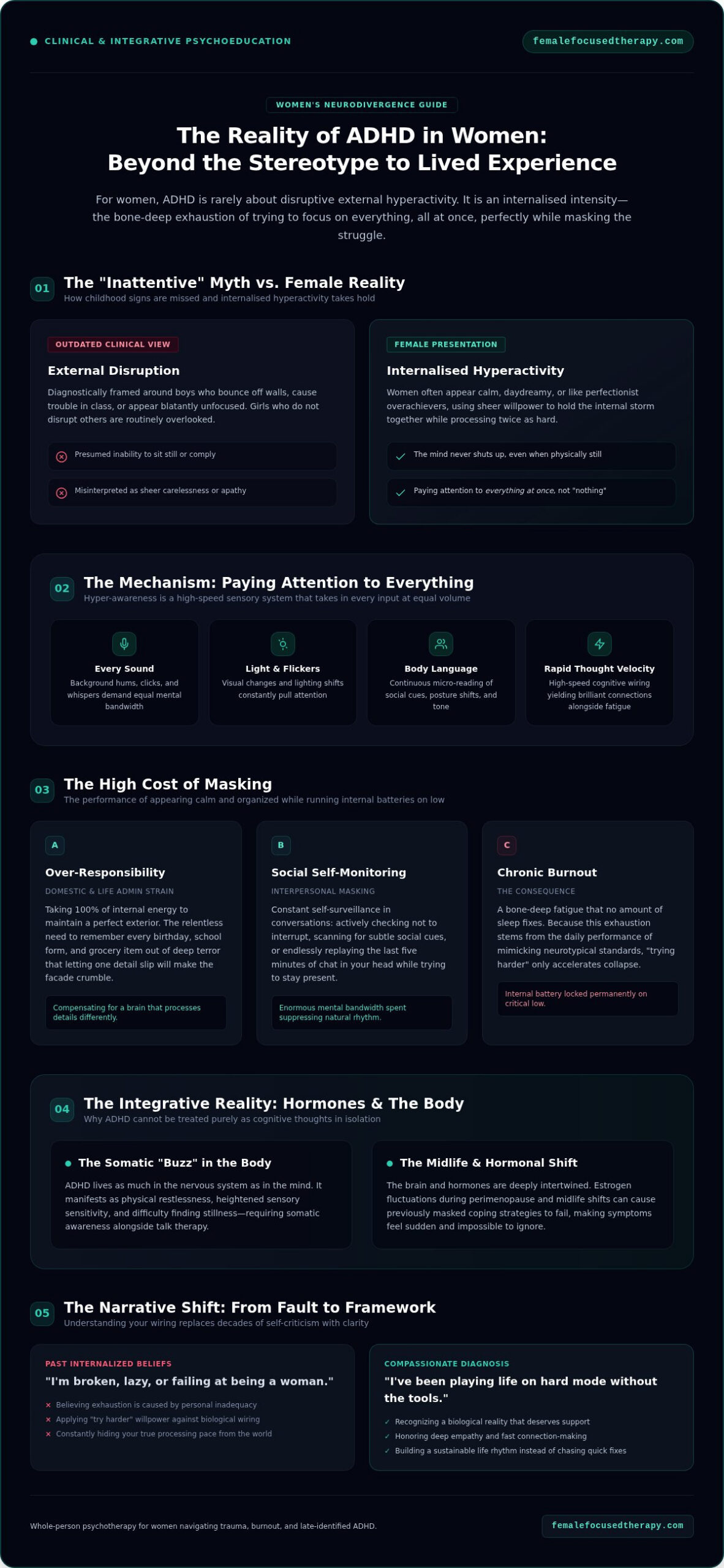
I want to start by saying that if you’ve always felt like you’re running on a faster motor than everyone else, you’re not alone. I know that feeling of being perpetually “on,” even when you’re physically exhausted. The clinical ADHD meaning often misses the point for women, because it focuses so heavily on external disruption. For us, it isn’t just about a lack of focus. It’s about a relentless internal intensity that colours every part of our lives.
I often describe this experience as internalised hyperactivity. While the world sees a woman who is calm and composed, your mind is likely a storm of half-finished thoughts, vivid ideas, and urgent reminders. This is a core part of how Attention Deficit Hyperactivity Disorder (ADHD) presents in the female brain. It’s the mind that never shuts up, even when your body is finally still at the end of a long day in Singapore.
I see ADHD as a fundamentally different way of processing the world. It’s a brain that is wired for high-speed connections and deep empathy, though it often comes with a sensory system that feels everything too loudly. Once we stop trying to be “typical” and start understanding our own rhythm, we can begin to see these traits as the superpowers they truly are.
The ‘Inattentive’ Myth in Women
You might have been missed as a child because you weren’t the one bouncing off the walls or causing trouble in class. In my experience, many women were the daydreamers or the perfectionist overachievers. You were actually working twice as hard as everyone else just to keep up, using sheer willpower to mask the chaos inside.
The clinical term “inattentive” is often a misnomer for us. It isn’t that you aren’t paying attention; it’s that you’re paying attention to everything at once. Every sound in the room, every flicker of light, and every shift in someone’s body language demands your focus. This hyper-awareness is exhausting, but it’s also a sign of a brain that processes information with incredible speed.
Why a Diagnosis Matters Now
I’ve found that for many of the women I work with, a late diagnosis feels like a massive weight being lifted. It’s the moment you finally realize you aren’t lazy, careless, or broken. You’ve just been playing the game of life on “hard mode” without the right tools. Understanding the true ADHD meaning for your specific life is about more than just a label; it’s about context.
Moving away from years of self-blame and toward self-compassion is where the real work begins. Once you understand your wiring, you can stop fighting against yourself and start working with your brain. This shift is the foundation of ADHD-focused therapy, helping you rebuild your internal confidence and find a pace that actually feels sustainable.
The High Cost of Masking and ‘Trying Harder’
I know how exhausting it is to spend your whole day pretending you have it all together. Masking is the performance we put on to appear organised, calm, and in control when we feel the opposite inside. While the National Institute of Mental Health overview of ADHD provides a clinical foundation, for many women, the true ADHD meaning is tied to this deep, quiet exhaustion. It’s a fatigue that no amount of sleep seems to fix because it comes from the constant mental effort of hiding your true self.
Brilliant women in Singapore often reach the point of burnout because they’ve spent decades hiding their ADHD. You might be the one everyone relies on, the “superwoman” who never misses a deadline, yet you feel like a fraud. This burnout isn’t just about being busy; it’s the result of your brain working overtime to suppress its natural way of being. When your ADHD meaning is defined by how well you can mimic neurotypical standards, your internal battery is always on low.
Recognizing Your Own Mask
Your mask might look like a perfect house that takes 100% of your energy to maintain, leaving nothing left for your own joy. I call it over-responsibility. It’s that nagging need to be the one who remembers every birthday, school form, and grocery item because you’re terrified of forgetting just one thing and having the whole facade crumble. You’re not being “extra,” you’re trying to compensate for a brain that processes details differently.
Socially, masking is just as taxing. You might find yourself constantly self-monitoring in conversations. You’re checking to make sure you haven’t interrupted, wondering if you’ve missed a subtle social cue, or replaying the last five minutes of the chat in your head while trying to listen to what’s being said now. This vigilance is a heavy burden to carry and often leads to a total collapse once you’re finally home and alone.
From Masking to Authenticity
I believe that healing involves slowly and safely letting that mask slip. In my practice, we work on identifying who you are underneath the performance of being typical. It’s about discovering your own identity beyond the struggle. We look at what happens when you stop “trying harder” at things that aren’t designed for your brain and start building a life that actually fits your wiring.
Learning to ask for what you actually need, rather than what you think you should need, is a profound act of self-care. If you feel ready to explore what’s behind your own mask, you might find it helpful to book a session to talk through your experience in a safe, non-judgmental space. Moving toward authenticity isn’t about fixing yourself; it’s about coming home to the woman you’ve always been.
Hormones, Midlife, and the ADHD Shift
I’ve noticed a recurring pattern in my therapy practice here in Singapore. Many women come to me in their late 30s or 40s, feeling like they are suddenly “losing their mind.” They describe a level of internal chaos and forgetfulness they’ve never experienced before. I want you to know that your ADHD symptoms didn’t just appear out of thin air. Instead, the life-long effort you’ve put into managing them has likely become impossible to sustain due to significant hormonal shifts.
The ADHD meaning for women is deeply intertwined with our biology. As we move through different life stages, from the intense demands of motherhood to the onset of perimenopause, the way our brains function actually changes. What worked in your 20s might leave you feeling completely stranded now. This isn’t because you’re becoming “less capable,” but because the biological environment of your brain is shifting.
The Estrogen Connection
There is a very real link between our estrogen levels and how our ADHD brains function. Estrogen plays a vital role in helping our brains produce and use dopamine, the neurotransmitter responsible for focus, motivation, and reward. When estrogen levels begin to fluctuate and drop during perimenopause, our dopamine levels often follow suit. This is why many women find that their usual coping strategies suddenly stop working in their 40s.
I often hear from women who feel like they’ve failed because they can no longer “keep it together” like they used to. Please understand that this is a biological reality, not a personal failing on your part. The CDC facts on ADHD prevalence and diagnosis highlight how diagnosis can happen at any age, and for women, these hormonal windows are often the catalyst for finally seeking help.
Navigating Midlife Transitions
The “brain fog” often associated with menopause can feel like your ADHD has been turned up to high volume. It becomes harder to regulate emotions, track daily tasks, or even find the right words in a conversation. I specialise in helping women navigate these life transitions, where the old rules of your life no longer seem to apply and the noise inside feels deafening.
The ADHD meaning in midlife isn’t about decline; it’s about adaptation. We can find new ways to support your nervous system during these shifts, moving away from the “push through” mentality that leads to burnout. By listening to what your body is telling you during these hormonal changes, we can build a framework of support that respects your brain’s unique needs at this stage of your life.
An Integrative Approach: ADHD in the Body
I believe that we can’t just “talk” our way through ADHD; we have to listen to our bodies too. For many of us, the true ADHD meaning is a physical sensation as much as a cognitive one. It often feels like a constant, low-level restlessness or a subtle “buzzing” under the skin that never quite goes away. In my work with women in Singapore, I combine traditional psychotherapy with a deep focus on your nervous system and somatic awareness. I’ve found that when we learn to soothe the physical body, the mind’s relentless “chatter” often begins to settle as well.
Healing isn’t just about understanding your thoughts. It’s about helping your body feel safe. When your nervous system is perpetually on high alert, your brain can’t possibly focus or regulate emotions effectively. By bringing the body into the therapy room, we address the root of that internal noise. We move from just managing symptoms to restoring your internal stability.
Sensory Overwhelm and the Nervous System
Have you ever felt like a “small” background noise or an “itchy” clothing tag was a physical assault on your brain? This isn’t you being difficult. It’s your nervous system struggling to filter out sensory input. I encourage you to begin noticing where you hold tension in your body when you’re trying to focus or when you feel overwhelmed.
Is your jaw clenched? Are your shoulders up by your ears? The simple practice of noticing these physical cues is a powerful tool for adhd therapy. It allows you to catch the spiral of overwhelm before it takes over your entire day. When you recognize the physical signs of stress, you can intervene before you reach the point of total burnout.
The Power of the Exhale
I often talk about how the exhale should always be longer than the inhale. This isn’t just a simple relaxation tip; it is a direct biological signal to your body that you are safe. Using specific breath and movement patterns helps you manage the “emotional storms” that so often come with ADHD. It gives you a way to ground yourself when the world feels like it’s spinning too fast.
Rest isn’t a reward for being productive. For a neurodivergent brain, rest is a non-negotiable part of the healing process. Your system needs time to recalibrate and recover from the high-intensity processing it does every second. If you’re tired of feeling like your body is an enemy you have to fight, I invite you to book an appointment for ADHD-focused therapy so we can start working with your nervous system rather than against it.
Reclaiming Your Narrative and Finding Support
I want you to know that a diagnosis isn’t an end point; it’s the beginning of understanding your true self. For so many years, you may have felt like you were failing at things that seemed to come easily to others. When you finally understand the true ADHD meaning in the context of your own life, those years of struggle start to make sense. You aren’t lazy or broken. You’ve just been navigating a world that wasn’t built for your specific brain.
You don’t need to be fixed. You deserve to be understood and supported in a way that actually fits how you think and feel. I’ve helped many women in Singapore and across the globe move from a state of chronic overwhelm to a place of grounded, quiet confidence. Rebuilding your internal resilience starts at Female Focused Therapy, where we look at the whole picture of your life. The ADHD meaning for you can shift from a source of shame to a source of empowerment once you have the right tools and a safe space to finally unmask.
How Therapy Can Help You Thrive
In our sessions, we work together to manage the parts of ADHD that often hurt the most but are rarely talked about in clinical settings. This includes the high emotional intensity and that painful rejection sensitivity that can make even small interactions feel like a huge risk. I offer a space where you don’t have to explain why you’re overwhelmed or why you’ve missed a deadline. I already get it.
Whether you’re based here in Singapore or connecting with me through online therapy, we can find a path that works for your unique lifestyle. We focus on rebuilding your internal confidence and finding strategies that respect your energy levels and your hormonal cycles. It’s about creating a life where you can thrive as your authentic self, rather than exhausting yourself trying to meet neurotypical expectations.
Taking the First Step
I know it can feel daunting to reach out. There might be a voice in your head telling you that you should be able to handle this on your own. But you don’t have to navigate this alone anymore. If you’re not quite ready for a full session, you can explore my free therapy resources to start your journey of understanding today.
Stepping into this next chapter allows you to release old guilt and embrace practical, compassionate guidance. Processing a diagnosis takes time, patience, and deliberate self-care, but having tailored support makes all the difference. Whenever you are prepared, we can work together to help you unmask, cultivate emotional balance, and build a sustainable routine that honors who you are.
If you’d like to find out more about working with Cheryl Kennedy MacDonald, you can send an email to cheryl@femalefocusedtherapy.com or book an appointment online. For specialized lifestyle and yoga programmes, explore the offerings at YogaBellies.
Moving Forward with Clarity and Compassion
Understanding the true ADHD meaning in your life is a journey of rediscovery. It’s about moving away from the exhaustion of “trying harder” and toward a life that honours your unique intensity. We’ve seen how your symptoms are tied to your nervous system and hormonal shifts, proving your struggles are biological rather than a lack of willpower.
As a registered psychotherapist with lived ADHD experience, I provide a safe, trauma-informed space for women. My integrative approach focuses on both the mind and body, helping you navigate life transitions where neurodivergent traits feel louder. You deserve support that is as nuanced as you are.
I’d love to help you navigate your journey and find grounded confidence. Book a session with me here to start your path toward internal restoration. You’ve spent long enough fighting yourself; it’s time to work with your brain.
If you’d like to find out more about working with Cheryl Kennedy MacDonald, you can email her at cheryl@femalefocusedtherapy.com or go ahead and book an appointment here: https://www.femalefocusedtherapy.com/book-now/ or lifestyle and yoga progammes, visit YogaBellies on www.yogabellies.com
Frequently Asked Questions
What is the true meaning of ADHD in adult women?
The true ADHD meaning for us is often an internalised experience of intensity rather than the external hyperactivity typically seen in boys. It manifests as a mind that never stops, chronic overwhelm, and the bone-deep exhaustion of masking your traits to fit social expectations. For many of us, it means feeling like you’re working twice as hard as everyone else just to keep up with the basic demands of daily life.
Can ADHD symptoms appear for the first time during menopause?
ADHD is a lifelong neurodevelopmental condition, so it doesn’t technically start at menopause. However, your symptoms often become impossible to ignore during this time. Dropping estrogen levels directly impact your brain’s ability to use dopamine, which is essential for focus and emotional regulation. This biological shift can make previously manageable traits feel like a sudden crisis, leading many women in Singapore to seek their first assessment in their 40s or 50s.
What is the difference between ADHD masking and just being polite?
While being polite is a conscious social choice, ADHD masking is an exhausting survival strategy. It involves a constant, often subconscious effort to hide your natural wiring to avoid judgment. This might look like suppressing the urge to fidget, over-rehearsing conversations, or forcing yourself to stay still when your skin feels like it’s buzzing. This performance is incredibly draining and often leads to a total collapse of energy once you’re alone.
How does ADHD affect relationships and intimacy for women?
ADHD can create significant waves in relationships, often appearing as emotional dysregulation or deep rejection sensitivity. You might feel “too much” for your partner or struggle with the mental load of domestic life, which leads to feelings of failure and shame. In terms of intimacy, sensory overwhelm can make physical touch feel overstimulating, while a racing mind might make it difficult to stay present and connected during quiet, intimate moments with your partner.
Why do I feel so much more overwhelmed than other women my age?
You likely feel more overwhelmed because your brain’s executive functions, such as planning and emotional regulation, are working on a different frequency. While other women might find “juggling” life stressful, for a woman with ADHD, it can feel like a constant sensory assault. This feeling is often intensified by the pressure to meet traditional roles in Singapore, which demand a high level of organisation, social grace, and emotional labour that your brain isn’t wired for.
Is it possible to have ADHD if I was a ‘gifted’ child?
It is absolutely possible, and actually quite common, for gifted women to have ADHD. This is often called being “twice-exceptional.” High intelligence allows you to develop sophisticated coping mechanisms that hide your struggles during your school years. You might have excelled academically while secretly feeling like a chaotic mess inside, only reaching a breaking point when the complexities of adult life, motherhood, or career finally outpaced your ability to compensate using sheer willpower.
How can somatic therapy help with ADHD symptoms?
Somatic therapy addresses the physical restlessness and “buzz” that often accompany ADHD. Instead of just talking about your thoughts, we focus on calming your nervous system through body awareness and breathwork. By learning to notice where you hold tension and how to signal safety to your body, you can lower your overall baseline of stress. This helps settle the mental chatter and makes your other cognitive coping strategies much more effective and sustainable.
What are the first steps to getting an ADHD assessment in Singapore?
In Singapore, you can start by visiting a Polyclinic to request a referral to a specialist at a public hospital, though wait times can be significant. Alternatively, you can seek a private assessment through a clinical psychologist or psychiatrist for a faster process. I often recommend starting with therapy to explore your symptoms and build regulation tools while you navigate the formal diagnostic pathway, as the understanding you gain is often more vital than the label.

Article by
Cheryl Kennedy MacDonald MA BA (Hons) Pg. Dip. SAC BACP
Cheryl Kennedy MacDonald is a psychotherapist specialising in women’s mental health, relationships, and life transitions. She works with women navigating trauma, relationship breakdown, identity shifts, and midlife change, helping them rebuild self-trust, emotional stability, and a clear sense of who they are and what they want.
With over 20 years’ experience working with women internationally, Cheryl is the founder of YogaBellies, a global women’s yoga school, and the creator of the Birth ROCKS method. Her work sits at the intersection of psychotherapy and embodiment, integrating evidence-based therapeutic approaches with somatic, body-based practices that support deep, lasting change.
Known for her grounded and direct approach, Cheryl moves beyond surface-level insight to address the patterns held in the body and nervous system. Her work supports women to regulate, reconnect, and respond to their lives from a place of clarity, strength, and self-respect.
She is a published author in academic journals and has written multiple books on women’s health, pregnancy, and midlife wellbeing, available on Amazon and leading book retailers worldwide.