
What if that constant, buzzing hum in your mind isn’t a personal flaw, but simply how your brain is wired? You likely spend your days feeling like you’re running a marathon just to keep up with the basics, only to collapse in a state of emotional exhaustion by dinner time. I know that feeling of being “too much” for some and yet “not enough” for yourself. As a woman living with adhd myself, I understand that the mental load of managing a career or a home can feel like trying to carry water in a sieve. It’s a quiet, often invisible struggle that leaves you questioning your own worth.
I want you to know that your experience is real and it has a name. I’ll help you make sense of the internal noise and the executive dysfunction that might be holding you back. We’ll explore how an integrated approach, looking at both your mind and your body, can move you from a place of chronic overwhelm toward a sense of clarity and internal restoration. I’ll share how you can begin to rebuild self-trust and find practical ways to manage the unique, beautiful rhythm of your own mind.
Key Takeaways
- Understand why your experience of adhd might look like internal exhaustion and racing thoughts rather than physical hyperactivity.
- Recognise the hidden energy cost of “masking” and why your environment might be triggering intense sensory overwhelm.
- Learn how your menstrual cycle and fluctuating estrogen levels directly influence your focus and dopamine throughout the month.
- Discover how somatic tools and nervous system regulation can help you settle the mind when talk therapy alone isn’t enough.
- See how I use an integrative, female-focused approach to help you move from chronic overwhelm to internal clarity and self-trust.
The Quiet Weight of Living with ADHD as an Adult Woman
When you think of ADHD, you might picture a young boy who cannot sit still in class. For us, the reality is often much quieter on the outside, but deafeningly loud within. It’s less about running around a room and more about a mind that never stops racing, even when your body is slumped on the sofa in total exhaustion. I understand this weight because I live it too. I know what it’s like to appear high-functioning, to be the woman who “has it all together,” while internally feeling like you’re one minor inconvenience away from a total collapse.
Today, we understand ADHD as a neurodivergent trait that impacts executive function and emotional regulation, manifesting as a deeply personal way the nervous system processes every experience. For many women, this results in an intense internal noise that makes even the simplest daily tasks feel like climbing a mountain with a heavy pack.
Why so many of us are missed until adulthood
Many of us grew up under the “good girl” narrative. We learned early on to hide our struggles, to double-check our work, and to stay quiet so we wouldn’t be a burden. This masking is incredibly draining, but it often works for a while. Your intelligence might carry you through school and early career hurdles, effectively hiding the executive dysfunction that’s bubbling underneath. However, as life transitions hit, such as motherhood or the hormonal shifts of menopause, those old coping mechanisms often crumble. The clinical presentation of adult attention deficit hyperactivity disorder in women is frequently characterised by internalised restlessness rather than the external hyperactivity traditionally seen in males.
The emotional toll of the ‘lazy’ or ‘careless’ label
If you’ve spent years being told to “just try harder” or “be more organised,” those words likely live in your head as a form of self-sabotage. You’ve probably felt the sting of being called lazy or careless when you were actually working three times harder than everyone else just to stay afloat. This constant friction erodes your self-trust. When you add the heavy mental load of managing a household or a career here in Singapore, the pressure can feel suffocating. Reclaiming your story starts with understanding that your struggles were never a character flaw. It was simply your brain. Through ADHD-focused therapy at Female Focused Therapy, we can begin to peel back those labels and see your nervous system for what it truly is: different, not broken.
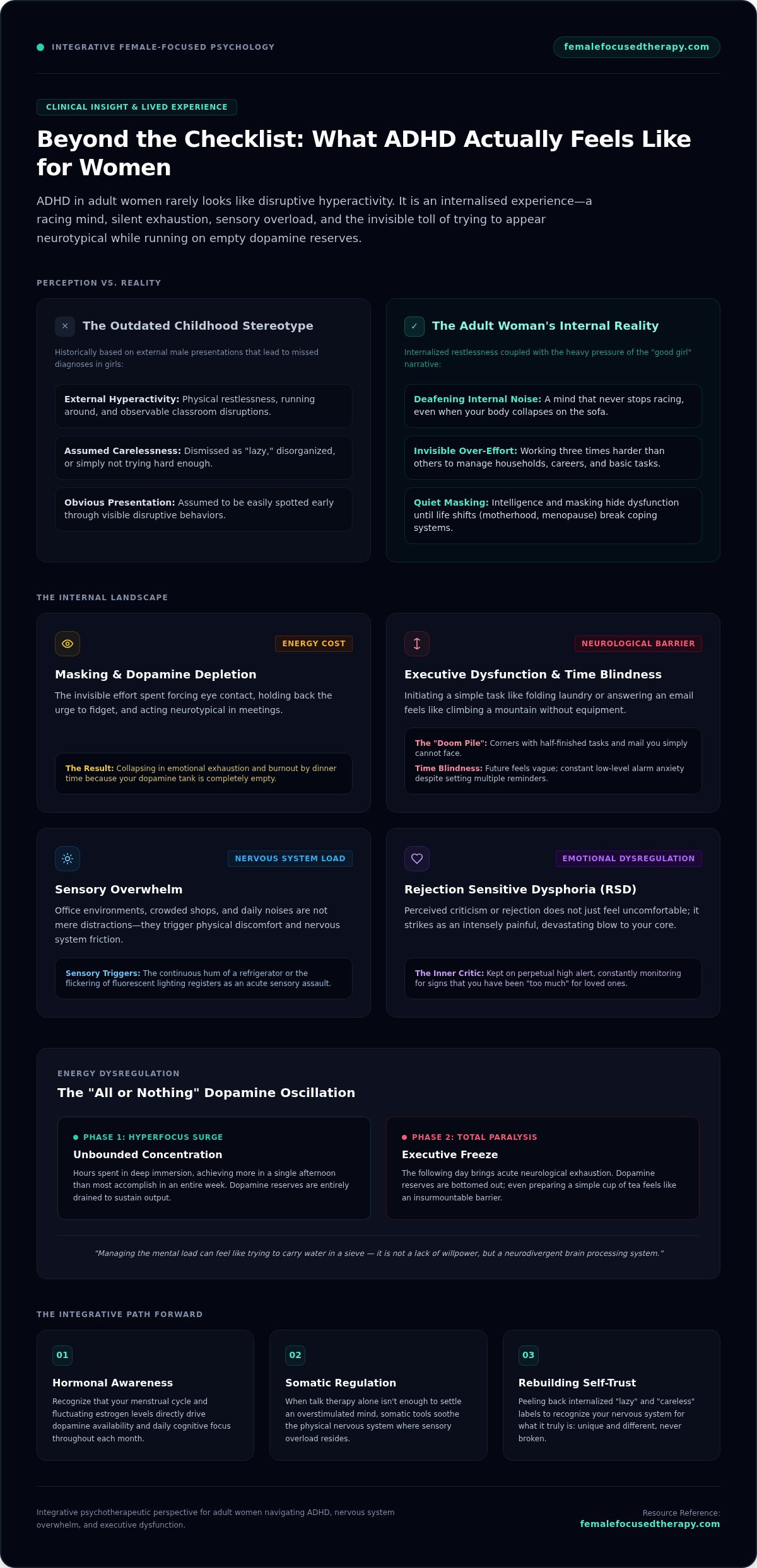
Beyond the Checklist: What ADHD Actually Feels Like for Us
Most clinical lists focus on external behaviours like fidgeting or losing your keys. While those are real, they don’t capture the internal exhaustion of “masking.” Masking is the immense, invisible energy you spend every day trying to appear neurotypical. It’s the effort of holding eye contact when you’re distracted, or suppressing the urge to move so you don’t seem “unprofessional.” By the time you get home to your family in Singapore, you’re often left with nothing but burnout because your dopamine reserves are completely spent.
This internal experience often includes sensory overwhelm that can feel like physical pain. In a busy office or a crowded mall, the hum of a refrigerator or the flickering of a fluorescent light isn’t just a distraction. It’s an assault on your nervous system. Many women with adhd also live in an “all or nothing” energy cycle. You might spend hours in a state of hyperfocus, achieving more in an afternoon than most do in a week, only to fall into a state of total paralysis the next day where even making a cup of tea feels impossible.
The invisible struggle of executive dysfunction
For us, executive dysfunction isn’t about being “lazy.” It’s a neurological barrier. “Just getting started” on a simple task, like answering an email or folding laundry, can feel like trying to climb a mountain without equipment. This often leads to the “doom pile,” those corners of our homes filled with half-finished projects or unsorted mail that we simply cannot face. We also deal with time blindness, where the future feels like a vague concept. This creates a constant, low-level anxiety about being late or forgetting an important appointment, even when we’ve set five different alarms.
Rejection Sensitivity and the ADHD heart
One of the most painful parts of this journey is Rejection Sensitive Dysphoria (RSD). This is an intense emotional response to perceived criticism or rejection. While most people find criticism uncomfortable, for a woman with adhd, it can feel like a devastating blow to her very core. This emotional intensity often keeps your inner critic on high alert, constantly scanning for signs that you’ve been “too much” for the people you love. You can find more information on clinical symptoms and treatments for ADHD to understand how these brain-based differences impact your daily life.
This intensity doesn’t stay at work. It follows us home, impacting our partnerships and intimacy. When you feel like you’re constantly failing at the “small things,” it’s easy to withdraw from your partner to protect yourself from further perceived disappointment. If you’re tired of feeling like you’re constantly misunderstood, you might find that exploring these patterns in therapy can help you rebuild that lost self-trust.
The Hormonal Connection: Why Your ADHD Changes with Your Cycle
Estrogen and dopamine work side-by-side in your brain. Estrogen enhances dopamine receptor availability, so when your estrogen levels dip, particularly in the week before your period, your focus, mood, and calm can feel like they vanish with it. This is the physical reality of a neurodivergent brain in a female body. It explains why your adhd management tools might work perfectly for two weeks of the month, then fail you completely during your luteal phase. It’s a biological shift, not a personal failure, and acknowledging this connection is the first step toward self-compassion.
Hormonal shifts across the lifespan
We often see significant spikes in symptoms during major life transitions like puberty, pregnancy, and midlife. For many women I work with in Singapore, a late diagnosis often happens when estrogen begins to fluctuate unpredictably in their 40s. This shift into perimenopause and menopause often acts as the final straw for high-effort masking. Research into the ADHD presentation in women and girls shows that our symptoms are deeply tied to our endocrine system. Instead of fighting against these changes, we can learn to work with your body’s natural rhythm. This means adjusting your expectations and your self-care during lower-estrogen windows, allowing for more rest when your brain has less chemical support.
Why the body holds what the mind can’t say
Because we spend so much energy trying to keep up, our bodies often pay the price. The stress of neurodivergence isn’t just a mental state; it manifests physically as chronic tension in the jaw, shoulders, and gut. When the mental load becomes overwhelming, your nervous system may drop into “functional freeze.” This is a state where you might look like you’re just sitting on the sofa, but your internal system is actually in high-alert survival mode, unable to move or choose a task. Somatic healing involves noticing these physical cues before they become a total shutdown. By integrating the body into your recovery, you can use tools like breath and sensory grounding to gently lead your nervous system back to a state of safety and clarity.
Restoring the Balance: Somatic Tools for ADHD Overwhelm
Talk therapy is vital, but when your mind is spinning at a hundred miles an hour, “thinking” your way out of it often feels impossible. This is because your nervous system is stuck in a state of high arousal. To truly settle an adhd mind, we have to involve the body. It’s about moving from a “top-down” approach to a “bottom-up” one, where we use physical cues to signal safety to the brain. When we engage the body, we aren’t just managing symptoms; we’re changing the physiological state that creates the overwhelm.
One of the most powerful tools I use is the simple act of “noticing.” This isn’t about fixing anything or judging yourself for being stressed. It’s about becoming a gentle observer of your internal state. Are your shoulders up at your ears? Is your breath shallow and tight in your chest? By noticing these sensations without judgment, you create a tiny bit of space between yourself and the noise. That space is where your power to regulate begins.
Your breath is a direct dial to your nervous system. When you’re overstimulated, your heart rate increases and your body prepares for a threat. By consciously making your exhale longer than your inhale, you physically signal your system to slow down. It’s also important to reframe what rest looks like. For an adhd brain, sitting in a dark room doing nothing can actually be stressful because the internal noise gets louder. Real rest often looks like “low-demand” activities: knitting, a familiar walk, or listening to a podcast you’ve heard before.
Practical tools for the overstimulated moment
When you feel that familiar wave of sensory overload hitting you in a busy Singapore shopping centre or during a high-pressure meeting, try these three steps to ground yourself:
- Step 1: Sense. Ground yourself by identifying three things you can physically feel right now. The weight of your feet on the floor, the texture of your phone in your hand, or the cool air from the aircon.
- Step 2: Breathe. Inhale for a count of four, then exhale slowly for a count of six or eight. Focus entirely on that long, steady release. The exhale is always the key to calming the heart.
- Step 3: Move. Release that pent-up “fidget” energy safely. Shake your hands, roll your ankles, or take a quick, brisk walk. Give that nervous energy somewhere to go so it doesn’t stay trapped in your body.
Creating a life that fits your brain
Prevention is just as important as regulation. This means setting firm boundaries around your time and energy to prevent the burnout that follows hyperfocus. It’s okay to say no to social events that you know will leave you depleted. The journey of “unmasking” is also essential. You need safe spaces where you don’t have to perform or hide your neurodivergent traits. I’ve found that women often heal best when they feel connected and understood by others who truly get the experience of living with this brain type. If you’re ready to stop fighting your nature and start building a life that actually works for you, I invite you to book a session with me so we can begin that work together.
Finding Your Way Forward Through ADHD-Focused Therapy
Therapy often gets framed as a way to fix something that is broken. When we work together, I want you to know that I don’t see your brain as something that needs repairing. Instead, we focus on building a life that actually honours how you function. My approach is deeply integrative. We don’t just talk about your schedule; we look at the trauma you might be carrying, your relationships, and how your nervous system reacts to the world. It’s about moving from a place of constant friction to one of internal flow.
Years of living with undiagnosed adhd can leave you with a deep-seated sense of self-doubt. You might have spent decades wondering why you couldn’t just “be like everyone else.” Rebuilding that lost self-trust is a core part of our work. It involves peeling back the layers of masking we discussed earlier and learning to listen to your own intuition again. You don’t have to navigate this heavy sense of overwhelm alone. I’m here to walk alongside you as someone who truly understands the internal noise and the exhaustion that comes with it.
The collaborative journey of ADHD therapy
Our time together is a partnership. We work to identify your unique ADHD superpowers, such as your creativity, your ability to hyperfocus, or your deep empathy, while creating practical strategies to manage the very real challenges of executive dysfunction. I use ADHD-focused therapy to specifically target the unique shame that women carry in our society. In our sessions, you can expect a space that values both your mind and your body. We might talk through a difficult week, but we’ll also check in with your breath and notice where you’re holding tension.
One small step toward clarity
A common hurdle for many women in Singapore is the feeling that they need a formal clinical diagnosis before they can seek help. I want to reassure you that you don’t need a piece of paper to start supporting how you feel. If you’re struggling, that’s enough of a reason to reach out. Remember, the exhale is always longer. Take a moment right now to simply breathe and acknowledge that help is available when you’re ready. I invite you to explore this safe space for healing where your experience is validated and your voice is heard. You’ve spent long enough trying to do this on your own; let’s find your way forward together.
Reclaiming Your Clarity and Self-Trust
You’ve spent long enough feeling like you’re running a race you can’t win. Understanding that your adhd is a unique nervous system response, rather than a personal failure, is the first step toward internal restoration. We’ve explored how your hormonal cycle impacts your focus and how somatic tools can help settle the noise when your mind feels like it’s spinning. Healing isn’t about fixing your brain; it’s about learning to work with its natural rhythm.
I’m Cheryl Kennedy MacDonald, and as a registered psychotherapist with over 20 years of experience, I’ve supported countless women through these exact challenges. I live this reality too, and I know that true stability comes when we involve both the mind and the body. You don’t have to carry the weight of chronic exhaustion or self-doubt alone anymore.
If you’d like to find out more about working with me through my integrative, trauma-informed approach at Female Focused Therapy in Singapore, you can email me at cheryl@femalefocusedtherapy.com or go ahead and book an appointment here. You deserve a life that honours exactly who you are.
Frequently Asked Questions
What is the difference between ADD and ADHD in women?
ADD is an older clinical term that is no longer used for formal diagnoses. Today, we use the term ADHD, predominantly inattentive presentation, to describe the experience of many women. Instead of physical hyperactivity, you might experience internalised fogginess, a wandering mind, or a feeling of being constantly distracted. It is less about running around and more about a mind that feels like it is racing in multiple directions at once.
Can you develop ADHD as an adult woman or was it always there?
This is a neurodevelopmental condition, meaning it was always there, even if you were not diagnosed until adulthood. Many women are missed as girls because they were high-achievers who used anxiety to fuel their productivity. You likely developed intense coping mechanisms that worked for years. However, major life transitions, such as starting a career or motherhood, can make these high-effort strategies impossible to sustain any longer.
How does ADHD in women affect relationships and marriage?
It often creates a dynamic where you feel “too much” and your partner feels overwhelmed by the chaos. You might struggle with the mental load of the household or feel deep shame when you forget important dates. This can lead to a cycle of criticism and withdrawal. Learning how your brain works allows you to communicate your needs clearly and rebuild the intimacy that chronic stress often erodes over time.
Is it possible to manage ADHD without medication through therapy?
It is entirely possible to manage your symptoms through targeted, integrative therapy. While I do not provide medication management, my approach focuses on building self-trust and nervous system regulation. We use cognitive strategies and somatic tools to help you navigate your day with more ease. The goal is to create a lifestyle that supports your unique brain type rather than trying to force yourself into a neurotypical mould that does not fit.
Why do my ADHD symptoms feel worse during my period or menopause?
This is due to the biological link between estrogen and dopamine. When your estrogen levels dip, such as in the week before your period or during perimenopause, your dopamine receptors become less effective. This makes your adhd symptoms feel significantly more intense. Understanding this hormonal connection allows you to adjust your expectations and practice more self-compassion during the times of the month when your brain has less chemical support available.
What is masking in ADHD and why is it so exhausting for women?
Masking is the immense effort of “performing” neurotypicality to fit into social or work environments. It is the silent work of suppressing your fidgets, forcing eye contact, or scripting conversations in your head so you do not seem “different.” For many women, this constant vigilance leads to deep emotional exhaustion. It is why you might be high-functioning at work but feel completely unable to function once you get home.
How can I tell if I have ADHD or just chronic anxiety and burnout?
The two are often deeply intertwined, as anxiety is frequently a response to the chaos that this neurodivergence creates. If you have felt “different” since childhood and find that your anxiety does not respond to traditional treatments, it may be because the root cause is a neurodivergent nervous system. We look at your history and your internal experience to help you distinguish between a temporary state of burnout and a lifelong trait.
What does somatic therapy have to do with managing ADHD?
Somatic therapy addresses the “bottom-up” regulation of your nervous system. Because this brain type involves a state of chronic autonomic hyperarousal, we use the body to signal safety to the brain. By noticing where you hold tension and using breath or movement to release it, you can move out of a “functional freeze.” This mind-body approach helps you manage the physical reality of overwhelm in a way that purely talking cannot.

Article by
Cheryl Kennedy MacDonald MA BA (Hons) Pg. Dip. SAC BACP
Cheryl Kennedy MacDonald is a psychotherapist specialising in women’s mental health, relationships, and life transitions. She works with women navigating trauma, relationship breakdown, identity shifts, and midlife change, helping them rebuild self-trust, emotional stability, and a clear sense of who they are and what they want.
With over 20 years’ experience working with women internationally, Cheryl is the founder of YogaBellies, a global women’s yoga school, and the creator of the Birth ROCKS method. Her work sits at the intersection of psychotherapy and embodiment, integrating evidence-based therapeutic approaches with somatic, body-based practices that support deep, lasting change.
Known for her grounded and direct approach, Cheryl moves beyond surface-level insight to address the patterns held in the body and nervous system. Her work supports women to regulate, reconnect, and respond to their lives from a place of clarity, strength, and self-respect.
She is a published author in academic journals and has written multiple books on women’s health, pregnancy, and midlife wellbeing, available on Amazon and leading book retailers worldwide.