
You’ve just finished a successful day at work, but a small, offhand comment from a colleague sends you into a tailspin of self-doubt. It feels like you’re an emotional wreck, even though everyone else sees a woman who has it all together. This experience of emotional dysregulation adhd women often navigate is one of the most exhausting parts of our lives, yet it’s the piece that’s most frequently misunderstood.
I understand that crushing weight of mental fatigue and the shame that comes from being told you’re “too sensitive” or “dramatic.” I’ve felt those internal racing thoughts myself. It’s important you know that these intense reactions aren’t a character flaw or a lack of willpower. They’re a biological part of how your neurodivergent brain and nervous system process the world around you.
I will help you understand why your emotions feel so big and how to find a sense of calm through a neuro-affirming, somatic approach. We’re going to explore how to move toward self-trust and internal restoration. I’ll share practical ways to regulate your nervous system without adding more “work” to your already overflowing plate.
Key Takeaways
- Discover why the “invisible storm” of emotions you experience is a biological part of your neurodivergence rather than a personal failing.
- Understand how societal expectations of being “stable” and “nurturing” add a layer of shame to the emotional dysregulation adhd women experience.
- Gain insights into Rejection Sensitive Dysphoria (RSD) and learn how to untangle your identity from your symptoms.
- Explore why your ADHD brain often needs to start with the body, using somatic tools to find a sense of calm and safety.
- Learn how integrative therapy supports you in thriving with the brain you have, rather than trying to “fix” who you are.
The Invisible Storm: What Emotional Dysregulation Really Feels Like
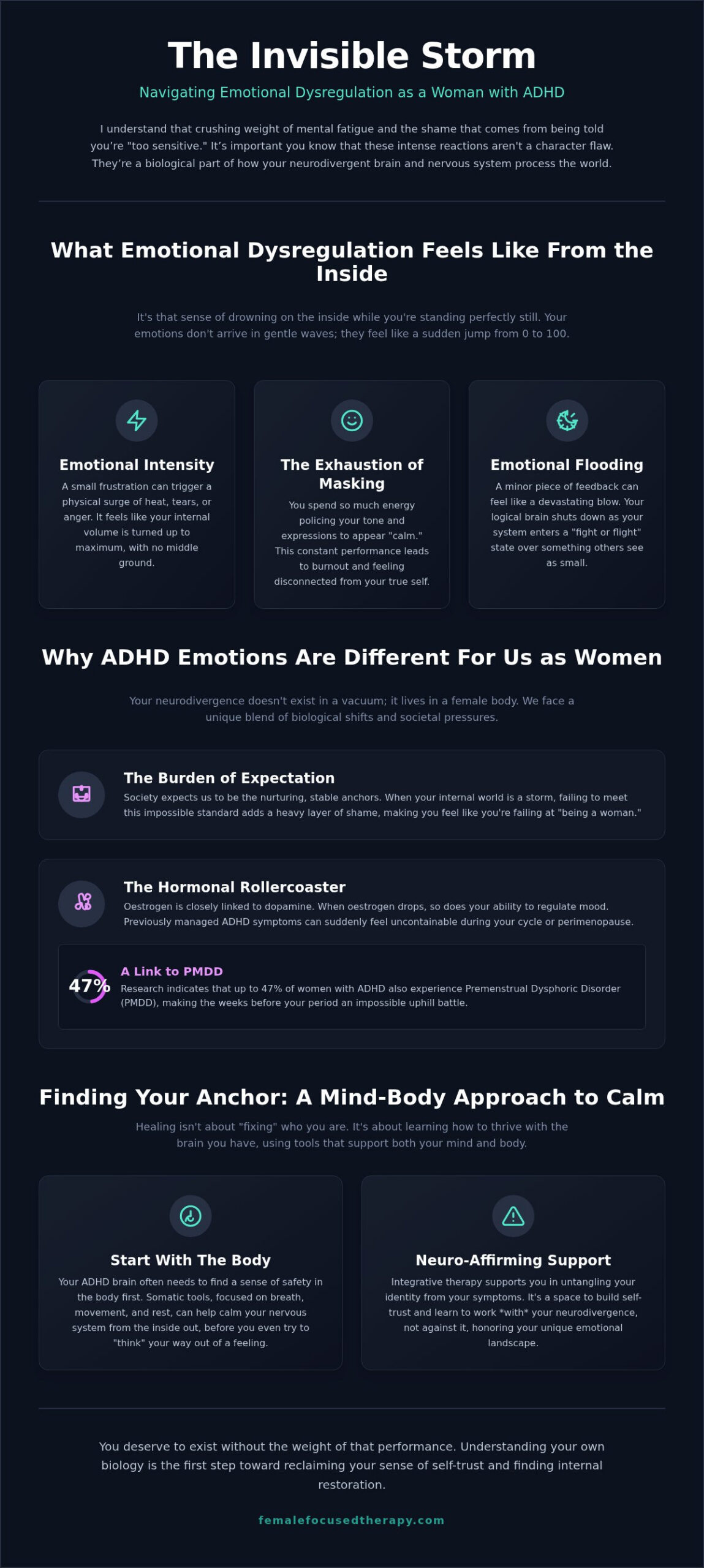
I want to start by acknowledging a feeling you might know intimately. It’s that sense of drowning on the inside while you’re standing perfectly still in a meeting or at the dinner table. When we talk about emotional dysregulation adhd women experience, we aren’t just talking about being “moody.” We’re talking about a biological difficulty in managing both the intensity and the duration of your feelings. It’s like having a high-performance engine but brakes that only work half the time.
For many of us, emotions don’t arrive in gentle waves. They feel like a sudden jump from 0 to 100 with no middle ground. One moment you’re fine, and the next, a small frustration has triggered a physical surge of heat, tears, or heart-pounding anger. This happens because the ADHD brain processes emotional stimuli differently than a neurotypical one. The part of your brain that feels deep emotion often reacts before the part that handles logic can even get started.
The Exhaustion of Masking Your Intensity
I see how hard you work to appear calm when your mind is racing at a thousand miles an hour. You spend so much energy policing your tone of voice or your facial expressions so nobody thinks you’re “too much.” This constant self-monitoring is called masking, and it’s a major contributor to the emotional dysregulation adhd women face every day while navigating professional and personal lives.
The mental fatigue that comes from this doesn’t just make you tired; it leads to a profound sense of burnout. When you’re always performing a “stable” version of yourself, you eventually feel disconnected from who you actually are. You’re left feeling like an empty shell because all your resources went into hiding your intensity from the world. You deserve to exist without the weight of that performance.
When Small Moments Feel Like Big Crises
Have you ever had a minor piece of feedback feel like a devastating blow to your entire self-worth? That’s what we call emotional flooding. When your system is overwhelmed by a feeling, it effectively shuts down your executive function. You can’t think logically because your brain has entered a “fight or flight” state over something others might see as small.
I’ve experienced this myself many times. When my emotions are high, the whole world feels too loud and too bright. It’s as if my internal volume is turned up to the maximum, making it impossible to find an anchor. This isn’t a choice you’re making; it’s your nervous system trying to navigate a world that feels incredibly overwhelming. Understanding this is the first step toward reclaiming your sense of self-trust.
Why ADHD Emotions Are Different for Us as Women
Our neurodivergence doesn’t exist in a vacuum; it lives in a female body. We face a unique blend of biological shifts and societal pressures that men simply don’t experience. I believe that understanding these factors is the first step toward self-compassion. When we look at the emotional dysregulation adhd women often face, we have to look at the whole woman, not just a list of clinical symptoms.
Society expects us to be the “nurturing” and “stable” anchors for everyone around us. We’re taught from a young age to be the peacekeepers and the organisers. When your internal world feels like a storm, failing to meet that impossible standard adds a heavy layer of shame. You might feel like you’re failing at “being a woman” because you can’t just “calm down” or “let it go” as easily as others seem to.
The Hormonal Rollercoaster: From Puberty to Menopause
Your hormones play a starring role in how your brain functions every single day. Oestrogen is closely linked to dopamine production; when your oestrogen levels drop, so does your brain’s ability to focus and regulate mood. This is why your dysregulation might feel significantly worse during the second half of your cycle. Research indicates that up to 47% of women with ADHD also experience PMDD, which can make those weeks feel like an impossible uphill battle.
Many of my clients find that they hit a wall when navigating the “perfect storm” of perimenopause and ADHD. As hormones decline during this transition, previously managed symptoms can suddenly feel uncontainable. It’s not that you’re getting “worse” at managing your life; it’s that your biological foundation is shifting, and your ADHD brain is reacting to that change.
The Burden of the ‘High-Functioning’ Label
Being successful at work or in your community can actually make your struggle feel more lonely. Because you’re high-achieving, people often dismiss your internal emotional turmoil. They assume that if you were really struggling, you wouldn’t be hitting your targets or caring for your family so well. I see the invisible cost of this over-compensation. You might use perfectionism as a shield to hide your ADHD symptoms, but that shield is incredibly heavy to carry every day.
This is exactly who I work with: intelligent, capable women who seem to have it all together on the outside but feel like they’re crumbling on the inside. You don’t have to keep pretending that the weight isn’t there or that you aren’t exhausted. If you feel ready to move toward a life that feels more balanced and grounded, we can start that conversation together in a space where you are truly seen.
Moving Beyond the Shame of ‘Being Too Much’
For most of my life, I felt like I was simply “too much” for the people around me. Too loud, too sensitive, too intense. If you’ve spent years hearing these labels, it’s only natural that you’ve started to believe them. I want to help you untangle your true identity from these symptoms. Understanding the nuances of emotional dysregulation adhd women experience is the first step in realising that your intensity isn’t a flaw; it’s a part of your wiring.
Those childhood messages about being “dramatic” don’t just disappear. They live in your body, often manifesting as a deep sense of shame that follows you into adulthood. This shame makes it incredibly difficult to trust your own instincts. Part of our work together is rebuilding self-trust after a lifetime of feeling like you’re fundamentally “wrong” for having big feelings.
Rejection Sensitivity and the Fear of Disappointing Others
Many of us live with Rejection Sensitive Dysphoria (RSD), an extreme emotional pain triggered by the perception of being rejected or criticised. It isn’t just a fleeting feeling in your head; it’s a physical sensation. I’ve felt it as a crushing weight in my chest or a sickening knot in my stomach. When your brain processes social feedback this way, every minor interaction can feel like a high-stakes survival situation.
To cope with this pain, we often become chronic people-pleasers. We work twice as hard to be perfect, hoping that if we never disappoint anyone, we’ll never have to feel that devastating sting of rejection again. I’ve learned that acknowledging this physical pain is the only way to move through it. You can’t think your way out of a nervous system response, but you can learn to meet it with kindness.
The Link Between ADHD and Relationship Trauma
When you struggle to regulate your emotions, you can become uniquely vulnerable in toxic relationships. If you’ve been told your whole life that your reactions are “crazy” or “over the top,” you might stop questioning when someone treats you poorly. You might assume the conflict is always your fault because you’re the one with the “emotional problem.”
This often leads to a cycle of over-explaining and over-apologising for your basic needs. You might find yourself trying to justify your feelings to someone who isn’t interested in understanding them. Healing involves breaking this cycle and recognising that you deserve to be seen and heard. It’s about moving away from the trauma of being misunderstood and toward a life where your sensitivity is seen as the gift it truly is.
Somatic Tools: Calming Your Nervous System from the Inside Out
While traditional talk therapy is wonderful for understanding our patterns, the ADHD brain often needs to start with the body. When we experience the emotional dysregulation adhd women know so well, our nervous system has already hijacked our logic. I’ve found that trying to “think” your way out of a panic or a rage is like trying to reason with a thunderstorm.
I integrate somatic movement and yoga into my practice because your body needs to feel safe before your mind can find peace. Using your breath is the fastest way to signal safety to your “fight or flight” response. A simple, elongated exhale tells your brain that the immediate “threat” has passed, even if the emotional weather is still heavy.
It’s also helpful to create a “sensory toolkit” for those moments when you feel a storm brewing. This might include a heavy blanket, a specific scent, or even a particular texture to touch. These aren’t just distractions; they’re physical anchors that help pull you back from the edge of emotional flooding.
The Power of Rest and Mindful Movement
I know that “rest” is often the hardest thing for an ADHD mind to do. We feel like we should always be moving, fixing, or doing. But for us, rest is a radical act of regulation. I encourage you to see movement as a way to release stored emotional tension rather than another chore to check off your list.
Gentle, mindful movement allows you to process emotions that have become “stuck” in your physical form. Whether it’s a slow stretch or a rhythmic walk, these actions help your nervous system return to a baseline of calm. It’s about moving with your body, not against it. For those looking for further professional guidance on managing these emotional states, you can check out Think Well Therapy to learn more about their online psychological strategies.
When you feel overwhelmed, a simple five-minute grounding practice can bring you back to the present. You might try the “glimmers” approach, which involves looking for tiny, small moments of joy or beauty in your immediate surroundings. A glimmer could be the way light hits a glass or the soft sound of a bird outside.
Somatic grounding acts as a gentle bridge between the brain’s internal chaos and the body’s physical presence, offering a path through the emotional dysregulation adhd women often face. It reminds your system that you are here, you are safe, and the intensity of this moment will eventually pass.
If you’re tired of feeling like your emotions are in the driver’s seat, I’m here to help you find your way back to yourself. You can book a session with me to start exploring these somatic tools in a safe, supportive space.
How Integrative Therapy Can Support Your ADHD Journey
I don’t believe in “fixing” you. You aren’t a broken machine that needs a mechanic; you’re a person with a beautifully complex brain that simply requires a different set of instructions. In my practice, ADHD-focused therapy is a collaborative journey of self-discovery. We work together to understand the unique ways emotional dysregulation adhd women experience impacts your daily life, from your closest relationships to your professional world.
My approach is deeply trauma-informed. I recognise that years of being misunderstood or told you’re “too much” can leave lasting emotional scars. We don’t just look at symptoms; we respect your history and the ways you’ve learned to cope. By combining evidence-based psychological tools with somatic practices, we create a path toward internal restoration that feels sustainable and safe.
Creating a Life That Fits Your Brain
The goal of our work isn’t to make you neurotypical. It’s to help you build a life that actually accommodates your neurodivergence rather than fighting it every day. This often starts with setting boundaries that protect your energy and emotional well-being. We identify the triggers that lead to “survival mode” and develop strategies to move you back into a place of sustainable, calm insight.
I am here to hold space for you while you rediscover your own strength. We look at how to structure your environment and your schedule to support your brain’s natural rhythms. When you stop trying to force yourself into a mould that wasn’t made for you, you’ll find that your intensity can become a source of creativity and connection rather than just a source of shame. It’s about finding a rhythm that allows you to breathe again.
Your Next Step Toward Emotional Stability
You don’t have to navigate this “invisible storm” alone. Whether you’re dealing with the crushing weight of mental fatigue or the sting of rejection sensitivity, there is a way forward. I invite you to explore my free therapy resources as a starting point. These tools are designed to offer immediate, gentle support for your nervous system as you begin to untangle your experiences.
When you feel ready for deeper work, I am here to support you. We can explore a focused intensive session to tackle specific challenges or establish ongoing support. Whatever path you choose, know that your feelings are a biological part of your ADHD; finding a sense of calm and self-trust is entirely possible when you have the right support by your side.
Finding Your Way Back to a Grounded Self
I’ve walked this path myself, and I know that the journey from feeling like an “emotional wreck” to finding internal restoration is entirely possible. We’ve explored how the emotional dysregulation adhd women navigate is deeply tied to our biology, our hormones, and a lifetime of societal pressure. It isn’t a character flaw, and you’ve never been “too much” for the right kind of support.
By integrating somatic tools and a trauma-informed perspective, you can learn to work with your brain rather than fighting against it. As a Registered Integrative Psychotherapist specialising in female neurodivergence and trauma, I offer global online therapy for women who are ready to move beyond the shame. You deserve a life where you feel safe in your own body and confident in your own intuition.
I invite you to book a consultation with me today to begin your journey toward emotional calm. You don’t have to carry the weight of the “invisible storm” alone anymore. Let’s work together to build a sense of calm that lasts, anchored in self-trust and kindness.
Frequently Asked Questions
What does emotional dysregulation feel like for women with ADHD?
It feels like an internal storm where emotions are disproportionately intense compared to the situation. You might experience a sudden surge of anger, sadness, or frustration that feels impossible to contain. I often describe it as having a volume knob that is permanently stuck on high. For many of us, it’s not just about the feeling itself, but the physical exhaustion that follows as our system tries to reset.
Is emotional dysregulation the same as Bipolar Disorder?
No, they are distinct, though they are often confused. In ADHD, emotional shifts are usually triggered by specific events and happen very quickly, often lasting only hours. Bipolar Disorder involves longer periods of mania or depression that typically aren’t tied to immediate external triggers. While the intensity might look similar from the outside, the biological mechanism and the duration of the emotional state are fundamentally different for those of us with ADHD.
How do hormones affect ADHD emotional symptoms in women?
Hormonal shifts significantly impact our ability to regulate. When oestrogen levels drop, such as during the luteal phase of your cycle or perimenopause, your brain’s dopamine production decreases. This often makes symptoms of emotional dysregulation adhd women experience feel much more volatile. I find that many women only start to notice their ADHD once they hit perimenopause, as the protective effects of oestrogen begin to fade and their coping mechanisms reach a breaking point.
Can you have ADHD without being externally hyperactive?
Yes, this is very common in women and is often referred to as the “Inattentive” presentation. Instead of running around, your hyperactivity is internal; it’s a mind that never stops racing and a constant stream of thoughts. You might appear calm and composed on the outside while feeling completely overwhelmed on the inside. This “internalised” hyperactivity is one of the reasons so many women are missed during childhood diagnostic processes.
How can therapy help with ADHD emotional overwhelm?
Therapy provides a safe space to untangle your identity from your symptoms. I focus on helping you understand the biological roots of your overwhelm so you can replace shame with self-compassion. We work on identifying early warning signs in your body and developing a toolkit of strategies that actually work for your neurodivergent brain. It’s about building a life that supports your needs rather than constantly trying to “mask” your true self.
What are some quick ways to calm down during an ADHD emotional flood?
When you’re in the middle of a flood, you need to engage your parasympathetic nervous system quickly. I recommend trying the “psychological sigh,” which involves two short inhales followed by one long, slow exhale. You can also try splashing cold water on your face or holding an ice cube. These physical sensations can act as a “circuit breaker” for your brain, helping to pull you out of the emotional spiral and back into the present.
Why is ADHD in women often misdiagnosed as anxiety or depression?
Women are socialised to “mask” their struggles, which often leads to internalised symptoms. When you’re constantly exhausted from trying to keep up with neurotypical expectations, it looks like clinical depression. When your mind is racing and you’re worried about forgetting tasks, it looks like generalised anxiety. Without a specialist understanding of emotional dysregulation adhd women often face, clinicians may only see the secondary emotional fallout rather than the underlying ADHD.
Can somatic movement really help with ADHD emotions?
Somatic movement is a powerful tool because it addresses the physical tension we hold in our bodies. Since ADHD emotions are felt so physically, talking isn’t always enough to release the “charge” of an experience. Gentle movement, breathwork, and body awareness help to discharge that pent-up energy and signal safety to your nervous system. I’ve seen how these practices allow women to move from a state of high alert to one of grounded stability.

Article by
Cheryl Kennedy MacDonald MA BA (Hons) Pg. Dip. SAC BACP
Cheryl Kennedy MacDonald is a psychotherapist specialising in women’s mental health, relationships, and life transitions. She works with women navigating trauma, relationship breakdown, identity shifts, and midlife change, helping them rebuild self-trust, emotional stability, and a clear sense of who they are and what they want.
With over 20 years’ experience working with women internationally, Cheryl is the founder of YogaBellies, a global women’s yoga school, and the creator of the Birth ROCKS method. Her work sits at the intersection of psychotherapy and embodiment, integrating evidence-based therapeutic approaches with somatic, body-based practices that support deep, lasting change.
Known for her grounded and direct approach, Cheryl moves beyond surface-level insight to address the patterns held in the body and nervous system. Her work supports women to regulate, reconnect, and respond to their lives from a place of clarity, strength, and self-respect.
She is a published author in academic journals and has written multiple books on women’s health, pregnancy, and midlife wellbeing, available on Amazon and leading book retailers worldwide.