
What if your constant need to make everyone else happy isn’t a personality flaw, but a brilliant survival strategy your younger self created to keep you safe? I’ve seen so many women struggle with the exhausting link between childhood trauma and people-pleasing, feeling as though they must monitor the mood of every person in the room just to feel okay.
I understand that sense of losing your own identity and the sharp spike of anxiety that hits when you even think about setting a boundary. It’s a heavy weight to carry, and it often leaves you feeling emotionally depleted and disconnected from your own desires and needs.
I will help you understand why your people-pleasing is actually a survival response called fawning, and how we can gently restore your self-trust. We’ll look at the roots of these behaviours and find a way for you to feel secure without constantly over-extending yourself for others.
In this article, I’ll guide you through the process of rebuilding your internal stability and finding a calm, steady path back to yourself. We will explore how to soothe your nervous system and reclaim the space you deserve in your own life.
Key Takeaways
- I will help you reframe your people-pleasing as a brilliant survival strategy your body once needed to keep you safe.
- We will explore the deep connection between Childhood Trauma and People-Pleasing and why you feel responsible for managing other people’s moods.
- I’ll explain why being high-functioning often masks a sense of internal exhaustion and a loss of your own identity.
- You will learn how a mind-body approach, including somatic movement, can help you feel safe enough to set gentle boundaries.
- I’ll share how integrative therapy focuses on restoring your natural self-trust rather than trying to “fix” who you are.
Understanding Why You Always Put Others First
I want to start by acknowledging that your kindness is a beautiful gift. It’s likely one of the things people love most about you. But I also know that for you, it often feels incredibly heavy. You’ve spent years managing the ’emotional weather’ of everyone around you, ensuring the skies stay clear so you can feel safe.
In my practice, I see this as a learned behaviour that once served a vital purpose. When we look at the link between Childhood Trauma and People-Pleasing, we see that your younger self was incredibly resourceful. You learned how to read a room before you even entered it, not because you were simply ‘nice’, but because you had to be.
I define this type of trauma-induced pleasing as a safety-seeking mechanism. It’s a way of navigating childhood trauma by becoming whatever the adults around you needed you to be. It wasn’t a choice; it was a necessity for your emotional or physical survival during your formative years.
The Difference Between Generosity and Pleasing
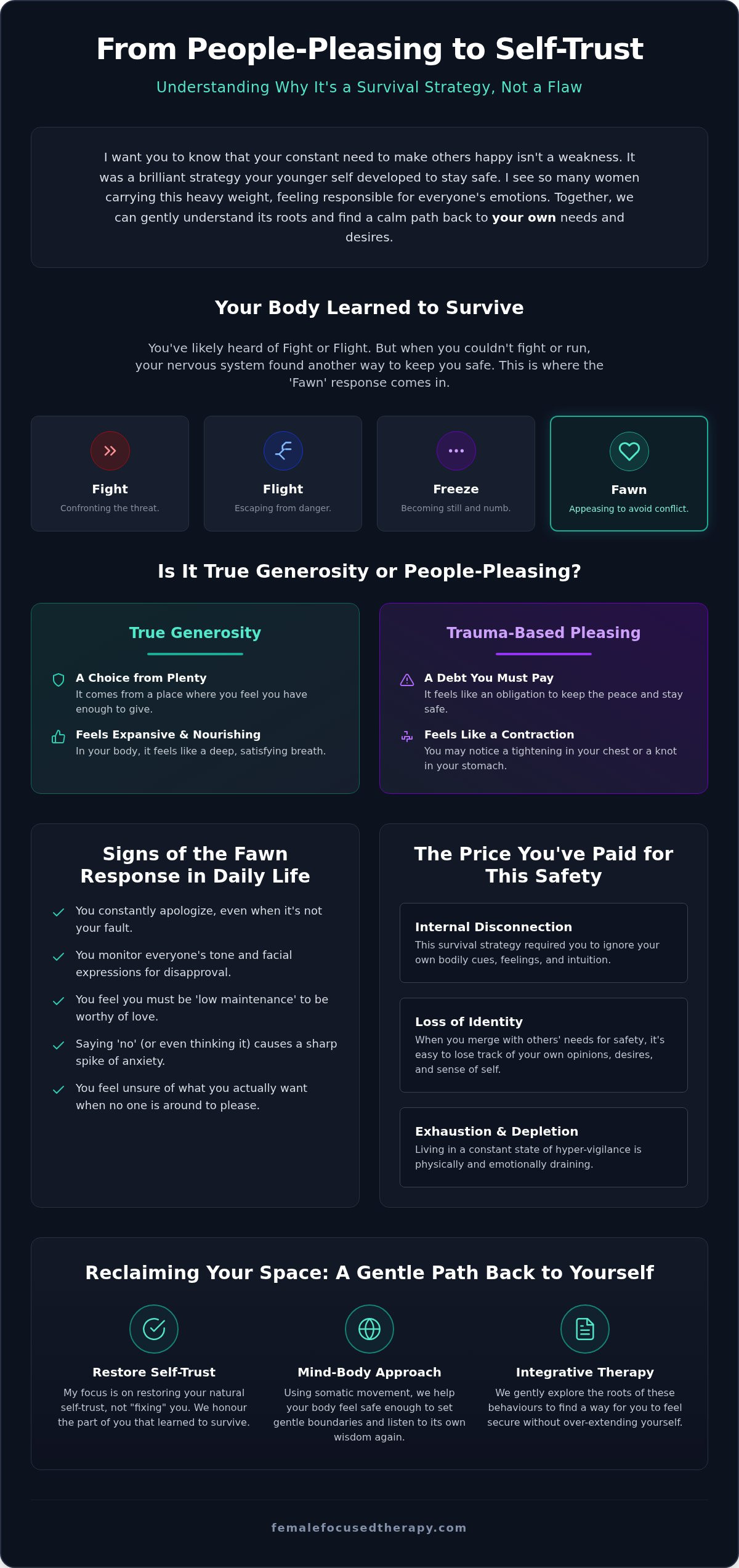
I often tell my clients that generosity feels expansive, like a deep, nourishing breath. Pleasing, however, feels like a physical contraction or a tightening of your spirit. Generosity is a choice you make from a place of plenty, whereas pleasing is a debt you feel you must pay to stay safe in a relationship.
I want you to notice how your body feels when you say ‘yes’ but actually mean ‘no’. Is there a tightening in your chest or a knot in your stomach? This is why I often integrate somatic movement and yoga into our work, as it helps you reconnect with these physical cues that your mind has learned to ignore.
Recognising the Signs in Your Daily Life
Do you find yourself constantly apologising for things that aren’t your fault? Maybe you say ‘sorry’ when someone bumps into you or when you ask a simple question. I notice many women monitor facial expressions and tone of voice with intense hyper-vigilance, looking for the slightest hint of disapproval from a partner or colleague.
I see this most often in intelligent, capable women who feel they must be ‘easy’ or ‘low maintenance’ to be worthy of love. You might feel that your value lies solely in how much you can do for others. It’s exhausting to live this way, but please know that this pattern of Childhood Trauma and People-Pleasing can be gently unlearned as we restore your self-trust.
The Fawn Response: How Your Body Learned to Survive
Most of us are familiar with the classic trauma responses of fight, flight, and freeze. But I want to introduce you to a term called ‘fawning’. This is the fourth trauma response, and it’s the one most closely tied to the cycle of Childhood Trauma and People-Pleasing.
When you were a child, you couldn’t fight back against a volatile adult, and you certainly couldn’t run away. Your body, in its infinite wisdom, learned to appease instead. The Fawn Response is essentially a way of ‘merging’ with a parent’s needs to avoid their anger or neglect.
I see this as a brilliant adaptation of your nervous system. It kept you safe when you were at your most vulnerable. It’s a success story of survival. Before we try to change anything, I want us to honour that child who was smart enough to figure out how to stay safe.
Growing Up with Unpredictable Parents
If you grew up walking on eggshells, you became a world-class expert at anticipating the needs of others. You could read a microscopic shift in a parent’s jaw or the tone of their voice from the next room. I often work with women who experienced narcissistic abuse early in life.
In those environments, your survival depended on being whatever they needed you to be. It required a constant, exhausting state of hyper-vigilance. I want you to realise that your ‘people-pleasing’ wasn’t a lack of character. It was your way of being a hero for yourself in an impossible situation.
The Price of Forfeiting Your Needs
However, this safety came at a high price. Fawning requires you to abandon your own opinions, desires, and even your sense of self to keep the peace. In my sessions, we explore how this leads to a deep sense of internal disconnection and identity loss.
You might feel like a hollow shell, unsure of what you actually like or want when no one else is around. I believe healing starts when we acknowledge the massive emotional price you’ve paid for this safety. It’s about moving from a state of survival into a state of authentic living.
If you feel ready to stop abandoning yourself and start the journey of restoration, you can book an online therapy session with me to begin this gentle work together.
When Being High-Functioning Masks Your Internal Exhaustion
I work with so many intelligent, ‘successful’ women who are secretly drowning in overwhelm. To the outside world, you look like you’re thriving and managing everything with ease. But I know the reality involves a constant, quiet panic about letting someone down or being found ‘wanting’.
Your ability to please others has likely made you an incredible employee or partner, but at what cost to your own soul? This high-functioning pleasing is often a carefully constructed mask for Rejection Sensitive Dysphoria, where the mere hint of disapproval feels like a physical blow to the chest.
This intersection of Childhood Trauma and People-Pleasing creates a cycle where you feel you must be perfect just to be safe. You aren’t just doing your job or being a good friend; you’re performing a role to prevent what feels like an impending emotional catastrophe.
The ADHD and People-Pleasing Connection
As a woman with ADHD myself, I know the intense pressure to over-compensate for feeling ‘too much’ or ‘not enough’. I find that many neurodivergent women use pleasing as a way to avoid the sharp pain of perceived failure or social rejection. It’s a way of masking our struggles to fit into a neurotypical world.
We often struggle with executive function or emotional regulation, and we try to ‘make up for it’ by being the person who never says no. I want to help you unpick where your ADHD in women ends and your trauma-response begins. Understanding this distinction is vital for your restoration.
The Burnout Nobody Sees
You might look like you have it all together, but I know the mental load you carry is absolutely crushing. I see this constant ‘performing’ as a form of chronic stress that eventually exhausts your nervous system. You’re living in a state of high alert, even when you’re supposedly resting.
Your body isn’t failing you; it’s communicating with you in the only way it knows how. I believe your burnout is a clear signal from your body that it’s time to stop performing for others and start listening to your own needs. Healing involves acknowledging this exhaustion and giving yourself permission to finally put the mask down.
Moving Beyond People-Pleasing Toward Internal Restoration
I don’t believe in ‘fixing’ you. You aren’t broken; you’ve just been in survival mode for a very long time. My goal is to help you with the restoration of the self you had to hide to stay safe during your early years.
Healing from the patterns of Childhood Trauma and People-Pleasing isn’t just about talking through your past. I integrate somatic movement and yoga into my work because your body holds the memory of that trauma. We need to help you feel safe in your skin again.
I want us to move from ‘fawning’ to ‘finding’. This means finding your authentic voice and your right to exist without apology. Before you can set a boundary with someone else, you have to learn how to listen to the signals your body is sending you.
Here are three gentle ways to check in with your body before you say yes to a request:
- Place a hand on your heart or belly. Physical touch can ground you in the present moment and help you feel your internal state.
- Take one slow, conscious breath. This creates a tiny ‘pause’ between the request and your response, giving your nervous system time to settle.
- Scan for tension. Ask yourself, “Does this request make my chest feel tight or my stomach knot up?” If it does, your body is likely saying ‘no’.
Listening to the Body’s ‘No’
I encourage you to notice the specific physical sensation of a ‘no’. For many women, it’s a tightness in the throat or a heavy weight in the chest. I use breathwork to help my clients expand that ‘pause’ so they don’t automatically jump into pleasing mode.
I believe that every time you honour your own needs, you are actively healing that inner child who wasn’t allowed to have any. I help women rebuild the ‘internal compass’ that was silenced years ago. We work together to turn up the volume on your own intuition.
In my practice, we celebrate the first time you say ‘no’ and still feel okay afterward. It’s a significant milestone on the path to restoration. If you’re ready to start rebuilding your self-trust in a safe space, you can book a session with me today.
Rebuilding Your Self-Trust Through Gentle Integrative Therapy
Whether you are looking for a therapist in Singapore or need the flexibility of online therapy from anywhere in the world, I am here to support you. We can work together in person at my practice or through secure digital sessions. My goal is to make professional support accessible, regardless of your geographical location. For those navigating substance use challenges as part of their healing, a private recovery coach NYC can provide specialized, one-on-one support that complements therapeutic work.
A Personal Approach to Your Healing
I bring my whole self to our sessions. This includes my clinical expertise as an integrative psychotherapist, my empathy, and my own lived experience as an adult woman with ADHD. I want you to feel seen and understood as a whole person. You aren’t just a set of symptoms to be ‘treated’ or a problem to be solved.
I believe that you already have the deep intuition you need to heal. My job is simply to help you clear away the layers of trauma responses so you can find that inner voice again. We’ll work at a pace that feels manageable for your nervous system, ensuring you always feel grounded and safe. This restoration of self-trust is the foundation of everything we do together.
Your Next Step Toward Restoration
I know how scary it can be to stop pleasing others. It can feel like you’re losing the very thing that has kept you safe for decades. But I promise you won’t be doing it alone. I’ll be there to hold the space when the guilt or anxiety feels loud, helping you navigate those first uncomfortable steps toward setting boundaries.
For those who feel ready to dive deeper into their recovery more quickly, I offer focused intensive therapy. This allows us to dedicate concentrated time to unravelling these patterns and rebuilding your internal stability. It’s a powerful way to accelerate your journey toward self-assurance and authentic living.
I invite you to take one small, realistic step toward your own restoration today. You don’t have to have all the answers yet. You can book a consultation with me to see how we can begin the journey of coming home to yourself. I am ready when you are.
Reclaiming Your Voice and Your Life
You have spent so much of your life looking outward, ensuring everyone else is comfortable while you quietly disappear. I want you to remember that your people-pleasing isn’t a flaw in your character. It’s a testament to your resilience and your body’s brilliant ability to keep you safe when you needed it most.
By understanding the link between Childhood Trauma and People-Pleasing, you can begin to shift from survival into authentic living. We can work together to restore your internal compass and help you feel safe in your own skin through integrative, trauma-informed care.
As a registered integrative psychotherapist, I offer specialised support for high-functioning women and neurodivergent minds. I respect your pace and your boundaries as we navigate this journey together. You don’t have to carry the weight of everyone else’s expectations anymore.
I invite you to book a consultation with me to start your journey of restoration. You deserve to feel steady, secure, and entirely yourself. Let’s begin this gentle work of coming home to who you truly are.
Frequently Asked Questions
Is people-pleasing always a sign of childhood trauma?
No, people-pleasing isn’t always a sign of trauma, but when it feels like an urgent survival instinct, there is usually a deeper root. Some people are naturally agreeable or raised in cultures that value self-sacrifice. However, if you feel a spike of panic when you can’t appease someone, it often points back to the link between childhood trauma and people-pleasing. I look for that feeling of an internal “must” versus a genuine “want”.
How do I know if I am fawning or just being kind?
The difference lies in how your body feels during the interaction. Kindness is a choice made from a place of abundance and warmth; it feels expansive. Fawning is a reaction driven by fear or a need to avoid conflict; it feels like a physical contraction. If you’re being kind, you feel fine saying no. If you’re fawning, saying no feels like a threat to your safety or belonging in that relationship.
What kind of childhood trauma causes people-pleasing?
People-pleasing is most often rooted in prolonged, repeated experiences rather than a single event. This includes growing up with unpredictable parents, narcissistic abuse, or environments where your needs were ignored unless you were perfect. In these settings, you learned that being easy was the only way to get love or avoid anger. This is why the connection between childhood trauma and people-pleasing is so common in women who felt responsible for adult emotions.
Can people-pleasing be a symptom of ADHD in women?
Yes, it absolutely can be. Many women with ADHD struggle with Rejection Sensitive Dysphoria, where the threat of disapproval feels physically painful. To avoid this pain, you might over-compensate by becoming a chronic people-pleaser. You try to be perfect or helpful to mask the internal chaos you feel from your ADHD. It’s a way of ensuring you aren’t rejected for being too much or making mistakes that others might notice.
How can I stop people-pleasing without feeling guilty?
I often tell my clients that guilt is simply a sign that you are breaking an old, familiar pattern. It doesn’t mean you’re doing something wrong. You can start by practising a pause before responding to requests. Use a simple phrase like, “Let me check my calendar and get back to you.” This creates space for you to check in with your body and decide if you actually have the capacity to say yes.
What does the fawn response look like in adult relationships?
In adult relationships, fawning often shows up as hyper-vigilance toward your partner’s mood. You might find yourself apologising for things you didn’t do or constantly changing your opinions to match theirs. It feels like you are merging with them to keep the peace. You might also struggle to identify your own needs or feel a deep sense of resentment because you never feel truly seen or heard for who you actually are.
Is it possible to heal from people-pleasing through therapy?
It is absolutely possible to heal. Through integrative therapy, I work on both the mind and the body to restore your self-trust. We use CBT to challenge old beliefs and somatic practices to help your nervous system feel safe without the need to please. Healing isn’t about fixing you; it’s about restoring your ability to listen to your own intuition and set boundaries that protect your energy and your long-term well-being.
What is the first step to setting boundaries with my parents?
The first step is actually an internal one. I want you to start by noticing the physical sensations that arise when you interact with them. Before you try to change their behaviour, acknowledge your right to have a different opinion or a separate life. A small first step might be deciding not to answer a non-urgent text immediately. This allows you to practise holding your own space without the immediate pressure of their reaction.

Article by
Cheryl Kennedy MacDonald MA BA (Hons) Pg. Dip. SAC BACP
Cheryl Kennedy MacDonald is a psychotherapist specialising in women’s mental health, relationships, and life transitions. She works with women navigating trauma, relationship breakdown, identity shifts, and midlife change, helping them rebuild self-trust, emotional stability, and a clear sense of who they are and what they want.
With over 20 years’ experience working with women internationally, Cheryl is the founder of YogaBellies, a global women’s yoga school, and the creator of the Birth ROCKS method. Her work sits at the intersection of psychotherapy and embodiment, integrating evidence-based therapeutic approaches with somatic, body-based practices that support deep, lasting change.
Known for her grounded and direct approach, Cheryl moves beyond surface-level insight to address the patterns held in the body and nervous system. Her work supports women to regulate, reconnect, and respond to their lives from a place of clarity, strength, and self-respect.
She is a published author in academic journals and has written multiple books on women’s health, pregnancy, and midlife wellbeing, available on Amazon and leading book retailers worldwide.