
If you are navigating the disorienting aftermath of a toxic relationship, you may feel lost, exhausted, and full of a profound self-doubt that makes you question your own memories. The emotional whirlwind of shame, confusion, and even a lingering attachment to the person who hurt you is a heavy burden to carry. Please know, your feelings are valid. What you are experiencing is a recognised and deeply human response to manipulation and emotional harm. Understanding the stages of narcissistic abuse recovery is often the first, vital step towards finding solid ground again.
This compassionate guide is here to offer you a gentle roadmap for that journey. We will explore the non-linear path of healing, helping you find validation for your experiences and make sense of the complex emotions you’re facing. Our goal is to help you move forward with a renewed sense of clarity, begin to rebuild trust in your own judgment, and find hope in the knowledge that you can, and will, reconnect with your authentic self and find lasting peace.
Understanding the Aftermath: What You’re Healing From
If you are reading this, you may be feeling exhausted, confused, and deeply hurt. It’s important to first acknowledge that what you are experiencing is not a normal breakup. Healing from a relationship with a narcissist is a journey of recovering from profound psychological trauma. The pain and disorientation you feel are valid, normal responses to an incredibly difficult and abnormal situation. Understanding what you are healing from is the crucial first step in navigating the stages of narcissistic abuse recovery.
The impact of this type of abuse is far-reaching. It is designed to systematically dismantle your sense of self, leaving you with shattered self-worth and a fragile grip on your own reality. Over time, this constant emotional and mental strain can lead to severe anxiety, depression, and symptoms that align with Complex Post-Traumatic Stress Disorder (C-PTSD). Rebuilding your life begins with gently understanding the invisible wounds you carry.
Cognitive Dissonance: The War in Your Mind
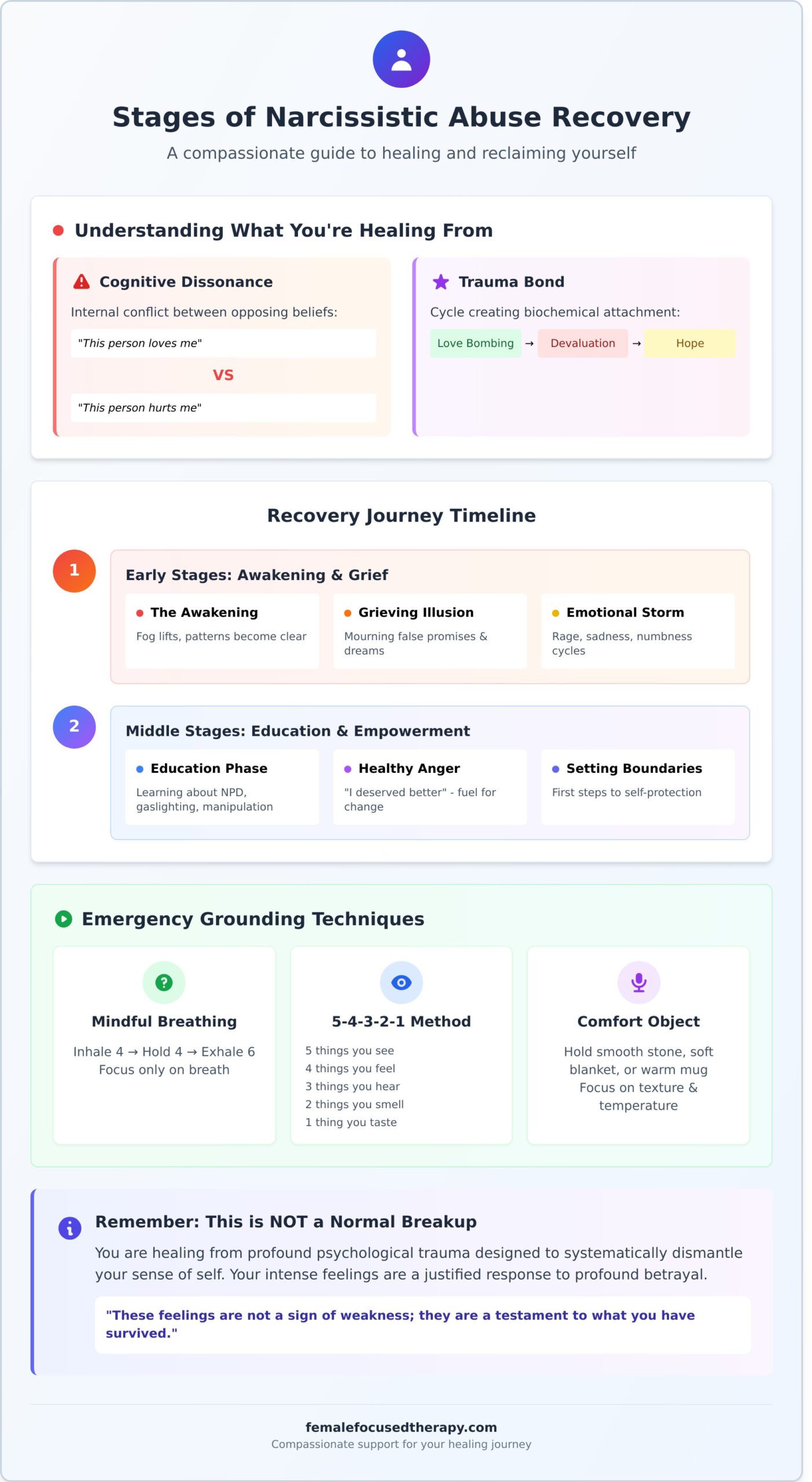
One of the most disorienting effects of narcissistic abuse is cognitive dissonance. This is the intense mental conflict that occurs when you hold two opposing beliefs simultaneously: ‘This person loves me and is my everything’ and ‘This person hurts me and makes me feel worthless.’ This internal war creates a fog of confusion, causing you to doubt your perceptions, your memories, and ultimately, yourself.
The Trauma Bond: Why Leaving Feels Impossible
Many women wonder why they stayed so long or why the urge to return is so powerful. The answer often lies in a trauma bond-a powerful biochemical attachment created by intermittent reinforcement. The cycle of intense affection (love bombing) followed by devaluation and cruelty creates an addictive dynamic, similar to a gambling addiction. You become conditioned to endure the pain in hopes of experiencing the ‘good times’ again. Please know this bond is a survival mechanism, not a weakness.
Acknowledging these dynamics is a foundational part of moving through the stages of narcissistic abuse recovery with clarity and self-compassion. You are beginning the journey of reconnection with the most important person in your life: yourself.
The Early Stages: Awakening, Shock, and Grief
The first of the stages of narcissistic abuse recovery is often the most disorienting. It begins the moment the illusion shatters, plunging you into a chaotic mix of clarity and emotional turmoil. This is not a gentle transition but a sudden, jarring awakening to a reality you may have spent months or years denying. You may feel lost and overwhelmed, but please know this: this raw, painful beginning is the necessary first step toward reclaiming yourself.
The Awakening: Lifting the Fog
This awakening can be triggered by a single event-a final, brutal discard, a conversation with a trusted friend, or a breakthrough moment in therapy. Suddenly, the fog of confusion and cognitive dissonance lifts. You begin to connect the dots, and the once-isolated incidents of manipulation, gaslighting, and emotional cruelty form a clear, undeniable pattern. This newfound clarity is a double-edged sword, bringing with it both a profound sense of relief and a wave of terror as you confront the truth of your experience.
Grieving the Illusion
The grief that follows is complex and deeply layered. You are not just mourning the person you loved, but the person you thought they were. You are grieving the future you meticulously planned together, the promises that were never real, and the beautiful dream of the ‘idealisation’ phase. This is a period of profound loss where you may cycle through intense sadness, bargaining for what could have been, and a deep, simmering anger at the deception.
Navigating Emotional Turmoil
Your emotional landscape may feel like a storm of rage, anxiety, profound sadness, and even periods of complete numbness. Understanding the complex dynamics of this manipulation, as outlined by resources like The National Domestic Violence Hotline, can help you see that these intense feelings are a justified response to profound betrayal. During these overwhelming moments, simple grounding techniques can offer a lifeline:
- Mindful Breathing: Inhale slowly for four counts, hold for four, and exhale for six. Focus only on your breath.
- The 5-4-3-2-1 Method: Name 5 things you can see, 4 things you can feel, 3 things you can hear, 2 things you can smell, and 1 thing you can taste.
- Hold a Comforting Object: Focus on the texture and temperature of a smooth stone, a soft blanket, or a warm mug in your hands.
Remember, these feelings are not a sign of weakness; they are a testament to what you have survived. Radical self-compassion is your most essential tool as you navigate these early stages of narcissistic abuse recovery.
The Middle Stages: Education, Anger, and Boundaries
After the initial shock and devastation, you enter one of the most active and empowering phases in the stages of narcissistic abuse recovery. This is where you begin to move from a place of confusion to one of clarity and self-protection. It’s a time of deep learning, emotional awakening, and taking the first brave steps to reclaim your life.
The Power of Education
You may find yourself with an insatiable thirst for knowledge, spending hours learning everything you can about narcissistic personality disorder (NPD). Discovering terms like gaslighting, hoovering, and love bombing can feel like a profound revelation. These concepts provide a name for the confusing and painful experiences you endured, offering validation that what you went through was real and that you are not alone. This education helps you externalise the blame that was unfairly placed on you, allowing you to understand that the abuse was never your fault. This knowledge becomes your shield, helping you recognise and resist manipulation in the future.
Embracing Healthy Anger
Anger is often an uncomfortable emotion, but in this context, it is a powerful and healthy sign of healing. This isn’t about destructive rage; it’s a constructive, righteous anger that signals a shift in your perspective. It is the fuel that powers change. This anger is your spirit finally saying, “I deserved better than that.” It acknowledges the injustice you experienced and energises you to build the boundaries needed to protect your wellbeing moving forward.
Building Your First Boundaries
Boundaries are not walls to keep others out; they are clear lines that define what is acceptable for you. This is where the work of rebuilding self-trust truly begins. The most crucial first step is often implementing No Contact or, if that isn’t possible, a strict Low Contact plan.
- No Contact: This means cutting off all forms of communication with the narcissistic individual, including blocking them on your phone and social media.
- Internal Boundaries: You might decide to stop ruminating on past conversations or consciously refuse to engage in self-blame.
- External Boundaries: This includes unfollowing their friends on social media or declining invitations to events where you know they will be present.
Setting these boundaries will likely feel scary and uncomfortable at first, especially if you have a history of people-pleasing. But with each boundary you set and enforce, you send a powerful message to yourself: you are worthy of safety, respect, and peace.
Beyond personal boundaries, it’s also wise to consider legal and financial protections, especially if the relationship involved shared assets or inheritance concerns across different countries. For those navigating such complex international legal issues, you can visit Israel Cross Border Law Firm.
The Later Stages: Reclaiming Your Identity and Self-Trust
After the initial storm of leaving and establishing safety, you enter one of the most transformative stages of narcissistic abuse recovery. This is where the focus gently shifts from the abuser to you. It’s a quiet, internal process of rebuilding-a tender reconnection with the person you were before the relationship and the person you are becoming now.
The central task here is to turn inward with compassion and patience, healing the inner critic that so often echoes the abuser’s voice and replacing self-blame with profound self-compassion.
Rediscovering Who You Are
A relationship with a narcissist often requires you to shrink yourself-your hobbies, opinions, and even your personality-to make space for their ego. You may look in the mirror and no longer recognise the person looking back. Reclaiming your identity begins with gentle curiosity. Ask yourself:
- What did I love to do before this relationship?
- What music, books, or films brought me joy?
- What values did I hold that I may have compromised?
Allow yourself to experiment. Try a new art class, join a walking group in one of Singapore’s beautiful nature reserves, or simply spend an afternoon reading in a café. This isn’t about finding a “new you” overnight, but about collecting pieces of yourself and creating a life that feels authentic and full of your own choices.
Learning to Trust Yourself Again
Perhaps the most damaging legacy of narcissistic abuse is the erosion of self-trust. Gaslighting is a systematic dismantling of your perception of reality, leaving you second-guessing your every thought, feeling, and memory. Rebuilding this trust is a delicate and deliberate process.
Start small. Make a simple decision-what to have for dinner, which route to take home-and trust your choice without overthinking it. Practice mindfulness to tune into your body’s signals and reconnect with your intuition. Your inner wisdom never left; it was just silenced. Healing this deep wound is fundamental to moving forward with confidence and clarity. Rebuilding self-trust is a core part of our therapeutic work.
Thriving Beyond Recovery: Integration and Post-Traumatic Growth
The journey through healing doesn’t just return you to who you were before; it offers the potential to become someone stronger, wiser, and more aligned with your true self. This final phase in the stages of narcissistic abuse recovery is defined by post-traumatic growth. This is the profound process where you find new meaning and strength from adversity. It’s not about forgetting what happened, but about skillfully integrating the experience into your life story, allowing it to inform your wisdom without defining your future.
From Victim to Survivor to Thriver
This beautiful evolution represents a fundamental shift in how you see yourself and your place in the world. The powerless feeling of being a ‘victim’ transforms into the resilient identity of a ‘survivor,’ which then blossoms into the empowered, flourishing mindset of a ‘thriver.’ You begin to experience a deep sense of inner peace and emotional stability. While triggers may occasionally surface, you now possess a toolkit of coping strategies and a deep well of self-trust to navigate them with grace.
Building Healthy Future Relationships
Your past experiences have honed your intuition. With newfound clarity, you can now identify relationship red flags with a quiet confidence. The fear of intimacy is gently replaced by a desire for genuine connection, built on a non-negotiable foundation of mutual respect, empathy, and reciprocity. You learn that vulnerability is not a weakness to be exploited, but a gift to be shared within safe, supportive relationships. This capacity for healthy connection allows for a depth of authentic intimacy you may have never thought possible.
Ultimately, thriving is about living an authentic life, guided by your values and your rebuilt self-trust. The scars of the past become a testament to your incredible resilience, not a source of shame. You are no longer just surviving; you are actively creating a life filled with purpose, joy, and healthy connections. Navigating these final stages of narcissistic abuse recovery is a profound journey, and you don’t have to walk it alone. If you are ready to fully embrace this new chapter, we are here to support your growth.
Your Path Forward: Embracing Hope and Healing
Navigating the path out of narcissistic abuse is a profound journey of rediscovery. Remember that healing is not linear; it’s a process with unique phases. Acknowledging each step-from the initial shock and grief to the empowering work of setting boundaries and rediscovering your identity-is crucial. Understanding the stages of narcissistic abuse recovery illuminates your progress and validates your experience, reminding you that growth is happening even on the most difficult days.
You do not have to walk this path alone. At Female Focused Therapy, we provide specialized, trauma-informed support in a safe, supportive space designed for women. Our integrative approach is dedicated to helping you gently rebuild self-trust and find your way back to holistic wellbeing.
If you’re ready to begin your healing journey, book a confidential consultation today. A future filled with clarity, confidence, and a stronger sense of self is not only possible-it is your right.
Frequently Asked Questions About Narcissistic Abuse Recovery
How long does it take to recover from narcissistic abuse?
There is no set timeline for healing, as everyone’s journey is unique. The length of recovery can depend on factors like the duration of the abuse and the support you have. It’s a process of moving through the different stages of narcissistic abuse recovery at a pace that feels safe for you. Remember to be patient and compassionate with yourself. The focus is on steady progress and rebuilding your sense of self, not on meeting a deadline.
What is a trauma bond and how do I break it?
A trauma bond is a powerful emotional attachment to an abuser, created by an intense cycle of mistreatment followed by kindness. To begin breaking it, implementing strict no-contact is a crucial first step. This creates the space needed for clarity. Seeking support from a trauma-informed therapist can help you navigate the complex emotions and rebuild your self-trust. Journaling and mindfulness can also increase your awareness of the unhealthy patterns you’ve endured.
Is it normal to still miss my narcissistic ex?
Yes, it is completely normal and a very common part of the healing process. You are likely not missing the abuse, but rather the person you thought they were during the love-bombing phase or the positive moments that created the trauma bond. Acknowledging these feelings without judgment is an important step. It’s a sign of the deep connection you were led to believe you had, and these feelings will lessen as you continue to heal.
How do I deal with the guilt and shame from the relationship?
Guilt and shame are heavy burdens, often intentionally instilled by the abuser through manipulation tactics like gaslighting. The first step is to practice self-compassion and recognise that you are not to blame for someone else’s abusive behaviour. Working with a therapist provides a safe, confidential space to unpack these feelings. Together, we can reframe self-blame and help you reconnect with your inherent worth, separate from the experience of the relationship.
Will I ever be able to trust anyone again after this experience?
This is a deeply valid fear after your trust has been so profoundly broken. The path forward isn’t about trusting others blindly, but about first rebuilding trust in yourself. Healing involves learning to recognise red flags, honour your intuition, and set firm boundaries. As you strengthen your self-trust and learn what a healthy connection feels like, your ability to extend trust to safe, deserving people will naturally grow at a pace that feels right for you.
What’s the difference between a difficult relationship and narcissistic abuse?
While all relationships have challenges, a difficult one involves two people with mutual respect who are trying to work through conflict. Narcissistic abuse, however, is a consistent pattern of psychological control and manipulation designed to benefit the abuser. Key differences include a profound lack of empathy, intentional gaslighting to distort your reality, and a persistent power imbalance. It is not a conflict between equals; it is a system of oppression within the relationship.

Article by
Cheryl Kennedy MacDonald MA BA (Hons) Pg. Dip. SAC BACP
Cheryl Kennedy MacDonald is a psychotherapist specialising in women’s mental health, relationships, and life transitions. She works with women navigating trauma, relationship breakdown, identity shifts, and midlife change, helping them rebuild self-trust, emotional stability, and a clear sense of who they are and what they want.
With over 20 years’ experience working with women internationally, Cheryl is the founder of YogaBellies, a global women’s yoga school, and the creator of the Birth ROCKS method. Her work sits at the intersection of psychotherapy and embodiment, integrating evidence-based therapeutic approaches with somatic, body-based practices that support deep, lasting change.
Known for her grounded and direct approach, Cheryl moves beyond surface-level insight to address the patterns held in the body and nervous system. Her work supports women to regulate, reconnect, and respond to their lives from a place of clarity, strength, and self-respect.
She is a published author in academic journals and has written multiple books on women’s health, pregnancy, and midlife wellbeing, available on Amazon and leading book retailers worldwide.