
You may be here because you feel emotionally exhausted, caught in a painful cycle of confusion and hurt. Your partner’s lack of empathy or their sudden, intense reactions leave you feeling wounded, yet you’re immediately flooded with guilt. You ask yourself: Is this intentional cruelty, or a neurological misunderstanding I should be more patient with? This constant doubt is incredibly isolating, especially when trying to navigate the challenging landscape of autism vs narcissism in relationships. Your confusion, your hurt, and your search for answers are completely valid.
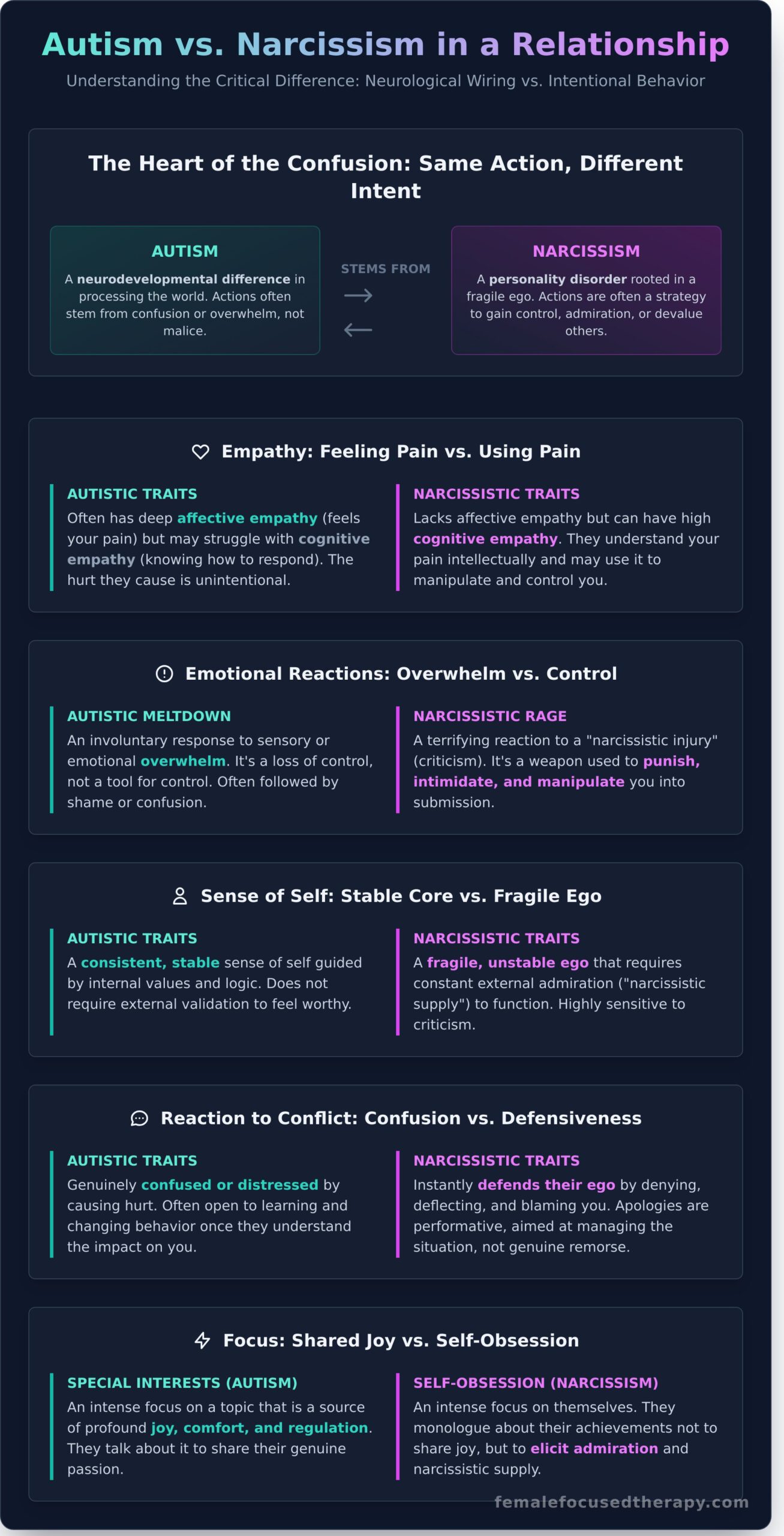
The crucial difference, however, rarely lies in the action itself, but in the underlying intent. Autism is a neurodevelopmental condition-a different way of processing the world-that impacts social communication, sensory processing, and interaction, often supported from a young age through interventions like ABA Therapy Sessions. In contrast, Narcissistic Personality Disorder (NPD) is a personality disorder rooted in a fragile sense of self, which manifests as a need for admiration, a lack of empathy, and a pattern of exploitation. For a deeper clinical context, Understanding Narcissistic Personality Disorder provides a foundational overview. Gaining clarity on these core differences is the first step toward rebuilding your sense of self-trust.
This compassionate guide was created to offer the clarity and validation you need. We will gently unpack the crucial distinctions between autistic traits and narcissistic behaviours, moving beyond surface-level actions to understand the core intent-or lack thereof-behind them. From differentiating a meltdown from narcissistic rage to understanding the nature of empathy in both contexts, our goal is to empower you. You will gain the insight needed to trust your feelings, protect your wellbeing, and find a clear path forward with confidence.
The Heart of the Confusion: Why Autistic and Narcissistic Traits Can Seem So Similar
If you are reading this, you may be feeling emotionally exhausted, confused, and deeply invalidated. You might be trying to make sense of a relationship that leaves you feeling unseen, unheard, or perpetually on edge. Please know that your confusion is understandable. On the surface, certain autistic and narcissistic behaviours can appear strikingly similar, making it incredibly difficult to navigate the dynamics of autism vs narcissism in relationships.
The crucial difference, however, rarely lies in the action itself, but in the underlying intent. Autism is a neurodevelopmental condition-a different way of processing the world-that impacts social communication, sensory processing, and interaction. In contrast, Narcissistic Personality Disorder (NPD) is a personality disorder rooted in a fragile sense of self, which manifests as a need for admiration, a lack of empathy, and a pattern of exploitation. For a deeper clinical context, Understanding Narcissistic Personality Disorder provides a foundational overview. Gaining clarity on these core differences is the first step toward rebuilding your sense of self-trust.
Social Awkwardness vs. Intentional Disregard
An autistic partner may genuinely miss social cues or non-verbal communication, which can be misinterpreted as disinterest or dismissiveness. This comes from a different neurological wiring. A narcissistic partner, however, often perceives the same cues but may intentionally ignore them to devalue you, assert dominance, or maintain control, making you feel insignificant.
Intense Focus: Special Interests vs. Self-Obsession
For an autistic individual, a special interest is a source of profound joy, comfort, and self-regulation. They may talk at length about it from a place of genuine passion. For a narcissist, the intense focus is on themselves-their achievements, status, and needs. They monologue not to share joy, but to elicit admiration and narcissistic supply, quickly losing interest when the conversation is no longer about them.
Emotional Reactions: Meltdowns vs. Narcissistic Rage
An autistic meltdown is an intense, involuntary response to sensory or emotional overwhelm; it is a loss of control, not a tool for control. Conversely, narcissistic rage is a terrifying reaction to a perceived slight or criticism (a ‘narcissistic injury’). It is a weapon used to punish, intimidate, and manipulate the other person into submission, re-establishing the narcissist’s perceived superiority.
The Crucial Difference: Unpacking Motivation, Empathy, and Self-Awareness
When you are trying to navigate the complexities of autism vs narcissism in relationships, the outward behaviours can feel confusingly similar. You may experience a partner who seems socially awkward, misses emotional cues, or appears self-focused. However, the path to clarity begins when we move beyond observing what they do and start to compassionately understand why they do it. The internal motivations are worlds apart.
It’s important to hold this information gently, using it as a tool for understanding and empowerment, not for diagnosing your partner. This exploration is about helping you make sense of your own experience and rebuilding your sense of self-trust.
| Core Trait | In an Autistic Partner | In a Narcissistic Partner |
|---|---|---|
| Empathy | Often feels your pain deeply (affective empathy) but may struggle to express it or know the “right” response (cognitive empathy). | Understands your pain intellectually (cognitive empathy) but does not feel it; may use this understanding to manipulate or control. |
| Sense of Self | A consistent, stable sense of self, guided by strong internal values and logic. Does not typically require external validation. | A fragile, unstable ego that requires constant external admiration and validation to feel worthy. Highly sensitive to criticism. |
| Reaction to Conflict | Genuinely confused or distressed by causing hurt. Often open to learning and changing their behaviour once they understand the impact. | Defends their ego by denying, deflecting, and blaming you. Apologies are often performative, aimed at managing the situation. |
The Nature of Empathy: A Fundamental Divide
One of the most profound differences lies in how empathy is experienced. An autistic individual often has deep affective empathy-they genuinely feel your emotions and can become overwhelmed by them. However, they may struggle with cognitive empathy, which is the ability to understand and predict what someone else might be thinking or feeling. This can lead to unintentionally hurtful actions because they simply didn’t see the situation from your perspective.
Conversely, a person with narcissistic traits often has strong cognitive empathy but lacks affective empathy. They can be incredibly skilled at reading people, understanding their insecurities, and predicting their reactions. This ability, however, is not used to connect, but to control and manipulate, making them highly effective at saying exactly what you want to hear or what will hurt you most.
Sense of Self: A Stable Identity vs. a Fragile Ego
An autistic individual’s sense of self is typically stable and internally referenced. Their identity is built on their values, interests, and logic, not on the opinions of others. While they may feel misunderstood, their core identity remains intact. In contrast, a narcissist’s sense of self is extremely fragile and requires constant external validation-a concept known as “narcissistic supply.” Their entire self-worth is dependent on admiration from others. This is why they cannot handle criticism; it threatens the very foundation of their constructed identity. While the underlying psychological structures are very different, some research on autism and narcissistic traits explores how different developmental pathways can impact self-concept in relationships.
Desire for Change: Openness to Feedback vs. Resistance
Perhaps the most telling distinction when navigating autism vs narcissism in relationships is the response to feedback. When you explain to an autistic partner that their actions were hurtful, a common response is genuine confusion, distress, and a desire to understand. They may ask questions to learn your perspective so they can avoid repeating the mistake. There is often sincere remorse for the pain caused.
A narcissistic partner, when confronted, will almost always react defensively. Their fragile ego cannot accept fault. Instead, they will likely deny what happened, deflect blame onto you (“You’re too sensitive”), or engage in gaslighting to make you question your own reality. Any apology is likely to be performative, designed to end the conflict and regain control, rather than a genuine expression of remorse.
How These Differences Manifest in Your Daily Relationship
Understanding the core motivations behind autism and narcissism is one thing; seeing how they play out in your day-to-day life is another. When you are trying to navigate the complex dynamic of autism vs narcissism in relationships, these internal differences create vastly different external behaviours. You may feel confused or emotionally exhausted when your partner’s reactions don’t align with your own. Let’s explore some common scenarios to bring clarity to your experience.
Conflict and Criticism
Disagreements are a natural part of any partnership, but the way they are handled can reveal everything. When you voice a concern, the response you receive is often telling. An autistic partner, due to rejection sensitivity and a tendency to take things literally, might become visibly distressed or withdraw. They may focus on the specific wording of your criticism, needing clear, unambiguous rules to understand what went wrong. Their reaction stems from a place of genuine confusion or hurt.
A narcissistic partner, however, perceives criticism as a direct attack on their fragile ego. Their response is typically defensive and escalatory. You may be met with rage, blame-shifting (“Well, I wouldn’t have done that if you hadn’t…”) or gaslighting (“That never happened, you’re imagining things”). This distinction between a reaction rooted in emotional sensitivity versus one driven by ego protection is a key part of Understanding the Differences Between Autism and Narcissism and their impact on a relationship.
Intimacy and Connection
How you build and maintain connection can also be a point of divergence. An autistic partner may express love in ways that are less conventional but deeply sincere. This could look like “info-dumping” about a subject they are passionate about, wanting to share their world with you. It might be “parallel play”-feeling content and connected simply by being in the same room with you, each doing your own thing. For them, intimacy is about shared, quiet presence and genuine interest, though sensory sensitivities might affect their comfort with certain types of physical touch.
In contrast, a narcissistic partner often uses intimacy as a tool. In the beginning, this looks like love-bombing-intense, overwhelming affection and idealisation designed to secure your attachment. Over time, however, intimacy and affection may become transactional, given to reward you or withheld to punish you, all in an effort to maintain control and seek validation.
Rules, Routines, and Spontaneity
The need for predictability is another area where motivations diverge sharply. For an autistic individual, routines are a lifeline. They create structure and reduce overwhelming sensory and social input, which calms anxiety and makes the world feel safe. A cancelled plan or a sudden change can cause genuine distress because it disrupts their internal sense of stability.
For a narcissistic individual, the focus is not on internal safety but on external control. They may insist on plans that suit them and become enraged when things don’t go their way. Their anger isn’t about the disruption of a calming routine; it’s about a perceived loss of power over you and their environment. Their need for control is about dominance, not regulation.
The Vulnerability Factor: Why Autistic Women Can Be Targets for Narcissists
If you are an autistic woman who has found yourself in a relationship with a narcissist, please know you are not alone. This is a pattern seen frequently in clinical practice and discussed widely within online communities. It is not a sign of weakness. Rather, it is often a result of your own genuine, authentic traits being unintentionally exploited. Understanding this dynamic is a crucial part of navigating the complex issue of autism vs narcissism in relationships and is the first step toward self-protection and healing.
Taking Words at Face Value
A natural tendency towards direct communication and literal interpretation is a wonderful quality; it fosters honesty and clarity. In a relationship with a narcissist, however, this can become a significant vulnerability. You may believe what your partner says because you operate from a place of sincerity, making it difficult to detect sarcasm, hidden meanings, or passive aggression. This makes manipulative tactics like gaslighting incredibly effective, leaving you feeling confused, disoriented, and questioning your own reality.
A History of Masking and People-Pleasing
From a young age, many autistic women learn to ‘mask’ their true selves to navigate a neurotypical world. This often involves suppressing your own needs, thoughts, and feelings to make others comfortable. This can lead to an incredibly high tolerance for discomfort and poorly defined personal boundaries. A narcissist, who requires constant admiration and prioritisation, thrives with a partner who has been conditioned to put the needs of others far above their own.
Deep Empathy and a Desire to ‘Fix’
Contrary to outdated stereotypes, many autistic people experience profound affective empathy-the ability to deeply feel another person’s emotions. This powerful compassion can lead you to see the ‘wounded child’ within the narcissist, excusing their harmful behaviour as a symptom of past trauma. Your genuine desire to help and heal them can be systematically exploited, trapping you in an abusive cycle where your kindness is used to ensure you stay.
Your honesty, deep empathy, and loyalty are immense strengths. Recognizing how these qualities can be targeted is not about changing who you are; it’s about learning to protect your wellbeing. Building this awareness is a vital step in rebuilding self-trust and fostering relationships where you are seen, valued, and respected for your authentic self. If this pattern feels familiar, know that support is available to help you navigate your path to healing with clarity and confidence.
Finding Your Path Forward: From Confusion to Confident Action
Navigating the landscape of autism vs narcissism in relationships can leave you feeling lost in a fog of confusion. After analysing the traits and patterns, the most empowering step you can take is to shift your focus from your partner’s potential diagnosis to your own emotional reality. The goal is no longer to label them, but to listen to, honour, and act upon your own needs and feelings.
Focus on the Impact, Not the Diagnosis
The endless cycle of trying to determine if your partner’s behavior stems from autism or narcissism can be emotionally draining. It’s time to gently shift your focus. Instead of asking, “What are they?” ask yourself, “How does this behavior make me feel?” Your feelings of being dismissed, confused, or unloved are valid, regardless of the underlying reason. A potential diagnosis might offer an explanation for their actions, but it is never an excuse for behavior that causes you harm or distress.
Setting Boundaries Based on Your Needs
Clarity comes from action. Setting boundaries is not about controlling your partner; it is about honouring your own emotional and mental wellbeing. It’s a powerful way to reclaim your sense of self within the relationship. Start by clearly identifying what is and is not acceptable for you, then communicate these needs calmly and firmly.
- Define your limits: For example, “I need you to not raise your voice at me during disagreements.”
- Communicate clearly: “When you interrupt me, I feel dismissed. I need to be able to finish my thoughts.”
- Observe the response: A partner willing to work with you will try to respect your boundaries, even if they struggle. A partner who reacts with anger or accusations of control is revealing a different, more challenging dynamic.
When to Seek Professional Support
If you feel trapped in a cycle of anxiety, self-doubt, and emotional exhaustion, you don’t have to navigate it alone. A therapist can provide a safe, confidential space to process your experiences, validate your feelings, and help you rebuild the self-trust that often erodes in confusing relationships.
Support is available to help you find your footing and move forward with confidence. It can be incredibly helpful to speak with someone who understands these complex dynamics. Gaining clarity is the first step toward creating a healthier future, whether that is within your current relationship or beyond it.
From Confusion to Clarity: Your Path Forward
Untangling the complexities of autism vs narcissism in relationships begins by looking beyond behavior to the underlying intent. The crucial takeaway is that motivation matters most-whether a partner’s actions stem from a different way of processing the world or a conscious need for control. Recognizing this distinction is a powerful first step toward ending self-blame and reclaiming your sense of reality.
Making sense of these dynamics can be emotionally exhausting. If you’re feeling lost in your relationship, you don’t have to navigate it alone. We provide a safe, confidential space with specialized support for narcissistic abuse recovery and trauma-informed therapy designed for neurodivergent women. Reach out to begin your journey toward clarity and self-trust. Your well-being matters, and a path toward peace and confidence is possible.
Frequently Asked Questions
Can a person be both autistic and have narcissistic personality disorder?
Yes, it is possible. When navigating the complexities of autism vs narcissism in relationships, it’s important to know that an individual can be autistic and also meet the criteria for Narcissistic Personality Disorder (NPD). This is known as co-occurrence. While some traits may appear similar on the surface, such as social challenges, their internal motivations are vastly different. A professional diagnosis is essential to gain clarity and ensure the right support is in place for everyone involved.
What is the difference between an autistic meltdown and narcissistic rage?
An autistic meltdown is an intense, involuntary response to sensory or emotional overwhelm-it is not an attempt to control others but a sign of profound distress. In contrast, narcissistic rage is a reaction to a perceived slight or ‘narcissistic injury’. It is often used to punish, manipulate, or regain control over a person or situation. Understanding this core difference in motivation is a vital step toward navigating your relationship with more compassion and insight.
If my partner is autistic, does that mean I have to accept hurtful behavior?
Absolutely not. While understanding that a behaviour stems from a neurotype can foster empathy-for instance, a blunt comment may arise from social processing differences, not malice-it does not excuse hurtful impact. Healthy relationships are built on mutual respect and clear boundaries. It is essential to communicate your needs and feelings. Your emotional wellbeing is paramount, and therapy can support you in establishing boundaries that honour both your needs and your partner’s.
Is a lack of eye contact a sign of narcissism or autism?
A lack of eye contact is most commonly associated with autism, where it can feel intensely overwhelming, intrusive, or physically uncomfortable. For an autistic person, avoiding eye contact often helps them to concentrate and process information. While someone with narcissistic traits might also avoid eye contact, it is more likely to be a strategic choice used to convey disinterest, superiority, or to unsettle you. The key difference lies in the internal experience: profound discomfort versus a tool for manipulation.
How can I tell if an apology is genuine or a form of manipulation?
A genuine apology focuses on their actions and acknowledges your feelings. It sounds like, “I am sorry that my words hurt you.” A manipulative apology often includes excuses, shifts blame (“I’m sorry you feel that way”), or is used simply to end the conflict without true accountability. Notice if their behaviour changes afterward. Sincere remorse is followed by a conscious effort not to repeat the hurtful action, which is a crucial step in rebuilding self-trust and safety in the relationship.
Why do I feel so exhausted all the time in this relationship?
Feeling emotionally exhausted is a very real and valid experience when navigating complex relationship dynamics. This fatigue often stems from hypervigilance-constantly being on alert-or from the heavy mental load of trying to decipher confusing behaviours and manage miscommunications. This exhaustion is a sign that your own emotional needs may be unmet. It’s so important to have a safe, confidential space to process these feelings and focus on your own wellbeing and growth.

Article by
Cheryl Kennedy MacDonald MA BA (Hons) Pg. Dip. SAC BACP
Cheryl Kennedy MacDonald is a psychotherapist specialising in women’s mental health, relationships, and life transitions. She works with women navigating trauma, relationship breakdown, identity shifts, and midlife change, helping them rebuild self-trust, emotional stability, and a clear sense of who they are and what they want.
With over 20 years’ experience working with women internationally, Cheryl is the founder of YogaBellies, a global women’s yoga school, and the creator of the Birth ROCKS method. Her work sits at the intersection of psychotherapy and embodiment, integrating evidence-based therapeutic approaches with somatic, body-based practices that support deep, lasting change.
Known for her grounded and direct approach, Cheryl moves beyond surface-level insight to address the patterns held in the body and nervous system. Her work supports women to regulate, reconnect, and respond to their lives from a place of clarity, strength, and self-respect.
She is a published author in academic journals and has written multiple books on women’s health, pregnancy, and midlife wellbeing, available on Amazon and leading book retailers worldwide.