
Have you ever stood in a beautiful, sun-drenched kitchen in a city you chose, only to feel a crushing sense of loneliness that you can’t quite explain? It’s a confusing place to be, especially when you’re told you’re living the dream. Many of the women I work with through therapy for expat women feel this exact way; they’ve moved across borders, yet their professional identity feels like it stayed behind at the airport.
I see how the loss of your support networks and the lack of familiar structure can send ADHD symptoms into overdrive or leave you feeling untethered. In this guide, I’ll help you understand the emotional complexities of living abroad and show you how integrative therapy can restore your internal stability. You deserve to feel seen in this unique struggle and to regain that vital sense of self-trust.
We’ll explore how relocation affects your emotional regulation and why the shift in your relationship dynamics can be so deeply triggering. I’ll also share how to find a therapist who truly understands both the psychological and practical weight of your international transition, helping you move forward with a renewed sense of self-assurance.
Key Takeaways
- Learn how to validate the ‘identity mourning’ that occurs when you leave your professional world and support networks behind.
- Understand why relocation can trigger unmanageable ADHD symptoms and why past relationship trauma often resurfaces during international transitions.
- Discover how my integrative approach to therapy for expat women combines mindfulness and somatic awareness to release the stress your body is holding.
- Identify the subtle signs that suggest you’ve moved from ‘coping’ with your new life to simply ‘surviving’ it.
- Find out how we can work together to restore your internal stability and rebuild self-trust through a warm, boundaried therapeutic partnership.
Why Specialised Therapy for Expat Women is Essential for Your Transition
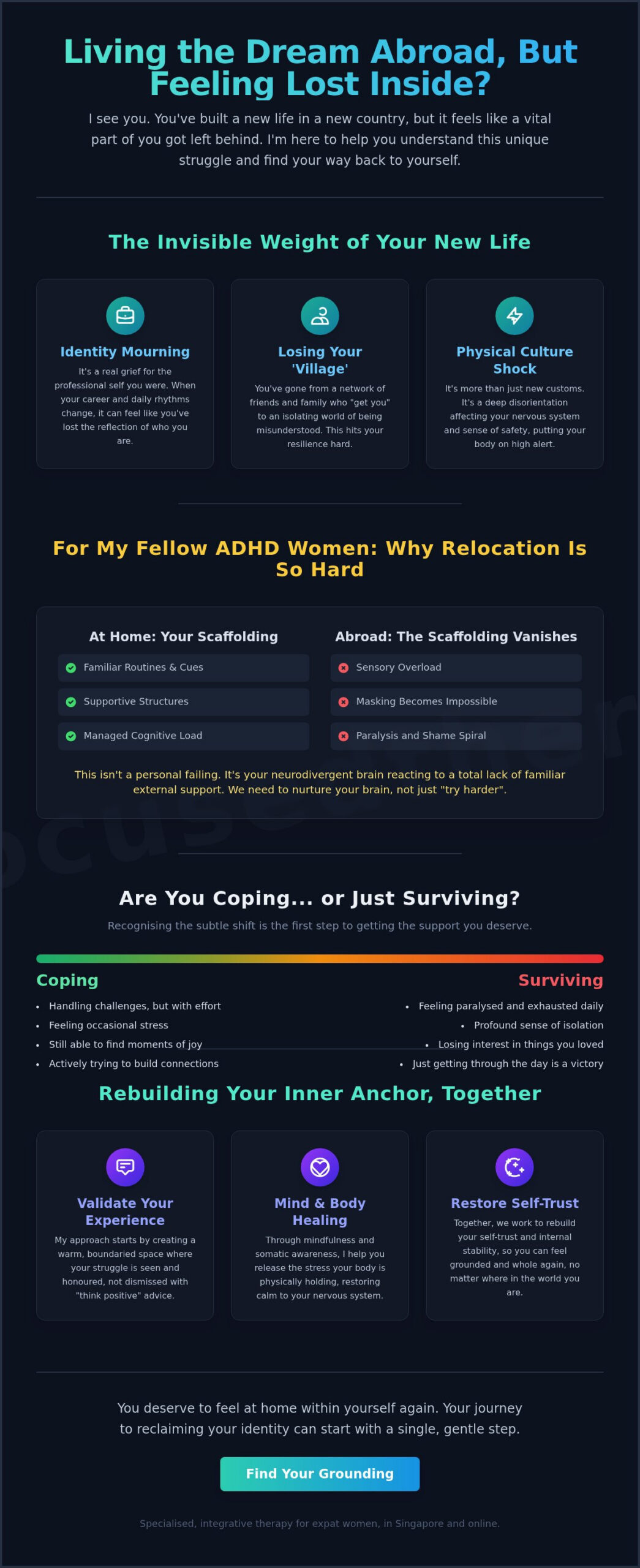
I believe moving to a new country is one of the most profound psychological shifts a woman can experience. It isn’t just about finding a new house or learning the local transport system. It’s about the quiet, often invisible process of identity mourning.
You’re not just leaving a location; you’re leaving the version of yourself that was reflected in your old community, your career, and your daily rhythms. This loss of reflection can leave you feeling untethered and unsure of who you are in this new context.
We often hear the term “trailing spouse,” but I find that label incredibly reductive and even harmful. It implies you’re just following along, but the reality is often a sudden and jarring loss of agency. This can feel like a hidden trauma, especially when others expect you to be grateful for the adventure.
In my experience, specialised therapy for expat women is vital because it validates this loss rather than asking you to just “think positive.” It provides a space where your internal struggle is given the weight and attention it truly deserves.
Many women I see are dealing with culture shock, which is far more than just being confused by new customs. It’s a deep disorientation that affects your nervous system and sense of safety. It’s a physical response to an unfamiliar world.
Generic therapy often misses these nuances, treating your anxiety as a personal failing rather than a natural response to massive upheaval. I focus on how this transition impacts your internal stability, acknowledging that your struggle is both psychological and practical.
Navigating the Loss of Your Support System
Back home, you likely had a “village.” These were the friends you could call on a whim, the colleagues who understood your professional worth, and the family who knew your history without explanation. When that’s gone, your emotional resilience takes a hit.
I see a big difference between the loneliness of being alone and the isolation of being misunderstood in a new culture. We work toward internal restoration to help you find your footing when your external anchors have vanished.
The Identity Crisis of the Global Nomad
If you’re a high-functioning woman, a “pause” in your career or a change in your professional status can feel like losing a limb. I’ve noticed that the women who struggle most are often the ones who were the most successful back home.
Your new environment doesn’t yet reflect your competence, and that can shatter your self-trust. It’s okay to feel grief, even if the move was a “positive” choice. Validating that grief is the first step in rebuilding a version of yourself that feels grounded and whole.
How Relocation Often Triggers ADHD and Unresolved Relationship Trauma
Relocation is a massive stress test for your nervous system. It’s a total dismantling of the systems you’ve spent years building to keep your life on track. If you’re a woman living with ADHD, those systems were likely your lifeline. When you land in a new country, the familiar cues that tell your brain what to do next simply vanish. I’ve experienced this myself. As an adult woman with ADHD, I know how the sensory overload of a new city can turn into a physical weight.
In my practice offering therapy for expat women, I often see how this lack of structure triggers a spiral of shame. You might feel like you’re failing at basic tasks that used to be easy. This isn’t a character flaw. It’s your neurodivergent brain reacting to a lack of familiar external scaffolding. The noise, the heat, and even the different smells of a new location can lead to a state of constant sensory flight-or-fight.
When Your Coping Mechanisms No Longer Work
For many high-functioning women, masking is the primary way they navigate the world. You work twice as hard to appear organised and calm. But the sheer cognitive load of an international move makes that mask impossible to maintain. This is why ADHD women often experience profound paralysis or burnout shortly after arriving. We need to move away from the “try harder” mentality and start understanding how your specific brain needs to be nurtured in this new environment.
The Echoes of Narcissistic Abuse Abroad
A vulnerable transition can act like a spotlight on old wounds. If you’ve experienced relationship trauma in the past, being far from your original support network can make you feel exposed. Without your village to ground you, it’s easier to doubt your own reality. You might fall back into patterns of people-pleasing just to avoid conflict in an already stressful situation. Being far from home can unfortunately make you more susceptible to gaslighting because you have fewer people around to validate your perspective.
I help you recognise these echoes and reclaim the intuition that may have been silenced by past abuse or the chaos of relocation. Healing involves listening to what your body is telling you through breath and rest. If you’re feeling overwhelmed by these shifts, you might find it helpful to explore how we can work together to find your internal calm again.
Restoring Your Sense of Self Through Integrative Psychotherapy
In my practice, I’ve found that traditional talk therapy often only scratches the surface of the expat experience. While Cognitive Behavioural Therapy (CBT) is brilliant for reframing those racing thoughts, it doesn’t always reach the tension held in your shoulders or the knot in your stomach. This is why I use an integrative approach. I combine evidence-based psychological modalities with mindfulness and somatic awareness to create a path for true internal restoration.
Relocation is a physical event as much as a mental one. Your body carries the stress of every flight, every unfamiliar street, and every moment you’ve had to navigate a language barrier. When I provide therapy for expat women, I look at the whole person. We work through a gender-centric lens, acknowledging how your unique biology and life stages impact your ability to process change. We aren’t just talking about your move; we’re rebuilding your “internal home” so you feel safe within yourself, no matter where your passport takes you.
The Role of Somatic Movement and Breath
When we’re in a state of transition, our energy often gets “stuck.” You might feel a sense of constant buzzing or, conversely, a heavy lethargy that you can’t shake. I weave in elements of somatic yoga to help your nervous system find its way back to a baseline of calm. Somatic movement isn’t about fitness; it’s about using breath and gentle motion to release the physical remnants of trauma and stress. It’s a way to find rest when your mind is still busy with the logistics of international life.
Building Emotional Stability and Self-Assurance
Living abroad often keeps us in a state of hyper-vigilance. You’re always scanning for cues, trying to fit in, or waiting for the next thing to go wrong. My goal is to help you move from that reactive state into a grounded presence. Therapy isn’t about “fixing” a broken version of you. It’s about helping you trust your own intuition again. I focus on the long-term journey of restoration because a quick fix rarely survives the complexities of a global lifestyle. You deserve a space where you can slowly, steadily regain your self-assurance.
Recognising When it is Time to Seek Professional Support Abroad
Many women I meet in my practice tell me they feel they “should” be fine. You might have a beautiful home and a supportive partner, yet you feel a quiet, persistent emptiness.
This is the high-functioning trap. You look successful on the outside, but internally, you’re just keeping your head above water. It’s the difference between truly coping and simply surviving.
I want you to know that your internal world matters regardless of your external circumstances. Feeling “fine” isn’t the same as feeling whole or at peace.
Often, the strain of relocation shows up in our closest bonds. If your partnership is bearing the weight of all your transition stress, couples therapy can provide a space to reconnect.
It helps you work through the move as a team rather than letting it pull you apart. Seeking therapy for expat women isn’t a sign of weakness; it’s an act of self-respect.
You don’t have to wait for a total crisis to ask for support. Catching the subtle signs of overwhelm before they turn into full-blown burnout is an act of kindness to yourself.
5 Signs You Might Benefit from Expat Counselling
- Decision Fatigue: You feel a persistent “brain fog” or find it impossible to make simple choices about your daily life.
- Imposter Syndrome: You feel like an actor in your own life, waiting for someone to realise you don’t belong here.
- Physical Tension: You notice somatic signs of stress like a tight jaw, shallow breathing, or persistent insomnia that won’t shift.
- Numbing Behaviours: You’re increasingly relying on scrolling, wine, or overworking to dull the edge of your daily anxiety.
- Emotional Volatility: You feel “thin-skinned” or find yourself reacting with unexpected intensity to small inconveniences.
Choosing Between Online and In-Person Therapy
I offer both in-person sessions in Singapore and online therapy for women across the globe. Seeing a therapist who understands the local environment can be incredibly grounding.
I know the specific pressures of this fast-paced city. However, online sessions offer a vital sense of continuity if you travel frequently or have a demanding schedule.
I ensure that both spaces are warm, boundaried, and entirely confidential. You deserve to feel grounded and self-assured in your international life.
If these signs feel familiar, I invite you to book a session with me so we can begin the process of restoring your internal calm together.
How I Can Support Your Healing Journey in Singapore and Online
I know what it’s like to stand in a new city and feel like you’ve lost the map to your own identity. As an expat who has navigated these same transitions and an adult woman living with ADHD, I’ve walked the path you’re on. I don’t just see you as a client; I see you as a woman in a significant life transition. You aren’t broken, and you aren’t failing. You’re simply learning to navigate a world that has suddenly lost its familiar shape.
In my practice, I provide a space that is warm but boundaried. This means you’ll find deep compassion and safety, but also the grounded, professional expertise of a registered integrative psychotherapist. Whether we meet in person in Singapore or through online sessions, my goal is to help you restore your internal stability. I use a multidisciplinary approach that respects both your mind and your body’s response to stress.
Starting therapy for expat women with me is a gentle process. We begin exactly where you are, without pressure or judgment. I’m here to act as a wise, supportive guide, helping you move forward with a renewed sense of self-assurance. We’ll work together to rebuild your internal confidence, ensuring you feel seen and validated in your unique struggle.
What to Expect in Our Sessions
Our work together focuses on your real-life experience rather than dry, academic theories. I’ve designed my approach specifically for the intelligent, self-aware woman who is often high-functioning but emotionally exhausted. We’ll integrate your personal history, your neurodivergence, and the practical weight of your current move into one cohesive narrative. This helps you understand why you feel this way and, more importantly, how to find your way back to yourself.
Taking Your First Realistic Step
If you feel ready to explore how we can work together, I invite you to book a consultation. It’s a simple, low-pressure way for us to see if we’re a good fit for your healing journey. If you aren’t quite ready for a session, you can access my free therapy resources as a gentle starting point to help ground your nervous system today.
Please remember that you don’t have to carry the weight of this international move alone. There is a way to feel grounded, calm, and truly at home within yourself again. I’m here to hold that space for you whenever you’re ready to begin.
Finding Your Way Back to Yourself Abroad
Living internationally is a beautiful adventure, but it’s also a profound psychological transition that requires more than just “coping.” We’ve explored how relocation can unmask ADHD symptoms and why your body might still be carrying the weight of past relationship trauma. True restoration happens when we look at the whole picture, combining mind and body to rebuild your internal stability.
I specialize in ADHD, trauma, and narcissistic abuse recovery, bringing my experience of supporting women in Singapore and globally to our sessions. My work as a Registered Integrative Psychotherapist and Yoga Master is designed to help you move from simply surviving your move to feeling grounded and self-assured. I’m here to act as your guide, helping you find that vital sense of internal calm through specialized therapy for expat women.
You don’t have to carry this transition alone. If you’re ready to reclaim your sense of self and trust your intuition again, book a consultation with me to begin your journey of restoration. You deserve to feel at home within yourself, wherever your passport takes you.
Frequently Asked Questions
Is it normal to feel depressed after moving abroad for a ‘better life’?
It’s completely normal to feel a dip in your mood after a major move. Even if you’ve moved for what feels like a “better life,” you’re still experiencing a massive upheaval of your support systems and daily habits. I often see women struggling with guilt because they feel they “should” be happy; but your brain is simply processing a significant loss of familiarity and connection.
How does therapy for expat women differ from standard counselling?
Therapy for expat women specifically addresses the unique psychological weight of international relocation. Unlike standard counselling, it validates the “identity mourning” and cultural disorientation that comes with moving across borders. I focus on the gender-specific challenges you face, such as the loss of professional identity or the strain of being a “trailing spouse,” which generic therapy might often overlook or misunderstand.
Can I still have therapy if I am only in Singapore for a short-term contract?
Yes, you can certainly engage in therapy even if your time in Singapore is limited. We can work together to find immediate grounding and emotional stability during your contract. If you move on, I offer online sessions to ensure you have a sense of continuity and support; no matter where your next contract or life adventure takes you.
Does relocation make ADHD symptoms worse for women?
Relocation often makes ADHD symptoms feel much more intense because it dismantles the external structures you rely on to stay regulated. As a woman with ADHD, I know that without your familiar routines, your brain can quickly become overwhelmed by sensory input and decision fatigue. In our work, we focus on rebuilding those structures in a way that respects your neurodivergent brain.
What is ‘identity mourning’ in the context of expat life?
Identity mourning is the process of grieving the version of yourself that existed in your home country. You might miss your professional status, your role in your family, or even just the “you” who knew where to find the best local coffee. It’s a real and valid form of grief that I help you navigate as you build a new, grounded life abroad.
How do I know if I need individual psychotherapy or couples counselling?
If you feel your struggle is primarily about your own sense of self, internal stability, or past trauma, individual psychotherapy is a beautiful place to start. However, if you find that the move is causing significant friction or distance between you and your partner, couples counselling can help you navigate the transition as a team. We can discuss which path feels right for you during a consultation.
What are somatic movement and mindfulness, and how do they help with transition stress?
Somatic movement and mindfulness are practices that help you reconnect with your body’s physical sensations to release “stuck” stress. Transition stress often lives in our nervous systems as physical tension or shallow breathing. By using gentle movement and breath, I help you move out of a state of constant high alert and back into a place of grounded, internal calm.
Can I continue my therapy sessions if I move to another country?
Continuity is a cornerstone of the healing process, so I offer online therapy for women who move between countries. You don’t have to start over with a new therapist every time you relocate. Keeping that consistent, safe space allows us to continue your journey of internal restoration and self-trust, regardless of your physical location or how many times you move.

Article by
Cheryl Kennedy MacDonald MA BA (Hons) Pg. Dip. SAC BACP
Cheryl Kennedy MacDonald is a psychotherapist specialising in women’s mental health, relationships, and life transitions. She works with women navigating trauma, relationship breakdown, identity shifts, and midlife change, helping them rebuild self-trust, emotional stability, and a clear sense of who they are and what they want.
With over 20 years’ experience working with women internationally, Cheryl is the founder of YogaBellies, a global women’s yoga school, and the creator of the Birth ROCKS method. Her work sits at the intersection of psychotherapy and embodiment, integrating evidence-based therapeutic approaches with somatic, body-based practices that support deep, lasting change.
Known for her grounded and direct approach, Cheryl moves beyond surface-level insight to address the patterns held in the body and nervous system. Her work supports women to regulate, reconnect, and respond to their lives from a place of clarity, strength, and self-respect.
She is a published author in academic journals and has written multiple books on women’s health, pregnancy, and midlife wellbeing, available on Amazon and leading book retailers worldwide.