
You’ve spent another hour in talk therapy, but as you walk to your car, your jaw is still clenched. That familiar, heavy knot in your stomach hasn’t moved an inch. It feels like your mind understands the “why” of your stress, but your body simply hasn’t received the memo yet.
I know how exhausting it is to live in a state of constant “freeze” or to feel strangely numb even when you’re doing the work to heal. As a therapist, I’ve seen how often racing thoughts continue even when we think we’ve found the answers. Using somatic practices for women for emotional healing allows us to address the tension that talk therapy alone sometimes can’t reach.
I’m going to show you how to use gentle, body-based movements to release the emotional weight you’ve been carrying in your shoulders and gut. We’ll explore how befriending your nervous system can help you move from a place of survival back to a sense of internal restoration. By the end of this, you’ll have simple tools to help you feel safe, grounded, and truly at home in your own skin again.
Key Takeaways
- Learn why your body might still feel tense even after talk therapy and how to listen to the “silent signals” it sends you.
- Recognise how stress from relationship trauma or neurodivergent overwhelm shows up physically in your jaw, gut, and breath.
- Discover gentle somatic practices for women for emotional healing that you can easily integrate into your daily routine.
- Understand the concept of “titration” and why taking small, manageable steps is the kindest way to process stored tension.
- Find out how a trauma-informed space can provide the scaffolding you need to feel truly safe in your own skin again.
Understanding the connection between your body and emotional healing
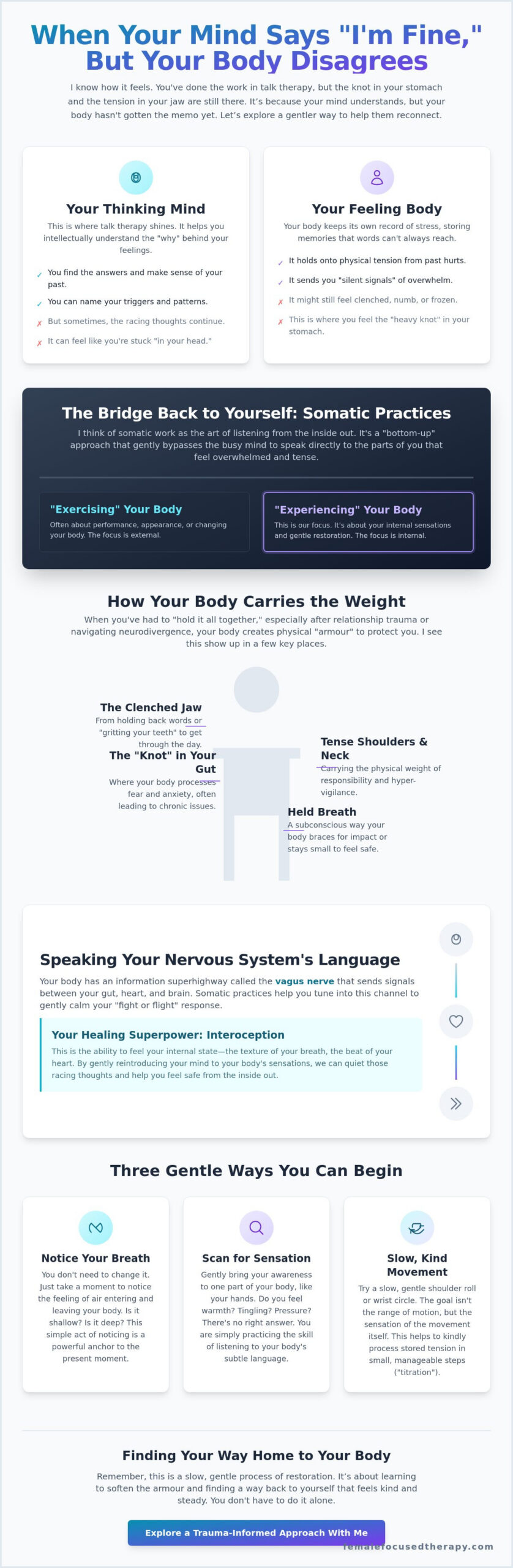
Have you ever noticed how your body keeps its own record of your stress? I’ve spent years working as both an integrative psychotherapist and a yoga master, and I’ve seen how common it is for women to understand their trauma intellectually while their bodies remain stuck in a state of alarm. Talk therapy is a wonderful tool, but it sometimes hits a ceiling because our tissues and nervous systems store memories that words can’t always reach.
Somatic practice is the art of listening from the inside out. It’s not about how you look from the outside; it’s about the internal landscape you’re navigating. There’s a vital difference between “exercising” your body, which is often about performance or change, and “experiencing” your body. My work focuses on this internal restoration, helping you move from simply surviving to feeling truly present in your own skin.
What are somatic practices exactly?
Somatic practices are gentle, conscious movements that prioritise your internal sensations over how a movement looks to an observer. This “bottom-up” approach begins with the simplest elements, like the texture of your breath or the sensation of your skin against your clothes. It bypasses the busy “thinking” mind to speak directly to the parts of you that feel overwhelmed.
I’ve found that these practices act as a safe harbour for women navigating high-stress transitions or recovering from relationship trauma. By focusing on the body first, we give the mind a chance to rest. This is a core part of Somatic psychology, which acknowledges that our physical and emotional selves are completely intertwined and cannot be healed in isolation.
The bridge between your mind and your nervous system
Your nervous system communicates through a long, winding pathway called the vagus nerve. It’s essentially the “information superhighway” for emotional regulation, sending signals from your gut and heart up to your brain. When we use somatic practices for women for emotional healing, we’re learning to speak the language of this nerve to calm the “fight or flight” response.
We do this through interoception, which is the ability to feel your internal state. Think of it as a superpower for healing. Many of the women I work with feel “stuck in their heads,” which is actually a very clever survival mechanism. When the body feels unsafe, the mind tries to take over to keep you protected. It’s a way of distancing yourself from physical pain or discomfort.
By gently reintroducing your mind to your body, we can start to quiet those racing thoughts. If you’re curious about how this looks in practice, you might find my approach to somatic movement and yoga helpful. It’s about finding a way back to yourself that feels kind, steady, and entirely your own.
How trauma and stress show up in a woman’s body
I’ve found that many women I work with are experts at “managing” their lives while their bodies are quietly struggling. You might have a successful career and a busy home life, but you’re also dealing with chronic gut issues or a neck that feels like it’s made of stone. These physical symptoms are often the body’s way of processing the residue of narcissistic abuse or the long-term effects of healing from relationship trauma.
When you’ve had to stay small or stay quiet to survive a difficult relationship, your body learns to “armour” itself. This creates a state of chronic hyper-vigilance where your nervous system never truly powers down. Life transitions like menopause can amplify these sensations. The hormonal shifts don’t just cause hot flushes; they can make your nervous system feel more exposed and raw. It’s a time when many women find that their old coping mechanisms simply don’t work anymore.
The physical weight of ‘holding it all together’
High-functioning women are often the best at ignoring their own physical needs. You might find yourself clenching your jaw while answering emails or holding your breath during a difficult conversation. This “armouring” is a protective response, but it’s also incredibly exhausting. Somatic practices for women for emotional healing help you recognise these patterns before they lead to total burnout.
It’s about learning to hear the “whispers” of your body before they become physical “screams.” When we ignore our body’s need for rest or safety, the emotional cost is high. We end up feeling disconnected from ourselves, as if we’re just a head carrying around a body that we don’t quite trust. Learning to soften this armouring is a slow, gentle process of restoration.
Neurodivergence and the somatic experience
My own experience with ADHD has taught me that our somatic experience is often much more intense. We process physical and emotional “noise” differently, and our nervous systems can become easily overwhelmed by sensory input. For a neurodivergent woman, being told to “just sit still and clear your mind” can feel incredibly distressing. It can actually trigger more anxiety rather than providing relief.
This is why support for women with ADHD must be tailored to how our brains and bodies actually work. We need movement and sensory-friendly tools that respect our need for stimulation while providing a sense of grounding. You don’t have to carry this physical and emotional weight alone. If you’re ready to start listening to what your body is trying to tell you, you can book a session with me to begin that journey.
Three gentle somatic practices you can try at home
I want to remind you right now that there is no “perfect” way to do this work. Your body is the expert here, and my role is simply to offer you some gentle starting points. When we use somatic practices for women for emotional healing, we use a concept called “titration.” This means we take very small, manageable steps. We don’t want to overwhelm your system by trying to “fix” everything in one go. We’re looking for tiny shifts that feel safe and sustainable.
Before you begin, try to find a small “sacred space” where you won’t be interrupted. It doesn’t need to be a fancy yoga studio; a quiet corner of your bedroom or a comfortable chair is perfect. The first practice I often suggest is the “Voo” Breath. Take a slow breath in and, as you exhale, make a low, vibrating “Vooooo” sound. Focus on the feeling of that vibration in your chest and belly. This simple sound helps soothe the nervous system by stimulating the vagus nerve directly.
Practice 2: Grounding through the ‘Orientation’ technique
When we feel overwhelmed or “frozen,” our world often feels like it’s narrowing down to a single point of stress. Orientation is a way to tell your brain that you are actually safe in your current environment. Start by slowly, very slowly, scanning the room you are in. Let your eyes land on objects that feel neutral or pleasant. You might notice the colour of a cushion, the texture of a rug, or the way the light hits a wall.
Use your five senses to anchor yourself. What is one thing you can hear right now? What is one thing you can smell? A key part of this is the softening of the eyes. Instead of a hard, focused stare, let your gaze become wide and relaxed. This simple shift in your vision can actually lower your heart rate and signal to your brain that the “threat” has passed.
Practice 3: The ‘Somatic Shake’ for releasing pent-up energy
If you’ve ever seen a dog shake themselves after a stressful encounter, you’ve seen somatic release in action. They are literally shaking the stress out of their muscles. As humans, we often suppress this natural impulse, which keeps cortisol and adrenaline trapped in our bodies. A gentle “micro-shake” can help release this pent-up energy. You can start by just gently shaking your hands or bouncing your heels while you sit.
If it feels safe, you can stand and let the shake move up through your arms and legs. I know it can feel a bit silly at first, but I promise that feeling is completely normal. It’s just your mind trying to make sense of a new way of being. By allowing your body to move this energy through, you are teaching your nervous system that it’s okay to let go of the “fight or flight” response. These somatic practices for women for emotional healing are all about returning to a state of internal peace at your own pace.
Integrating somatic movement into your daily life for lasting change
Healing isn’t a project with a finish line; it’s a lifelong relationship you’re building with yourself. I often see women approaching somatic practices for women for emotional healing with a “fix-it” mindset, as if they are a problem to be solved. The real shift happens when you move toward simply befriending your physical self. It’s important to remember that this journey isn’t linear. Some days you’ll feel light and grounded, while others might feel heavy and “stuck,” and both are valid parts of the process.
In my work sharing my somatic movement and yoga approach, I’ve found that the most lasting changes come from what I call “micro-practices.” These aren’t hour-long workouts but tiny moments of awareness woven into your existing routine. They help bridge the gap between your time on the mat and the realities of a demanding life.
Creating ‘pockets of peace’ in your schedule
You don’t need a dedicated studio or special clothes to begin. You can check in with your body while waiting for the kettle to boil or while sitting in traffic on the PIE in Singapore. Notice the sensation of your feet on the ground or the way your back feels against the seat. These small moments of awareness help retrain your nervous system to find safety in the present moment without requiring extra time you don’t have.
Taking thirty seconds for a quick body scan before a difficult conversation or a high-pressure meeting can completely shift your internal state. It allows you to soften your shoulders or uncurl your toes before the stress takes over. I truly believe that choosing to rest, even for just a few minutes, is a radical act of somatic healing. In our busy lives, giving ourselves permission to simply “be” is one of the kindest things we can do for our recovery.
Listening to your body’s boundaries
Your body is constantly providing you with valuable data if you know how to listen. Start noticing the difference between a “constriction,” which feels like a hard, protective wall, and a “contraction,” which might be a temporary tightening. Trusting these gut feelings is a cornerstone of your emotional recovery, especially if you’ve experienced trauma that made you doubt your own instincts. When your body says “no,” it’s often trying to protect your energy.
The wisdom of the belly is a profound source of self-trust that acts as an internal compass, guiding you toward what feels safe and away from what feels draining. Learning to honour these physical boundaries is how you rebuild your internal confidence after years of people-pleasing or “holding it all together.” If you’d like to explore this deeper, you can book an individual psychotherapy session with me to begin your journey of restoration.
Finding a safe space to deepen your mind-body journey
I know that starting this work can feel daunting. While the techniques I’ve shared are gentle, they can sometimes stir up old emotions that have been tucked away for a long time. This is why working with a trauma-informed therapist is so helpful. I provide the “scaffolding” you need to stay grounded while you explore these deeper layers of yourself.
My role in our sessions is to be a compassionate witness to your healing. I offer a boundaried and warm space where you can feel truly seen and understood. We don’t just talk about your problems; we work with them as they show up in your body and mind. By integrating CBT and mindfulness with somatic practices for women for emotional healing, we create a comprehensive path toward restoration.
You don’t have to carry the weight of your past alone. Whether you’re navigating the aftermath of relationship trauma or the sensory overwhelm of ADHD, I’m here to support you. We move at your pace, ensuring you always feel safe and in control of your own process. It’s about building a sense of internal stability that lasts long after our session ends.
Is integrative therapy right for you?
My “Female Focused” approach is designed specifically for women, by a woman who understands our unique life stages and challenges. I know how hormonal transitions, societal pressures, and neurodivergence can complicate the healing process. If you’re wondering if we’d be a good fit, you can find more about who I work with on my website.
I bring my own lived experience as a woman with ADHD and a yoga master into every session. This blend of professional expertise and personal warmth helps create a space that is both effective and deeply human. You can learn more about my background and my journey into this work if you’d like to get a better sense of how I practice.
Your realistic next step
Before you close this page, I invite you to take one deep, conscious breath right now. Notice the air moving in and out of your body. This simple act is a somatic practice in itself. It’s a way of coming back to yourself, even for just a second, and acknowledging your own presence.
If you feel ready to explore this further, I’d love to help you find your way back to a grounded, peaceful self. You can browse my free resources or, if you’re ready for more direct support, you can book a consultation with me. Let’s take that first step together at a pace that feels right for you.
Beginning your path to internal restoration
We’ve explored how your body carries the weight of trauma and how gentle movements can start to release that stored tension. Healing isn’t about forcing a change; it’s about learning to trust your physical instincts again. It’s a slow, steady process of befriending the skin you’re in.
As a Registered Integrative Psychotherapist and Yoga Master with over 20 years of experience, I specialise in helping women navigate trauma and neurodivergence. I know that somatic practices for women for emotional healing offer a bridge that talk therapy alone sometimes can’t cross. My goal is to help you rebuild your internal confidence at a pace that feels entirely safe for you.
If you feel ready to move from “thinking” about healing to truly feeling it, I invite you to book a quiet, confidential session with me here. You don’t have to navigate this journey on your own, and I’m here to hold space for you whenever you’re ready.
Common Questions About Somatic Healing
What is the difference between somatic therapy and regular exercise?
Somatic therapy focuses on your internal sensation rather than external performance or fitness. While exercise often aims to change the body’s shape or strength, somatic practice is about experiencing the body as it is in the present moment. It’s the difference between doing a squat to build muscle and noticing the weight in your heels to signal safety to your nervous system.
Can somatic practices help with my ADHD symptoms?
These practices can be incredibly grounding for the neurodivergent brain. Because ADHD often brings sensory overwhelm and racing thoughts, somatic tools offer a way to anchor yourself in physical reality. Instead of trying to “quiet the mind” through forced stillness, which can be frustrating, we use gentle movement to channel that energy and find a sense of internal calm.
I’ve experienced narcissistic abuse; will somatic exercises make me feel too vulnerable?
It’s natural to feel protective of yourself after experiencing narcissistic abuse. My approach uses “titration,” which means we take very small, controlled steps so you never feel overwhelmed. We focus on building your internal sense of safety first. You are always in control of how much you feel, and we only go as deep as your body feels ready to go.
How often should I do these practices to see an emotional change?
Consistency matters more than duration. You don’t need to spend an hour every day; even five minutes of conscious breathing or grounding can make a difference. Using somatic practices for women for emotional healing works best when integrated into your daily life. Over time, these small check-ins help retrain your nervous system to stay regulated during stressful moments.
Do I need any special equipment or yoga experience to start?
You don’t need any equipment, special clothes, or prior experience with yoga. These practices are about your internal experience, not your flexibility or fitness level. You can do them in your pyjamas, at your desk, or even while sitting in your car. The only requirement is a willingness to be curious about what your body is feeling right now.
What should I do if a strong emotion comes up during a somatic exercise?
If a strong emotion arises, the best thing to do is to pause and orient yourself to the room. Look around and name three things you can see, or feel the weight of your feet on the floor. This helps signal to your brain that you are safe in the present moment. If it feels too intense, it’s a sign to stop and rest.
Is somatic healing suitable for women going through menopause?
Menopause is a significant life transition that can make the nervous system feel particularly raw or exposed. Somatic practices for women for emotional healing are very effective for managing the anxiety and “brain fog” that often accompany hormonal shifts. By grounding yourself in your body, you can navigate these changes with more grace and a greater sense of internal stability.
How can I find a therapist in Singapore who uses somatic techniques?
I offer individual psychotherapy sessions in Singapore and online that integrate these mind-body techniques. It’s important to find a practitioner who is trauma-informed and understands the unique challenges women face. You can book a quiet, confidential chat with me to see if my approach feels right for you and your specific journey toward restoration.

Article by
Cheryl Kennedy MacDonald MA BA (Hons) Pg. Dip. SAC BACP
Cheryl Kennedy MacDonald is a psychotherapist specialising in women’s mental health, relationships, and life transitions. She works with women navigating trauma, relationship breakdown, identity shifts, and midlife change, helping them rebuild self-trust, emotional stability, and a clear sense of who they are and what they want.
With over 20 years’ experience working with women internationally, Cheryl is the founder of YogaBellies, a global women’s yoga school, and the creator of the Birth ROCKS method. Her work sits at the intersection of psychotherapy and embodiment, integrating evidence-based therapeutic approaches with somatic, body-based practices that support deep, lasting change.
Known for her grounded and direct approach, Cheryl moves beyond surface-level insight to address the patterns held in the body and nervous system. Her work supports women to regulate, reconnect, and respond to their lives from a place of clarity, strength, and self-respect.
She is a published author in academic journals and has written multiple books on women’s health, pregnancy, and midlife wellbeing, available on Amazon and leading book retailers worldwide.