
How to Protect Your Peace From a Narcissistic Parent
You’re sitting on your sofa, finally enjoying a quiet cup of tea, when your phone vibrates on the coffee table. Your stomach drops before you even see the name. You know that physical “freeze” response, the sudden tightness in your chest, and the immediate urge to explain away why you can’t talk right now. If this feels familiar, you’re likely carrying the heavy weight of trying to protect your own peace while managing a parent who consistently puts their needs above yours.
It’s exhausting to live in a constant state of emotional high alert, feeling responsible for their outbursts while your own needs get pushed to the side. You’ve probably spent years second-guessing your reality because of gaslighting, wondering if you’re the one being difficult. I want you to know that you’re not “bad” or “ungrateful” for wanting space.
I’ll help you navigate the complex guilt that comes with this process so you can protect your emotional well-being and find your way back to yourself. We’ll look at how to handle the initial backlash of saying “no” and explore how gentle, somatic practices can help you stay grounded when the old patterns try to pull you back in. Setting boundaries with narcissistic parents is not an act of war; it’s an act of self-restoration.
Key Takeaways
- Understand why your body “freezes” during parental interactions and how to stop feeling responsible for their emotional outbursts.
- Explore the practical steps of setting boundaries with narcissistic parents, including how to use Low Contact as a mental shield.
- Learn the “Grey Rock” method to protect your energy by becoming as uninteresting as a pebble to those who drain you.
- Reframe the heavy weight of guilt as a sign of your own healing rather than an act of unkindness toward your family.
- Discover somatic tools like the “Breath before the Boundary” to help you stay grounded and calm when you need to speak your truth.
Why setting boundaries with narcissistic parents feels so overwhelming
I know that heavy, sinking feeling in your stomach when you think about saying no. It’s not just a lack of confidence. It’s a deep-seated reaction to years of navigating unpredictable moods and emotional demands. For many of the women I work with, setting boundaries with narcissistic parents feels like breaking a fundamental, unspoken law of the family.
When we talk about narcissistic parents, we aren’t just looking for a clinical label. We’re looking at patterns of behaviour where your needs were consistently secondary to theirs. You might have grown up in a home where love felt conditional, or where you were expected to mirror your parent’s emotions rather than having your own. This makes the idea of setting boundaries with narcissistic parents feel incredibly risky.
This “daughterly guilt” you feel today is actually a learned survival response. As a child, keeping the peace wasn’t a choice; it was how you stayed safe and connected. Now, as an adult woman, your brain still triggers that same alarm system whenever you try to protect your own space. You aren’t being cruel; you’re simply unlearning a habit that no longer serves you.
The physical toll of the ‘freeze’ response
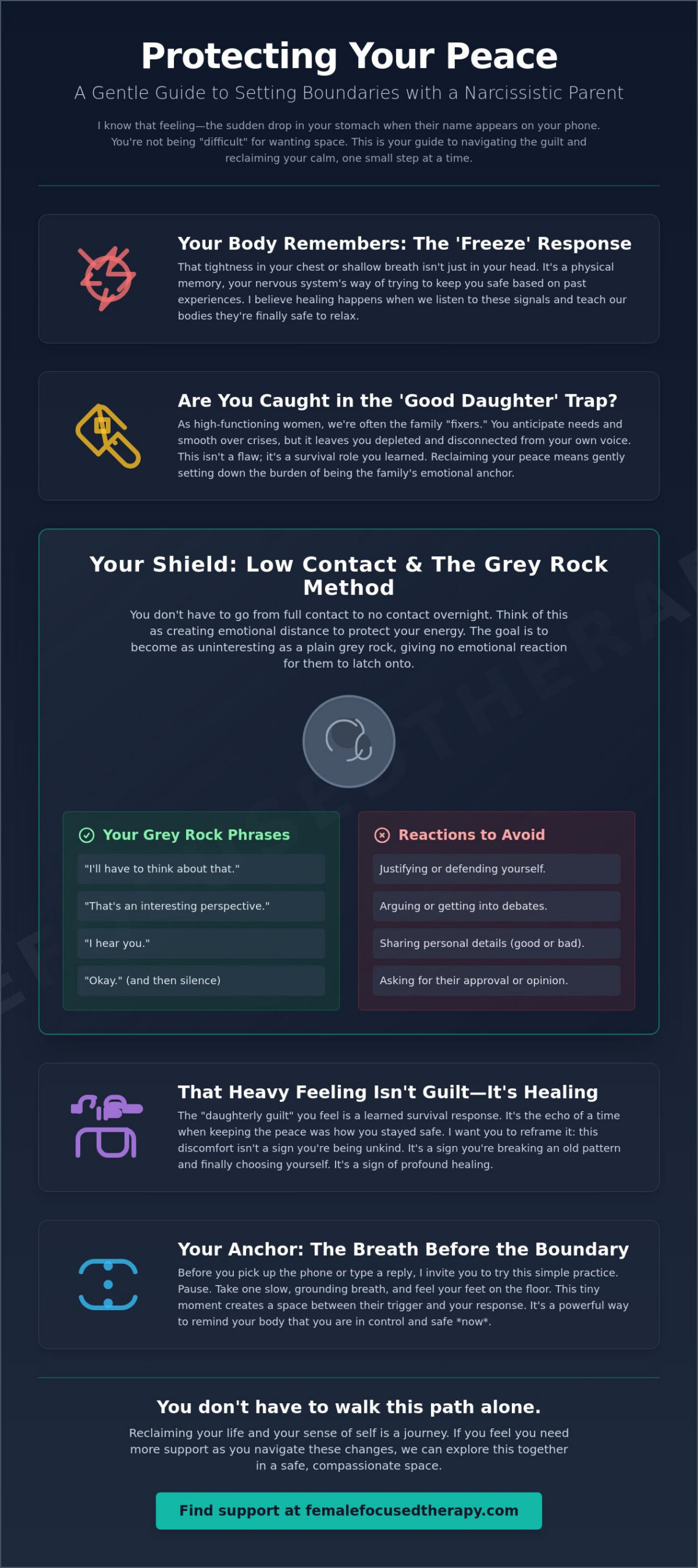
Your body often remembers what your mind tries to rationalise away. You might notice your breath becoming shallow or a sudden tension in your jaw the moment you see their name on your phone. This is your nervous system entering a “freeze” state, a physical memory of times when you felt small or unheard.
I believe that true restoration can’t happen in the mind alone. We have to acknowledge these somatic signals and listen to what the body is telling us. Healing means teaching your body that it’s finally safe to take up space and breathe deeply, even when someone else is unhappy with your choices.
Recognising the ‘Good Daughter’ trap
Many high-functioning women are the “fixers” in their family dynamics. You’re the one who anticipates every crisis and steps in to smooth things over, often at the expense of your own peace. While this trait makes you successful in your career, it leaves you utterly depleted in your personal life.
This role is a trap that leads directly to burnout and a profound loss of self-trust. You’ve spent so long looking outward to manage their reactions that you’ve lost touch with your own inner voice. Understanding the roots of relationship trauma and narcissistic abuse is the first step in realising you don’t have to be the family’s emotional anchor anymore.
Understanding Low Contact and the ‘Grey Rock’ method
Often, when we talk about setting boundaries with narcissistic parents, the conversation jumps straight to “No Contact.” While that’s a valid and sometimes necessary path, it can feel incredibly daunting if you’re just starting. I like to focus on Low Contact as a protective state of mind. It isn’t just about physical distance; it’s about reclaiming the emotional real estate they’ve occupied for decades.
One of the most effective tools in this transition is the “Grey Rock” method. The goal is to become as uninteresting as a plain, grey pebble. Narcissistic personalities often thrive on drama and emotional reactions, which they use as “supply.” By becoming boring, you stop providing the fuel they need. You remain polite, but you withdraw your emotional investment. It’s a way of being present without being vulnerable.
It’s a shift from being an active participant in their drama to being a calm observer. You’re still there, but you’re no longer “plugged in.” Remember, your terms are the only ones that matter during this shift. You don’t need their permission to change how you interact. If you feel you need more support as you navigate these changes, we can explore this together in online therapy sessions.
How to be a ‘Grey Rock’ in conversation
To be a Grey Rock, keep your responses short and neutral. If they try to bait you with a criticism or a guilt trip, you might say, “I’ll think about that,” or “That’s an interesting perspective.” These are non-committal and give them nothing to push against. I’ve found it’s also helpful to avoid sharing “good news” or vulnerable details. While it’s natural to want a parent’s praise, sharing your wins can often lead to disappointment if they find a way to diminish your success. Stick to safe, superficial topics like the weather, a film you saw, or a new recipe.
Deciding your own ‘sweet spot’ for contact
I encourage you to reflect on how much contact you can actually handle before you feel drained or “frozen.” This is your “sweet spot.” For some, it’s a monthly phone call; for others, it’s only communicating via text. You might decide on a rule of “no unscheduled calls” to prevent that sudden spike of anxiety when the phone rings. This isn’t about being “difficult.” It’s about managing your nervous system so you can stay grounded.
This process is a vital part of your internal restoration. It’s about building a life where your peace is the priority. You’re allowed to move at your own pace and adjust your boundaries as you grow stronger. There’s no right or wrong way to protect your heart, only what feels sustainable for you.
Moving through the guilt of self-protection
Setting boundaries with narcissistic parents often feels like you’re doing something fundamentally wrong. That’s no accident. Guilt was likely the primary tool used in your childhood to keep you compliant and “in line.” When you start to reclaim your space, that old familiar weight can feel almost unbearable.
I want you to try reframing this. Setting a boundary isn’t an act of cruelty toward your parent. It’s an act of profound kindness toward yourself. You’re finally choosing to be the person who looks after you, a role that was perhaps left vacant for a very long time. Your well-being is not a secondary concern.
You might notice that when you first stick to your guns, your parent’s behaviour actually gets worse. In psychology, we call this an “extinction burst.” Think of it like someone pushing a lift button repeatedly when it doesn’t open. They’re testing the limit to see if you’ll fold. It’s a sign that your boundary is actually working, even if it feels chaotic in the moment.
It’s also vital to remember that you aren’t responsible for your parent’s emotional regulation. If they feel hurt or angry because you can’t attend a dinner or answer a late-night text, that’s their emotion to manage. You’re only responsible for your own actions and your own peace. You can’t “fix” their reaction, and you don’t need to.
Dismantling the ‘Bad Daughter’ narrative
Guilt is often just a lingering echo of childhood conditioning. When that voice starts telling you that you’re a “bad daughter,” I want you to stop and ask: whose voice is that, really? Is it yours, or is it a script you were taught to follow to keep others comfortable? Most of the time, that voice belongs to someone else.
When things feel particularly heated, I find it helpful to use a simple mantra. Try saying to yourself, “I am allowed to protect my peace, and I am not responsible for their reaction.” This small act of self-validation can help you stay grounded when the emotional weather gets rough. It reminds your nervous system that you are safe in your choices.
Finding safety in your own choices
You don’t have to do this alone. Building a safety net of friends who “get it” or working with a professional can make all the difference. Sometimes, we need an outside perspective to help us see that our choices are sane and necessary. It’s hard to see the patterns when you’re still standing in the middle of them.
For individuals who feel their recovery also has a spiritual dimension, Minister Angela Preston offers Christ-centred inner healing and deliverance to help address the spiritual oppression that often accompanies toxic family dynamics.
I’ve seen how individual psychotherapy can help untangle these knots of obligation. It gives you a safe space to process the grief of the relationship you wished you had, while strengthening your resolve for the one you actually have. Your peace is worth every bit of the temporary discomfort that comes with a boundary. You deserve a life that feels like yours.
Somatic tools and scripts for boundary setting
Most advice on setting boundaries with narcissistic parents focuses entirely on what you should say. But if your heart is racing and your throat feels tight, even the most perfect script won’t feel accessible. I’ve found that we must prepare the body before we can ever hope to use the voice effectively.
I call this the “Breath before the Boundary.” It’s a single, conscious inhale and a slow, steady exhale before you pick up the phone or send that text. This small act signals to your nervous system that you are safe in this moment, regardless of the reaction you’re about to receive from the other person.
While you’re talking, try using physical anchors to stay present. I often suggest pressing your heels firmly into the floor or gently squeezing a soft object in your hand. These sensations keep you grounded in the “now,” preventing your brain from slipping back into that childhood “freeze” response we explored earlier.
After any interaction, give yourself a dedicated “Rest and Reset” period. You’ve just done a heavy emotional lift, and your body needs time to discharge that energy. I often use somatic movement and yoga to help my clients release the physical tension that tends to linger in the hips and shoulders after a difficult conversation.
Scripts for the high-functioning woman
Having a few pre-prepared phrases can stop you from over-explaining when you’re feeling pressured. If you’re being pushed for time, try: “I can’t talk right now, I’ll call you on Sunday for 20 minutes.” This sets a clear start and end point for the interaction.
If the conversation turns to criticism, you might say: “If you continue to criticise my career, I will have to hang up.” It’s a firm statement of your limits. For unwanted “help,” try: “I’m not looking for advice on this right now, but thank you for sharing.” It acknowledges them without letting them take the lead.
Grounding your body in the moment
If you feel the panic rising when the phone vibrates, try the 4-7-8 breathing exercise. Inhale for four seconds, hold for seven, and exhale for eight. This specific rhythm is a powerful way to override the fight-or-flight response. It forces your heart rate to slow down and brings you back to centre.
You can also use the “5-4-3-2-1” technique to manage emotional overwhelm. Notice five things you see, four you can touch, three you hear, two you can smell, and one you can taste. This pulls your focus away from the internal chaos and back into the safety of your current surroundings.
Remember that finding rest is an act of rebellion against the chaos of a difficult relationship. You’re allowed to take up space and care for your own needs first. If you’re feeling ready to start this work but want a safe space to practise, you can book a session with me to explore these tools further.
Reclaiming your life and your sense of self
There is a specific kind of quiet that happens when you finally stop trying to manage another person’s universe. I often describe it to my clients as “coming home to yourself.” Once the external noise of a parent’s demands begins to fade, you might find that your internal world feels surprisingly spacious. It’s in this space that your own voice finally has the room to be heard.
Setting boundaries with narcissistic parents rarely stays confined to just that one relationship. I’ve seen how this work ripples out into every other area of life. You might find you’re more assertive at work, more present with your partner, or more patient with your own children. When you stop leaking energy into a bottomless bucket, you finally have enough for the people and projects that actually nourish you.
I encourage you to look back at the versions of yourself you might have “put away” to stay safe or compliant. Perhaps there was a hobby you loved, a style of dress you abandoned, or a dream you stopped mentioning because it wasn’t “approved” of. Reclaiming your life means picking those pieces back up. Whether it’s returning to a dance class or simply enjoying a weekend without checking your phone, these small acts of joy are vital to your restoration.
Healing is absolutely possible, and I want you to know that you aren’t alone in this. Many women walk this path, and while the initial steps are often the hardest, the view from the other side is much clearer. You’re building a foundation of self-reliance that no one can take away from you.
Rebuilding self-trust after gaslighting
If you’ve lived with gaslighting, you’ve been taught to ignore your own intuition. Rebuilding that trust takes time and gentle practice. I often suggest keeping a simple journal to “track your truth.” Write down what was said and how you felt in the moment. When the old doubts creep back in, you have a physical record of your reality to lean on.
Listening to your gut is like a muscle that needs regular exercise. Start small. Trust yourself on the little things, like what you want for dinner or when you need a nap. If you’re looking for more ways to support this process, I have several free therapy resources available to help you stay grounded.
Your next step toward peace
The journey toward peace doesn’t require a massive leap today. It only requires one realistic next step. Perhaps today, that step is simply letting one unscheduled call go to voicemail. You don’t have to explain why. You’re allowed to decide when you are emotionally available to talk, and when you are not.
I know this work can feel heavy, especially when you’re navigating it alongside the demands of a busy life. If the path feels too steep to walk alone, you are always welcome to book a session with me. We can work together to untangle these knots at a pace that feels safe for you. You already have the internal strength to do this; sometimes you just need a steady hand to help you find it.
Stepping into your new season of peace
I hope you feel a little lighter knowing that setting boundaries with narcissistic parents isn’t about starting a war; it’s about ending the one within yourself. We’ve explored how to manage that physical “freeze” response and why your peace is worth the temporary discomfort of saying no. You don’t have to carry the heavy weight of their emotional world any longer.
As a Registered Integrative Psychotherapist specialising in narcissistic abuse recovery, I’ve seen how a trauma-informed approach can change everything. By combining CBT and mindfulness with somatic movement, we can help your body feel as safe as your mind wants to be. You deserve a gender-focused space where you can heal and restore your internal confidence.
If you’re ready to rebuild your self-trust and find peace from narcissistic patterns, I invite you to book a consultation with me here. You’ve already taken the bravest step by acknowledging that things need to change. I’m here to walk beside you as you find your way back to the woman you were always meant to be.
Your questions about protecting your peace
Is setting boundaries with a narcissist even possible?
Yes, it’s absolutely possible, but I always tell my clients it’s about your reaction, not their permission. When you stop waiting for them to agree with your limits, you reclaim your power. You’re setting the rule for yourself, deciding what you will and won’t tolerate in your own life. It’s a shift from asking for space to simply taking it for your own well-being.
What if my parent threatens to cut me off for setting boundaries?
Threats of abandonment are a common control tactic used to pull you back into old, compliant patterns. While this can feel terrifying, it’s often a bluff designed to test your resolve in the moment. I encourage you to look at the quality of the connection you’re protecting. If a relationship depends on you having no voice, it isn’t truly a healthy connection.
How do I deal with the ‘flying monkeys’ (relatives who take the parent’s side)?
You have to be just as firm with mediators as you are with the parent themselves. These people often mean well but are being used to relay messages or guilt-trip you into breaking your limits. I suggest a simple script like, “I’m not discussing my relationship with my mother right now.” If they persist, you’re allowed to end the call to protect your mental energy.
Can a narcissistic parent ever change their behaviour?
It is very rare for a narcissistic parent to change, as they often lack the self-awareness to see their own patterns. While it’s natural to hold out hope for a breakthrough, waiting for them to change keeps you stuck in a cycle of disappointment. Acceptance of who they are right now is usually the most liberating step. Your growth is the only thing you can control.
How do I stop feeling like a ‘bad daughter’ when I say no?
I use somatic tools to help my clients release the physical weight of that old childhood conditioning. That heavy guilt you feel is often just a lingering echo of the past, not a true reflection of your character today. You aren’t a bad daughter for having needs; you’re an adult woman taking responsibility for your own health. Saying no is an act of self-respect.
Is ‘No Contact’ the only way to heal from narcissistic abuse?
No, you can choose the level of distance that feels sustainable for your heart and your specific situation. Many women find that Low Contact or using the “Grey Rock” method provides enough distance to reclaim their sense of self without a total family rupture. The right choice is whichever one allows you to stay grounded and safe in your own daily life.
How do I explain my boundaries to my children without bad-mouthing their grandparents?
I recommend focusing on house rules and specific behaviours rather than critiquing the grandparent’s character. You might say, “We don’t allow shouting in our home, so we’re going to take some space now.” This teaches your children about healthy limits without involving them in adult drama. You’re modelling how to handle difficult situations with grace and firmness, which is a powerful life lesson.
What should I do if setting a boundary leads to an explosive argument?
The moment an interaction turns explosive, your only job is to disengage and find a safe, quiet space. You don’t need to win the debate or explain your position one more time to someone who isn’t listening. I often advise my clients to simply leave the room or hang up the phone immediately. Once you’re alone, focus on your breath to settle your nervous system.

Article by
Cheryl Kennedy MacDonald MA BA (Hons) Pg. Dip. SAC BACP
Cheryl Kennedy MacDonald is a psychotherapist specialising in women’s mental health, relationships, and life transitions. She works with women navigating trauma, relationship breakdown, identity shifts, and midlife change, helping them rebuild self-trust, emotional stability, and a clear sense of who they are and what they want.
With over 20 years’ experience working with women internationally, Cheryl is the founder of YogaBellies, a global women’s yoga school, and the creator of the Birth ROCKS method. Her work sits at the intersection of psychotherapy and embodiment, integrating evidence-based therapeutic approaches with somatic, body-based practices that support deep, lasting change.
Known for her grounded and direct approach, Cheryl moves beyond surface-level insight to address the patterns held in the body and nervous system. Her work supports women to regulate, reconnect, and respond to their lives from a place of clarity, strength, and self-respect.
She is a published author in academic journals and has written multiple books on women’s health, pregnancy, and midlife wellbeing, available on Amazon and leading book retailers worldwide.