
You might be sitting in the nursery right now, feeling a heavy, grey fog that “just being a new mum” doesn’t quite explain. It’s that quiet, aching sense of disconnection from your baby or the partner who is trying so hard to reach you. I know how lonely it feels to wonder what is perinatal depression and if this shadow is simply who you are now.
It is so common to feel a deep sense of shame when you aren’t “enjoying every minute” like the world tells you to. You are likely exhausted, not just from the lack of sleep, but from the mental weight of trying to perform a happiness you don’t feel. I want you to know that your feelings are valid and, more importantly, they are part of a recognised condition that affects one in seven women.
I am here to offer you a compassionate look at the reality of this transition and show you how to begin finding your way back to yourself. We will explore the difference between the common “baby blues” and clinical depression, while looking at how a blend of therapy and somatic care can help you feel like “you” again. There is a path through this, and you don’t have to walk it alone.
Key Takeaways
- Learn to distinguish between the transient “baby blues” and what is perinatal depression, so you can stop wondering if your feelings are just a temporary phase.
- Understand how your nervous system responds to the overwhelm of motherhood and why your body might feel stuck in a state of physical exhaustion or “freeze.”
- Discover why being a high-functioning woman often makes it harder to ask for help and how to safely lower the mask of productivity.
- Find out why I believe rest is a vital part of your recovery rather than a luxury, and how to start with small, gentle shifts toward healing.
- Explore how my integrative, female-focused therapy creates a safe, boundaried space for you to begin your journey of emotional restoration.
What is perinatal depression and how does it differ from “baby blues”?
I often talk with women who feel a deep sense of confusion about their changing moods during such a significant life shift. I define perinatal depression as the spectrum of low mood and anxiety occurring during pregnancy, which we call antenatal, or after birth, known as postpartum. It’s more than just a bad day; it’s a persistent weight that doesn’t seem to lift, no matter how much you try to “think positive.”
When clients ask me what is perinatal depression, I explain that it is a treatable medical condition that affects both your emotional and physical wellbeing. It isn’t a reflection of your ability to mother or your love for your child. It’s a physiological and emotional response to one of the most intense transitions a woman can experience. Understanding this is the first step toward your restoration.
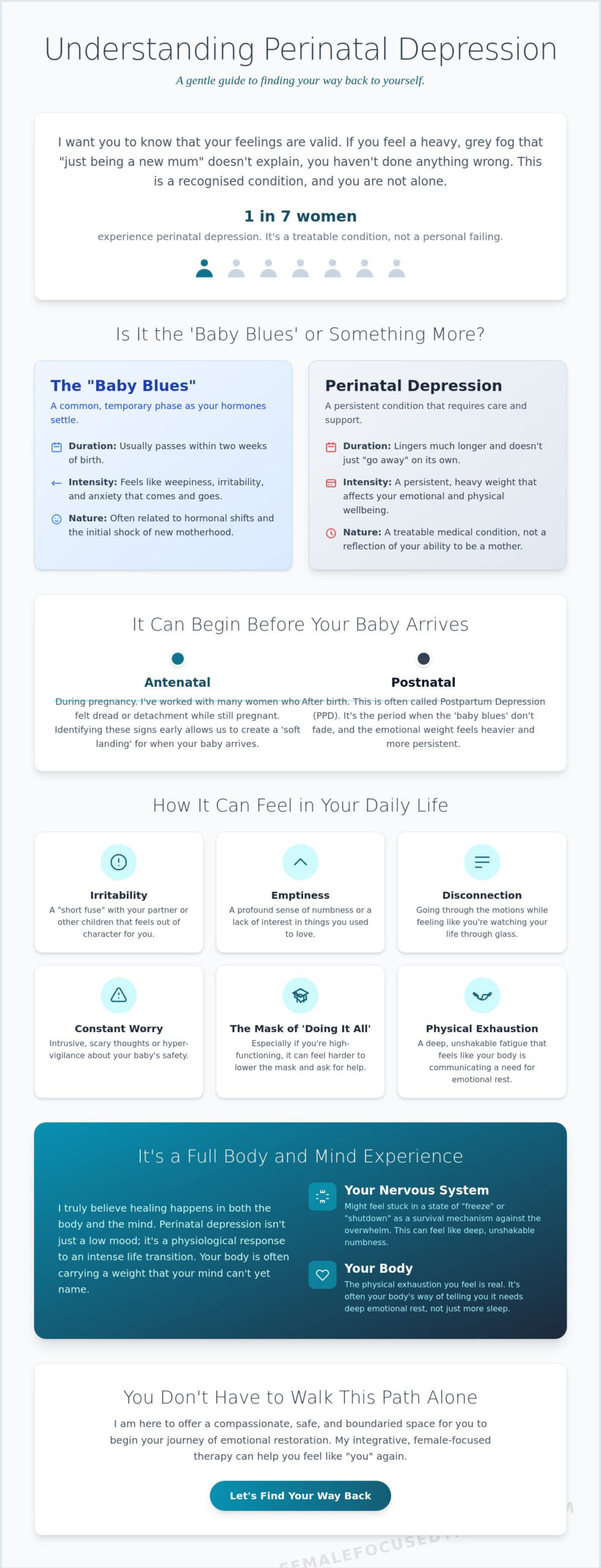
Most new mums experience what we call the “baby blues.” This is usually a period of weepiness, anxiety, and irritability that peaks a few days after birth and passes within two weeks as your hormones begin to settle. Postpartum depression (PPD), also known as perinatal depression, is different because it lingers much longer and feels significantly heavier. It doesn’t just “go away” on its own without support.
I want you to know that in Singapore, about one in ten women will experience clinical depression during this time. You aren’t alone in this, and you haven’t done anything wrong. This condition is a recognised part of the life transitions that many of us navigate, and it requires the same care and attention as any other health concern.
The difference between antenatal and postnatal struggles
I often see women who struggle during pregnancy but think they must wait until the baby arrives to seek help. There’s a common myth that depression only happens after birth. In reality, antenatal depression can be even more common than what happens after the delivery. I’ve worked with many women who felt a sense of dread or detachment while still pregnant, wondering why they didn’t feel the “glow” everyone talks about.
Identifying these signs early is incredibly powerful. It allows us to work together during your pregnancy to create a “soft landing” for when your baby arrives. By addressing the roots of your anxiety or low mood now, we can build the internal resources you’ll need for the postpartum period. You don’t have to wait for a crisis to reach out for a safe, supportive space.
Recognising the symptoms in your daily life
Symptoms don’t always look like the stereotypical image of a mother crying in a dark room. It might look like irritability or a “short fuse” with your partner or older children. I notice many women feel a profound sense of “emptiness” or a total lack of interest in things they used to love. You might find yourself going through the motions of childcare while feeling like you’re watching your life through a thick pane of glass.
If you find yourself constantly worrying about the baby’s safety to the point of physical exhaustion, this is a sign I can help with. These intrusive, scary thoughts are often your mind’s way of trying to manage extreme overwhelm. When your nervous system is overtaxed, it can manifest as hyper-vigilance or a feeling that you can never truly rest, even when the baby is sleeping. Recognising these patterns is the beginning of finding your way back to yourself.
How perinatal depression feels in your body and mind
I truly believe that healing happens in both the body and the mind. When we explore what is perinatal depression from a somatic perspective, we see it’s much more than just a low mood. It frequently leaves a physical footprint that can feel impossible to ignore, acting as if your body is carrying a weight your mind can’t yet name.
Your nervous system might be stuck in a state of “freeze” or “shutdown” as a response to extreme overwhelm. This is a survival mechanism. When the demands of motherhood exceed your current internal resources, your system tries to protect you by dimming the lights, resulting in a deep, unshakable numbness.
I want to help you understand the role of the significant hormonal shifts you are experiencing. These changes aren’t just “hormones” in the way people dismissively use the word; they directly impact your internal stability. Your physical exhaustion may be your body’s way of communicating a need for deep emotional rest.
Understanding these physical cues is vital. It helps in distinguishing perinatal depression from ‘baby blues’. If you are wondering what is perinatal depression versus normal new-mum exhaustion, look for that persistent feeling of being physically “stuck” or heavy even after you’ve managed to get some sleep.
The somatic markers of depression
I often hear women describe a “heaviness” in their limbs or a tightness in their chest that won’t go away. We can look at how your breath changes when you feel anxious about your new role as a mother. Are you holding your breath? Is it shallow and high in your chest?
Restoring your sense of self-trust begins with listening to these quiet signals from your body. Instead of fighting the fatigue, we can learn to sit with it and understand what it’s trying to tell you. This gentle awareness is a key part of the somatic movement and yoga approach I weave into our work.
The mental fog and decision fatigue
I know how hard it is to make even simple choices when you are navigating this haze. Choosing what to eat or when to shower can feel like climbing a mountain. This decision fatigue is a real symptom of your brain trying to process too much at once while your emotional reserves are low.
For my clients with ADHD, perinatal depression can feel like your usual executive function has completely vanished. The strategies you usually use to stay on top of things might suddenly stop working. This can lead to a spiral of shame, but I want you to know it’s a physiological response, not a personal failure.
I provide a safe space to unpick these feelings without any judgment or pressure to “perform.” We can work together to clear the fog at a pace that feels manageable for you. If you feel like you are drowning in these daily tasks, you might find it helpful to book a session to talk it through.
Why high-functioning women often miss the signs
I work with many intelligent, self-aware women who feel they “should” be able to handle everything. In my practice, I often see clients who are incredibly capable in their careers, yet they find themselves blindsided by this emotional shift. We often hide our struggles behind a mask of productivity. This makes it much harder for loved ones to see we are drowning because, on the surface, everything looks “fine.”
Understanding what is perinatal depression involves looking at the pressure we put on ourselves. Just because you are still managing the household and responding to emails doesn’t mean you aren’t suffering. Being high-functioning doesn’t make your depression any less real or deserving of support. In fact, the effort required to “keep it together” can lead to a deeper state of physical and mental exhaustion.
I want to challenge the myth of the “perfect mother” that so many of us in Singapore feel pressured to embody. There’s a specific cultural expectation here to be the pillar of the family, always composed and always capable. When we try to live up to this impossible standard, we ignore our own needs. This pressure can make it feel impossible to admit when you are struggling, leading to a profound sense of isolation.
If you are constantly trying to perform the role of the happy new mother, you might be missing the quiet signals your body is sending you. I’ve noticed that for many high-achieving women, the first sign of what is perinatal depression is a sudden, sharp loss of confidence in their own intuition. You might feel like you’ve lost your “spark” or your ability to trust your own decisions.
The “I should be happy” trap
I hear the word “guilt” more than almost any other word in my sessions with new mums. You might feel like you’re failing because you aren’t experiencing the constant joy you expected. Comparing your “inside” to everyone else’s “outside” is a recipe for internal distress. It’s a heavy burden to carry when your reality doesn’t match the nursery-rhyme expectations.
Social media often feeds this, showing only the highlights while you are left feeling the weight of the shadows. I can help you move from self-criticism to a place of self-compassion. It’s okay to acknowledge that you can love your baby and still find the reality of motherhood incredibly difficult. Giving yourself permission to feel these complex emotions is the beginning of healing.
Navigating life transitions and identity
Becoming a mother is perhaps the biggest identity shift you will ever experience. It changes your relationship with your body, your partner, and your sense of self. I specialise in helping women through these life transitions, ensuring you don’t lose your core identity in the process. You are still an individual with your own dreams and needs.
Your needs still matter, even when you have a little one who depends on you for everything. Taking time to breathe, move, and rest is not a betrayal of your baby; it is an act of restoration for both of you. When you are emotionally supported, you have more capacity to be present for your family. Restoration isn’t about fixing a flaw; it’s about reclaiming the space you need to thrive.
Gentle steps toward your emotional restoration
When you’re in the thick of a grey fog, trying to “fix” everything feels like just another chore on an endless list. I suggest starting with very small, manageable shifts rather than trying to change your whole world at once. You don’t need a total life overhaul today; you just need enough space to breathe and feel safe.
I define restoration as a gradual journey of rebuilding your internal confidence and self-reliance. It isn’t about returning to the person you were before your baby arrived, but about integrating this new experience into a stronger sense of self. We move at a pace that respects your energy levels and your current capacity.
When we look at what is perinatal depression, we see a nervous system that has been pushed into a state of survival. This is why I tell my clients that rest is not a luxury; it is a vital, non-negotiable part of your recovery process. I encourage you to find one small way to reconnect with your body each day, even just for five minutes of quiet awareness.
It’s important to remember that these small moments of connection add up over time. You might feel like five minutes isn’t enough to make a difference, but it’s a signal to your brain that you are worthy of care. Understanding what is perinatal depression helps us realise that your body needs these gentle invitations to come back into balance.
The power of somatic movement and breath
I often integrate somatic movement and yoga to help settle a frazzled nervous system. When you’re overwhelmed, your breath often becomes shallow and fast, keeping you in a state of high alert. A simple, conscious focus on your exhale can tell your brain that you are safe in this specific moment.
These tools aren’t about “exercise” or hitting a fitness goal. They are about finding a way to feel at home in your body again after a period of feeling disconnected or betrayed by your emotions. By moving gently and breathing with intention, you begin to thaw the “freeze” response that often accompanies low mood and anxiety.
Building your support village
I know it feels hard to ask for help, especially when you’re used to being the one everyone else relies on. But you weren’t meant to do this alone. Try to identify just one person you can be completely honest with about how you are feeling, without the need to put on a brave face.
Sometimes, the most supportive part of your village is a professional who sits outside your daily life. I offer online therapy so you can access this kind of compassionate, boundaried support from the comfort of your own home. If you’re ready to take that first small step toward feeling like yourself again, you can book an individual session with me here.
How I support you through perinatal depression
I use an integrative approach that combines evidence-based therapy with a deep, lived understanding of the female experience. In our work together, I don’t just look at a list of symptoms. I look at you as a whole person, navigating a complex and often overwhelming chapter of your life.
My goal is to provide a boundaried, professional space where you feel completely seen and validated. It’s a place where the mask of “having it all together” can finally be set aside. We create a container that is safe enough for you to express the thoughts you might be too afraid to say out loud to anyone else.
When we explore what is perinatal depression in the context of your life, we often find that it has eroded your confidence. I help you rebuild that lost self-trust, so you can move forward with a renewed sense of stability. We work on reconnecting your mind and body, ensuring you feel grounded as you find your way back to yourself.
I want you to take a slow, deep breath right now and realise that help is available whenever you are ready. You don’t have to wait until you are at breaking point to reach out for support. Healing is a steady process, and it begins with the simple acknowledgement that you deserve to feel better.
A trauma-informed perspective on motherhood
I recognise that your own history and past experiences shape how you navigate this new chapter of motherhood. Sometimes, the transition to being a parent can stir up old wounds or feelings of inadequacy that you thought were long settled. This is a natural part of the process, but it can feel very frightening when you’re also dealing with a newborn.
We work together to ensure you feel grounded and safe as we explore these deeper themes. I use a trauma-informed lens to help you understand why certain aspects of parenting might feel particularly triggering for you. You can read more about who I work with to see if my integrative approach resonates with your current needs.
Taking the next step
I offer focused therapy options designed to fit into your life, even when things feel chaotic and unpredictable. Whether you prefer to meet in person or through online therapy, we can find a rhythm that works for your schedule. You don’t need to have all the answers before our first session.
Remember, reaching out is a sign of your immense strength, not a reflection of any weakness. It takes courage to admit that the fog has become too thick to navigate alone. If you’re ready to begin this journey of restoration, you can book a consultation with me to see how we can work together.
Finding your way back to yourself
You’ve taken a brave first step today just by seeking to understand what is perinatal depression and how it impacts your life. We’ve explored the difference between the “baby blues” and clinical depression, the somatic signals your body sends, and why high-functioning women often mask their struggles. Healing isn’t about a quick fix; it’s a steady journey toward restoration.
As a Registered Integrative Psychotherapist and specialist in women’s life transitions, I offer a trauma-informed and ADHD-aware approach. My goal is to help you rebuild your internal confidence in a safe, boundaried space. You don’t have to navigate this transition alone, and your needs matter just as much as your baby’s.
If you’re ready to find your way back to yourself, I’m here to support you. Book a gentle consultation with me today to begin our work together. You have the strength to reach out, and I am ready to listen whenever you are.
There is hope, and you deserve to feel grounded, stable, and like yourself once more. This shadow doesn’t have to be your forever, and I look forward to helping you find the light again.
Frequently Asked Questions
How do I know if I have perinatal depression or just normal mummy brain?
Normal “mummy brain” usually involves misplaced keys or forgetting why you walked into a room due to sleep deprivation. When we look at what is perinatal depression, we see a much deeper, persistent cloud that affects your ability to feel joy or connection. If your forgetfulness is accompanied by a heavy mood, irritability, or a sense of dread that lasts more than two weeks, it is likely more than just simple exhaustion.
I often tell my clients to look for the “heaviness” in their daily life. While tiredness is a part of motherhood, the grey fog of depression feels different. It is a physical and emotional weight that doesn’t lift even when you manage to get a few hours of sleep.
Can perinatal depression affect my bond with my baby?
It can certainly make you feel disconnected or like you’re “going through the motions” without any real emotional spark. This is a very common symptom of the condition and it doesn’t mean you’re a bad mother or that your bond is broken forever. Your baby still feels your care, even if you feel numb inside right now.
In our sessions, we work on gentle ways to reconnect with yourself first. I’ve found that as you begin to feel safer and more grounded in your own body, the natural connection with your baby starts to feel more accessible. This disconnection is temporary and treatable with the right support.
Is it safe to have therapy while I am pregnant or breastfeeding?
Yes, therapy is completely safe and is actually one of the most recommended ways to support your mental health during these stages. It provides a non-invasive, supportive space to process the massive changes happening in your life. I offer a calm, boundaried environment where we can focus on your emotional wellbeing without any risk to your physical health or your baby’s.
Taking care of your mind is a vital part of your prenatal and postnatal care. When you feel supported, you’re better able to navigate the physical demands of pregnancy and new motherhood. I’ve seen how much of a difference it makes when women have a safe place to unburden themselves during these transitions.
What if I feel ashamed to tell my partner how I am really feeling?
Shame is a very common part of this experience, especially when you feel you “should” be happy. You might worry that your partner will judge you or think you aren’t coping. However, keeping these feelings hidden often makes the burden feel much heavier. I provide a safe space where you can practice expressing these emotions without any fear of judgment.
I often find that once women start to open up, they realise their partners have been wanting to help but didn’t know how. We can work together to find the right words to share your reality. Remember, your feelings are a response to a recognised condition, not a personal failure on your part.
How long does it typically take to feel like myself again?
There is no fixed timeline for recovery, as every woman’s journey is unique and depends on her specific circumstances. However, most of my clients start to notice small, positive shifts in their mood and energy within a few months of consistent support. Healing is a steady process of restoration rather than a quick fix that happens overnight.
We focus on making small, manageable changes that build your internal confidence over time. Some days will feel easier than others, and that’s a normal part of the healing path. My goal is to support you at a pace that feels sustainable, ensuring you have the tools to maintain your stability long-term.
Can perinatal depression happen even if I had a “perfect” birth experience?
Yes, because what is perinatal depression is often tied to significant hormonal shifts and neurochemical changes rather than just the birth event itself. You can have a beautiful, intervention-free birth and still find yourself struggling with low mood or anxiety. It isn’t a “reward” or a “punishment” for how your delivery went.
I’ve worked with many women who felt extra guilt because they had the birth they wanted but still felt miserable afterwards. It’s important to separate the physical event of birth from your emotional response to motherhood. Both are valid, and you deserve support regardless of how your baby entered the world.
Does having ADHD make me more likely to experience perinatal depression?
As an adult woman with ADHD myself, I know that our sensitive nervous systems can make big life transitions feel much more intense. Research suggests that neurodivergent women may be more prone to emotional overwhelm during the perinatal period. The change in routine and the sensory demands of a new baby can be particularly taxing for an ADHD brain.
I specialise in ADHD-focused therapy, helping you understand how your unique brain wiring plays a role in your current feelings. We work on strategies that respect your neurodivergence rather than trying to force you into a neurotypical mould. Understanding this connection can be a huge relief and a vital part of your healing process.
What should I do if I think a friend is struggling with perinatal depression?
The best thing you can do is listen without judgment and offer very specific, practical help. Instead of saying “let me know if you need anything,” try saying “I’m bringing dinner over on Tuesday” or “I’ll hold the baby while you take a nap.” These concrete actions take the pressure off her to make decisions when she’s already overwhelmed.
Gently let her know that you’ve noticed she hasn’t seemed like herself lately and that it’s okay to talk about the hard parts. You can share that support is available and that she doesn’t have to feel this way forever. Being a steady, compassionate presence can make a world of difference to someone sitting in the fog.

Article by
Cheryl Kennedy MacDonald MA BA (Hons) Pg. Dip. SAC BACP
Cheryl Kennedy MacDonald is a psychotherapist specialising in women’s mental health, relationships, and life transitions. She works with women navigating trauma, relationship breakdown, identity shifts, and midlife change, helping them rebuild self-trust, emotional stability, and a clear sense of who they are and what they want.
With over 20 years’ experience working with women internationally, Cheryl is the founder of YogaBellies, a global women’s yoga school, and the creator of the Birth ROCKS method. Her work sits at the intersection of psychotherapy and embodiment, integrating evidence-based therapeutic approaches with somatic, body-based practices that support deep, lasting change.
Known for her grounded and direct approach, Cheryl moves beyond surface-level insight to address the patterns held in the body and nervous system. Her work supports women to regulate, reconnect, and respond to their lives from a place of clarity, strength, and self-respect.
She is a published author in academic journals and has written multiple books on women’s health, pregnancy, and midlife wellbeing, available on Amazon and leading book retailers worldwide.