
Do you ever feel like you’re running on a treadmill, putting in immense effort only to feel constantly overwhelmed and behind? Perhaps you’ve spent a lifetime being called ‘too sensitive’ or ‘lazy,’ while internally wondering why you can manage a complex project at work but forget to pay a bill on time. This quiet, confusing experience is a reality for many, and it often points towards the specific, often-missed adhd symptoms women in Singapore face.
If these struggles resonate deeply, please know you are not broken, and you are not alone. This guide was created to be a safe, validating space for you. Together, we will gently illuminate the subtle signs of ADHD in adult women, helping you finally understand the ‘why’ behind your challenges. Our aim is to replace years of self-blame with self-compassion and provide a clear, gentle first step toward navigating support and rebuilding a stronger sense of self, right here in Singapore.
Why ADHD in Women Looks Different (And Is Often Missed in Singapore)
When you hear “ADHD,” what comes to mind? For many, it’s the outdated stereotype of a young boy who can’t sit still in class. This narrow view has left countless women feeling unseen and misunderstood. The reality is that ADHD in women often presents not as an external disruption, but as a quiet, internal struggle with focus, organisation, and emotional regulation. Recognising the distinct adhd symptoms women singapore experience is the first, crucial step toward clarity and support.
The Myth of the ‘Typical’ ADHD Presentation
Historically, research on Attention Deficit Hyperactivity Disorder (ADHD) focused almost exclusively on hyperactive young boys. This created a deeply biased understanding of this complex neurodevelopmental disorder, and its diagnostic criteria were shaped accordingly. As a result, girls whose symptoms are primarily inattentive-being seen as “daydreamers,” “chatty,” or “spacey”-are often overlooked. Their struggles are dismissed as personality quirks or, more concerningly, misdiagnosed as anxiety or depression, leaving the root cause unaddressed.
‘Masking’: The Exhausting Performance of Being ‘Normal’
From a young age, girls are often socialised to be agreeable, organised, and accommodating. To meet these expectations and hide their internal chaos, many women with ADHD develop a coping strategy called “masking.” This is the exhausting, subconscious effort to appear neurotypical. Masking can look like:
- Perfectionism: Overcompensating for a fear of making mistakes or being forgetful.
- People-pleasing: Agreeing to everything to avoid social rejection or conflict.
- Mimicking others: Carefully watching and imitating social behaviours to fit in.
While a powerful survival tool, masking is emotionally draining and a major cause of burnout, chronic anxiety, and low self-esteem.
The Impact of Singapore’s High-Performance Culture
In a fast-paced, high-achieving environment like Singapore, the pressure to be efficient and organised is immense. For a woman with undiagnosed ADHD, this can intensify feelings of inadequacy. The daily struggle to manage deadlines, social commitments, and personal responsibilities can feel like a constant personal failing. Ironically, many women with ADHD are highly intelligent and driven, achieving significant career success. This very success can make it harder for them-and others-to recognise the profound effort and exhaustion required just to keep up.
The Internal World: Core Inattentive Symptoms in Daily Life
For many women, the experience of ADHD is not about outward hyperactivity but a constant, unseen internal battle. What might be dismissed by others as being “ditzy,” “lazy,” or “overly sensitive” are often profound challenges rooted in a neurodivergent brain. Understanding these internal experiences is the first, most crucial step toward clarity and self-compassion. These are not character flaws; they are traits that, once understood, can be navigated with support and kindness. Let’s explore the lived reality behind the clinical checklists for adhd symptoms women singapore often face.
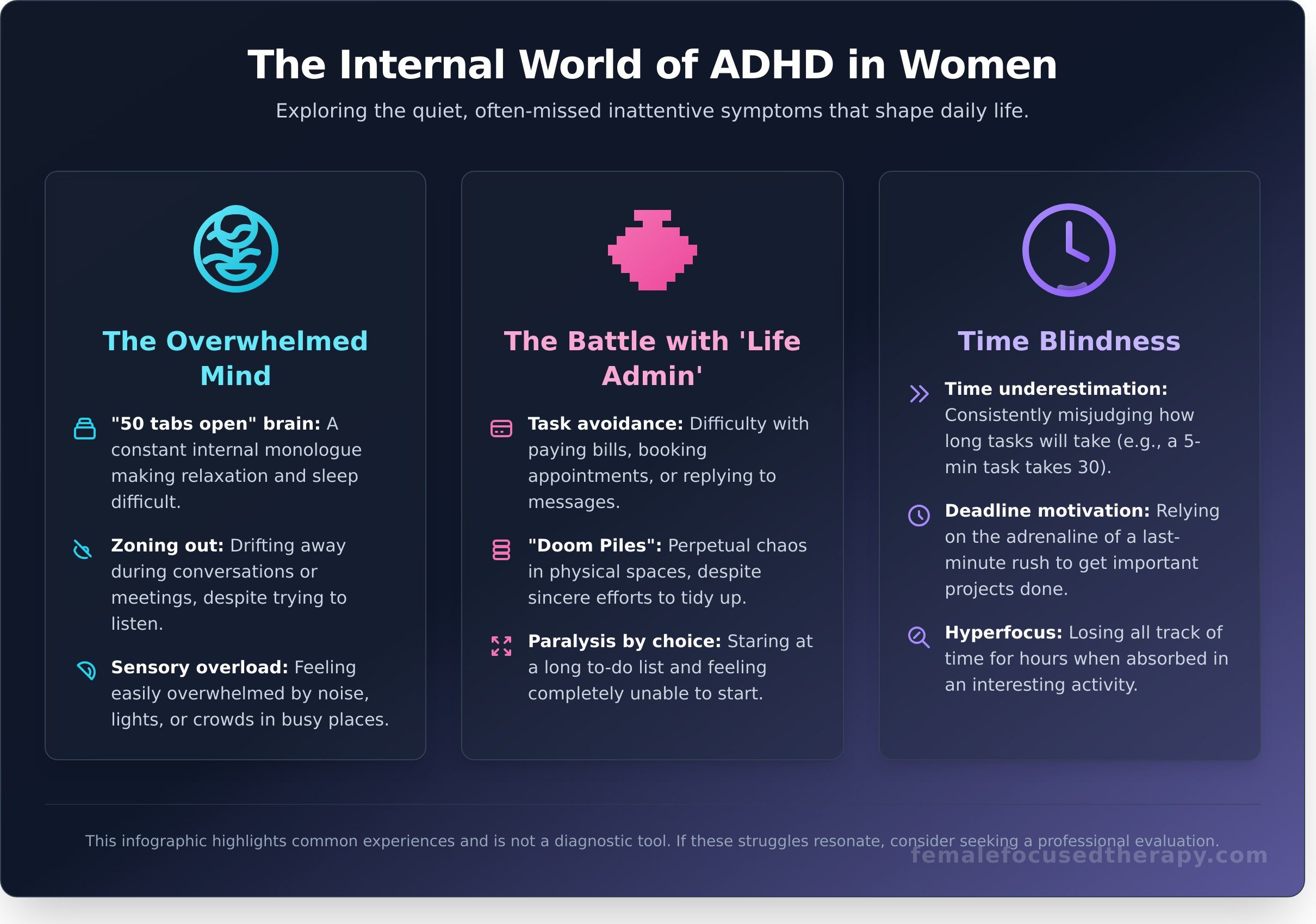
The Overwhelmed Mind: More Than Just Daydreaming
This goes far beyond simple daydreaming. It’s an internal state of being constantly “switched on” and overloaded, making focus feel like an impossible task. You may feel like your mind is a web browser with 50 tabs open at once, all playing different sounds. This can manifest as:
- A non-stop internal monologue or “busy brain” that makes it hard to relax or fall asleep.
- Zoning out during important work meetings or while a friend is talking, despite trying your best to listen.
- Feeling easily overstimulated by the noise in a hawker centre or the bright lights of a shopping mall.
- A sense of decision paralysis when faced with too many choices, whether on a menu or a to-do list.
The Battle with ‘Life Admin’ and Organisation
The relentless, everyday tasks required to run a life can feel like climbing a mountain. This struggle isn’t due to a lack of effort but a challenge with executive functions like planning and organisation. This might look like:
- A persistent difficulty with paying bills on time, booking appointments, or replying to important WhatsApp messages.
- An “out of sight, out of mind” reality, where forgotten items and tasks cease to exist.
- Staring at a long to-do list and feeling completely paralyzed, not knowing where to begin.
- Your home or workspace feeling perpetually chaotic, with “doom piles” of mail and other items, despite sincere efforts to tidy up.
Time Blindness: The ‘Where Did My Day Go?’ Phenomenon
For many women with inattentive ADHD, time feels abstract and fluid, not linear. This “time blindness” can create significant stress and impact relationships and professional life. This is a core aspect of the adhd symptoms women singapore residents navigate daily. You might recognise:
- Consistently underestimating how long a task will take, from writing an email to travelling across town on the MRT.
- Struggling to switch from one activity to another, even if you know you need to move on (task inertia).
- Relying on the adrenaline of a last-minute deadline to finally get started on an important project.
- Losing all track of time when absorbed in something interesting (hyperfocus), only to look up and realise hours have passed.
The Emotional Experience: When ‘Hyperactivity’ is Felt, Not Seen
When we think of hyperactivity, we often picture a child who can’t sit still. For women, however, this hyperactivity is frequently an internal experience-a constant, churning restlessness of thoughts and emotions. This internal storm is one of the most misunderstood and profoundly challenging adhd symptoms women singapore navigate, often leading to diagnoses of anxiety or depression instead.
Understanding this emotional landscape is a crucial step towards clarity. It’s not about being ‘too much’; it’s about having a brain that processes emotions with incredible intensity.
Emotional Dysregulation: Feeling ‘Too Much, Too Intensely’
Emotional dysregulation is a core, yet often unrecognised, feature of ADHD in women. It can feel like your emotions have a mind of their own, shifting from zero to one hundred with little warning. You may recognise this as:
- Rapid and intense mood swings that feel overwhelming and out of your control.
- A very low tolerance for frustration, boredom, or waiting in queues.
- A history of being described by others (or yourself) as ‘too sensitive’ or ‘overly dramatic’.
Rejection Sensitive Dysphoria (RSD): The Unseen Wound
Rejection Sensitive Dysphoria (RSD) is a term for the extreme emotional pain experienced in response to perceived rejection, criticism, or failure. This isn’t just feeling sad; it’s a debilitating wound. This can manifest as intense social anxiety, chronic people-pleasing to avoid disapproval, and a tendency to be your own harshest critic. You might find yourself avoiding new situations or opportunities for fear of not being good enough.
Internal Restlessness and Relationship Challenges
This constant internal ‘hum’ of hyperactivity can make it difficult to ever feel truly at peace. This inner restlessness often spills over into your relationships. It might look like impulsively oversharing, interrupting conversations without meaning to, or feeling a persistent boredom in stable relationships that lack novelty. These patterns can create cycles of misunderstanding and strain connection, impacting your self-perception and how you relate to others.
If this emotional experience resonates with you, know that you are not alone. Understanding these patterns is the first step towards navigating them with greater self-compassion and seeking the right support. You can learn to rebuild self-trust and find your calm.
From Recognition to Action: Your Gentle Next Steps in Singapore
If you see yourself in the descriptions of ADHD in women, please know this: your journey of discovery is valid and courageous. Reaching this point of recognition is a significant step. The goal isn’t simply to find a label, but to find understanding, compassion, and a path forward that feels supportive and true to you. This is about moving from a place of struggle to one of clarity and self-acceptance.
When to Seek a Professional Opinion
It might be time to speak with a professional if you find that your experiences are consistently affecting your life. Consider reaching out if:
- Symptoms of inattention, emotional dysregulation, or overwhelm are creating challenges in your career, relationships, or sense of self-worth.
- You feel emotionally exhausted from the constant effort of ‘masking’ your difficulties to meet expectations.
- You suspect that ongoing struggles with anxiety or depression could be connected to underlying and unaddressed ADHD.
Finding the Right Support in Singapore
Navigating the next steps means finding a professional who truly understands the nuances of how adhd symptoms women singapore present. It is essential to find a therapist experienced in adult ADHD, particularly in women, who can offer a compassionate and non-judgmental space for you to be heard. An integrative approach, combining evidence-based psychotherapy with mind-body practices, can help you build a holistic understanding of how your unique brain works.
How Therapy Can Help You Thrive with ADHD
Therapy offers a safe space to unpack the years of self-blame or shame that so often accompany a later-in-life diagnosis. It is a place to build profound self-compassion and rebuild self-trust. Together, you can develop practical, personalised strategies for managing executive function challenges like organisation and overwhelm, and learn to better understand and regulate your emotions. This journey is about learning to work with your mind, not against it. Explore how specialized therapy can support your journey.
Your Journey from Recognition to Reconnection
Recognizing the nuances of how ADHD presents in women is a profound first step toward self-understanding. As we’ve explored, the experience is often an internal one-marked by inattentiveness and emotional intensity rather than visible hyperactivity. This awareness is the key to validating your struggles and understanding the specific adhd symptoms women singapore so often face. This new insight is not an endpoint, but a compassionate doorway to effective support and growth.
If your story is reflected in these pages, please know that you don’t have to navigate this path alone. Female Focused Therapy specializes in supporting adult women with ADHD and neurodivergence within a safe, confidential, and trauma-informed therapeutic space. Our integrative approach combines proven methods like CBT with mindfulness and somatic practices to help you build lasting strategies, reconnect with yourself, and move forward with confidence.
Ready to feel understood? Learn more about our specialized ADHD therapy for women in Singapore.
Taking this gentle next step is a powerful act of self-care, paving the way for a life with greater clarity and ease.
Frequently Asked Questions About ADHD in Women
Can I really have ADHD if I did well in school or have a successful career?
Absolutely. Many high-achieving women develop sophisticated coping mechanisms, like perfectionism or overworking, to compensate for underlying executive function challenges. While you may appear successful on the outside, this success often comes at the cost of immense internal effort, chronic stress, and potential burnout. A successful life doesn’t negate the possibility of ADHD; it often means you’ve simply been working much harder to navigate it.
What’s the difference between ADHD symptoms and just being lazy or undisciplined?
This is a crucial distinction rooted in neuroscience, not character. Laziness is a choice not to act, whereas ADHD involves a genuine, neurobiological difficulty with executive functions like task initiation and focus. You may desperately want to do something but find yourself unable to start. It’s the difference between “won’t” and “can’t.” This internal struggle, often invisible to others, is a key indicator of a challenge, not a moral failing.
Do I need an official medical diagnosis to start therapy for ADHD symptoms in Singapore?
No, you do not need an official medical diagnosis to begin therapy. A psychotherapist can help you explore your experiences, understand your symptoms, and develop practical coping strategies in a supportive, confidential space. However, if you wish to explore medication as a treatment option, you will need a formal assessment and diagnosis from a registered psychiatrist or clinical psychologist in Singapore.
How is ADHD in adult women typically managed or treated?
Management is typically a multi-faceted, integrative process tailored to you. It often combines psychoeducation to understand your unique brain wiring with therapy (like CBT) to build new skills and reframe negative self-talk. This is complemented by practical strategies for organisation and emotional regulation. For some, a psychiatrist may also prescribe medication to help manage core symptoms. The goal is to create a supportive toolkit for a more balanced life.
Is it common to be diagnosed with ADHD for the first time as an adult?
Yes, it is incredibly common. The presentation of ADHD symptoms women in Singapore and worldwide often differs from the classic male stereotype. Girls are more likely to be inattentive, internalise their struggles, and be seen as ‘daydreamers’ rather than disruptive. Many women only seek a diagnosis in adulthood when the demands of a career or family life make their lifelong coping strategies unsustainable. You are certainly not alone in this discovery.
Could my anxiety or depression actually be undiagnosed ADHD?
There is a significant overlap, and it is very possible. The chronic stress, frustration, and low self-esteem from living with undiagnosed ADHD can directly lead to anxiety and depression. These are often secondary conditions that arise from the daily struggle. For many women, understanding and managing the underlying ADHD provides immense relief from anxious and depressive symptoms. A thorough assessment is key to finding the right path to support and wellbeing.