
Does the constant juggle between a demanding career and a full home life leave you feeling perpetually exhausted and on the edge of burnout? For many women, the quest for ADHD and work-life balance feels less like a goal and more like a source of constant guilt. You’ve likely tried all the standard productivity hacks, only to find they weren’t designed for your unique, creative brain, leaving you feeling like you’ve somehow failed when they don’t stick.
This guide offers a different path forward-a more compassionate one. Here, you will find a safe space to understand why traditional advice often falls short and discover gentle, brain-friendly strategies tailored to support you. Together, we will explore how to navigate your days with more clarity, reclaim your precious energy, and create a sustainable rhythm that brings joy and presence back into both your work and personal life. It’s time to stop fighting your brain and start working with it.
Why ‘Work-Life Balance’ Feels Impossible with ADHD (Especially for Women)
If you’re a woman with ADHD, the very idea of ‘work-life balance’ might feel less like an achievable goal and more like a frustrating myth. You may feel like you’re constantly running on a treadmill, putting in twice the effort for half the results, and ending each day emotionally exhausted. Please know, this feeling is not a reflection of your character or your work ethic. The struggle to achieve adhd and work life balance is rooted in the fundamental differences in how your brain is wired.
Traditional workplaces are often built around neurotypical standards of productivity-linear timelines, predictable focus, and seamless task management. For those with ADHD, these expectations can feel like an impossible standard, creating a cycle of stress and self-doubt. This challenge is often magnified for women, who navigate these internal struggles while also facing unique societal pressures.
The Role of Executive Dysfunction
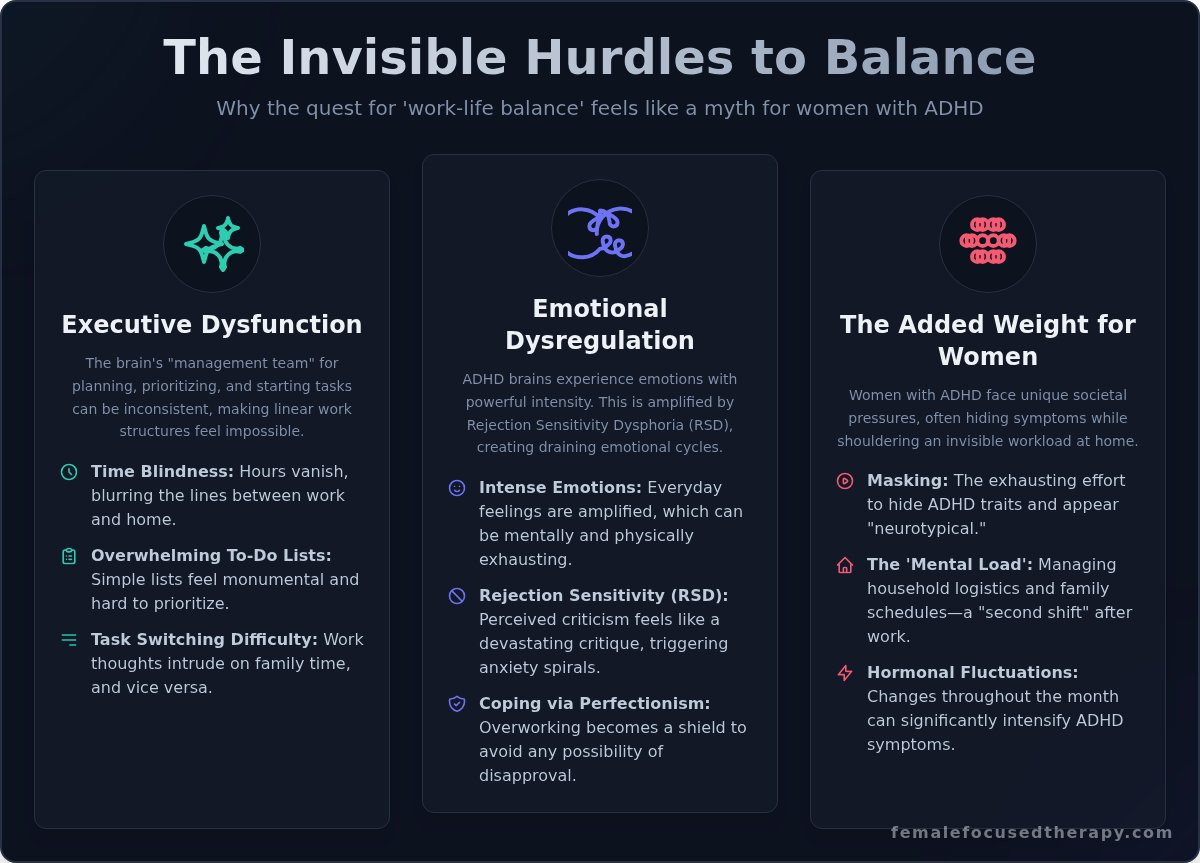
Executive functions are your brain’s management team, responsible for planning, prioritising, and initiating tasks. With ADHD, this team can be inconsistent. This often leads to “time blindness,” where hours can vanish without warning, and a simple to-do list becomes overwhelming. The difficulty in switching between tasks means work thoughts intrude on family dinner, and home responsibilities pop up during important meetings, blurring the lines between your two worlds.
Emotional Dysregulation and Rejection Sensitivity
Living with ADHD means experiencing emotions with a powerful intensity, which can be draining. This is compounded by Rejection Sensitivity Dysphoria (RSD), an extreme emotional pain in response to perceived criticism or rejection. At work, a neutral comment from a manager can feel like a devastating critique, triggering a spiral of anxiety. To cope, many women with ADHD turn to perfectionism and overworking, hoping to create a flawless shield against any possibility of failure or disapproval.
The Added Weight for Women: Masking and the Mental Load
Many women spend decades without a diagnosis because their symptoms present differently. The diagnostic criteria for Adult attention deficit hyperactivity disorder have historically been based on observations of hyperactive young boys. As a result, women become experts at ‘masking’-the exhausting, conscious effort to hide their ADHD traits and appear neurotypical. On top of this, women often carry the invisible ‘mental load’ of managing household logistics, family schedules, and emotional wellbeing, a second shift that begins after the first one ends. When combined with hormonal fluctuations that can intensify ADHD symptoms, it’s no wonder that finding balance feels out of reach.
Redefining ‘Balance’: Moving from Perfection to a Sustainable Rhythm
The image of a perfectly balanced scale, with work on one side and life on the other, is a powerful but damaging myth-especially for women navigating ADHD. Chasing this impossible 50/50 split often leads to burnout and a constant feeling of falling short. A more compassionate and effective approach to adhd and work life balance begins with an internal shift. It’s about moving away from the rigid concept of ‘balance’ and embracing a more fluid, personal ‘rhythm’. This is a practice of energy management, not just time management, that honours your unique neurological wiring.
Letting Go of Perfectionism
For many women with ADHD, perfectionism is a protective shield against the intense fear of failure and criticism, a common experience known as Rejection Sensitive Dysphoria (RSD). But this shield is heavy. Embracing the concept of ‘good enough’ is an act of liberation. It means allowing the laundry to be folded but not perfectly colour-coded, or sending an important email that is clear and effective, rather than spending another hour perfecting its prose. By intentionally lowering the stakes on non-essential tasks, you reclaim precious mental and emotional energy for what truly matters.
Practicing Radical Self-Compassion
When you have an ADHD brain, some days will feel chaotic and plans will go astray. The shame and guilt that often follow are exhausting. Self-compassion is the gentle antidote that rebuilds self-trust. When you feel overwhelmed or make a mistake, try speaking to yourself with kindness: “This is a moment of struggle. It is okay. I am doing my best with the brain I have.” This isn’t about making excuses; it’s about seeing ‘failures’ as learning opportunities. Each misstep offers valuable data about your unique needs, helping you navigate your life with more clarity and less self-blame.
Identifying Your True Priorities and Values
The ADHD brain is often drawn to what feels urgent, but a fulfilling life is built on what is truly important. Take a quiet moment to define what a rich, meaningful life looks like for you. Is it creative time, deep connection with loved ones, or simply moments of unstructured rest? Understanding what you value is the first step toward creating a supportive environment. As discussions around Neurodiversity at Work emphasize, aligning your daily structures with your authentic needs is key to long-term wellbeing. Try scheduling your personal non-negotiables-like exercise, a hobby, or quiet time-into your calendar first, treating them with the same importance as a work meeting.
ADHD-Friendly Strategies for Creating Clear Boundaries
For many women navigating the complexities of ADHD, the concept of boundaries can feel like a restriction. We often see them as walls that shut others out. But what if we reframed them? Think of boundaries not as walls, but as the gate to your garden-a tool you control to protect your energy, focus, and wellbeing. This is especially true when dealing with common ADHD traits like emotional sensitivity and a tendency towards people-pleasing, a pattern increasingly understood in the expert consensus on ADHD in women. Creating these gentle structures is a foundational step toward achieving a sustainable adhd and work life balance.
Time Boundaries: Counteracting Time Blindness
Time blindness can make the workday feel like an endless, unstructured blur. Creating external cues helps your brain understand when to be ‘on’ and when to switch ‘off’.
- Use External Timers: The Pomodoro Technique (working in focused 25-minute blocks with short breaks) is incredibly effective. A simple kitchen timer can be your best ally in managing focus and preventing burnout.
- Create ‘Bookend’ Rituals: Start your day with a consistent 5-minute ritual (e.g., making tea and reviewing your top 3 priorities). End it with another (e.g., clearing your desk, closing all tabs, and saying “work is now complete”). These rituals signal a clear transition to your brain.
- Schedule Buffer Time: Avoid back-to-back meetings. Scheduling 10-15 minutes of buffer time in between tasks allows your brain to reset, preventing the overwhelm that leads to exhaustion.
Task Boundaries: The Gentle Art of Saying ‘No’
Protecting your energy often means politely declining requests that pull you away from your priorities. This isn’t selfish; it’s essential for managing adhd and work life balance. Here are some gentle scripts:
- To decline a non-urgent request: “Thank you for thinking of me for this. My plate is full right now, so I can’t give it the attention it deserves.”
- The ‘Not right now, but…’ technique: “I can’t get to this today, but I can look at it on Thursday. Would that work for you?” This honours the request while protecting your current focus.
- To ask for help: “I’m feeling a bit overwhelmed with my current tasks. Could you help me prioritise what’s most important right now?”
Digital and Communication Boundaries
In our always-on world, digital distractions are a major source of energy drain. Creating clear digital boundaries is non-negotiable for protecting your personal time and mental space.
- Set ‘Office Hours’ for Email: Designate specific times to check and respond to messages (e.g., 9 am, 1 pm, and 4 pm) instead of reacting to every notification.
- Turn Off Notifications: After your workday ends, silence all work-related notifications on your phone and computer. This is a powerful signal to your brain that it’s time to rest.
- Create Separate User Profiles: On your computer, set up one user profile for ‘Work’ and another for ‘Personal’. This simple environmental shift helps create a powerful psychological separation between your roles.
Designing Your Environment for Focus and Flow
For women with ADHD, the external world can feel like a constant drain on internal resources. Every notification, misplaced item, or background conversation demands a sliver of your executive function. The goal isn’t to build a perfect, sterile bubble, but to consciously shape your surroundings to reduce cognitive load. This creates the space needed to find a sustainable adhd and work life balance.
It’s a process of gentle experimentation. What works for one person may not work for you, and that’s perfectly okay. The key is to remain curious and compassionate as you discover how to support your unique brain.
Minimizing Distractions to Conserve Willpower
Your willpower is a finite resource, and distractions are its primary expense. By creating intentional barriers, you conserve that precious energy for the tasks that truly matter. It’s not about fighting your brain, but about giving it fewer battles to fight.
- Control your soundscape: Invest in noise-cancelling headphones or use apps that play ambient sounds like rain or white noise to mask distracting office chatter.
- Clear your space, clear your mind: A cluttered desk or a desktop full of icons can be visually overwhelming. Take a few minutes at the start and end of each day to tidy your physical and digital workspaces.
- Identify your ‘kryptonite’: Is it your phone? A particular news website? A chatty colleague? Acknowledge your biggest distractors and create gentle friction-put your phone in another room, use a website blocker, or politely signal when you need to focus.
Leveraging Hyperfocus Intentionally
Hyperfocus can be one of the most powerful assets of the ADHD brain, but it can also lead to burnout if left unchecked. By channelling it deliberately, you can transform it from a random occurrence into a reliable tool for deep, meaningful work.
- Schedule ‘deep work’ blocks: Protect your calendar by blocking out 90-minute to two-hour chunks of uninterrupted time for your most important projects.
- Align with your energy: Notice when your focus is sharpest-is it first thing in the morning or late in the afternoon? Schedule your most challenging tasks for these peak periods.
- Set break reminders: The downside of hyperfocus is losing track of time and forgetting to eat, drink, or stretch. Set alarms to gently pull you out and remind you to reset.
Energy Management Throughout the Day
A successful day is less about rigid discipline and more about dynamic energy management. The ADHD nervous system is highly sensitive, so tuning into your body’s signals is crucial for maintaining equilibrium and preventing overwhelm.
- Incorporate movement: Short, frequent breaks to stretch, walk around, or do a few jumping jacks can reset your focus and release restless energy.
- Fuel your brain: Dehydration and low blood sugar can mimic and worsen ADHD symptoms. Keep a water bottle on your desk and have protein-rich snacks ready.
- Plan for decompression: Recognise the signs of sensory overload-irritability, fatigue, a desire to withdraw. Have a plan to decompress, whether it’s sitting in a quiet room for five minutes, listening to calming music, or stepping outside for fresh air.
Another powerful strategy is ‘body doubling,’ where you work alongside another person (in person or virtually) to foster accountability and focus. If you’re looking to explore these strategies and build a more personalized toolkit for navigating adhd and work life balance, we are here to support you on that journey.
How Therapy Supports Your Journey to a Balanced Life
Navigating the demands of a career and home life with ADHD can feel like a solitary, uphill battle. You may have tried countless strategies, only to feel frustrated when they don’t stick. Therapy offers a different path-one of partnership and genuine support. It provides a confidential, non-judgmental space where you can untangle the complexities of your experience without fear of being misunderstood. Think of a therapist not as someone with all the answers, but as a skilled co-pilot, helping you navigate turbulence and find a sustainable flight path.
Understanding Your Unique ADHD Brain
Your experience with ADHD is entirely your own. In therapy, we move beyond generic advice to explore your specific challenges and strengths. Together, we can gently unpack how past experiences may have shaped your current coping mechanisms-both the helpful and the unhelpful. This process of discovery is foundational to understanding your needs and building a life that truly works for you, not against you.
Building a Personalized Coping Toolkit
A key part of improving your ADHD and work life balance is developing strategies that fit your unique brain and lifestyle. We will work together to co-create a personalized toolkit, which may include:
- Practicing boundary-setting in a safe, supportive environment.
- Developing techniques to manage emotional dysregulation and Rejection Sensitive Dysphoria (RSD).
- Finding practical ways to manage time, energy, and focus that feel intuitive to you.
Rebuilding Self-Trust and Confidence
Living with undiagnosed or unsupported ADHD often leads to a lifetime of negative self-talk and internalized shame. A crucial part of our work is to challenge these narratives and begin rebuilding the self-trust that has been eroded. By learning to acknowledge your progress-celebrating small wins over perfection-you can cultivate a more compassionate inner voice and a renewed sense of confidence in your abilities. This is the heart of creating lasting change.
Ready to start your journey towards clarity and balance? Explore how therapy can help you find your rhythm.
Your Journey to a More Balanced Life Starts Here
Navigating the complex interplay of career ambitions and personal wellbeing with ADHD can often feel like an impossible task, but it doesn’t have to be a constant struggle for control. As we’ve explored, the path forward isn’t about achieving a flawless, static ‘balance,’ but about cultivating a sustainable, personal rhythm. This means compassionately redefining what success looks like for you, implementing firm yet flexible boundaries that protect your energy, and intentionally designing your environment to foster focus and flow rather than friction.
Embracing these strategies is a profound act of self-care. It’s how you begin to build a truly sustainable sense of adhd and work life balance, one that honours your neurotype instead of fighting against it. This journey is deeply personal, but you do not have to navigate it alone.
If you’re ready for dedicated guidance, we offer specialized support for adult women with ADHD. Using an integrative, trauma-informed therapeutic approach in a safe, professional space, we can work together to help you untangle patterns of burnout and rebuild essential self-trust.
Ready to build a more compassionate and balanced life? Book a confidential consultation today.
Frequently Asked Questions
How can I explain my need for certain accommodations at work without disclosing my ADHD diagnosis?
You can focus on the specific need rather than the diagnosis. Frame your requests around productivity and workflow. For example, instead of mentioning distraction, you could say, “I find I produce my most focused work in a quieter environment. Would it be possible to use noise-cancelling headphones?” This approach positions your needs as a benefit to your role and the company, allowing you to get the support you require while maintaining your privacy.
These strategies sound great, but how do I stick with them when my motivation disappears?
It’s important to acknowledge that motivation naturally ebbs and flows with ADHD. When it dips, lean on external support like “body doubling” or accountability apps. Break tasks into tiny, manageable steps and celebrate small completions. True adhd and work life balance isn’t about forcing constant motivation, but about having compassionate systems in place for when it fades. This approach supports your wellbeing rather than demanding perfection.
What’s the difference between ADHD burnout and regular job burnout?
While regular job burnout often stems from external factors like workload, ADHD burnout is frequently internal. It arises from the chronic stress of masking symptoms, fighting against your brain’s natural wiring, and the immense mental energy required for executive functions. This can feel like a complete system shutdown where even simple tasks, not just work-related ones, feel monumental. Understanding this distinction is a key step toward navigating it with self-kindness.
I work from home. How can I create a physical and mental separation between my job and my life?
Creating clear boundaries is essential for your wellbeing. Physically, designate a specific workspace, even if it’s just a corner, and pack away your work items at the end of the day. Mentally, create a “shutdown ritual.” This could be a short walk, changing your clothes, or listening to a specific playlist. These simple actions signal to your brain that the workday is officially over, helping you transition and be more present in your personal time.
How do I handle the guilt I feel when I choose to rest instead of being ‘productive’?
This guilt is incredibly common. It can be helpful to reframe rest not as laziness, but as a vital part of your productivity cycle. Your brain needs downtime to recharge, process information, and function effectively. See rest as a strategic tool that prevents burnout and supports long-term success. Practising self-compassion and reminding yourself that your worth is not tied to your output can help you honour your body’s needs without judgement.
Can medication for ADHD solve my work-life balance problems on its own?
Medication can be an incredibly supportive tool, often providing the clarity and focus needed to implement new strategies. However, it is rarely a complete solution on its own. Achieving a sustainable adhd and work life balance requires a holistic approach. This includes developing coping mechanisms, building routines that work for your brain, and setting boundaries. Medication is one important piece of a much larger puzzle for your overall wellbeing.

Article by
Cheryl Kennedy MacDonald MA BA (Hons) Pg. Dip. SAC BACP
Cheryl Kennedy MacDonald is a psychotherapist specialising in women’s mental health, relationships, and life transitions. She works with women navigating trauma, relationship breakdown, identity shifts, and midlife change, helping them rebuild self-trust, emotional stability, and a clear sense of who they are and what they want.
With over 20 years’ experience working with women internationally, Cheryl is the founder of YogaBellies, a global women’s yoga school, and the creator of the Birth ROCKS method. Her work sits at the intersection of psychotherapy and embodiment, integrating evidence-based therapeutic approaches with somatic, body-based practices that support deep, lasting change.
Known for her grounded and direct approach, Cheryl moves beyond surface-level insight to address the patterns held in the body and nervous system. Her work supports women to regulate, reconnect, and respond to their lives from a place of clarity, strength, and self-respect.
She is a published author in academic journals and has written multiple books on women’s health, pregnancy, and midlife wellbeing, available on Amazon and leading book retailers worldwide.