
If you find yourself here, you may be navigating a fog of confusion, wrestling with a persistent sense of self-doubt, and feeling profoundly isolated in your experience. The emotional exhaustion and the slow erosion of your identity are common, painful after-effects of a toxic dynamic. Please know that what you are feeling is valid. The path of narcissistic abuse recovery can feel overwhelming and uncertain, but it is a journey toward healing and reconnection with your true self-and you do not have to walk it alone.
This gentle guide is designed to be a warm, supportive companion as you take your first steps forward. Together, we will explore the effects of narcissistic abuse in a way that feels safe and understandable. Our promise is to offer you a clear, compassionate path to help you rebuild your self-worth, reclaim your confidence, and, most importantly, learn to trust your own judgment again. Your journey to reclaiming yourself begins here.
First, Understanding What Happened to You
If you are here, you may be feeling confused, exhausted, and profoundly hurt. You might be questioning your own reality, wondering if you are the one to blame for the pain in your relationship. Please know this: your feelings are valid. What you have experienced is real, and the first crucial step in your narcissistic abuse recovery is to gently and clearly understand what happened to you.
Narcissistic abuse is a deeply disorienting pattern of emotional and psychological manipulation designed to control you by eroding your sense of self. It’s not about a single argument or a bad day; it’s a pervasive atmosphere of instability and self-doubt. While there are clinical definitions, such as those found when Understanding Narcissistic Abuse from a technical perspective, what matters most right now is recognizing how these behaviours have personally impacted your wellbeing.
Recognizing the Subtle Patterns of Narcissistic Abuse
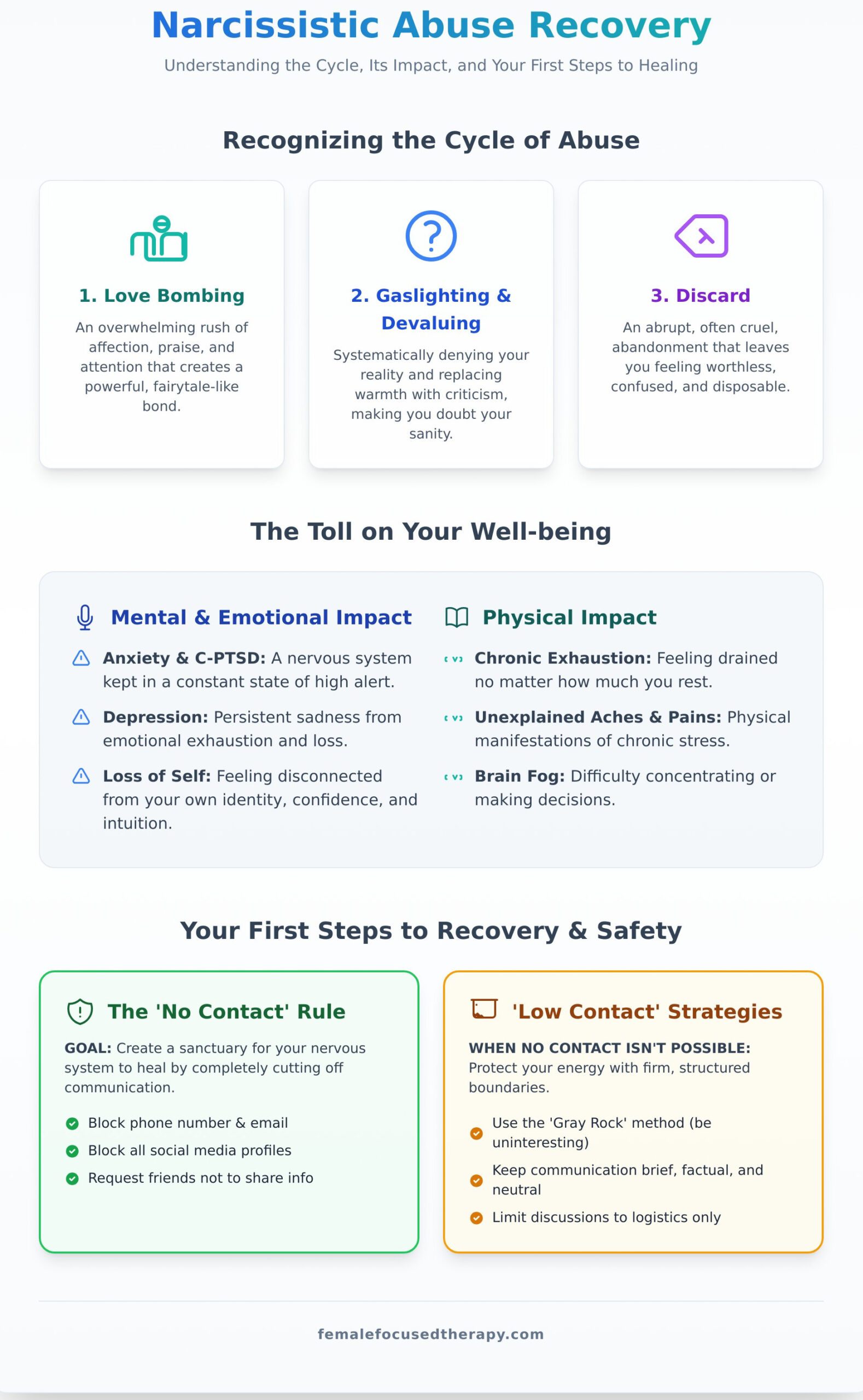
This type of abuse operates in a confusing cycle, which is why it can be so difficult to identify and leave. It often includes tactics that feel deeply personal and are designed to keep you off-balance:
- Love Bombing: An intense, overwhelming period of affection, praise, and attention at the beginning of a relationship. It feels like a fairytale, creating a powerful bond that becomes the benchmark you desperately try to return to.
- Gaslighting: The abuser systematically denies your reality, making you doubt your own memories and sanity. You might hear phrases like, “You’re being too sensitive,” “I never said that,” or “You’re imagining things.”
- Devaluing and Discarding: The warmth of love bombing is replaced by constant criticism, dismissiveness, and emotional withdrawal. This is followed by the final, often abrupt, discard, leaving you feeling worthless and abandoned.
The Toll on Your Mental and Physical Health
The constant stress of navigating this unpredictable environment takes a significant toll. It’s not just “in your head”; the impact is real and can manifest in many ways. Many women who experience this abuse develop conditions like anxiety, depression, and even Complex PTSD (C-PTSD) as their nervous systems are kept in a perpetual state of high alert.
Physically, you may be experiencing chronic exhaustion, unexplained aches, digestive issues, or a persistent “brain fog” that makes it hard to concentrate. More than anything, you may feel you’ve lost your sense of self-your confidence, your intuition, and your connection to your own identity. This feeling of being erased is a common and painful consequence of narcissistic abuse, and acknowledging it is a brave first step toward healing.
The First Steps on Your Recovery Path: Safety and Separation
Taking the first step to separate from a narcissistic partner is often the most difficult, yet most courageous, part of your journey. You may be feeling an intense mix of grief, relief, and confusion. Please know this is not a failure; it is a profound act of self-preservation. Acknowledging the powerful pull of the trauma bond is essential as you begin to navigate this tender stage of your narcissistic abuse recovery.
The Power of ‘No Contact’
The ‘No Contact’ rule is a powerful tool for healing. In practice, this means blocking their phone number, email, and all social media profiles, and asking mutual connections not to share information about you. This space is not about punishment; it is about creating a quiet sanctuary for your nervous system to calm down and for the fog to lift. It allows you to break the cycle of manipulation and begin rebuilding your self-trust, one day at a time.
When ‘No Contact’ Isn’t Possible: Low-Contact Strategies
For many women, especially those co-parenting or dealing with family members, ‘No Contact’ isn’t a realistic option. Here, we shift to a ‘Low-Contact’ approach. Strategies like the ‘Gray Rock’ method-where you become as emotionally uninteresting as a gray rock-can be incredibly effective. Communication should be structured, brief, and factual, often limited to a specific platform for logistics. These firm boundaries are vital to protect your emotional energy.
Creating Your Safe Haven
Your immediate priority is creating a safe haven, both physically and emotionally. This means surrounding yourself with people who validate your experience and offer genuine, non-judgmental support. Building a thoughtful Safety and Separation Plan can provide a clear, actionable roadmap during this uncertain time. This is a critical period where professional support can make all the difference, providing a confidential, trauma-informed space to process your experiences and safely guide the next steps in your healing.
Navigating the Emotional Aftermath: Processing Grief and Anger
The journey of narcissistic abuse recovery is rarely a straight line. Instead, it’s often a confusing and overwhelming landscape of emotions. You might feel a disorienting mix of love, rage, relief, and profound sadness-sometimes all at once. Please know that this is a completely normal part of the process. Healing is not linear, and every feeling that surfaces is a valid and necessary part of your path toward reclaiming your life.
Allowing Yourself to Grieve the Person You Thought They Were
A significant part of healing involves grieving, but it’s a complex kind of grief. You are not just mourning the end of a relationship; you are mourning the person you believed them to be and the future you carefully built in your mind. It’s okay to miss the ‘good times’ or the charm that once captivated you. Acknowledging these feelings doesn’t invalidate the abuse. It simply means you are honouring the loss of a powerful illusion-the potential you saw and the love you so deeply hoped for. Giving yourself permission to feel this loss is a vital step forward.
Working Through Anger and Betrayal in a Healthy Way
Anger is often a misunderstood emotion in recovery, but it can be one of your greatest allies. It is a natural, healthy response to injustice, manipulation, and betrayal. Your anger is a powerful signal that your boundaries were violated and your trust was broken. Instead of suppressing it, therapy provides a safe space to explore and channel it constructively. Healthy outlets can include:
- Journaling to release thoughts without judgment.
- Physical movement like walking, yoga, or dancing to release pent-up energy.
- Creative expression through art or music.
This powerful emotion can become the fuel you need to establish and maintain firm boundaries, protecting your peace as you move forward.
Overcoming Pervasive Self-Blame and Guilt
Narcissistic abuse is strategically designed to make you question your own reality and blame yourself. You may find yourself endlessly replaying events, wondering what you could have done differently to prevent the outcome. This persistent self-blame is a direct result of manipulation, not a reflection of your worth or character. It is crucial to understand that the emotional and psychological manipulation you endured is a key feature of this dynamic; a comprehensive overview of the Signs and Effects of Narcissistic Abuse often highlights how abusers instill this very guilt. Let me be clear: the abuse was never your fault. In therapy, we work together to cultivate self-compassion, helping you replace that harsh inner critic with a voice of kindness. True narcissistic abuse recovery involves learning to treat yourself with the gentleness you have always deserved.
Rebuilding from Within: Reconnecting with Your True Self
After investing so much emotional energy into understanding the abuse and the abuser, the focus of your healing can now gently shift inward. This is a hopeful and empowering stage dedicated entirely to you. It is here that we begin the vital work of rebuilding self-trust and fostering a deep reconnection with the person you were before the relationship, and the person you are now becoming. This reclamation of self is a cornerstone of sustainable narcissistic abuse recovery.
Rediscovering Your Identity, Hobbies, and Passions
Narcissistic abuse often forces you to shrink your world, compelling you to set aside your own interests and preferences to keep the peace. Reclaiming them is a joyful act of defiance. You might start by thinking back to activities you enjoyed before the relationship-perhaps it was walking through the Botanic Gardens, visiting a museum, or simply reading in a quiet café. It can also be incredibly powerful to explore something entirely new to create fresh experiences that belong only to you. The goal is to rediscover the simple pleasure of making a choice based purely on what brings you joy and comfort.
Learning to Trust Your Intuition Again
Perhaps the most damaging legacy of narcissistic abuse is the erosion of trust in your own judgment and perception. Constant gaslighting and criticism can leave you second-guessing every thought and feeling. Rebuilding this trust is like strengthening a muscle; it happens with gentle, consistent practice.
- Start with small decisions. When choosing what to eat or which path to take on a walk, notice your first gut feeling and try to honour it without over-analysing.
- Practice somatic check-ins. Throughout the day, pause and notice the sensations in your body. Does a situation make your shoulders tighten or your stomach clench? Your body holds wisdom your mind has been taught to ignore.
- Celebrate each step. Every independent decision, no matter how small, is a significant victory in reclaiming your inner compass.
Practicing Radical Self-Compassion
Self-compassion is not self-pity; it is the practice of offering yourself the same warmth and kindness you would extend to a dear friend. After enduring relentless criticism, learning to be gentle with yourself is a revolutionary act. This can be as simple as placing a hand on your heart, taking a deep breath, and silently offering yourself a kind phrase like, “This is a difficult moment,” or “May I be kind to myself.” This reframes self-care from an indulgence into a non-negotiable part of your healing journey.
This self-care can take many forms, from mindfulness practices to tangible actions that help you feel good in your own skin. For some, reclaiming their physical sense of self is a vital step. While based in Chile, an inspiring example is the approach taken by Clínica Corpórea, which focuses on aesthetic and hair treatments as a way to help individuals restore confidence and feel more like themselves. This illustrates how investing in your physical well-being can be a powerful act of self-reclamation on the path to recovery.
This path of reconnection is deeply personal, and you do not have to walk it alone. Therapy provides a safe, supportive space to navigate these steps at a pace that feels right for you. If you are ready to rebuild, you can learn more about how we support women on their healing journey.
How Trauma-Informed Therapy Can Support Your Recovery
Taking the step to seek professional support is an act of profound self-compassion and strength. After the disorienting experience of narcissistic abuse, therapy offers a safe harbour-a place to anchor yourself, process what happened, and begin to navigate your path forward with clarity and confidence. It is a dedicated space to support your healing and personal growth.
Why a Specialist in Narcissistic Abuse Matters
Navigating the aftermath of narcissistic abuse requires more than general support; it requires specialised understanding. A therapist experienced in this area comprehends the complex dynamics of trauma bonding, gaslighting, and psychological manipulation. This is a cornerstone of effective narcissistic abuse recovery. A trauma-informed approach ensures your story is met with validation, not doubt, creating a non-judgmental space where you can safely unpack your experiences without fear of being misunderstood or blamed. This professional guidance is invaluable in untangling the confusion and rebuilding your sense of reality.
What to Expect in Therapy for Narcissistic Abuse
Your healing journey is unique, and therapy is a collaborative process that always honours your pace. Together, we focus on gently rebuilding what was eroded. Our work may involve:
- Reconnecting with yourself: Rediscovering your values, needs, and sense of identity outside of the abusive dynamic.
- Rebuilding self-worth and self-trust: Learning to value your own perceptions and judgments again is a central goal.
- Setting healthy boundaries: Developing the skills to protect your emotional and mental wellbeing in all future relationships.
- Processing difficult emotions: Navigating complex feelings of grief, anger, and betrayal in a supportive environment.
We use an integrative approach, drawing from methods like Cognitive Behavioural Therapy (CBT) and mindfulness-based practices to help you develop practical coping skills. The goal is not just to heal from the past, but to empower you for a healthier, more authentic future. You don’t have to do this alone. Learn more about our supportive therapy for women.
Begin Your Journey to Reconnection and Healing
Navigating the path out of narcissistic abuse is a profound act of courage. The journey begins with the brave step of acknowledging what you have endured and understanding that your feelings of grief and anger are valid. From there, the gentle process of rebuilding can begin-reconnecting with the person you were always meant to be, separate from the narrative forced upon you. Remember that your journey of narcissistic abuse recovery is not one you have to walk alone.
Professional, trauma-informed therapy provides the guidance and safety needed to process your experiences and rebuild self-trust. At Female Focused Therapy, we specialize in creating a supportive, confidential space for women to heal. With online sessions available worldwide, you can access compassionate care from wherever you are, including right here in Singapore.
If you are ready to move forward with clarity and confidence, we invite you to take the next step. Begin your healing journey with a confidential consultation. Reclaiming your life is possible, and a future defined by your own strength and peace is waiting.
Frequently Asked Questions About Narcissistic Abuse Recovery
How long does narcissistic abuse recovery take?
There is no set timeline for healing, as each woman’s journey is unique. The duration of your narcissistic abuse recovery depends on many factors, including the length of the relationship and your support systems. Therapy provides a safe, non-judgmental space to process your experience at a pace that feels sustainable. The focus is on deep, lasting healing and rebuilding self-trust, not on rushing through a checklist. Your path is your own, and we honour that.
Will I ever feel like my old self again after narcissistic abuse?
This is a question many survivors ask. While the experience may change you, recovery is about integration and growth, not erasure. Therapy helps you reconnect with your core self while building new resilience, stronger boundaries, and a deeper sense of self-awareness. The goal is not just to return to who you were, but to move forward as a more empowered version of yourself, grounded in hard-won wisdom and self-compassion.
What is C-PTSD and how is it related to narcissistic abuse?
C-PTSD, or Complex Post-Traumatic Stress Disorder, often develops from prolonged, repeated trauma, which is characteristic of narcissistic abuse. Unlike PTSD from a single event, C-PTSD deeply impacts one’s sense of self, relationships, and emotional regulation. You might experience feelings of worthlessness, chronic anxiety, or difficulty trusting others. A trauma-informed therapist can help you navigate these complex effects and gently rebuild your sense of safety.
How can I explain what happened to friends and family who don’t understand?
It can feel incredibly isolating when others don’t grasp the nature of psychological abuse. You are not obligated to make everyone understand. It can be helpful to use simple phrases like, “It was an emotionally unsafe relationship, and I’m focusing on my healing now.” In therapy, we can explore ways to set boundaries around these conversations, helping you protect your energy for your own recovery journey.
Is it possible for a narcissist to change?
While we can all hope for positive change in others, true, lasting change for an individual with narcissistic personality traits is exceptionally rare. It requires a level of self-awareness and accountability that they are typically unable to access. Your energy is best invested in your own healing, safety, and wellbeing. Focusing on what you can control-your own path forward-is the most empowering choice you can make.
What is trauma bonding and how do I break it?
A trauma bond is a powerful emotional attachment to an abuser, created by an intense cycle of abuse and positive reinforcement. This bond can feel like love, which makes leaving so difficult. Breaking it begins with recognising the unhealthy pattern and creating distance, often through no-contact. In therapy, we work to rebuild your self-worth and help you learn what a secure, respectful connection feels like, which is a vital part of healing.