
You may be here because you feel an intense, magnetic pull toward someone who also causes you deep pain. It’s a confusing, exhausting cycle. Just one moment of connection followed by another of hurt, leaving you feeling isolated and questioning your own judgment. You might wonder, "If it’s so bad, why can’t I leave?" This powerful, often misunderstood attachment is not a sign of weakness; it’s a sign you may be experiencing a trauma bond.
This healing journey often involves professional support, and as you explore your options, you can discover more about Treatment for Mental Health Conditions that can guide your recovery.
Please know that you are not alone, and your feelings are entirely valid. This guide is designed to be a gentle, supportive resource on your journey toward clarity. We will help you navigate the complexities of this experience, offering a safe space to understand what a trauma bond truly is and why it feels so inescapable. Together, we will explore the signs and causes, and most importantly, illuminate a compassionate path toward breaking free, rebuilding your self-trust, and beginning the process of healing.
What Is a Trauma Bond? Understanding the Invisible Chains
If you feel deeply connected to someone who consistently causes you pain, you are not alone. This confusing mix of love and hurt can be incredibly isolating, making you question your own judgment. What you may be experiencing is a powerful psychological attachment known as a trauma bond. In simple terms, and as detailed in encyclopedic resources explaining traumatic bonding, this is a strong emotional bond that forms with an abuser as a result of a recurring cycle of mistreatment. It is crucial to understand that this is not a character flaw or a sign of weakness; it is a powerful survival instinct, an attempt to navigate an unsafe situation by attaching to the source of that danger.
The Cycle of Abuse: How Trauma Bonds Are Formed
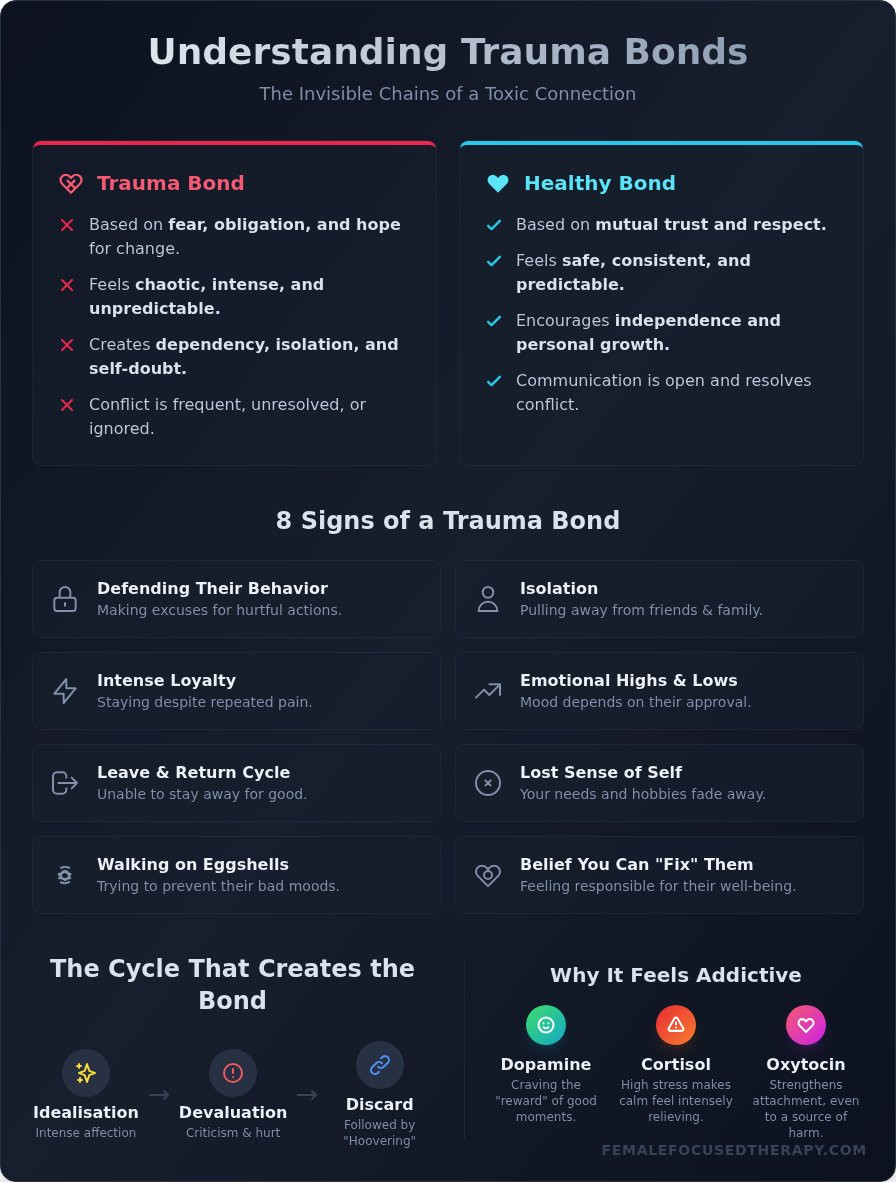
These bonds are forged in inconsistency. This pattern, known as intermittent reinforcement, works just like a slot machine: the unpredictable rewards keep you hooked, hoping for the next "win." The cycle often includes stages of idealisation (intense affection), devaluation (criticism), and discard, followed by "hoovering" (attempts to pull you back in with kindness). For example, a partner might shower you with praise for a week (idealisation), then spend days criticising everything you do (devaluation), creating a desperate hope for the "good times" to return and reinforcing the bond.
Trauma Bonding vs. Healthy Love: Key Differences
The intensity of a trauma bond is often mistaken for deep passion, but it feels fundamentally different from the security of a healthy connection. Healthy love fosters growth and self-trust, while a toxic bond diminishes you. Here are some key differences:
Healthy Bond:
-
Based on mutual trust and respect.
-
Feels safe, consistent, and predictable.
-
Encourages your independence and growth.
-
Communication is open and resolves conflict.
Trauma Bond:
-
Based on fear, obligation, and hope.
-
Feels chaotic, intense, and unpredictable.
-
Creates dependency and isolation.
-
Conflict is frequent, unresolved, or ignored.
The ‘Addiction’ Explained: The Science Behind the Bond
There is a biological reason this connection feels so addictive. Your brain’s chemistry becomes dysregulated by the extreme highs and lows of the abuse cycle. Three key chemicals play a significant role:
-
Dopamine: The "feel-good" chemical floods your brain during the brief, positive moments, creating a powerful craving for that reward.
-
Cortisol: The constant stress and fear keep your body in a high-alert state, making the moments of calm feel intensely relieving.
-
Oxytocin: The "bonding" hormone, released during moments of affection, strengthens your attachment even when it is to a source of harm.
7 Signs You Are Experiencing a Trauma Bond
Recognising the signs of a trauma bond is a courageous first step towards reclaiming your sense of self. It can be a confusing and painful experience, often leaving you questioning your own reality. As you read through these signs, please be gentle with yourself. This isn’t about judgment; it’s about gaining clarity. These powerful attachments can form in any type of relationship: With a romantic partner, a family member, or even a colleague. You may notice that some of these indicators, which are widely acknowledged by health experts, feel deeply familiar.
Emotional and Psychological Indicators
Often, the first signs of a trauma bond are felt internally. It’s a quiet shift in your emotional landscape that can be difficult to pinpoint. You may notice that you:
-
Defend or make excuses for their behaviour. You might find yourself justifying their hurtful actions to concerned friends or family, or even to yourself, often minimising the harm they’ve caused.
-
Feel an intense sense of loyalty. Despite repeated betrayals, lies, or emotional pain, you feel a powerful, unshakable loyalty to them and the relationship.
-
Isolate yourself from your support system. When friends and family express concern, you may pull away from them to protect the relationship, leading to profound loneliness.
-
Experience extreme emotional highs and lows. Your mood becomes entirely dependent on their approval or attention. The small moments of kindness feel euphoric, making the periods of neglect or abuse feel even more devastating. This intense cycle is a key part of what makes a trauma bond so difficult to break.
Behavioral Patterns to Recognize
These internal feelings often manifest in your actions and choices. Your behaviour can become a clear reflection of the bond’s powerful hold. You may find yourself:
-
Repeatedly trying to leave, only to return. You know the relationship is unhealthy and may have attempted to end it multiple times, but the intense emotional pull and their promises of change draw you back in.
-
Feeling like you’ve lost your identity. Your own opinions, hobbies, and sense of self have faded into the background. Their needs and desires have become your primary focus.
-
Constantly walking on eggshells. You spend a significant amount of energy trying to anticipate their moods and manage their emotions to prevent conflict or disapproval.
-
Believing you are the only one who can ‘fix’ or ‘understand’ them. You may feel a deep sense of responsibility for their wellbeing, believing that your love and patience are the keys to helping them change.
Your Path to Freedom: How to Start Breaking a Trauma Bond
Beginning the journey to break a trauma bond is one of the most courageous steps you can take. Please know that this is a process, not a single event. It requires immense patience and self-compassion. The goal is not to make a dramatic leap overnight, but to take small, sustainable steps that gently shift the power back to you, all at a pace that feels safe and manageable.
Step 1: Acknowledge the Reality of the Situation
The first, most vital step is to gently move past denial and acknowledge that the relationship is harmful. Understanding the mechanics of What Is Trauma Bonding? can be an illuminating part of this process, helping you see the cycle for what it is. Consider starting a private journal to document events and, more importantly, how they make you feel. This creates a personal record you can turn to when doubt or confusion sets in. Above all, practice self-compassion. You are not to blame for being in this situation; you were surviving.
Step 2: Reconnect with Your Support System
A trauma bond thrives in isolation. Rebuilding your connections with the outside world is a powerful way to weaken its hold. Start by identifying one or two trusted friends or family members you can confide in. You don’t need to share every detail at once; simply opening a small window for support can make a world of difference. Hearing an outside perspective can help reinforce your new understanding of the situation. Re-engage in social activities or hobbies that you enjoy, separate from the other person, to begin rebuilding your sense of self.
Step 3: Create Distance and Set Boundaries
Creating physical and emotional space is crucial for healing. If it is safe to do so, implementing a ‘no contact’ or ‘low contact’ rule can stop the cycle of idealisation and devaluation. This often includes blocking them on social media to prevent ‘hoovering’-attempts to draw you back in. If you have any concerns about their reaction or your physical safety, it is essential to create a safety plan. Setting these boundaries can feel overwhelming and even unsafe to do alone. Professional support can guide you through this process safely.
Healing and Rebuilding: Life After a Trauma Bond
Breaking free is the first courageous step; the next is the gentle, steady journey of coming home to yourself. Healing is not about erasing the past, but about building a new foundation for your future-one grounded in safety, self-worth, and authentic connection. It is entirely possible to move forward with clarity and confidence.
As you navigate this path, it’s important to acknowledge any grief you may feel. It is perfectly normal to mourn the relationship you wished you had and the future you envisioned. Allowing yourself to feel these emotions without judgment is a vital part of the healing process after leaving a trauma bond.
The Role of Trauma-Informed Therapy in Your Recovery
A trauma-informed therapist provides a confidential, non-judgmental space where you can safely process your experiences. This partnership is designed to help you understand the roots of your attachment patterns, learn to regulate your nervous system when triggers arise, and begin the essential work of rebuilding self-trust. Together, we can navigate the complexities of your healing at a pace that feels right for you.
Reconnecting With Your Authentic Self
This phase is a beautiful opportunity for rediscovery. After being in a relationship that may have diminished your sense of self, it’s time to reconnect with the person you are. This often involves small, intentional steps that honor your own wellbeing:
-
Rediscover your passions: Re-engage with hobbies, interests, and creative outlets you may have set aside.
-
Embrace solitude: Spend quiet time alone to get comfortable in your own company and listen to your inner voice again.
-
Define your values: Clearly identify your personal needs, values, and non-negotiables for all future relationships.
Learning What Healthy Connection Feels Like
After the intense highs and lows of a toxic dynamic, healthy love can feel surprisingly calm. The goal is to retrain your nervous system to recognise safety and stability over chaos. This means learning to identify ‘green flags’ like mutual respect, consistency, and emotional safety. It’s about understanding that healthy connection is a steady partnership, not a rollercoaster. Rebuilding your ability to trust your own judgment is the ultimate goal in moving forward from a trauma bond.
If you are in Singapore and ready to begin this journey of healing and self-reconnection, our female-focused therapy services are here to support you.
Reclaiming Yourself: Your Path Forward After a Trauma Bond
Understanding that a trauma bond is a powerful psychological response to abuse-not a sign of weakness-is the first, most crucial step toward freedom. Recognizing the signs in your own life is a courageous act of self-awareness that opens the door to healing. Remember, breaking these invisible chains isn’t about erasing the past, but about intentionally rebuilding your sense of self and learning to trust your own inner voice once more.
You do not have to navigate this complex journey alone. At Female Focused Therapy, we specialize in providing trauma-informed therapy for women, particularly those in narcissistic abuse recovery. We are dedicated to creating a safe, supportive space where you can feel heard and understood as you heal and grow. If you are ready to move forward with clarity and confidence, we are here to support you. Ready to begin your healing journey? Book a confidential consultation today.
Your future is waiting, and it can be one filled with peace, strength, and authentic connection. The path forward starts now.
Frequently Asked Questions About Trauma Bonds
How long does it take to heal from a trauma bond?
Healing is a deeply personal journey, not a race with a finish line. The time it takes to recover varies for everyone, depending on the length of the relationship, your personal history, and the support you have. It’s important to be gentle with yourself. The focus should be on steady progress and rebuilding self-trust at a pace that feels safe and sustainable for you, rather than on a specific timeline. True healing is about reconnection with yourself.
What is the difference between trauma bonding and codependency?
While they can overlap, codependency is a broader pattern where you might prioritise your partner’s needs over your own, often feeling responsible for their emotions. A trauma bond, however, is a specific and powerful attachment formed within a cycle of abuse. It is forged through intermittent reinforcement-periods of kindness mixed with cruelty-which creates an intense, addictive-like connection to the abuser. Not all codependent relationships involve this distinct cycle of harm.
Is it my fault that I developed a trauma bond?
Let us be perfectly clear: it is never your fault. Developing a trauma bond is a psychological and physiological survival response to a dangerous and confusing situation. It is not a sign of weakness or a character flaw, but a testament to your brain’s attempt to survive by connecting with the very person causing you harm. You were navigating an impossible dynamic, and this bond was a natural way your system tried to cope and stay safe.
Can an abuser change and the relationship become healthy?
While it is natural to hope for change, it is exceptionally rare for an abusive dynamic to transform into a healthy one. Genuine change requires the abuser to take full accountability and engage in long-term, specialised therapy to address their behaviour. Your priority must be your own safety and wellbeing. Focusing your energy on healing yourself, rather than on the hope they will change, is the most empowering path forward to regaining your confidence and clarity.
How do I cope with the intense loneliness after leaving a trauma-bonded relationship?
The loneliness can feel overwhelming because the bond was all-consuming, even though it was harmful. It’s vital to begin reconnecting with your own needs and interests. Start by reaching out to a trusted friend or family member. Explore gentle activities that bring you a sense of calm or joy, like walking in nature or rediscovering a hobby. Remember, this is a time for nurturing yourself and rebuilding a supportive community at your own pace.
Why do I miss the person who abused me?
Missing the person who hurt you is a very common and confusing part of the healing process. You are not missing the abuse; you are likely missing the moments of perceived love, hope, and connection. These intermittent rewards create a powerful biochemical bond in the brain, similar to an addiction. Your mind is grieving the loss of the person you hoped they were and the future you imagined, which is a completely normal part of this journey.

Article by
Cheryl Kennedy MacDonald MA BA (Hons) Pg. Dip. SAC BACP
Cheryl Kennedy MacDonald is a psychotherapist specialising in women’s mental health, relationships, and life transitions. She works with women navigating trauma, relationship breakdown, identity shifts, and midlife change, helping them rebuild self-trust, emotional stability, and a clear sense of who they are and what they want.
With over 20 years’ experience working with women internationally, Cheryl is the founder of YogaBellies, a global women’s yoga school, and the creator of the Birth ROCKS method. Her work sits at the intersection of psychotherapy and embodiment, integrating evidence-based therapeutic approaches with somatic, body-based practices that support deep, lasting change.
Known for her grounded and direct approach, Cheryl moves beyond surface-level insight to address the patterns held in the body and nervous system. Her work supports women to regulate, reconnect, and respond to their lives from a place of clarity, strength, and self-respect.
She is a published author in academic journals and has written multiple books on women’s health, pregnancy, and midlife wellbeing, available on Amazon and leading book retailers worldwide.