
You look back at your childhood photos and see family holidays, birthday cakes, and parents who were always present. Yet, as an adult, you carry a quiet, heavy loneliness that you can’t quite explain. It feels almost ungrateful to admit that something was missing when you had so much on the surface.
I know how difficult it is to reconcile these conflicting truths. When your parent was loving but emotionally unavailable, you often learn to prioritize their needs or your own high achievements just to feel seen. You might find yourself constantly striving for perfection while deeply doubting whether your own emotions are even valid.
I will help you understand why you feel this lingering emptiness despite having what looked like a good childhood. My goal is to guide you toward emotional restoration without needing to diagnose or blame your parents for their own limitations. We can acknowledge your wounds while still holding onto the love you felt.
We’ll explore how to regulate your emotional intensity and rebuild the self-trust you might have lost along the way. By combining psychological insight with gentle somatic awareness, you can finally begin to feel grounded in your own skin and certain of your own heart.
Key Takeaways
- You’ll learn to bridge the gap between being physically provided for and being emotionally seen, validating that lingering sense of loneliness you carry.
- I’ll help you identify the subtle signs of internalised survival strategies, such as over-explaining or fear of conflict, which often develop when your parent was loving but emotionally unavailable.
- We’ll navigate the complex guilt of naming your childhood wounds, allowing you to acknowledge what was missing without feeling like you’re betraying your parents.
- You will discover why ‘talking it out’ isn’t always enough and how somatic practices can gently regulate your nervous system and process what the mind cannot yet name.
- I’ll show you how an integrative approach to therapy can help you rebuild a foundation of self-trust and internal restoration.
Understanding the Gap Between Being Provided For and Being Seen
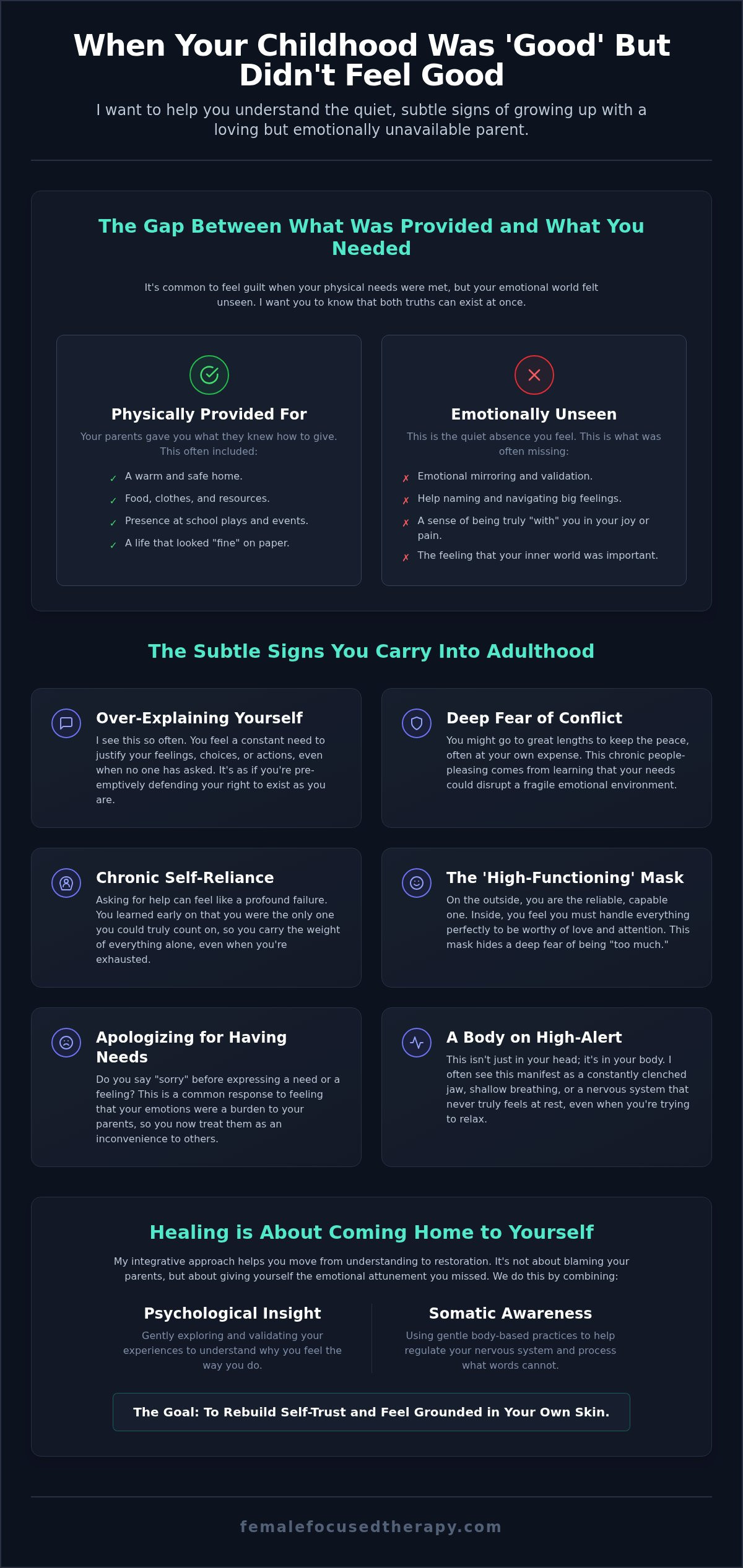
I often meet women in my online therapy practice who feel a deep sense of guilt for even seeking support. They tell me their childhood was “fine.” They had a warm house, clothes that fit, and parents who never missed a school play. Yet, beneath that surface of stability, they carry a heavy, silent loneliness that feels impossible to name.
This experience is common when your parent was loving but emotionally unavailable. It is a confusing dynamic because there is no obvious “bad guy.” Emotional unavailability doesn’t mean your parents didn’t care. It means they could provide for your physical needs but were unable to mirror your internal world.
I see this often as a result of “attunement” gaps. Attunement is that precious feeling that someone is truly “with” you in your joy or your fear. When this is missing, it’s usually because the parent is navigating their own unhealed trauma, their own neurodivergence, or perhaps a cultural conditioning that taught them emotions were things to be managed rather than felt.
When ‘Fine on Paper’ Doesn’t Feel Fine
I want you to know that your physical safety doesn’t negate your emotional hunger. You can be grateful for the roof over your head while still mourning the connection you lacked. There is a vast difference between a parent who is “there” and a parent who is “present.”
When a parent is present, they look into your eyes and see the “you” behind the behaviour. If they are merely “there,” they might be physically in the room but emotionally miles away. For many high-functioning women, this dynamic leads to “perfect daughter” syndrome. You learned that being high-achieving and low-maintenance was the only way to get a sliver of that elusive attention.
The Quiet Absence of Emotional Mirroring
Emotional mirroring is the vital foundation of self-trust, acting as a reflection that tells you your feelings are real and valid.
What happened when you had big emotions as a child? Perhaps you were met with silence, a quick distraction, or a parent who immediately tried “fixing” the problem instead of sitting in the discomfort with you. This absence of comfort leaves a mark. In your adult relationships today, it often manifests as a chronic need to over-explain yourself or a deep fear that if you show your true intensity, you’ll be too much for others to handle. Understanding this gap is the first step toward relationship recovery and internal peace.
The Subtle Signs of Growing Up with Emotional Unavailability
I find that these signs are often so subtle they feel like a normal part of your personality. You might think you’re just “the reliable one” or “a natural leader” in your social circle. In reality, these traits are often internalised behaviours developed to bridge the gap left by an emotionally distant parent.
When your parent was loving but emotionally unavailable, you didn’t learn to trust that others would hold your feelings. Instead, you learned to manage yourself. This often manifests in recognisable ways:
- Over-explaining your reasons or actions, even when no one has asked.
- A deep fear of conflict that leads to chronic people-pleasing.
- Chronic self-reliance, where asking for help feels like a personal failure.
You carry a “high-functioning” mask that tells the world you’re fine. Inside, you feel you must handle everything alone because you grew up believing no one was truly coming to help. This shows up in your body as a constant state of alert. You might live with shallow breathing or a jaw that never quite unclenches, even when you’re supposed to be resting.
Recognising Your Own Coping Mechanisms
Do you find yourself constantly apologising for simply having needs or feelings? This is a common response to feeling that your emotions were a burden to your parents. For many of the women I work with, there is a clear link between childhood emotional neglect and adult Understanding ADHD in Women.
If you weren’t taught to name and soothe your feelings as a child, the sensory and executive function overwhelm of ADHD can feel entirely unmanageable. You might feel you’re failing at life, when you’re actually just navigating a brain that needs the emotional foundation you missed.
The Internalised Voice of the Unavailable Parent
You might have learned to dismiss your own feelings before anyone else could. It’s a defensive reflex to protect yourself from the pain of being ignored. This creates a relentless “hustle for worthiness” in your career and your friendships. You work twice as hard to feel half as seen.
I often see this “shutdown” happen during moments of deep emotional intimacy. When things get too close, your body might go numb or push people away to maintain that safety of self-reliance. If you’re tired of carrying this weight alone, you might find it helpful to explore these patterns in therapy where we can work on unmasking your true self.
Moving Past the Guilt of Naming Your Childhood Neglect
I want to be very clear: acknowledging the gaps in your upbringing is not a betrayal of your parents’ love. Many women I work with feel a deep, gnawing guilt when they begin to name their childhood wounds. It feels “bad” or ungrateful to admit you were hurt by people who did their absolute best to provide for you.
This guilt often stems from a misconception that healing requires us to vilify our families. I’ve found that when your parent was loving but emotionally unavailable, the pain is quieter and harder to pin down. It isn’t about what they did, but what they were unable to do. You aren’t “making things up” just because your physical needs were met.
In the therapeutic process, we move away from blame and toward honest observation. We aren’t looking for someone to “fix” or a confrontation to have. Instead, we are simply mapping the emotional landscape of your life to understand why you feel a lingering emptiness today. This honesty is the only way to build a foundation of true self-trust.
Honouring Two Truths at Once
You can love your parents deeply and still have been profoundly hurt by their emotional distance. These two realities can coexist without one cancelling out the other. It’s possible to hold compassion for their limitations while still prioritising your own emotional restoration. You don’t need their permission to acknowledge your own experience.
As I often tell my clients: “Your inner child doesn’t need a villain to justify her pain; she simply needs a witness to validate her experience.” By becoming that witness for yourself, you stop waiting for an apology that may never come and begin to heal from the inside out. You are allowed to take up space with your own truth.
Breaking the Cycle of Emotional Inheritance
When we look closely, we often see that emotional unavailability is an inherited family “inheritance” rather than a conscious personal choice. Your parents likely didn’t receive the emotional mirroring they needed either. They couldn’t give you what they didn’t possess themselves. It was a relay race of unmet needs passed down through the years.
Realising this allows us to shift from resentment to a boundaried kind of empathy. By doing this work, you are actively preventing this pattern from passing to the next generation. You are choosing to be the one who stops the cycle. If you’re ready to explore these dynamics further, my work in Relationship Trauma & Recovery provides a safe, non-judgmental space to unpick these threads.
Somatic Practices to Regulate Your Overwhelmed Nervous System
I believe that healing emotional neglect starts in the body, not just the mind. While understanding your history is vital, “talking it out” isn’t always enough for women who have lived in survival mode for decades. Your mind might understand that you are safe now, but your nervous system often needs more tangible proof.
When your parent was loving but emotionally unavailable, your body learned to stay on high alert. You might have developed a hyper-vigilance to the smallest shifts in their mood, constantly scanning for a sign of connection. This chronic state of “alert” doesn’t just disappear once you leave home; it stays stored in your tissues and your breath.
Healing involves gently moving your system from “fight or flight” into a state of “rest and digest.” We want to teach your body that it is finally safe to unmask and relax. This internal restoration happens through small, consistent somatic practices that ground you in the present moment rather than the echoes of the past.
Breath and Movement as Emotional Anchors
I use the breath to signal safety to a body that has historically felt invisible. When you breathe deeply into your belly, you are physically telling your brain that there is no immediate threat. It is a simple but profound act of self-care that helps you reclaim your space in the world.
Gentle movement allows you to reconnect with physical sensations you may have suppressed to stay “low-maintenance” as a child. By focusing on how your body feels from the inside out, you begin to inhabit your own skin again. You can explore these themes further through Somatic Movement & Yoga for Women.
Creating Internal Safety and Rest
For a high-functioning woman, the idea of “doing nothing” can feel incredibly threatening. Your nervous system might associate rest with being unproductive or losing the sliver of attention you worked so hard to get. Learning to rest is an essential part of rebuilding self-trust and reclaiming your energy.
If you feel emotionally overwhelmed, try this 3-step grounding exercise:
- Feel the weight of your feet firmly on the floor and notice the physical support of the chair or ground beneath you.
- Place one hand on your heart and one on your belly to feel the warmth and presence of your own body.
- Exhale for twice as long as you inhale, which helps to soothe the vagus nerve and signal safety to your brain.
These practices help you listen to the “whispers” of your body before they become the “shouts” of burnout or illness. If you find it difficult to settle your system on your own, I invite you to book a session so we can work on these somatic tools together in a safe, guided space.
How My Integrative Approach Supports Your Emotional Restoration
I work with women to rebuild that missing foundation of self-trust and internal stability. When your parent was loving but emotionally unavailable, you often missed out on the fundamental mirroring that confirms your inner world is valid. My goal is to help you find that safety within yourself, perhaps for the very first time.
My approach is intentionally integrative. We look at the mind, the body, and your unique history as parts of a single, connected story. By combining traditional psychotherapy with somatic awareness, we can address the deep-seated patterns that talk therapy alone sometimes misses. We work with the whole of you.
In our work together, therapy provides the attunement you may have missed as a child. This therapeutic relationship acts as a gentle, corrective experience where your emotions are finally met with presence rather than distraction or silence. I offer a safe, confidential space in Singapore and online for you to explore these truths.
A Safe Space to Unmask and Heal
A typical session with me is gentle, unhurried, and deeply supportive. We move at a pace that respects your nervous system, ensuring you never feel overwhelmed by the process. There is immense power in being truly seen and heard by a trauma-informed guide who understands your specific challenges as a high-functioning woman.
You can read more About My Therapeutic Approach to see how I combine evidence-based psychology with mind-body practices. This space is designed for you to finally unmask. You don’t have to perform or achieve here; you simply have to be, and that is enough.
Your Next Step Toward Restoration
You don’t have to carry this silent loneliness alone anymore. The heavy weight of chronic self-reliance is something we can unpick together, allowing you to find a more sustainable way of being. I invite you to book a consultation to see if we are a good fit for your journey toward restoration.
If you’re looking for one realistic next step to take today, I suggest this simple practice. Take five minutes to just sit and notice where you feel tension in your body. Don’t try to fix it or judge it. Just acknowledge that your body is holding something for you, and give it a moment of your kind attention.
Your Journey Toward Emotional Restoration
Healing isn’t about blaming your parents or erasing the love you felt. It’s about finally acknowledging the quiet gaps that left you feeling invisible as a child. When your parent was loving but emotionally unavailable, you learned to adapt by being “perfect” or entirely self-reliant. Now, you can choose a different path.
Through my work as a registered integrative psychotherapist, I’ve seen how powerful it is to combine mind-body tools with compassionate enquiry. We can move beyond the guilt of naming your needs and begin the process of internal restoration. You deserve to feel seen and understood, not just provided for.
I’m here to support you with a trauma-informed, integrative approach that respects both your mind and your body. You don’t have to carry the weight of this loneliness alone. It’s time to trust your own emotions and build a foundation of true self-reliance that feels steady and safe.
I invite you to book your consultation with me to begin your journey of restoration. You’ve spent so long looking after everyone else; let’s create a space where your healing is the priority.
Frequently Asked Questions
Is it really neglect if my parents were loving and never hit me?
Yes, emotional neglect is about the absence of emotional response rather than the presence of physical harm. While physical abuse is a visible act, emotional unavailability is the invisible absence of mirroring and attunement. When your parent was loving but emotionally unavailable, they might have met every physical need while leaving your internal world feeling lonely. You don’t need a visible wound to justify the deep hunger you feel for connection today.
Can I heal from emotional unavailability without confronting my parents?
You can absolutely heal without ever confronting your parents directly. Healing is an internal journey of restoration and rebuilding your own self-trust. It doesn’t depend on their ability to admit their limitations or apologise for the past. I work with women to find closure within themselves, creating a safe internal space where their experience is finally witnessed and validated by their own adult self, regardless of how their family might respond.
How do I know if I’m high-functioning or just coping with childhood trauma?
If you’re performing well at work and keeping up appearances but feel hollow or exhausted inside, you’re likely coping through high-functioning survival strategies. This often happens because you learned that your worth was tied to what you could do rather than who you were. You’ve built a life that looks successful on paper, yet you still feel like you’re waiting for someone to notice the real, overwhelmed person behind the mask.
Why do I feel so guilty for being unhappy with my childhood?
You feel guilty because you were cared for physically, making it feel wrong to name the emotional gaps. Society often tells us that if we had food and safety, we should be grateful. However, emotional attunement is a biological necessity for a child’s development. Acknowledging that you missed this isn’t an act of ingratitude; it’s an act of honesty about your own development. You can be thankful for the roof while mourning the connection.
What is the difference between emotional unavailability and just being a quiet parent?
A quiet parent can still be deeply attuned and present through their gaze, their touch, or their steady presence. Emotional unavailability is different; it’s a lack of mirroring where your feelings were met with a blank wall, a distraction, or an attempt to fix you. It’s the difference between a parent who is comfortable with silence and one who uses silence as a shield to avoid the depth of your emotional needs.
Can somatic therapy help even if I don’t remember specific bad events?
Somatic therapy is incredibly effective even if you don’t have clear narrative memories of specific events. Your nervous system remembers the feeling of being invisible or too much even if your mind doesn’t. We work with the tension and the patterns held in your body today. By regulating your nervous system in the present, we can heal the echoes of the past without needing to reconstruct every single childhood detail or conversation.
How long does it typically take to feel more emotionally secure in therapy?
Healing is a steady journey of restoration rather than a quick fix. Most women I work with begin to feel a renewed sense of internal stability and self-trust within a few months of consistent therapy. The timeline depends on your unique history and how long you’ve been living in survival mode. We move at a pace that feels manageable for your nervous system, ensuring the changes you make are grounded and lasting.
Do you offer online therapy for women outside of Singapore?
Yes, I offer online therapy for women across the globe, providing a safe and confidential space regardless of your location. While I am based in Singapore, my practice is designed to support high-functioning women through life transitions and relationship trauma wherever they are. This global accessibility ensures that you can receive specialised, trauma-informed support from the comfort of your own home, fitting into your life at a pace that works for you.

Article by
Cheryl Kennedy MacDonald MA BA (Hons) Pg. Dip. SAC BACP
Cheryl Kennedy MacDonald is a psychotherapist specialising in women’s mental health, relationships, and life transitions. She works with women navigating trauma, relationship breakdown, identity shifts, and midlife change, helping them rebuild self-trust, emotional stability, and a clear sense of who they are and what they want.
With over 20 years’ experience working with women internationally, Cheryl is the founder of YogaBellies, a global women’s yoga school, and the creator of the Birth ROCKS method. Her work sits at the intersection of psychotherapy and embodiment, integrating evidence-based therapeutic approaches with somatic, body-based practices that support deep, lasting change.
Known for her grounded and direct approach, Cheryl moves beyond surface-level insight to address the patterns held in the body and nervous system. Her work supports women to regulate, reconnect, and respond to their lives from a place of clarity, strength, and self-respect.
She is a published author in academic journals and has written multiple books on women’s health, pregnancy, and midlife wellbeing, available on Amazon and leading book retailers worldwide.