
I’ve sat with so many women who describe that exact moment: the phone vibrates with a call from a parent, and suddenly, the confident, capable adult you’ve become just disappears. Despite your professional success and your own life here in Singapore, you find yourself slipping back into the role of a child, feeling that familiar weight of expectation and a deep, nagging sense of guilt.
Setting boundaries with parents as an adult is often one of the most difficult shifts we ever have to make. It’s exhausting to feel like you’re constantly performing or apologising just to keep the peace. You might even find yourself physically tensing up before a family visit, bracing for the emotional drain that always seems to follow.
I understand how heavy this feels, but I also know that it’s possible to change this dynamic without losing your kindness. I’m going to help you navigate these complex emotions so you can reclaim your space and build a foundation of self-trust. We’ll look at practical ways to protect your energy and move toward a relationship where you finally feel like a respected equal.
Key Takeaways
- I’ll help you understand why you might feel small in your parents’ presence and how to bridge the gap between your successful adult life and your family role.
- You will learn to recognise the internal “red flags” like resentment or physical dread that signal when your personal space needs more protection.
- We will explore how Setting Boundaries with Parents as An Adult is an act of internal restoration that helps you release unearned guilt.
- I’ll share a gentle, drama-free framework for communicating your needs clearly without damaging the relationship.
- You’ll discover how to use somatic tools like breath and movement to let go of the tension that often follows family interactions.
Why it feels so difficult to set limits with parents
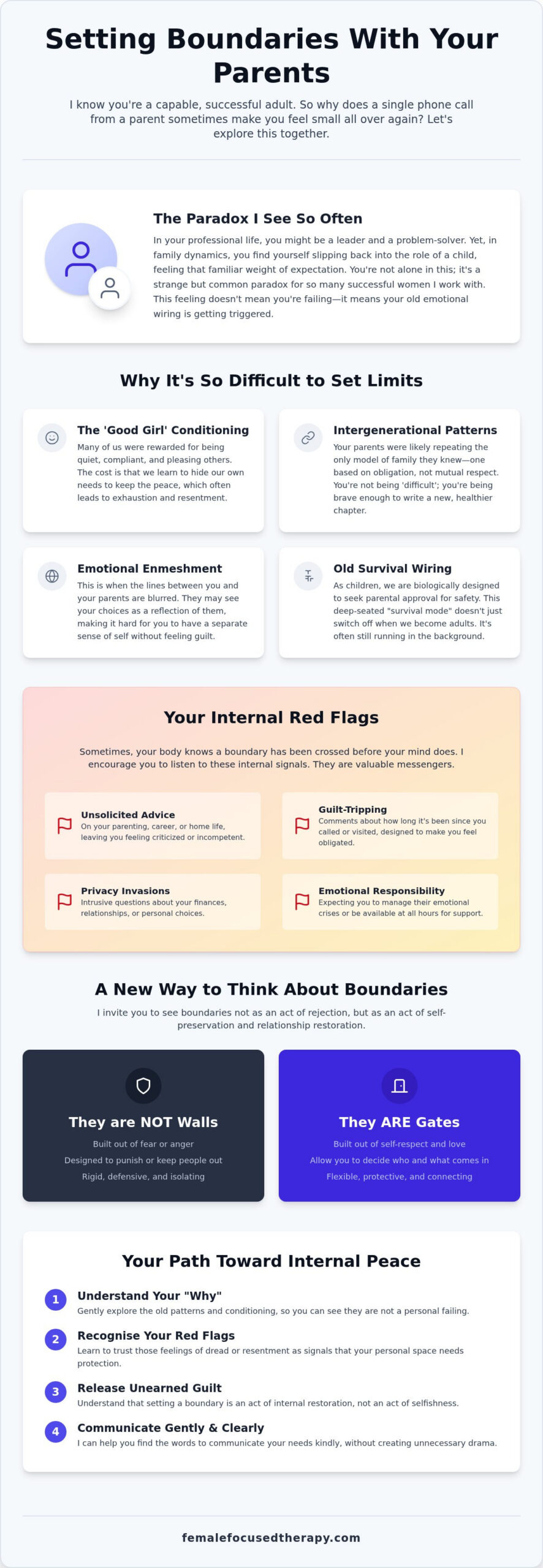
It is a strange sensation to be a successful, independent woman who suddenly feels five years old again the moment her mother sighs on the phone. I see this paradox constantly in my therapy room. You might be a leader in your field or a pillar of your community, yet you still find yourself shrinking in their presence. This happens because our early childhood wiring is incredibly persistent.
We are biologically designed to seek parental approval as a means of safety. That “survival mode” doesn’t just switch off because we’ve reached our 40s or 50s. When we talk about Setting Boundaries with Parents as An Adult, we have to address things like enmeshment, where the emotional lines between you and your parents are messy and blurred.
You might even find yourself in a “role reversal,” where you have become the emotional caretaker for the very people who were supposed to protect you. It is important to remember that boundaries are not walls designed to keep people out; they are the gates that allow you to stay in the relationship without losing your sense of self.
The ‘Good Girl’ conditioning and its cost
Many of the women I work with were raised with the heavy expectation of being the “good girl.” This usually means you were rewarded for being quiet, compliant, and hyper-aware of your parents’ moods. You became the emotional caretaker, the one who smoothed things over and kept the peace at any cost.
The cost, however, is often a deep sense of physical exhaustion. Constant people-pleasing is a high-stakes performance that leaves very little room for your own needs or rest. I invite you to consider if you are currently masking your true self just to avoid a conflict. When you hide your needs, you aren’t actually building a connection. You are just maintaining a silence that eventually turns into resentment.
Recognising the role of intergenerational patterns
It is also helpful to acknowledge that your parents likely didn’t have boundaries with their own folks. They might be repeating the only model of family life they ever knew, one based on obligation rather than mutual respect. In my work helping women navigate relationship trauma, we often explore how these patterns are handed down through generations.
You can view your parents’ behaviour with compassion, understanding that they lack the tools you are now developing, without excusing the impact their actions have on your mental health. Recognising that this is a “family script” can help you feel less like a “difficult daughter.” It allows you to see yourself as the person brave enough to start a new, healthier chapter for the whole family.
Identifying where your boundaries are being crossed
Identifying exactly where the line is can be tricky when it’s been blurred for decades. I often ask my clients to pay attention to their “internal red flags.” If you feel a heavy sense of dread when a text message pops up, or a sharp spike of resentment after a “helpful” comment, that is your intuition telling you a boundary has been crossed.
These violations aren’t always loud or aggressive. They often look like:
- Unsolicited advice on your parenting, career, or home life.
- Guilt-tripping about how long it’s been since you last visited or called.
- Privacy invasions, such as asking intrusive questions about your finances or your marriage.
- Expecting you to be available at all hours to manage their emotional crises.
Setting Boundaries with Parents as An Adult becomes essential when you start to feel constantly overwhelmed by these expectations. You aren’t being “difficult” or “ungrateful” by wanting to protect your peace. You’re simply acknowledging that your energy is finite and valuable, and you have every right to decide how it is spent.
When ADHD and neurodivergence enter the room
For my neurodivergent clients, these interactions can feel even more intense. If you have ADHD, parental criticism can trigger Rejection Sensitive Dysphoria (RSD), making a small comment feel like a sharp physical blow. You might also experience sensory overwhelm during family gatherings in Singapore, where loud dinners and overlapping conversations lead to a total emotional “shutdown.” I explore these specific challenges more deeply on my ADHD therapy page, as understanding your brain is the first step toward protecting it.
The subtle signs of emotional enmeshment
I often see women caught in the “we” trap. This happens when a parent doesn’t see where they end and you begin, using “we” to describe your life choices or expecting you to manage their happiness. You might find yourself being treated like a peer or even a parent, rather than a daughter who has her own separate life.
If you feel responsible for your parent’s emotional stability, it’s a sign that the roles have become skewed. Reclaiming your role as the daughter allows you to step out of that exhausting “caretaker” mode and back into your own life. If you’re ready to start untangling these threads, you can schedule a time to chat with me so we can look at your specific situation together in a safe space.
Releasing the guilt of being a ‘disappointing’ daughter
I often hear women say, “I know I need to say no, but I feel like such a bad person.” Guilt is the primary barrier when Setting Boundaries with Parents as An Adult. It is that heavy, sinking feeling in your chest that tells you your needs are less important than their comfort. This weight can keep you stuck in cycles of exhaustion for years.
We need to distinguish between “healthy guilt” and “unearned guilt.” Healthy guilt happens when we have actually done something wrong, like hurting someone intentionally. Unearned guilt is what you feel when you simply fail to meet someone else’s rigid expectations or unspoken rules. Most of the guilt you feel about your parents falls into this second category.
It’s a hard truth to accept, but your parents’ reaction to your boundary is their responsibility, not yours. If you set a limit with kindness and they choose to be angry, that anger belongs to them. You are not responsible for managing their emotional state at the expense of your own mental health.
Many of us stay stuck because of a deep-seated fear of abandonment or conflict. We worry that if we stop being the “fixer,” we will lose the relationship entirely. Validating this fear is part of the healing process, but it doesn’t have to drive your decisions anymore.
Dismantling the myth of the ‘bad daughter’
Saying no to a parent doesn’t mean you lack love or respect for them. In fact, it is often the most loving thing you can do for the longevity of the relationship. By protecting your energy, you prevent the deep resentment that eventually poisons your time together. You are choosing to be honest rather than just being “nice.”
This process is about internal restoration. It is about rebuilding the self-trust you might have lost while trying to be the “perfect” daughter. You can still be a caring, compassionate person while holding firm to your own needs. Love and boundaries are not opposites; they are actually partners in a healthy connection.
Managing the fear of parental disapproval
Why do we still feel like we are “in trouble” even when we are grown women with our own homes and careers? That fear of disapproval is a physical leftover from our childhood wiring. When you set a boundary, your body might react as if there is a genuine emergency, even when there isn’t.
I encourage my clients to practice “sitting with the discomfort” of their parents’ disappointment. It feels intense, but it is survivable. You can use simple mindfulness tools to stay grounded when the guilt-tripping starts. Notice the physical tension in your jaw or shoulders, take a slow breath, and remind yourself that you are a capable adult who is safe.
How to communicate your needs clearly and kindly
Once you’ve identified your limits, the next step is the conversation itself. It doesn’t have to be a grand, dramatic confrontation. In fact, Setting Boundaries with Parents as An Adult is much more effective when it’s done calmly and consistently. I always recommend using “I” statements because they focus on your experience rather than attacking their character.
For example, if you’re dealing with unannounced visits, you might say: “I love seeing you, but I need you to check with me before coming over so I can make sure I’m free to focus on you.” If it’s unsolicited advice, try: “I know you’re trying to help, but I need to make this decision myself.” For frequent calls: “I’m quite busy during the day, so I’ll be keeping my phone on ‘do not disturb’ until 6pm.”
Setting the stage for a calm conversation
I often suggest the “sandwich” method to keep things gentle. Start with validation, state the boundary, and end with another positive validation. For example: “I really value our weekly chats, but I can’t talk for two hours on a Tuesday night. I’ll need to hop off after thirty minutes so I can get enough rest for work.”
Timing is also everything. Don’t try to have this talk in the heat of a disagreement or when you’re already feeling depleted. Pick a neutral moment when everyone is fed and rested. Before you pick up the phone, take a few deep breaths to steady your voice and keep your sentences short and clear.
What to do when they push back
It’s natural for parents to push back, especially if they’ve never had to respect these lines before. You might hear the classic “But I’m your mother” or “I’ve done so much for you.” When this happens, stay calm and use the “broken record” technique. Simply repeat your boundary without adding new justifications or over-explaining yourself.
You don’t need to defend your need for peace. If the conversation becomes unproductive or circular, it’s okay to end it. You can say, “I can see this is upsetting for both of us, so I’m going to hang up now and we can try again another time.” If you’re feeling nervous about having these conversations, you can start your journey toward clearer communication by booking a session with me today.
Moving forward with self-trust and internal peace
Healing isn’t a one-time conversation. It’s a slow, steady journey of reclaiming yourself. When you practice Setting Boundaries with Parents as An Adult, you aren’t just changing a relationship dynamic; you are rebuilding your internal sense of safety. I want you to remember that it’s normal to feel a bit wobbly at first. You are unlearning decades of conditioning, and that takes time and patience.
Your body often knows where your boundaries are before your mind does. I invite you to notice where you hold family-related stress. Is your jaw tight? Are your shoulders pulled up toward your ears? These are physical signals that you are over-extending. You can try simple somatic exercises, like gently rolling your shoulders or exhaling with a long sigh, to signal to your nervous system that you are safe.
My somatic movement and yoga approach is designed to help you listen to these subtle body cues, moving from a place of tension to a place of internal restoration. After a difficult family interaction, I view rest as a radical act of self-care. It allows your system to settle and process the emotional weight without the pressure to immediately “fix” things.
Taking the next step in your healing journey
Tracking your progress can be incredibly grounding. I often suggest keeping a “boundary journal” where you can note down how you felt before, during, and after a family visit. Celebrate the small wins, like saying “I’ll call you back later” and actually waiting until you have the energy to do so. These tiny acts of self-trust build up over time, making Setting Boundaries with Parents as An Adult feel like a natural part of your self-care.
Navigating these shifts while managing other life transitions here in Singapore can feel like a lot to carry alone. Professional support provides you with a warm but boundaried space to untangle these patterns without judgment. If you feel ready to dive deeper into this work and rebuild your self-trust, I am here to hold that space for you whenever you feel ready to start.
Reclaiming your space and your peace
Reclaiming your life from the weight of parental expectations is a deeply personal journey of internal restoration. I have seen how Setting Boundaries with Parents as An Adult can lead to profound shifts, moving you from physical tension and “good girl” conditioning into a space of self-trust. You now have the tools to recognise your body’s signals and the permission to release unearned guilt.
As a Registered Integrative Psychotherapist, I provide trauma-informed and ADHD-focused care specifically for women navigating these complex relationships. My global online therapy offers a safe, confidential space where we can work together to untangle intergenerational patterns and honour your own needs. Whether you are here in Singapore or elsewhere, I am here to act as a grounded guide on your path to healing.
If you are feeling overwhelmed and ready to reclaim your peace, I invite you to book a session with me today. You are allowed to protect your energy and choose yourself; it is the most compassionate thing you can do for your own wellbeing and the future of your relationships.
Frequently Asked Questions
Is it mean to set boundaries with my elderly parents?
How do I start a conversation about boundaries without sounding disrespectful?
I always suggest leading with love and using “I” statements to reduce defensiveness. Instead of pointing out what they do wrong, focus on how you feel and what you need to stay connected. For example, you might say, “I value our time together so much, but I need us to avoid discussing my work so I can truly relax when we visit.” This frames the limit as a tool for closeness.
What if my parents simply refuse to respect the boundaries I’ve set?
It is important to remember that a boundary is about your actions, not their permission. You cannot control whether they listen, but you can control your response. If a limit is ignored, you might need to shorten the visit or end the phone call. Setting Boundaries with Parents as An Adult is a practice of following through on your own needs, even when others don’t agree with them.
Can I set boundaries with my parents and still have a close relationship?
Yes, boundaries actually make true closeness possible. Without them, we often resort to “people-pleasing” or distancing ourselves to avoid conflict, which creates an invisible wall. Clear limits remove the fear of being overwhelmed or judged, allowing you to be your authentic self. When you feel safe and respected, you can engage more deeply and enjoy the time you spend together without the usual physical tension.
Why do I feel like a child again whenever I visit my parents?
This is a very common experience often called age regression. Your brain and body remember the old patterns of childhood survival and automatically slip back into those roles when you are in the family home. Setting Boundaries with Parents as An Adult helps you break these neural loops. By consciously choosing new responses, you remind your nervous system that you are now a capable, independent adult who is safe.
How do I deal with the guilt-tripping that follows a boundary conversation?
I encourage you to view guilt-tripping as a sign that the boundary was necessary. It is often an unconscious tool parents use because they don’t know how else to express their own discomfort with change. You can acknowledge their feelings without taking responsibility for them. Try saying to yourself, “It’s okay for them to be disappointed, and it’s also okay for me to keep this limit for my own mental health.”
Is it ever okay to go ‘no contact’ with a parent?
Yes, choosing to end contact is sometimes the only way to protect your safety and wellbeing. While it is often a last resort, recent research suggests that many adults who choose this path do so after years of trying to repair the relationship. If a connection is consistently abusive or damaging, stepping away is an act of self-preservation. It is a deeply personal decision that deserves compassion and professional support.
How can therapy help me with parent-child boundaries as an adult?
Therapy provides a warm, confidential space to untangle the complex family scripts you’ve carried since childhood. I help you recognise your internal red flags and practice the specific language needed for Setting Boundaries with Parents as An Adult. We work on rebuilding your self-trust and using somatic tools to release the stress held in your body. It is about moving from a place of obligation into a life of internal peace.

Article by
Cheryl Kennedy MacDonald MA BA (Hons) Pg. Dip. SAC BACP
Cheryl Kennedy MacDonald is a psychotherapist specialising in women’s mental health, relationships, and life transitions. She works with women navigating trauma, relationship breakdown, identity shifts, and midlife change, helping them rebuild self-trust, emotional stability, and a clear sense of who they are and what they want.
With over 20 years’ experience working with women internationally, Cheryl is the founder of YogaBellies, a global women’s yoga school, and the creator of the Birth ROCKS method. Her work sits at the intersection of psychotherapy and embodiment, integrating evidence-based therapeutic approaches with somatic, body-based practices that support deep, lasting change.
Known for her grounded and direct approach, Cheryl moves beyond surface-level insight to address the patterns held in the body and nervous system. Her work supports women to regulate, reconnect, and respond to their lives from a place of clarity, strength, and self-respect.
She is a published author in academic journals and has written multiple books on women’s health, pregnancy, and midlife wellbeing, available on Amazon and leading book retailers worldwide.